Introduction
Aviation training has always been built on discipline, safety, practice, and expert instruction. Whether someone is learning to become a pilot, aircraft maintenance engineer, drone operator, airport operations professional, or aviation safety specialist, training requires accuracy, patience, and continuous improvement. Traditionally, aviation students learned through classroom sessions, textbooks, instructor-led lessons, simulator practice, real aircraft exposure, and structured assessments.
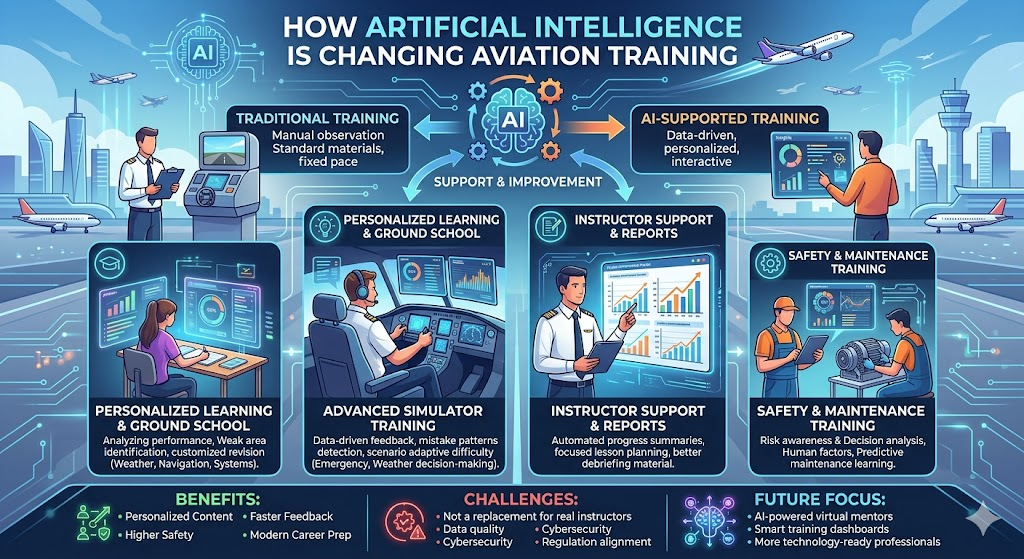
Now, Artificial Intelligence is adding a new layer to aviation training. AI is helping training academies, instructors, and students make learning more personalized, data-driven, interactive, and efficient. It can analyze student performance, identify weak areas, provide practice support, improve simulator feedback, and help learners understand complex aviation topics more clearly.
However, AI does not replace real aviation training. It does not replace certified instructors, real flight experience, safety procedures, or human judgment. Instead, AI works as a support system. It helps students learn better, helps instructors teach smarter, and helps aviation academies improve the overall training experience.
For beginners, this change is important to understand. The aviation industry is becoming more digital and technology-driven. Students who understand both aviation fundamentals and AI-supported learning will be better prepared for modern aviation careers. This guide explains how Artificial Intelligence is changing aviation training in simple, practical, and beginner-friendly language.
What Does AI Mean in Aviation Training?
Artificial Intelligence in aviation training means using intelligent software and data-based systems to support learning, practice, assessment, and performance improvement. In simple words, AI helps aviation students and instructors understand training progress more clearly.
For example, a student pilot may complete a simulator session. Traditionally, the instructor observes the session and gives feedback. With AI-supported training, the simulator data can also be analyzed automatically. The system may identify patterns such as unstable approach practice, delayed checklist response, difficulty with weather decisions, or repeated navigation errors. This gives both the student and instructor more useful information.
AI in aviation training can help with:
- Analyzing student performance
- Creating personalized learning plans
- Reviewing simulator sessions
- Identifying weak areas
- Recommending lessons or practice topics
- Supporting instructors with reports
- Improving safety-focused learning
- Helping students revise difficult concepts
- Tracking progress over time
- Making training more interactive
AI does not mean that a machine becomes the teacher. It means technology supports the learning process. Human instructors remain responsible for guidance, correction, supervision, motivation, and real-world aviation judgment.
Why AI Matters in Aviation Training
AI matters in aviation training because aviation is a high-responsibility field. A small mistake in understanding, communication, procedure, or decision-making can become serious in real aviation environments. Training must therefore be clear, structured, practical, and safety-focused.
AI can help improve aviation training in many ways.
First, it can make learning more personalized. Not every student learns at the same speed. Some students may understand aircraft systems quickly but struggle with navigation. Others may be good at theory but need more practice in simulator decision-making. AI can help identify these differences and suggest focused learning support.
Second, AI can provide faster feedback. In aviation training, timely feedback is important. If a student makes the same mistake repeatedly, early correction helps build better habits. AI can support instructors by quickly analyzing data and highlighting patterns.
Third, AI can improve simulator training. Simulators are already important in aviation education. AI can make simulator sessions even more useful by tracking performance, creating adaptive scenarios, and supporting better debriefing.
Fourth, AI can help students prepare for technology-driven aviation careers. Modern cockpits, airports, maintenance systems, drone operations, and airline platforms are becoming more digital. Aviation students who understand AI-supported systems will be more confident in future workplaces.
Traditional Aviation Training vs AI-Supported Aviation Training
Traditional aviation training is still essential. Students need certified instructors, practical experience, classroom learning, simulator sessions, aircraft exposure, safety discipline, and regulatory understanding. AI-supported training does not remove these foundations. It improves how training is delivered, measured, and personalized.
| Training Area | Traditional Aviation Training | AI-Supported Aviation Training |
|---|---|---|
| Classroom Learning | Instructor-led lessons and standard study material | Personalized content suggestions and adaptive revision support |
| Simulator Sessions | Instructor observes and gives feedback | AI analyzes simulator data and highlights performance patterns |
| Progress Tracking | Manual records and instructor notes | Data-based progress dashboards and learning reports |
| Lesson Planning | Same structure for most students | Customized learning paths based on student performance |
| Feedback | Mostly instructor feedback after sessions | Instructor feedback supported by AI-generated insights |
| Assessments | Standard quizzes and exams | Smart quizzes that focus on weak areas |
| Safety Training | Case studies and instructor explanation | Scenario-based risk practice and decision analysis |
| Debriefing | Verbal discussion and instructor review | Replay, data review, and pattern-based feedback support |
| Learning Speed | Often fixed by course structure | More flexible based on student needs |
| Instructor Support | Manual observation and reporting | Automated summaries and recommendation support |
The best aviation training model combines both approaches. Human instruction provides experience, judgment, and safety supervision, while AI provides data, personalization, and smarter feedback.
How AI Is Changing Pilot Training
Pilot training is one of the most important areas where AI can make a meaningful difference. Becoming a pilot requires strong knowledge of aircraft systems, navigation, meteorology, air law, communication, emergency procedures, human factors, and cockpit discipline. It also requires practical flying experience and continuous instructor guidance.
AI can support pilot training in several ways.
Personalized Ground School Learning
Ground school includes subjects such as aviation theory, navigation, weather, aircraft systems, regulations, flight planning, and human performance. Many students find some subjects easier than others. AI can help identify where a student is struggling and recommend specific lessons, quizzes, or revision topics.
For example, if a student repeatedly answers weather-related questions incorrectly, an AI learning system can suggest additional meteorology lessons, practice questions, and visual explanations.
Flight Theory Support
Flight theory includes concepts such as lift, drag, thrust, weight, aircraft stability, control surfaces, and performance. AI-based learning tools can explain these concepts in simple ways, generate practice questions, and help students revise difficult topics.
Simulator Performance Analysis
Simulators allow students to practice cockpit procedures, emergency responses, navigation, communication, and decision-making in a controlled environment. AI can analyze simulator performance and identify repeated mistakes, delayed reactions, missed checklist steps, or unstable procedures.
Cockpit Procedure Practice
Cockpit procedures require accuracy and discipline. AI can help students practice checklists, callouts, instrument scanning, and decision sequences. This is especially useful for building habits before real-world flight practice.
Weather Decision-Making Training
Weather is a major part of aviation decision-making. AI can help students practice weather interpretation by creating training scenarios based on changing visibility, wind, clouds, storms, and route conditions.
Emergency Scenario Preparation
Students can use AI-supported simulators to practice emergency situations such as engine failure, communication loss, navigation problems, system warnings, or poor weather conditions. AI can adjust scenario difficulty based on student performance.
Progress Tracking for Student Pilots
AI can help track a student’s performance over time. Instead of only seeing marks or pass-fail results, students and instructors can see improvement trends, weak areas, and readiness indicators.
Instructor Support and Training Reports
Flight instructors spend a lot of time observing, teaching, correcting, reporting, and planning. AI can support instructors by summarizing student performance and helping them prepare more focused lessons.
AI supports pilot training, but it does not replace certified flight instructors or real flight experience. Real aviation training still requires human supervision, real-world judgment, and practical flying skills.
AI in Flight Simulators
Flight simulators are already one of the most valuable tools in aviation training. They allow students to practice in a safe environment before facing real-world flight conditions. AI can make simulator training more powerful by adding smarter scenarios, deeper feedback, and better performance analysis.
Scenario-Based Training
AI can help create realistic training scenarios. For example, a student may practice flying through changing weather, handling technical warnings, managing communication workload, or making decisions during an emergency.
Emergency Situation Practice
Emergency training is critical in aviation. AI-supported simulators can help students practice emergency procedures repeatedly and safely. The system can also adjust the difficulty based on how well the student performs.
Real-Time Performance Monitoring
During a simulator session, AI can monitor actions such as altitude control, heading accuracy, checklist timing, communication flow, and decision-making. This gives useful data for later review.
Automated Feedback After Simulator Sessions
After the session, AI can generate a performance summary. It may show what the student did well, where mistakes happened, and which areas need more practice.
Mistake Pattern Detection
If a student repeatedly makes the same type of mistake, AI can detect the pattern. This helps instructors focus on the root cause instead of only correcting the visible mistake.
Adaptive Difficulty Levels
AI can adjust simulator scenarios based on the student’s skill level. Beginners can start with basic situations, while advanced students can move toward complex emergency and decision-making scenarios.
Replay and Debriefing Support
Debriefing is one of the most important parts of simulator training. AI can help by showing session replays, highlighting key moments, and helping instructors explain what happened.
AI for Personalized Learning
One of the biggest changes AI brings to aviation training is personalized learning. In traditional training, many students follow the same lesson plan. While this structure is important, students do not always learn the same way.
AI can create a more customized learning experience. It can study how a student performs in quizzes, simulator sessions, assignments, and practice exercises. Based on this, it can suggest what the student should study next.
For example:
- A student weak in navigation may receive extra route planning exercises.
- A student struggling with aircraft systems may receive visual explanations and practice tests.
- A student making checklist errors may receive repeated procedural practice.
- A student weak in aviation communication may receive radio phraseology exercises.
- A student struggling with weather may receive more meteorology scenarios.
Personalized learning helps students improve at their own pace. It also helps instructors understand each student better. Instead of guessing where a student needs help, instructors can use data-supported insights.
AI in Aviation Safety Training
Safety is the heart of aviation training. Every aviation student must understand that safety is not just a topic in a textbook; it is a mindset. AI can support safety training by creating better scenarios, analyzing decisions, and helping students understand risk.
AI can help with:
- Risk awareness training
- Human factors learning
- Incident case study analysis
- Decision-making practice
- Emergency response training
- Checklist discipline
- Threat and error management
- Fatigue and workload awareness
- Communication error practice
- Safety reporting education
For example, AI can help create a scenario where a student must decide whether to continue or delay a flight due to weather. The system can then review the decision, explain the risks, and show better alternatives.
AI can also help students learn from past safety cases in a structured way. Instead of memorizing incidents, students can understand what went wrong, how decisions were made, and what lessons can be applied.
AI for Flight Instructor Support
AI is not designed to replace flight instructors. Instead, it can help instructors work more efficiently and teach more effectively.
Flight instructors are responsible for student safety, practical correction, motivation, skill-building, and professional judgment. AI can support these responsibilities by providing useful data and reducing administrative workload.
AI can help instructors with:
- Student progress reports
- Weak-area identification
- Simulator session summaries
- Training recommendation support
- Lesson planning assistance
- Performance comparison over time
- Better debriefing material
- Time-saving administrative support
- Assessment preparation
- Learning gap analysis
For example, before a lesson, an instructor can review an AI-generated summary showing that a student needs more practice in approach stability, checklist timing, or weather interpretation. This allows the instructor to make the next lesson more focused.
AI gives instructors better information, but the instructor still provides the human guidance that aviation training requires.
AI in Aircraft Maintenance Training
Aviation training is not only about pilots. Aircraft maintenance students also benefit from AI-supported learning. Modern aircraft produce large amounts of technical data from engines, sensors, avionics, fuel systems, electrical systems, and maintenance records.
AI can help maintenance learners understand how aircraft systems behave, how faults are detected, and how predictive maintenance works.
AI can support aircraft maintenance training through:
- Predictive maintenance learning
- Fault detection practice
- Aircraft system simulation
- Sensor data interpretation
- Technical troubleshooting
- Digital maintenance logs
- Virtual inspection training
- Safety compliance learning
- Component failure pattern analysis
- Maintenance decision support exercises
For example, students can learn how changes in engine temperature, vibration, or pressure data may indicate a maintenance issue. AI can help them understand patterns and practice troubleshooting.
This prepares maintenance learners for modern aviation workplaces where digital tools and data-based maintenance are becoming more important.
AI in Air Traffic and Airport Operations Training
AI is also changing how students learn airport operations and air traffic basics. Airports are complex environments that involve passenger movement, baggage handling, gate planning, runway coordination, security, ground services, and flight schedules.
AI can support airport operations training through:
- Traffic flow simulation
- Airport passenger flow analysis
- Delay prediction exercises
- Runway and gate planning practice
- Ground operations training
- Resource allocation learning
- Airport safety scenarios
- Baggage system monitoring
- Queue management practice
- Disruption planning exercises
For example, students can use AI-supported simulations to understand how a delayed flight affects gates, baggage, crew schedules, passenger connections, and runway planning. This helps learners see aviation operations as a connected system.
Air traffic and airport operations students can also practice decision-making using simulated traffic flow, weather disruption, and resource planning scenarios.
AI in Drone and Unmanned Aircraft Training
Drone and unmanned aircraft training is another area where AI is becoming important. Drones are used in inspection, logistics, mapping, agriculture, security, emergency response, media, and research. Many drone operations depend on smart software and data analysis.
AI can support drone training through:
- Route planning
- Object detection
- Obstacle awareness
- Mission simulation
- Flight data analysis
- Safety checks
- Remote pilot decision support
- Battery and performance monitoring
- Weather-based mission planning
- Automated image analysis
Drone students can use AI-supported tools to understand safe mission planning, route selection, object recognition, and operational risk. However, remote pilots still need strong safety awareness, airspace knowledge, and regulatory understanding.
Benefits of AI in Aviation Training
AI brings many practical benefits to aviation training when used responsibly.
Personalized Learning
AI can help students learn according to their own strengths and weaknesses. This makes training more focused and less stressful.
Faster Feedback
Students can receive feedback more quickly after quizzes, simulator sessions, or practice tasks. Faster feedback helps correct mistakes early.
Better Simulator Debriefing
AI can analyze simulator data and help instructors conduct more detailed debriefing sessions.
Improved Safety Awareness
AI can create safety scenarios and decision-making exercises that help students understand risk more clearly.
More Efficient Instructor Support
AI can reduce some administrative work and help instructors focus more on teaching and student development.
Data-Based Progress Tracking
Instead of relying only on general impressions, students and instructors can use performance data to track improvement.
Better Preparation for Real Aviation Scenarios
AI-supported simulations can expose students to a wider range of situations before real-world practice.
Reduced Learning Gaps
When AI identifies weak areas early, students can fix learning gaps before they become serious.
Support for Remote and Hybrid Training
AI learning platforms can support online revision, remote assessments, virtual practice, and hybrid aviation education.
Career Readiness for Modern Aviation Roles
Students who learn with AI-supported tools become more comfortable with digital aviation systems and future industry expectations.
Challenges of Using AI in Aviation Training
AI has many advantages, but it must be used carefully in aviation training.
AI Cannot Replace Real Instructors
Aviation training needs human judgment, supervision, correction, and experience. AI can support learning, but instructors remain essential.
Students May Become Overdependent on Technology
Students should not use AI as a shortcut. They must still understand the concept, practice procedures, and build real skills.
Training Data Must Be Accurate
AI systems depend on data. If the data is poor or incorrect, the feedback may also be poor.
AI Tools Need Human Supervision
AI-generated feedback should be reviewed by qualified instructors, especially in safety-related training.
Cybersecurity and Privacy Matter
Student data, training records, simulator data, and academy systems must be protected.
High Implementation Cost for Academies
Good AI training systems may require investment in software, infrastructure, staff training, and data management.
Regulatory and Safety Alignment Is Important
Aviation training must follow safety and regulatory expectations. AI tools should support these standards, not bypass them.
Not Every Aviation Skill Can Be Learned Through AI
Communication, confidence, judgment, teamwork, and real-world flying skills require human guidance and practical experience.
Real Aircraft Experience Remains Essential
Simulators and AI tools are useful, but real flight experience remains a core part of pilot training.
Will AI Replace Flight Instructors?
AI will not fully replace flight instructors. Flight instructors are more than information providers. They are mentors, safety supervisors, skill builders, motivators, and decision-making guides.
A flight instructor can understand a student’s confidence, stress level, learning behavior, communication style, and practical ability. These human qualities are difficult for AI to replace. Instructors also bring real-world aviation experience, which is extremely valuable for students.
AI can help instructors by giving better performance data, identifying weak areas, preparing reports, and supporting lesson planning. But the instructor still makes the final judgment about student readiness, safety, and practical performance.
The future of aviation training is not AI versus instructors. It is AI plus instructors. The strongest training model will combine human expertise with intelligent learning support.
Skills Aviation Students Should Learn in the AI Era
As aviation becomes more digital, students should build both traditional aviation skills and modern technology awareness.
Important skills include:
- Aviation fundamentals
- Flight theory
- Aircraft systems
- Simulator practice
- Data awareness
- AI basics
- Digital cockpit understanding
- Weather interpretation
- Safety and human factors
- Cybersecurity awareness
- Communication skills
- Decision-making skills
- Adaptability
- Continuous learning
Students do not need to become AI experts immediately. However, they should understand how AI works, where it is used, and how to use it responsibly as a learning support tool.
How Aviation Academies Can Use AI Responsibly
Aviation academies should adopt AI carefully and responsibly. Since aviation training directly connects to safety, AI should be used as a support system, not as a replacement for qualified instructors.
Academies can use AI responsibly by following these principles:
Use AI as Support, Not Replacement
AI should improve learning and feedback, but final training decisions should involve qualified instructors.
Keep Instructors Involved
Instructors should review AI-generated insights and use their professional judgment before applying recommendations.
Protect Student Data
Training records, simulator results, personal information, and performance reports should be stored securely.
Validate AI Feedback
AI feedback should be checked for accuracy. Incorrect feedback can confuse students or create bad habits.
Follow Aviation Safety Standards
AI tools should support safety-first learning and align with aviation training requirements.
Train Students on Responsible Technology Use
Students should learn that AI is a tool for practice and support, not a shortcut for real understanding.
Combine AI Tools With Real-World Practice
The best training includes classroom learning, simulator practice, instructor feedback, real aircraft exposure, and AI-supported review.
Review AI Recommendations Before Applying Them
AI-generated suggestions should be evaluated by humans, especially when related to safety, performance, or readiness.
Future of AI in Aviation Training
The future of aviation training will likely become more personalized, digital, and data-driven. AI may help create smarter learning systems that adapt to each student’s needs.
Future aviation training may include:
- Smarter flight simulators
- AI-powered virtual instructors
- Personalized pilot training programs
- Advanced safety scenario training
- AI-assisted maintenance training
- Drone training automation
- Better training analytics
- Remote and hybrid aviation learning
- More realistic emergency simulations
- More technology-ready aviation careers
However, the future must remain balanced. Aviation is not only about technology. It is also about discipline, responsibility, safety, communication, teamwork, and real-world judgment. AI will make training smarter, but human expertise will remain the foundation.
Practical Tips for Students Learning Aviation With AI
Students can use AI effectively if they use it with the right mindset.
Use AI tools to revise concepts, but do not depend only on AI answers. Always verify important aviation topics with instructors, approved training material, and official learning resources.
Practice with simulators whenever possible. Simulator training helps students connect theory with practical situations. AI-supported feedback can make this practice even more useful.
Build strong aviation fundamentals first. Before using AI for advanced learning, understand basic topics such as aircraft systems, navigation, weather, communication, safety, and regulations.
Learn basic data and AI concepts. You do not need to become a programmer immediately, but understanding data, patterns, prediction, and automation will help you use AI tools more confidently.
Keep safety as the top priority. In aviation, technology should never encourage shortcuts. Every learning tool should support safer and better decision-making.
Review mistakes regularly. AI can help identify mistakes, but improvement happens when students study those mistakes and practice better responses.
Create a learning plan. Use AI for revision, quizzes, summaries, and practice, but follow a structured training path guided by instructors.
Common Mistakes Students Should Avoid
Students should be careful when using AI in aviation training. AI is useful, but only when used responsibly.
Common mistakes include:
- Thinking AI can replace actual flight training
- Ignoring instructor feedback
- Depending only on AI-generated answers
- Skipping aviation fundamentals
- Not practicing emergency procedures
- Ignoring safety rules
- Treating simulator practice casually
- Not reviewing training performance
- Avoiding communication practice
- Using AI without understanding the concept
- Copying AI answers without learning
- Forgetting the importance of human judgment
- Using AI as a shortcut before exams
- Ignoring real-world aviation discipline
Aviation students should remember that AI can support learning, but it cannot replace effort, practice, discipline, and professional guidance.
Frequently Asked Questions
1- What is AI in aviation training?
AI in aviation training means using intelligent software and data-based systems to support learning, practice, assessment, and performance improvement. It can help students understand weak areas, receive personalized lessons, review simulator sessions, and track progress. AI supports aviation training, but it does not replace instructors or real-world practice.
2- How does AI help pilot training?
AI helps pilot training by supporting ground school learning, simulator review, cockpit procedure practice, weather decision-making, emergency scenario training, and progress tracking. It can analyze performance data and help instructors give more focused feedback. This makes training more personalized and efficient.
3- Can AI replace flight instructors?
No, AI cannot fully replace flight instructors. Instructors provide safety supervision, real-world experience, correction, motivation, and professional judgment. AI can support instructors with reports, data, and recommendations, but human instructors remain essential in aviation training.
4- Is AI useful for beginner aviation students?
Yes, AI can be useful for beginner aviation students when used correctly. It can explain difficult concepts, create practice quizzes, suggest revision topics, and help students understand their weak areas. However, beginners should always verify important aviation topics with instructors and approved learning materials.
5- How is AI used in flight simulators?
AI can be used in flight simulators to monitor student performance, create adaptive scenarios, detect mistake patterns, provide session feedback, and support debriefing. It can help students practice normal procedures, emergency situations, weather decisions, and cockpit discipline in a safer training environment.
6- Can AI improve aviation safety training?
Yes, AI can improve aviation safety training by creating realistic risk scenarios, supporting incident analysis, reviewing decision-making, and helping students understand threat and error management. It can make safety learning more interactive and practical. Still, safety training must remain supervised by qualified aviation professionals.
7- Is AI used in aircraft maintenance training?
Yes, AI can support aircraft maintenance training by helping students learn predictive maintenance, fault detection, sensor data analysis, troubleshooting, and digital maintenance records. It can also support virtual inspection training and aircraft system simulations.
8- What skills should aviation students learn because of AI?
Aviation students should learn aviation fundamentals, aircraft systems, simulator practice, data awareness, AI basics, digital cockpit understanding, weather interpretation, safety and human factors, cybersecurity awareness, communication skills, and decision-making. These skills prepare students for modern aviation environments.
9- Can AI help students prepare for pilot exams?
AI can help students prepare for pilot exams by creating practice questions, summarizing concepts, identifying weak subjects, and supporting revision plans. However, students should not depend only on AI. They should study approved materials and follow guidance from instructors.
10- What is the future of AI in aviation training?
The future of AI in aviation training will likely include smarter simulators, personalized training paths, AI-assisted debriefing, virtual learning support, advanced safety scenarios, maintenance training tools, and better training analytics. Human instructors, real practice, and safety discipline will continue to remain essential.
Conclusion
Artificial Intelligence is changing aviation training by making learning more personalized, practical, measurable, and technology-driven. It helps students understand weak areas, supports simulator debriefing, improves safety learning, and gives instructors better data for training decisions. For pilot training, aircraft maintenance education, drone learning, airport operations, and aviation safety programs, AI can make the learning journey more efficient and interactive. But AI should never be seen as a replacement for real instructors, real aircraft experience, or strong aviation fundamentals. Aviation is a safety-first industry, and human judgment will always remain important. Students who use AI responsibly, practice consistently, listen to instructors, and build strong basics will be better prepared for the future of aviation. For beginners, the right approach is simple: learn aviation fundamentals first, use AI as a support tool, practice regularly, and stay focused on safety, discipline, and continuous improvement.