Introduction
Aviation is one of the most exciting and respected fields in the world. It connects aircraft, pilots, airports, air traffic systems, aircraft maintenance, safety procedures, passenger services, and advanced technology. Today, aviation is also becoming more digital, automated, and data-driven. Artificial Intelligence is now being used to support aviation training, flight operations, aircraft maintenance, airport planning, passenger experience, drone operations, and safety systems.
For beginners, this can feel confusing at first. Many students want to learn aviation, but they do not know where to start. Some want to become pilots. Some are interested in aircraft maintenance. Some want to work in airport operations, drone technology, aviation software, or AI-powered aviation systems. A clear learning roadmap helps beginners understand what to learn first, what skills to build next, and how to move step by step toward a future-ready aviation career.
AI Aviation Academy can be a useful learning direction for students who want to understand both aviation fundamentals and Artificial Intelligence applications in aviation. The goal is not to make beginners experts overnight. The goal is to help learners build a strong foundation, understand important concepts, practice with digital tools, explore real use cases, and prepare for modern aviation opportunities.
This guide explains a complete beginner-friendly roadmap for learning AI aviation step by step.
What Is an AI Aviation Learning Roadmap?
An AI aviation learning roadmap is a step-by-step study path that helps beginners learn aviation and Artificial Intelligence in the right order. It shows what topics to study first, what skills to practice, what tools to explore, and how to build practical knowledge over time.
A roadmap is important because aviation and AI are both large subjects. If a beginner starts with advanced AI models, machine learning algorithms, or technical aviation systems without understanding the basics, learning can become difficult. A roadmap keeps the learning process simple and organized.
A good AI aviation learning roadmap includes:
- Basic aviation knowledge
- Aircraft and flight concepts
- Aviation safety and regulations
- AI fundamentals
- Data and analytics basics
- Aviation AI use cases
- Simulator and digital tool practice
- Beginner project ideas
- Career-focused skills
- Portfolio building
- Internship and entry-level career preparation
In simple words, this roadmap helps you move from “I am new to aviation and AI” to “I understand the basics and can start building practical aviation technology skills.”
Why Beginners Should Learn AI in Aviation
AI is becoming important in aviation because the industry depends heavily on data, safety, planning, and decision-making. Aircraft generate data, airports handle operational data, airlines manage scheduling data, maintenance teams study technical data, and training academies track student performance data. AI helps professionals analyze this information faster and more effectively.
AI can support aviation in many areas:
- Flight route planning
- Weather-based decision support
- Pilot training assistance
- Flight simulator analysis
- Predictive aircraft maintenance
- Airport crowd management
- Air traffic flow support
- Drone mission planning
- Passenger support chatbots
- Aviation safety analysis
- Training performance tracking
However, beginners should clearly understand one important point: AI supports aviation professionals, but it does not fully replace pilots, instructors, engineers, air traffic controllers, or safety experts. Aviation still depends on human judgment, discipline, communication, experience, and responsibility.
Learning AI in aviation helps beginners prepare for a modern industry where technology and aviation knowledge work together. Students who understand both fields can explore more career opportunities in the future.
Who Is This Roadmap For?
This roadmap is designed for beginners who want a clear starting point. It is useful for:
- Aspiring pilots who want to understand future aviation technology
- Aviation students who want to build modern skills
- Aircraft maintenance learners interested in predictive maintenance
- Drone and unmanned aircraft learners
- Airport operations students
- AI and data science beginners interested in aviation
- School and college students exploring aviation careers
- Working professionals planning an aviation career switch
- Aviation academy learners
- Technology learners who want to enter aviation
- Beginners who want a simple path to learn AI aviation concepts
You do not need advanced coding knowledge to start. You also do not need to be a pilot or engineer. You can begin with basic aviation concepts and slowly build your AI knowledge.
Roadmap Overview
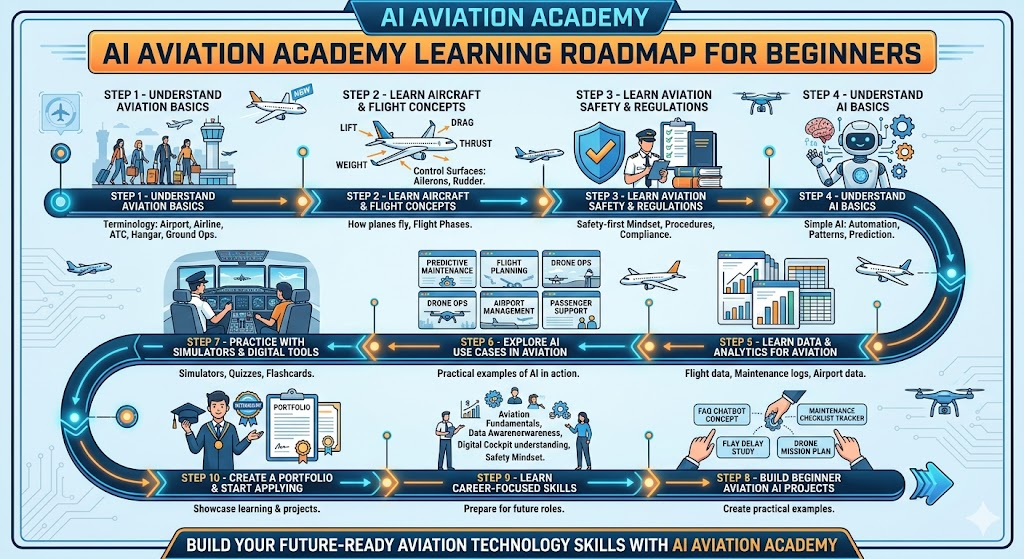
Here is the beginner-friendly roadmap you can follow:
| Step | Learning Stage | Main Goal |
|---|---|---|
| Step 1 | Understand Aviation Basics | Learn how the aviation industry works |
| Step 2 | Learn Aircraft and Flight Concepts | Understand how aircraft fly and operate |
| Step 3 | Learn Aviation Safety and Regulations | Build a safety-first mindset |
| Step 4 | Understand AI Basics | Learn what AI means in simple words |
| Step 5 | Learn Data and Analytics for Aviation | Understand how aviation uses data |
| Step 6 | Explore AI Use Cases in Aviation | See where AI is used practically |
| Step 7 | Practice With Simulators and Digital Tools | Apply learning through practice |
| Step 8 | Build Beginner Aviation AI Projects | Create practical learning examples |
| Step 9 | Learn Career-Focused Skills | Prepare for future aviation roles |
| Step 10 | Create a Portfolio and Start Applying | Showcase your learning and projects |
This roadmap is not meant to be rushed. Beginners should take it step by step and focus on understanding before moving to advanced topics.
Step 1- Understand Aviation Basics
The first step is to understand how the aviation industry works. Aviation is not only about flying aircraft. It includes airlines, airports, aircraft maintenance, air traffic control, ground handling, cargo, safety, training, weather, regulations, and passenger services.
Start by learning basic aviation terms and concepts such as:
- Aircraft
- Airline
- Airport
- Pilot
- Cabin crew
- Air traffic control
- Runway
- Taxiway
- Hangar
- Flight route
- Flight plan
- Ground operations
- Aircraft maintenance
- Aviation safety
- Aviation weather
You should also understand the different types of aviation, such as commercial aviation, general aviation, cargo aviation, military aviation, private aviation, and drone aviation.
This step gives you the foundation needed to understand more advanced topics later. Without aviation basics, AI use cases in aviation may not make sense.
Step 2- Learn Basic Aircraft and Flight Concepts
After learning general aviation basics, beginners should understand how aircraft fly. You do not need to become an expert immediately, but you should understand the core principles.
Start with the four forces of flight:
- Lift
- Drag
- Thrust
- Weight
Lift helps the aircraft rise. Drag slows the aircraft down. Thrust moves the aircraft forward. Weight pulls the aircraft downward. Understanding these four forces helps beginners understand the basic science of flight.
Next, learn about aircraft control surfaces:
- Ailerons
- Rudder
- Elevator
- Flaps
- Spoilers
These parts help control aircraft movement. Beginners should also learn basic cockpit instruments, aircraft engines, navigation systems, communication systems, and aircraft performance concepts.
You can also study simple flight phases:
- Pre-flight preparation
- Taxi
- Takeoff
- Climb
- Cruise
- Descent
- Approach
- Landing
- Post-flight checks
This stage helps you understand the physical and operational side of aviation before moving into AI-based applications.
Step 3- Learn Aviation Safety and Regulations
Safety is the heart of aviation. Every aviation professional, student, and learner must understand that safety comes before speed, convenience, or technology.
Aviation safety includes procedures, rules, habits, training, communication, and decision-making. Beginners should learn why checklists are important, why standard operating procedures are followed, and why every action in aviation must be careful and controlled.
Important safety topics include:
- Checklist discipline
- Standard operating procedures
- Human factors
- Emergency procedures
- Weather-related risks
- Communication clarity
- Decision-making
- Fatigue awareness
- Threat and error management
- Safety reporting
- Regulatory awareness
Regulations are also important because aviation is a controlled industry. Different countries have aviation authorities that create rules for pilots, aircraft, airports, maintenance, and operations. Beginners do not need to memorize every regulation at first, but they should understand why rules exist and why compliance matters.
AI must also follow safety expectations in aviation. Any AI-supported tool used in training, maintenance, flight operations, or safety must be used responsibly and under human supervision.
Step 4- Understand Artificial Intelligence Basics
Once you understand aviation basics, you can begin learning AI. Artificial Intelligence means using computer systems that can analyze data, recognize patterns, make predictions, automate tasks, and support decision-making.
For beginners, AI can be understood as a smart assistant that helps process information. It does not “think” like a human, but it can learn from data and help users make better decisions.
Important AI concepts for beginners include:
- Machine learning
- Automation
- Data analysis
- Prediction
- Computer vision
- Chatbots
- Natural language processing
- Intelligent decision support
- Digital assistants
- Pattern recognition
In aviation, AI can help analyze aircraft maintenance data, predict flight delays, support training feedback, track passenger flow, assist in drone operations, and review simulator performance.
Beginners should not worry about advanced coding at this stage. First, understand what AI does, why data matters, and how AI can support aviation professionals.
Step 5- Learn Data and Analytics for Aviation
AI depends on data. Aviation produces large amounts of data every day. Flights, airports, aircraft systems, maintenance logs, weather reports, passenger services, and training platforms all create useful information.
Types of aviation data include:
- Flight data
- Aircraft maintenance data
- Airport operations data
- Weather data
- Passenger data
- Simulator training data
- Safety reports
- Crew scheduling data
- Air traffic data
- Drone mission data
Beginners should learn basic analytics skills such as reading tables, understanding charts, identifying patterns, comparing information, and using spreadsheets. You do not need to become a data scientist immediately. Start with simple data thinking.
For example, if several flights are delayed at the same airport every evening, data analysis can help identify whether the cause is weather, congestion, staffing, aircraft availability, or scheduling. If a simulator report shows repeated checklist errors, data can help instructors understand where a student needs more practice.
Learning data awareness helps beginners understand how AI becomes useful in real aviation environments.
Step 6- Explore AI Use Cases in Aviation
After learning aviation basics, AI basics, and data concepts, beginners should explore practical AI use cases in aviation.
AI in Pilot Training
AI can support pilot training by creating personalized study plans, analyzing simulator performance, identifying weak areas, and helping students revise difficult topics. It can support ground school learning, cockpit procedure practice, weather decision-making, and emergency scenario training.
AI supports student pilots, but it does not replace certified flight instructors or real flight experience.
AI in Flight Simulators
Flight simulators are important training tools. AI can make simulators smarter by analyzing performance, detecting mistakes, adjusting scenario difficulty, and helping instructors conduct better debriefing sessions.
For example, AI can identify if a student repeatedly struggles with approach stability, altitude control, or checklist timing.
AI in Aircraft Maintenance
AI supports predictive maintenance by analyzing aircraft system data and identifying possible issues before they become serious. Maintenance learners can use AI-based examples to understand fault detection, sensor data, engine health monitoring, and troubleshooting.
AI in Airport Operations
Airports use AI to manage passenger flow, baggage tracking, queues, gate planning, staff allocation, and disruption management. Airport operations students can learn how AI helps improve efficiency and reduce confusion during busy periods.
AI in Air Traffic Management
AI can support air traffic flow analysis, delay prediction, runway planning, and congestion management. It does not replace air traffic controllers but can support decision-making and planning.
AI in Drone Operations
Drones use AI for route planning, object detection, obstacle awareness, mission planning, and flight data analysis. Drone learners should understand how AI supports safe and efficient unmanned aircraft operations.
AI in Aviation Safety
AI can help analyze safety reports, detect risk patterns, review incident data, and support decision-making training. Safety remains human-led, but AI can help teams identify issues earlier.
AI in Passenger Experience
AI-powered chatbots, travel updates, baggage tracking, and personalized support systems can improve passenger communication and service quality.
Step 7- Practice With Simulators and Digital Tools
Learning becomes stronger when beginners practice. Simulators and digital tools allow students to connect theory with practical experience.
Beginners can explore:
- Flight simulator tools
- Aviation quiz platforms
- Aircraft systems learning tools
- Weather learning tools
- Airport operation simulations
- Drone simulation tools
- Spreadsheet dashboards
- AI learning platforms
- Digital flashcards
- Basic data visualization tools
Simulator practice is useful because it allows learners to understand aviation procedures in a controlled environment. However, simulator practice does not replace real aircraft training for aspiring pilots. It is a support tool for understanding procedures, decision-making, navigation, and cockpit discipline.
Digital tools also help beginners revise faster, test their knowledge, and track learning progress.
Step 8- Build Beginner Aviation AI Projects
Projects help beginners move from theory to practical learning. You do not need advanced programming skills to start. Many beginner projects can be built using simple spreadsheets, notes, basic dashboards, or no-code tools.
Here are beginner-friendly aviation AI project ideas:
Flight Delay Prediction Concept
Create a simple project that studies possible causes of flight delays, such as weather, airport congestion, aircraft availability, and scheduling.
Basic Aviation FAQ Chatbot
Build a simple chatbot idea that answers beginner questions about aviation terms, pilot training basics, aircraft parts, and airport operations.
Aircraft Maintenance Checklist Tracker
Create a digital checklist tracker for basic aircraft maintenance learning. This helps beginners understand how maintenance records are organized.
Weather-Based Flight Planning Study
Study how weather can affect flight planning. Create a simple report showing how wind, visibility, rain, or storms can impact aviation decisions.
Airport Passenger Flow Dashboard
Create a basic dashboard showing passenger flow at different airport areas, such as check-in, security, boarding gates, and baggage claim.
Drone Mission Planning Concept
Create a simple drone mission plan that includes route, battery awareness, weather conditions, obstacle checks, and safety steps.
Simulator Performance Review Sheet
Create a sheet to track simulator performance, including checklist accuracy, altitude control, heading control, communication, and decision-making.
Aviation Safety Case Study Analyzer
Study an aviation safety case and write what happened, what risks were involved, and what lessons can be learned.
Aircraft Systems Learning Flashcards
Create flashcards for engines, cockpit instruments, control surfaces, navigation systems, and safety equipment.
AI-Based Aviation Quiz Assistant
Create a quiz assistant concept that helps students revise aviation basics, AI concepts, and safety topics.
These projects help beginners understand aviation and AI more practically. They also become useful portfolio items.
Step 9- Learn Career-Focused Skills
To prepare for future aviation opportunities, beginners should build a mix of aviation, technology, and professional skills.
Important career-focused skills include:
Aviation Fundamentals
Understand basic aviation operations, aircraft types, flight phases, safety rules, and airport systems.
AI Basics
Learn how AI works, where it is used, and how it supports decision-making.
Data Awareness
Understand how to read, analyze, and explain data in simple ways.
Digital Cockpit Understanding
Aspiring pilots should become comfortable with digital displays, automation, navigation tools, and cockpit information systems.
Aircraft Systems Knowledge
Maintenance learners and aviation students should understand engines, avionics, sensors, control systems, and aircraft structure.
Weather Interpretation
Weather affects aviation safety and decision-making. Beginners should learn basic aviation weather concepts.
Communication Skills
Clear communication is essential in aviation. Students should practice professional speaking, listening, and reporting.
Safety Mindset
Every aviation learner should develop a safety-first attitude. This includes discipline, patience, and responsibility.
Problem-Solving
Aviation professionals often need to analyze situations and make careful decisions.
Cybersecurity Awareness
As aviation becomes digital, cybersecurity becomes more important. Beginners should understand basic data protection and system safety.
Documentation Skills
Good aviation work requires accurate records, reports, checklists, and learning notes.
Continuous Learning
Aviation technology keeps changing. Students should stay curious and keep improving their knowledge.
Step 10- Create a Portfolio and Start Applying
A portfolio helps beginners show what they have learned. It is useful for internships, training programs, entry-level roles, and academic opportunities.
A beginner aviation AI portfolio can include:
- Aviation notes
- AI aviation project ideas
- Simulator practice summaries
- Aviation case studies
- Safety learning reports
- Maintenance checklist examples
- Drone mission planning examples
- Data dashboards
- Learning certificates
- Blog summaries
- Presentation slides
- Career goals
Beginners can start applying for:
- Aviation internships
- Training programs
- Aviation academy courses
- Drone training programs
- Airport operations learning roles
- Aviation technology support roles
- Entry-level data learning roles
- Flight operations assistant roles
- Aircraft maintenance learning programs
The goal is not to show perfection. The goal is to show consistency, curiosity, practical effort, and willingness to learn.
Suggested Learning Timeline for Beginners
A simple timeline can help beginners stay organized.
First 30 Days- Learn Aviation Basics
During the first 30 days, focus on understanding aviation terminology, aircraft types, airport basics, flight phases, and aviation career options. Build a simple notebook of key terms and concepts.
Next 30 Days- Learn AI and Data Basics
In the next 30 days, learn what AI means, how machine learning works at a basic level, why data matters, and how AI supports decision-making. Practice reading simple tables and charts.
Next 30 Days- Explore Aviation AI Use Cases
During this stage, study real-world AI use cases such as pilot training support, predictive maintenance, airport operations, drone planning, and aviation safety analysis. Write short notes for each use case.
Next 30 Days- Practice With Simulators and Projects
Use simulators, quizzes, dashboards, flashcards, and simple project ideas. Build at least two beginner projects, such as an aviation FAQ chatbot concept or flight delay prediction study.
After 120 Days- Build Portfolio and Career Direction
After 120 days, organize your notes, projects, and learning summaries into a portfolio. Choose a direction such as pilot training, maintenance technology, airport operations, drone learning, aviation data, or aviation software support.
Beginner Tools and Learning Resources to Explore
Beginners can explore different categories of learning tools without depending on only one source.
Useful categories include:
- Flight simulator tools
- Aviation glossary resources
- AI learning platforms
- Data analysis tools
- Spreadsheet tools
- Weather learning tools
- Aircraft systems learning resources
- Drone simulation tools
- Aviation safety case studies
- Portfolio documentation tools
- Quiz and flashcard tools
- Digital notebook tools
Choose tools that are beginner-friendly and easy to understand. Do not start with overly complex tools in the beginning.
Common Mistakes Beginners Should Avoid
Beginners often make the learning process harder by trying to do too much too quickly. Avoid these common mistakes:
- Starting with advanced AI before aviation basics
- Ignoring safety and regulations
- Depending only on AI-generated answers
- Skipping simulator practice
- Not learning aviation terminology
- Trying to learn everything at once
- Ignoring instructor or expert guidance
- Not building projects
- Avoiding communication practice
- Not creating a learning plan
- Using AI as a shortcut
- Copying answers without understanding
- Forgetting the importance of real-world practice
- Ignoring documentation and note-making
A good beginner does not rush. A good beginner learns step by step, asks questions, practices regularly, and focuses on understanding.
How AI Aviation Academy Can Help Beginners
AI Aviation Academy can help beginners by providing a structured and beginner-friendly learning direction for aviation and AI. Many students are interested in aviation technology, but they need simple explanations, clear roadmaps, and practical examples.
AI Aviation Academy can support learners with:
- Beginner aviation guides
- AI aviation concepts
- Learning roadmaps
- Pilot training awareness
- Aviation technology explanations
- Career guidance content
- Practical project ideas
- Safety-first learning resources
- AI use case education
- Beginner-friendly aviation terminology
The purpose is to make aviation and AI easier to understand. Instead of overwhelming beginners with complex technical language, AI Aviation Academy can help learners move step by step from basic aviation knowledge to practical AI aviation awareness.
Career Paths After Learning AI in Aviation
Learning AI aviation basics can open different career directions. Beginners should choose a path based on their interests, education, and long-term goals.
Aspiring Pilot
Students interested in flying can use AI knowledge to better understand modern cockpit technology, simulator feedback, flight planning tools, and aviation decision support systems.
Aviation Data Analyst
This role focuses on studying aviation data such as flight performance, delays, passenger trends, maintenance records, and airport operations.
AI Aviation Analyst
An AI aviation analyst studies how AI can support airlines, airports, training academies, maintenance teams, or aviation safety systems.
Aircraft Maintenance Technology Learner
This path is useful for students interested in aircraft systems, predictive maintenance, fault detection, and digital maintenance tools.
Airport Operations Assistant
This role supports airport activities such as passenger flow, ground operations, scheduling, baggage systems, and resource planning.
Flight Operations Analyst
Flight operations analysts help with route planning, fuel planning, schedule monitoring, weather impact analysis, and operational performance.
Drone Operations Specialist
Drone learners can work in mission planning, flight monitoring, safety checks, mapping, inspection, or unmanned aircraft operations.
Aviation Safety Data Assistant
This role supports safety teams by organizing safety reports, studying trends, and helping identify risk patterns.
Aviation Training Content Developer
This path is useful for people interested in creating aviation learning material, quizzes, simulations, and training modules.
Aviation Technology Support Executive
This role supports aviation software platforms, training tools, airport systems, or airline technology solutions.
Future of AI Aviation Learning
The future of AI aviation learning will likely become more personalized, practical, and interactive. Training platforms may become smarter. Simulators may provide deeper feedback. Students may receive customized learning paths based on their strengths and weaknesses.
Future aviation learning may include:
- Smarter training platforms
- AI-powered simulators
- Personalized pilot learning support
- Digital aircraft maintenance training
- Drone automation learning
- Airport automation education
- AI-assisted safety training
- Remote and hybrid aviation learning
- Data-driven student progress tracking
- Virtual aviation instructors
- More practical project-based learning
Even with these changes, aviation learning will continue to require human instructors, safety discipline, practical training, and real-world experience. AI will improve learning, but it will not remove the need for responsibility and human judgment.
Practical Tips for Beginners
Beginners can make faster progress by following simple habits.
Start with aviation basics before AI. Learn the language of aviation first. Understand aircraft, airports, pilots, maintenance, safety, and flight operations.
Learn AI step by step. Do not rush into complex machine learning models. First, understand data, automation, prediction, and decision support.
Use simple examples. Learn AI through aviation examples such as flight delays, simulator feedback, maintenance alerts, and airport crowd management.
Practice with simulators when possible. Simulators help you connect theory with real aviation situations.
Follow safety-first thinking. In aviation, safety is always more important than speed or shortcuts.
Ask instructors or experts for clarification. Do not depend only on AI-generated answers for important aviation concepts.
Build small projects. Projects help you understand what you are learning and give you something to show in your portfolio.
Keep notes and revision material. Good learners organize what they study.
Learn aviation terminology daily. Even five new terms a day can improve your confidence.
Stay consistent. A small amount of daily learning is better than irregular study.
Frequently Asked Questions
1- What is an AI aviation learning roadmap?
An AI aviation learning roadmap is a step-by-step learning path for beginners who want to understand aviation and Artificial Intelligence together. It explains what to study first, how to build basic aviation knowledge, when to learn AI concepts, and how to practice through tools, projects, and career-focused skills.
2- Can beginners learn AI in aviation without coding?
Yes, beginners can start learning AI in aviation without coding. The first step is to understand aviation basics, AI concepts, data awareness, and real-world use cases. Coding can be learned later if the student wants to build technical projects or enter data-focused aviation roles.
3- Is AI important for future aviation careers?
Yes, AI is becoming important because aviation is becoming more digital and data-driven. AI supports pilot training, aircraft maintenance, airport operations, drone planning, safety analysis, and passenger services. Students who understand AI aviation concepts may be better prepared for future career opportunities.
4- Does AI replace pilots or instructors?
No, AI does not fully replace pilots or instructors. Pilots, instructors, engineers, and safety professionals remain essential in aviation. AI works as a support tool that can provide data, feedback, predictions, and learning assistance, but human judgment and responsibility remain critical.
5- What should I learn first, aviation or AI?
Beginners should start with aviation basics first. Understanding aircraft, airports, flight operations, safety, and aviation terminology makes it easier to understand how AI is used in aviation. After learning the basics, students can begin AI and data concepts.
6- How can students start learning AI aviation?
Students can start by learning aviation fundamentals, then move to AI basics, data awareness, aviation AI use cases, simulator practice, and beginner projects. A structured roadmap helps students avoid confusion and build knowledge step by step.
7- What projects can beginners build in AI aviation?
Beginners can build simple projects such as a flight delay prediction concept, aviation FAQ chatbot, aircraft maintenance checklist tracker, airport passenger flow dashboard, drone mission planning concept, simulator performance review sheet, or aviation safety case study analyzer.
8- Is simulator practice useful for beginners?
Yes, simulator practice is useful because it helps beginners understand procedures, flight concepts, cockpit discipline, navigation, and decision-making in a safe environment. However, simulator practice does not replace real aircraft training for aspiring pilots.
9- What careers are possible after learning AI in aviation?
Possible career directions include aspiring pilot, aviation data analyst, AI aviation analyst, aircraft maintenance technology learner, airport operations assistant, flight operations analyst, drone operations specialist, aviation safety data assistant, aviation training content developer, and aviation technology support executive.
10- How can AI Aviation Academy help beginners?
AI Aviation Academy can help beginners by providing structured learning content, simple aviation explanations, AI aviation guides, career roadmap resources, beginner project ideas, and technology awareness. It can help learners understand aviation and AI step by step in a practical and beginner-friendly way.
Conclusion
The AI Aviation Academy learning roadmap gives beginners a clear path to start learning aviation and Artificial Intelligence together. The best way to begin is by understanding aviation fundamentals, aircraft basics, safety rules, and aviation terminology. After that, learners can move into AI basics, data awareness, aviation use cases, simulators, projects, and career-focused skills. AI is changing aviation learning by making it more personalized, practical, and data-driven, but aviation still depends on human judgment, discipline, safety, and real-world training. Beginners should not rush the process or depend only on technology. Instead, they should learn step by step, practice consistently, build small projects, and keep safety as the top priority. With the right roadmap, AI Aviation Academy can help learners build confidence, understand modern aviation technology, and prepare for future-ready aviation career opportunities.