Introduction
Aviation meteorology is one of the most important subjects in pilot and aviation training. Weather affects aircraft performance, flight planning, visibility, fuel requirements, airport operations, passenger comfort, and overall flight safety.
Pilots must understand clouds, wind, pressure, temperature, thunderstorms, turbulence, icing, fog, and other atmospheric conditions. They must also learn how to interpret aviation weather reports, forecasts, radar images, satellite data, and weather warnings.
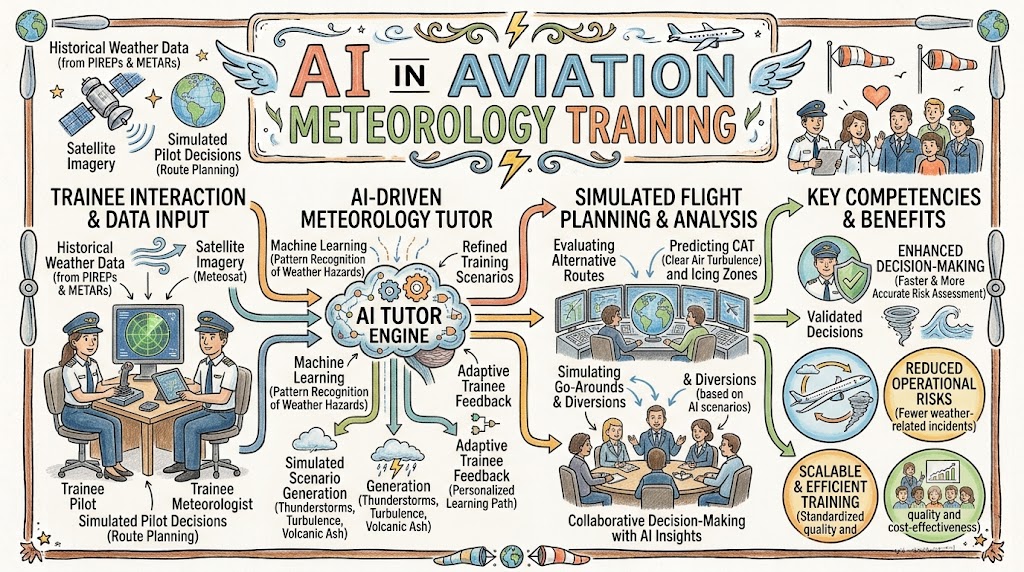
Traditional classroom teaching remains essential, but artificial intelligence is creating new ways to teach aviation weather.
AI-powered training systems can analyse student performance, generate realistic weather scenarios, provide instant feedback, and personalise lessons according to individual learning needs. They can also help students practise difficult weather decisions without exposing them to actual flight risk.
AI does not replace instructors or practical flight experience. It supports instructors by making meteorology training more interactive, measurable, and relevant to real aviation operations.
What Is Aviation Meteorology Training?
Aviation meteorology training teaches students how weather develops and how atmospheric conditions affect flight operations.
The training normally covers:
- Atmospheric pressure
- Temperature and humidity
- Wind speed and direction
- Cloud formation
- Visibility
- Fog and low clouds
- Thunderstorms
- Turbulence
- Aircraft icing
- Jet streams
- Fronts and pressure systems
- Weather reports and forecasts
- Radar and satellite images
- Weather-related flight decisions
The objective is not only to help students pass an examination. It is to develop the knowledge and judgment required to make safe operational decisions.
Why Aviation Weather Training Is Essential
Weather can change quickly and may differ significantly between the departure airport, route, destination, and alternate airport.
A pilot may need to decide whether to:
- Delay a flight
- Change the route
- Select another altitude
- Carry additional fuel
- Choose a different alternate airport
- Avoid thunderstorms
- Prepare for turbulence
- Discontinue an approach
- Perform a go-around
- Divert to another airport
Poor weather knowledge can lead to unsafe decisions, unexpected hazards, fuel problems, unstable approaches, and unnecessary pressure during flight.
Strong meteorology training helps pilots recognise risk before conditions become critical.
How AI Supports Aviation Meteorology Training
Artificial intelligence can process student data, weather information, simulation results, and assessment performance.
An AI-powered learning system may:
- Identify weak knowledge areas
- Recommend suitable lessons
- Generate practice questions
- Create weather scenarios
- Adjust lesson difficulty
- Provide immediate feedback
- Track learning progress
- Explain incorrect answers
- Compare student decisions
- Suggest additional practice
This creates a more personalised learning experience.
Instead of giving every student the same lesson, the system can focus on the areas where the learner needs the most improvement.
Personalised Weather Learning
Students do not always learn meteorology at the same speed.
One student may understand wind and pressure but struggle with cloud identification. Another may understand weather theory but have difficulty applying it during flight planning.
AI can analyse:
- Quiz results
- Response time
- Repeated mistakes
- Simulation performance
- Topic completion
- Confidence levels
- Decision patterns
The system can then create an individual learning plan.
For example, a student who repeatedly misinterprets icing forecasts may receive:
- Additional icing lessons
- More forecast examples
- Scenario-based exercises
- Visual explanations
- Short assessments
- Corrective feedback
Personalised learning prevents students from moving forward with important knowledge gaps.
AI-Powered Weather Simulations
Weather is often easier to understand when students can see how it develops.
AI-powered simulation systems can create realistic weather situations involving:
- Thunderstorms
- Crosswinds
- Wind shear
- Fog
- Heavy rain
- Snow
- Icing
- Turbulence
- Low cloud ceilings
- Rapid pressure changes
Students can review the weather situation and make operational decisions.
The system may ask them to:
- Approve or reject a flight
- Select a safe route
- Choose an altitude
- Identify hazards
- Select an alternate airport
- Calculate additional fuel
- Decide whether to divert
- Respond to deteriorating destination weather
After the exercise, the system can explain the consequences of each decision.
Scenario-Based Meteorology Training
Scenario-based learning connects weather theory with real flight operations.
A training exercise may present a student with:
- Aircraft type
- Departure airport
- Planned route
- Destination
- Passenger load
- Fuel information
- Weather reports
- Forecast charts
- Alternate airports
- Operational limitations
The student must evaluate the complete situation.
This approach develops practical judgment because aviation decisions are rarely based on one weather report alone.
AI can generate many versions of the same scenario by changing:
- Time of departure
- Wind direction
- Visibility
- Storm movement
- Fuel availability
- Destination conditions
- Aircraft capability
Students receive varied practice rather than memorising one fixed answer.
AI for Weather Report Interpretation
Pilots must understand standard aviation weather reports and forecasts.
These products contain information about:
- Wind
- Visibility
- Clouds
- Temperature
- Dew point
- Pressure
- Precipitation
- Thunderstorms
- Temporary conditions
- Expected changes
AI training tools can help students learn how to decode and interpret these reports.
A smart system may:
- Highlight each weather element
- Explain abbreviations
- Convert the report into plain language
- Ask interpretation questions
- Compare observations with forecasts
- Identify operational hazards
- Show how conditions may affect a flight
The system should gradually reduce assistance as the student becomes more confident.
The final goal is independent interpretation rather than permanent dependence on automation.
Teaching Radar Interpretation with AI
Weather radar helps pilots and aviation professionals identify precipitation and thunderstorm activity.
However, radar images require careful interpretation.
Students must understand:
- Precipitation intensity
- Storm-cell movement
- Radar image age
- Ground clutter
- Shadowing
- Attenuation
- False returns
- Gaps between storm cells
- Limitations of radar coverage
AI can create animated radar exercises and ask students to predict storm movement.
It can also compare the student’s prediction with actual development.
Computer vision may highlight:
- Growing storm cells
- Movement direction
- Dangerous areas
- Possible route conflicts
- Changes in intensity
Training must emphasise that radar images may be delayed and cannot prove that an uncoloured area is safe.
Satellite Imagery Training
Satellite images provide information about cloud cover, storm systems, moisture, fog, smoke, and atmospheric movement.
AI can help students learn satellite interpretation by identifying:
- Cloud types
- Frontal systems
- Tropical weather
- Developing convection
- Fog
- Dust
- Smoke
- Large weather patterns
The system can display satellite images from different times and ask students to describe how the weather system is changing.
This helps learners connect theoretical meteorology with visible atmospheric patterns.
AI in Thunderstorm Training
Thunderstorms are among the most serious weather hazards in aviation.
They may contain:
- Severe turbulence
- Lightning
- Hail
- Heavy rain
- Icing
- Strong vertical currents
- Wind shear
- Microbursts
- Reduced visibility
AI-powered training can simulate the complete life cycle of a thunderstorm.
Students can learn:
- How storms develop
- Which conditions support convection
- How radar intensity changes
- Why storm cells must be avoided
- How storms affect airports
- Why gaps may be unsafe
- How route decisions should change
The system can also present time pressure and operational pressure, helping students practise conservative decision-making.
Wind and Crosswind Training
Wind affects takeoff, landing, aircraft control, route planning, fuel use, and flight time.
AI tools can teach students to evaluate:
- Headwinds
- Tailwinds
- Crosswinds
- Wind gusts
- Surface wind
- Upper-level wind
- Wind shear
- Mountain waves
Interactive exercises may allow students to change wind speed and direction and observe how the crosswind component changes.
The training can include different:
- Runway directions
- Aircraft limits
- Runway surfaces
- Gust conditions
- Pilot experience levels
Students should still learn manual crosswind calculations and understand the underlying principles.
AI in Turbulence Training
Turbulence can occur near thunderstorms, mountains, jet streams, fronts, and unstable atmospheric layers.
AI training systems can combine:
- Wind information
- Temperature gradients
- Jet-stream position
- Pilot reports
- Aircraft movement data
- Terrain
- Atmospheric stability
Students can examine a route and identify where turbulence may occur.
They may then choose:
- A different altitude
- An alternative route
- A delayed departure
- A cabin preparation plan
This teaches students that turbulence management includes both flight-path decisions and passenger-safety actions.
AI in Icing Awareness Training
Aircraft icing can reduce lift, increase drag, affect engines, damage sensors, and make aircraft control more difficult.
AI-based exercises can help students understand how icing depends on:
- Temperature
- Moisture
- Cloud type
- Precipitation
- Altitude
- Aircraft equipment
- Exposure time
The system can present an icing forecast and ask the student to evaluate whether the planned flight is suitable.
It can also show how small changes in altitude or temperature may change the risk.
Training should make it clear that aircraft certification and anti-icing equipment do not remove every icing hazard.
Fog and Visibility Training
Fog and low visibility can affect taxiing, takeoff, approach, landing, and airport capacity.
AI can generate exercises involving:
- Radiation fog
- Advection fog
- Low cloud ceilings
- Heavy rain
- Smoke
- Dust
- Snow
- Runway visual range
Students can learn how humidity, temperature, wind, terrain, and nearby water influence fog formation.
The system may ask them to predict whether visibility will improve or deteriorate before arrival.
This helps students connect meteorological conditions with practical flight-planning decisions.
AI-Based Weather Decision Training
Knowing the weather is not enough. Pilots must use that information to make safe decisions.
AI can evaluate how students respond to operational situations.
| Weather Situation | Training Decision |
|---|---|
| Strong crosswind | Continue, delay, or select another runway |
| Thunderstorms along route | Reroute, delay, or cancel |
| Low destination visibility | Review alternate airport and fuel |
| Forecast icing | Change route, altitude, or departure time |
| Severe turbulence | Select another altitude or route |
| Wind shear warning | Delay departure or discontinue approach |
The system can score more than the final answer.
It may also evaluate:
- Information reviewed
- Risk recognised
- Alternatives considered
- Decision timing
- Safety margin
- Explanation provided
This provides a deeper assessment of judgment.
Adaptive Assessments
Traditional examinations often use the same difficulty level for every student.
AI-powered assessments can adjust questions according to student performance.
When a student answers correctly, the system may provide a more complex scenario. When the student struggles, it may return to the underlying concept.
Adaptive assessments help identify whether the student truly understands the subject.
They can test:
- Recall
- Interpretation
- Calculation
- Hazard recognition
- Flight planning
- Decision-making
Instructors receive detailed reports showing where each student needs support.
Virtual Instructors and AI Assistants
AI assistants can provide additional support outside normal classroom hours.
Students may ask questions such as:
- Why does fog form at night?
- How does a cold front affect flying conditions?
- What causes clear-air turbulence?
- Why does high temperature affect takeoff performance?
- How should a pilot interpret changing visibility?
The AI assistant can provide explanations, examples, and practice exercises.
However, educational systems should be carefully controlled. Incorrect or oversimplified answers can create safety risks.
Human instructors must review training content and remain responsible for teaching standards.
AI in Flight Simulator Weather Training
Flight simulators can reproduce difficult weather conditions without placing aircraft or students at risk.
AI can make simulator sessions more dynamic by changing weather according to student actions.
A simulator may introduce:
- Deteriorating visibility
- Increasing crosswinds
- Unexpected turbulence
- Thunderstorm development
- Wind shear
- Icing conditions
- Destination closure
The student must manage the aircraft while reviewing weather information and making operational decisions.
AI can analyse:
- Reaction time
- Aircraft control
- Use of weather information
- Communication
- Diversion planning
- Decision quality
- Compliance with procedures
This connects meteorological knowledge with cockpit workload.
Benefits of AI in Aviation Meteorology Training
Personalised Learning
AI adjusts lessons and exercises according to student needs.
More Realistic Practice
Students can experience complex and changing weather scenarios.
Immediate Feedback
Learners understand mistakes soon after making them.
Better Progress Tracking
Instructors can monitor topic knowledge and decision-making performance.
Safe Exposure to Hazardous Conditions
Students can practise severe-weather situations without real operational risk.
Increased Student Engagement
Interactive maps, simulations, and scenarios make theory easier to understand.
Consistent Assessment
AI can apply the same evaluation standards to all students.
More Practice Opportunities
Students can repeat exercises until they demonstrate competence.
Limitations of AI Meteorology Training
AI training also has important limitations.
Incorrect Information
An AI system may provide inaccurate or incomplete explanations.
Poor Training Data
Weak or unrepresentative data can reduce system quality.
Lack of Real-World Experience
Digital exercises cannot fully reproduce the pressure and complexity of actual flight operations.
Overdependence
Students may rely on automated summaries instead of learning independent analysis.
Limited Explainability
Some AI systems may not clearly explain why an answer is considered correct.
Technical Problems
Software, internet, sensor, or device failures can interrupt training.
Privacy Concerns
Student performance data must be collected and stored responsibly.
Human Instructors Remain Essential
Aviation meteorology requires professional judgment, practical examples, and safety-focused discussion.
Human instructors can:
- Explain difficult concepts
- Correct misunderstandings
- Share operational experience
- Evaluate student confidence
- Encourage conservative decisions
- Connect theory with real flights
- Identify unsafe attitudes
- Provide personal guidance
AI should act as an additional teaching tool rather than a replacement for qualified instructors.
The strongest training model combines instructor expertise with intelligent digital support.
Avoiding Automation Bias in Training
Automation bias occurs when a person trusts a computer recommendation without sufficient independent review.
Students may assume that a route is safe simply because an AI tool gives it a low-risk score.
Training should require students to:
- Review original weather information
- Check issue times
- Compare multiple sources
- Identify missing data
- Question unexpected outputs
- Explain their decisions
- Prepare alternative plans
- Apply safe operating limits
The absence of an AI warning does not prove that no hazard exists.
A Practical AI-Supported Training Process
Assess Existing Knowledge
Begin with questions covering basic meteorology and weather interpretation.
Create a Personal Learning Plan
Use the results to identify strengths and weak areas.
Teach Core Theory
Cover atmosphere, pressure, wind, clouds, storms, visibility, turbulence, and icing.
Practise Weather Interpretation
Use reports, forecasts, radar, satellite images, and weather charts.
Introduce Operational Scenarios
Ask students to apply weather information to realistic flights.
Use Simulation
Create changing conditions that require in-flight decisions.
Provide Detailed Feedback
Explain what was correct, what was missed, and how safety margins could improve.
Repeat Weak Areas
Assign additional exercises until the student demonstrates competence.
Conduct Instructor Review
A qualified instructor should evaluate the student’s final understanding and judgment.
Role of AI in Student Pilot Training
Student pilots often find meteorology difficult because it combines science, terminology, charts, calculations, and decision-making.
AI can simplify learning by:
- Explaining concepts in stages
- Providing visual examples
- Creating short quizzes
- Repeating difficult topics
- Generating local weather scenarios
- Connecting theory to flight lessons
- Tracking improvement
However, students must not use AI as a shortcut around fundamental learning.
They need enough knowledge to make safe decisions when digital systems fail or provide conflicting information.
AI Training for Commercial Pilots
Commercial pilots require advanced weather knowledge because they operate larger aircraft across wider regions and more complex airspace.
AI-based training can cover:
- High-altitude winds
- Jet streams
- Clear-air turbulence
- Tropical weather
- Long-range forecasting
- Destination and alternate planning
- Operational fuel decisions
- Airport capacity changes
- Weather-related diversions
- Crew coordination
Scenario training can reproduce real airline pressures involving schedules, passengers, fuel, and network disruption.
The training should always reinforce that safety takes priority over punctuality and cost.
AI Training for Dispatchers and Controllers
Aviation meteorology is important not only for pilots.
Flight dispatchers use weather information for:
- Route planning
- Fuel calculation
- Alternate-airport selection
- Flight monitoring
- Disruption management
Air traffic controllers use weather information to manage:
- Traffic flow
- Runway configuration
- Congestion
- Storm avoidance
- Airport capacity
AI training can create role-specific exercises for each profession.
It can also create joint scenarios where pilots, dispatchers, controllers, and airport teams must coordinate decisions.
Skills Students Should Develop
AI-supported aviation meteorology training should develop the following skills:
- Understanding weather fundamentals
- Interpreting aviation reports
- Reading radar and satellite images
- Recognising hazardous weather
- Evaluating forecast uncertainty
- Applying aircraft limitations
- Selecting alternate plans
- Making conservative decisions
- Communicating weather risks
- Using AI responsibly
- Recognising automation bias
- Maintaining situational awareness
A strong student should be able to explain both the weather and the operational decision.
Future of AI in Aviation Meteorology Training
Future training systems may become more immersive and personalised.
Possible developments include:
- Virtual-reality weather environments
- Real-time flight-specific scenarios
- Voice-based AI instructors
- Adaptive simulator weather
- Automated competency tracking
- Digital twins of airports
- Personalised weather-risk exercises
- Connected aircraft weather data
- Augmented-reality weather displays
- Multilingual aviation learning assistants
Students may be able to practise weather conditions from different regions without travelling to those locations.
For example, a learner could experience monsoon weather, mountain waves, desert dust, tropical storms, and winter icing within one training platform.
Best Practices for Aviation Training Organisations
Training organisations using AI should:
- Use verified aviation weather information.
- Involve qualified meteorology instructors.
- Review AI-generated content regularly.
- Explain system limitations.
- Protect student performance data.
- Combine digital learning with classroom instruction.
- Include realistic flight scenarios.
- Require students to justify decisions.
- Test knowledge without AI assistance.
- Update training data regularly.
- Maintain backup teaching methods.
- Focus on competence rather than course completion.
Frequently Asked Questions
What is AI in aviation meteorology training?
It is the use of artificial intelligence to personalise weather lessons, create simulations, assess student performance, and improve aviation weather decision-making.
Can AI teach aviation meteorology without an instructor?
AI can support learning, but qualified instructors remain necessary for validation, practical guidance, and safety-focused judgment.
How does AI personalise meteorology training?
AI analyses student answers, mistakes, progress, and simulation performance to recommend suitable lessons and exercises.
Can AI create realistic aviation weather scenarios?
Yes. It can generate scenarios involving thunderstorms, fog, turbulence, wind shear, icing, crosswinds, and changing visibility.
Is AI useful for student pilots?
Yes. It can simplify difficult concepts, provide repeated practice, and connect weather theory with flight decisions.
Can AI improve radar interpretation training?
AI can highlight storm movement, intensity changes, and route conflicts while providing interactive radar exercises.
Does AI replace real flight weather experience?
No. Simulation helps prepare students, but real-world instruction and supervised flying remain important.
What is automation bias in weather training?
Automation bias occurs when a student trusts an AI recommendation without checking the underlying weather information.
Can AI assess pilot weather decision-making?
Yes. It can evaluate hazard recognition, alternatives considered, decision timing, safety margins, and the final operational choice.
What is the future of AI in aviation weather education?
Future systems may include virtual reality, adaptive simulators, voice assistants, digital airport twins, and personalised real-time weather scenarios.
Conclusion
AI is improving aviation meteorology training by making weather education more interactive, personalised, and operationally realistic. It helps students practise storm avoidance, wind analysis, icing awareness, turbulence planning, and weather-related decision-making in a controlled environment. However, AI must remain a support tool. Effective training still depends on qualified instructors, verified weather information, practical experience, and strong human judgment.