Introduction
Climate change is creating new challenges for aviation. Airlines, airports, aircraft manufacturers, regulators, and air traffic organisations must prepare for more frequent heatwaves, stronger storms, flooding, rising sea levels, changing wind patterns, wildfire smoke, and other environmental risks.
These risks can affect flight safety, aircraft performance, airport infrastructure, operating costs, scheduling, and passenger experience.
Traditional climate planning often depends on historical weather records and long-term scientific models. These remain essential, but artificial intelligence can make the information easier to analyse and apply to aviation operations.
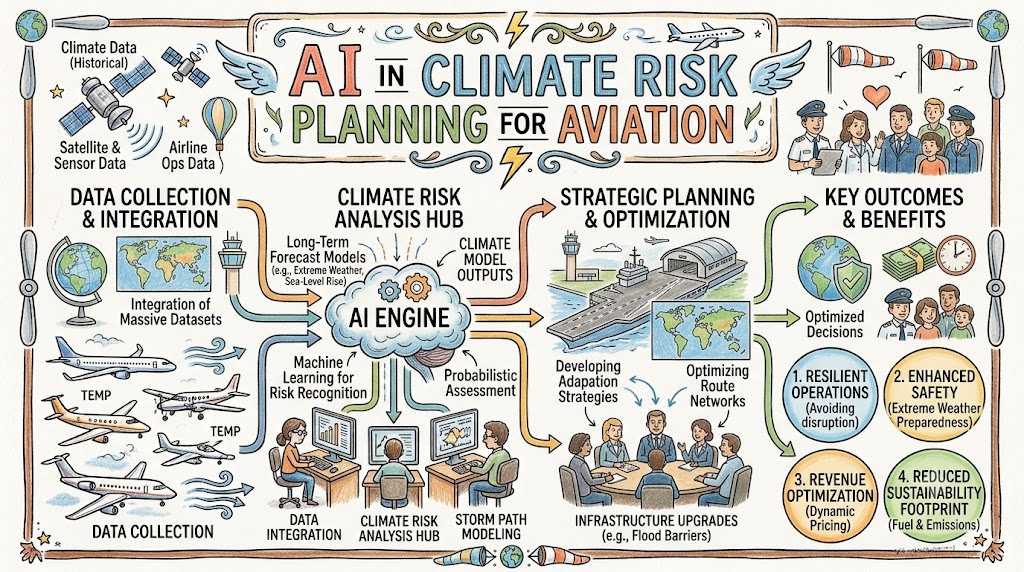
AI can examine large amounts of climate, weather, infrastructure, flight, and maintenance data. It can identify patterns, estimate future risks, test different scenarios, and help aviation organisations decide where to invest.
AI does not predict the future with complete certainty. Its main value is helping aviation professionals understand possible risks and prepare practical response plans.
What Is Climate Risk Planning in Aviation?
Climate risk planning is the process of identifying how changing environmental conditions may affect aviation systems.
It considers both immediate and long-term risks.
Immediate risks may include:
- Extreme heat
- Strong thunderstorms
- Flooding
- Heavy rainfall
- Wildfire smoke
- High winds
- Severe turbulence
- Runway contamination
Long-term risks may include:
- Rising sea levels
- Permanent changes in temperature
- Shifting storm patterns
- Changing wind conditions
- Water shortages
- Infrastructure damage
- Increased maintenance requirements
- Higher insurance costs
Climate risk planning helps aviation organisations decide how to maintain safety, reliability, and financial stability under changing conditions.
Why Climate Risk Planning Matters for Aviation
Aviation is highly sensitive to weather and environmental conditions.
Airports depend on stable runways, taxiways, terminals, navigation systems, fuel facilities, roads, drainage networks, and electrical infrastructure. Aircraft performance depends on temperature, air density, wind, visibility, and atmospheric conditions.
Climate-related disruption can cause:
- Flight delays and cancellations
- Reduced runway capacity
- Aircraft payload restrictions
- Infrastructure damage
- Higher fuel consumption
- More frequent maintenance
- Passenger inconvenience
- Supply-chain disruption
- Increased insurance claims
- Greater operating costs
An aviation organisation that plans only for current conditions may be unprepared for future risks.
Climate planning allows decision-makers to protect operations before major problems occur.
How AI Supports Aviation Climate Risk Planning
Artificial intelligence can combine information from many sources, including:
- Historical weather records
- Climate projections
- Satellite observations
- Airport sensors
- Flight operations data
- Aircraft performance records
- Maintenance reports
- Geographic information systems
- Flood and sea-level models
- Energy-use data
- Passenger traffic forecasts
- Infrastructure inspection records
AI models can identify relationships that may be difficult to detect manually.
For example, an AI system could examine temperature trends, aircraft performance, runway length, and passenger demand to estimate when extreme heat may begin creating regular payload restrictions at a specific airport.
The system could then compare possible solutions, such as changing departure times, extending runways, adjusting schedules, or using different aircraft.
Climate Risks Affecting Aviation
Extreme Heat
High temperatures reduce air density. This can affect aircraft lift, engine performance, and takeoff distance.
During very hot conditions, an aircraft may require:
- A longer runway
- A lower takeoff weight
- Reduced cargo
- Fewer passengers
- Additional fuel planning
- A different departure time
Extreme heat can also affect airport workers, electrical equipment, terminal cooling, runway surfaces, and ground vehicles.
AI can analyse historical heat events and future climate projections to estimate how often temperature-related restrictions may occur.
Flooding and Heavy Rainfall
Airports are often built on flat land, making some locations vulnerable to flooding.
Floodwater can affect:
- Runways
- Taxiways
- Electrical systems
- Baggage areas
- Access roads
- Fuel facilities
- Ground-support equipment
- Drainage systems
AI can combine rainfall forecasts, terrain data, drainage capacity, land use, and flood history to identify high-risk areas within an airport.
This helps airport planners decide where barriers, pumps, drainage upgrades, or elevated equipment may be required.
Rising Sea Levels
Coastal airports may face increasing risk from sea-level rise, storm surges, and coastal erosion.
AI-supported planning can evaluate:
- Future sea-level scenarios
- Storm-surge exposure
- Runway elevation
- Terminal vulnerability
- Local coastal protection
- Emergency access routes
- Long-term expansion plans
The analysis can help authorities decide whether to strengthen coastal defences, elevate infrastructure, relocate important systems, or reconsider future development.
Stronger Storms
Severe storms can damage infrastructure, interrupt flight schedules, and increase safety risks.
AI can help estimate:
- Storm frequency
- Possible storm intensity
- Infrastructure exposure
- Expected operational downtime
- Recovery time
- Financial impact
Scenario modelling allows airports and airlines to test how different storm events may affect their operations.
Changing Wind Patterns
Wind affects runway use, route planning, fuel consumption, turbulence, and aircraft performance.
Long-term changes in wind patterns may influence:
- Runway suitability
- Airport capacity
- Flight duration
- Fuel requirements
- Preferred flight routes
- Turbulence exposure
AI can analyse historical and projected wind data to determine whether existing runway and traffic plans will remain effective.
Wildfire Smoke
Wildfire smoke can reduce visibility, affect air quality, and disrupt flight operations over large areas.
AI can combine satellite images, wind forecasts, fire activity, and air-quality data to predict where smoke may travel.
Airlines and airports can use this information to prepare:
- Route adjustments
- Schedule changes
- Passenger notifications
- Worker protection
- Indoor air-quality measures
Water Shortages
Airports require water for sanitation, cooling, cleaning, firefighting, catering, and other services.
Climate-related water shortages may increase operational costs or create service limitations.
AI can analyse demand, local supply, seasonal patterns, and climate projections to support long-term water planning.
AI for Airport Infrastructure Resilience
Airport infrastructure is designed to operate for many years. New terminals, runways, and transport systems must therefore consider future climate conditions.
AI can help planners answer questions such as:
- Which airport areas are most vulnerable?
- Which assets are most important?
- When might existing systems become inadequate?
- Which investment provides the greatest risk reduction?
- How much disruption could a major event cause?
- Which projects should be completed first?
A climate-resilience plan may cover:
| Airport Asset | Climate Risk | Possible Adaptation |
|---|---|---|
| Runway | Heat and flooding | Heat-resistant materials and improved drainage |
| Terminal | Heatwaves and storms | Stronger cooling systems and structural protection |
| Electrical systems | Flooding | Elevation and waterproof protection |
| Fuel storage | Flooding and heat | Barriers, monitoring, and temperature controls |
| Access roads | Heavy rainfall | Drainage improvements and alternative routes |
| Navigation equipment | Storms and heat | Protective housing and backup systems |
AI can compare the cost of these improvements with the estimated cost of future disruption.
AI in Airline Climate Risk Planning
Airlines face climate risks across their route networks.
A single airline may operate through hundreds of airports with different environmental conditions.
AI can assess risk across the network by considering:
- Airport location
- Weather exposure
- Route importance
- Aircraft type
- Seasonal demand
- Maintenance facilities
- Crew bases
- Alternative airports
- Passenger connections
The system can identify which routes, hubs, or operating bases may face the greatest future disruption.
Airlines can then develop plans for:
- Alternative flight schedules
- Fleet selection
- Route changes
- Additional fuel requirements
- Aircraft positioning
- Crew planning
- Passenger recovery
- Insurance management
AI and Aircraft Performance Planning
Aircraft performance changes with temperature, altitude, humidity, and wind.
Hotter conditions may reduce takeoff capability, particularly at high-altitude airports or airports with shorter runways.
AI can combine:
- Aircraft performance data
- Airport elevation
- Runway length
- Temperature forecasts
- Passenger demand
- Cargo requirements
- Fuel needs
The system can estimate how climate trends may affect future operations.
For example, it may predict that certain flights will regularly require reduced payloads during hot summer afternoons.
The airline could respond by:
- Scheduling flights earlier
- Using a different aircraft
- Reducing cargo
- Adjusting the route
- Increasing turnaround flexibility
Predictive Maintenance and Climate Exposure
Climate conditions can affect aircraft and airport equipment.
Heat, moisture, salt, dust, strong winds, and heavy rainfall may accelerate wear or increase failure risk.
AI-powered predictive maintenance can monitor:
- Component temperature
- Corrosion patterns
- Equipment vibration
- Electrical performance
- Environmental exposure
- Repair history
- Sensor data
The system can identify equipment that may require earlier inspection or maintenance.
This helps organisations reduce unexpected failures during extreme conditions.
AI-Powered Climate Risk Maps
Climate risk maps show where hazards may affect aviation assets.
AI can create detailed maps using:
- Geographic information
- Airport layouts
- Terrain
- Weather history
- Flood zones
- Sea-level projections
- Heat exposure
- Infrastructure location
These maps can highlight:
- Flood-prone runway sections
- Heat-sensitive equipment
- Storm-exposed buildings
- Vulnerable access roads
- Coastal-risk zones
- Emergency response gaps
Visual risk maps make complex climate information easier for managers, engineers, and emergency teams to understand.
Digital Twins for Climate Planning
A digital twin is a virtual model of a real airport, aircraft system, or operational network.
It can be updated using real-world data.
An airport digital twin may include:
- Runways
- Terminals
- Roads
- Drainage systems
- Electrical networks
- Aircraft movement
- Passenger flow
- Weather conditions
AI can use the digital twin to simulate climate events.
For example, planners may test:
- A severe flood
- A long heatwave
- A major storm
- A runway closure
- A power failure
- A coastal surge
The simulation shows how operations may be affected and whether current emergency plans are sufficient.
Climate Risk Scoring for Aviation Assets
AI systems can assign risk scores to airports, routes, buildings, or equipment.
A risk score may consider:
- Hazard probability
- Asset exposure
- Operational importance
- Financial value
- Recovery time
- Safety impact
- Available backup systems
| Risk Level | Meaning | Planning Response |
|---|---|---|
| Low | Limited expected impact | Continue monitoring |
| Moderate | Some operational disruption possible | Prepare improvement plan |
| High | Major disruption likely | Prioritise adaptation investment |
| Critical | Severe safety or business risk | Take immediate protective action |
Risk scoring helps organisations decide where limited budgets should be used first.
AI in Emergency and Recovery Planning
Climate risk planning must include both preparation and recovery.
AI can support emergency planning by estimating:
- Which facilities may fail
- How many flights may be affected
- How long recovery may take
- Which resources will be needed
- Which routes should remain available
- Where passengers may require support
During an actual event, AI can process real-time information and help teams update their response.
After the event, AI can analyse performance and identify areas for improvement.
Benefits of AI in Aviation Climate Planning
Better Long-Term Forecasting
AI can analyse multiple climate scenarios and estimate their operational effects.
More Focused Investment
Organisations can prioritise projects that provide the greatest risk reduction.
Improved Infrastructure Protection
Risk maps and simulations identify vulnerable assets before damage occurs.
Stronger Operational Resilience
Airlines and airports can prepare alternative schedules, routes, facilities, and resources.
Lower Financial Losses
Early planning may reduce repair costs, cancellations, and long operational shutdowns.
Better Safety Planning
AI can identify climate conditions that may increase risks for aircraft, workers, passengers, and infrastructure.
Faster Scenario Testing
Digital models allow planners to compare many possible events and responses.
Improved Coordination
Airlines, airports, regulators, emergency services, and local authorities can share a common risk picture.
Limitations of AI Climate Models
AI-supported planning has important limitations.
Uncertain Climate Projections
Long-term forecasts depend on future emissions, local environmental changes, and complex climate systems.
Incomplete Historical Data
Some airports may have limited records for rare or extreme events.
Local Differences
Climate risks vary greatly between coastal, mountain, desert, tropical, and urban airports.
Model Bias
An AI model trained on one region may not perform well in another.
Poor Data Quality
Incorrect infrastructure or weather data can lead to misleading results.
Lack of Explainability
Decision-makers must understand why a model identifies an asset as high risk.
Cost of Implementation
Sensors, data platforms, digital twins, and skilled staff may require significant investment.
Human Oversight and Professional Judgment
AI should support climate planning, not control it independently.
Effective planning requires expertise from:
- Pilots
- Meteorologists
- Climate scientists
- Airport engineers
- Airline operations teams
- Emergency planners
- Financial specialists
- Regulators
- Environmental experts
- Local authorities
Human experts must review AI recommendations, question unrealistic results, and consider safety, legal, social, and financial factors.
A Practical AI-Supported Climate Planning Process
Identify Important Aviation Assets
List runways, terminals, aircraft, navigation systems, roads, fuel facilities, and other critical resources.
Collect Reliable Data
Gather weather records, climate projections, infrastructure details, operational data, and maintenance history.
Identify Climate Hazards
Review heat, flooding, storms, winds, smoke, water shortages, and sea-level risks.
Analyse Exposure
Determine which assets, routes, and operations are located in risk areas.
Estimate Operational Impact
Calculate possible delays, closures, maintenance requirements, safety concerns, and financial losses.
Compare Adaptation Options
Evaluate engineering improvements, schedule changes, alternative routes, equipment upgrades, and emergency plans.
Prioritise Investment
Focus first on high-risk assets with major safety or operational importance.
Monitor and Update
Climate risks and operational conditions change over time. Plans should be reviewed regularly.
AI Skills for Aviation Climate Professionals
Future aviation professionals may need knowledge in both climate science and digital technology.
Important skills include:
- Aviation weather analysis
- Climate risk assessment
- Data interpretation
- AI model evaluation
- Geographic information systems
- Infrastructure planning
- Scenario modelling
- Emergency management
- Sustainability planning
- Cybersecurity awareness
Pilots and operational staff do not need to become AI engineers, but they should understand how automated risk assessments are created and where uncertainty exists.
AI and Sustainable Aviation Planning
Climate adaptation and sustainability are closely connected.
Adaptation focuses on protecting aviation from climate risks. Sustainability focuses on reducing aviation’s environmental impact.
AI can support both goals by helping organisations:
- Reduce unnecessary fuel use
- Improve flight routes
- Optimise airport energy
- Manage water efficiently
- Plan low-emission ground operations
- Identify infrastructure risks
- Compare long-term investment options
Aviation organisations should avoid treating adaptation and emission reduction as separate issues. Both are important for long-term resilience.
Future of AI in Aviation Climate Risk Planning
Future AI systems may provide more detailed and local climate intelligence.
Possible developments include:
- Airport-specific climate forecasts
- Automated infrastructure inspections
- Real-time flood-risk monitoring
- Climate-aware flight scheduling
- Network-wide airline risk maps
- Advanced digital airport twins
- Predictive maintenance linked to environmental exposure
- Automated emergency resource planning
- Climate-based insurance modelling
- AI-supported airport design
Future systems may also connect climate information directly with flight planning, airport operations, and maintenance platforms.
This could allow airlines and airports to move from reactive management to continuous climate preparedness.
Best Practices for Aviation Organisations
Organisations using AI for climate planning should:
- Use multiple trusted data sources.
- Include local environmental information.
- Test models under different climate scenarios.
- Explain uncertainty clearly.
- Involve aviation and climate experts.
- Protect sensitive operational data.
- Review predictions regularly.
- Maintain emergency backup plans.
- Avoid relying on one model.
- Record actual climate impacts.
- Update infrastructure information.
- Keep safety above cost savings.
Frequently Asked Questions
What is AI in climate risk planning for aviation?
It is the use of artificial intelligence to analyse climate, weather, infrastructure, and operational data so aviation organisations can prepare for environmental risks.
Which climate risks affect aviation most?
Major risks include extreme heat, flooding, storms, sea-level rise, changing wind patterns, wildfire smoke, water shortages, and infrastructure damage.
How can AI help airports prepare for flooding?
AI can combine rainfall, terrain, drainage, and flood-history data to identify vulnerable airport areas and test possible protection measures.
Can climate change affect aircraft takeoff performance?
Yes. Higher temperatures reduce air density and may increase takeoff distance or require lower aircraft weight.
How does AI help airlines manage climate risk?
AI can identify vulnerable routes, airports, aircraft types, schedules, and operating bases across an airline network.
What is a digital twin in airport climate planning?
A digital twin is a virtual model of an airport that can simulate floods, heatwaves, storms, closures, and other climate-related events.
Can AI predict future climate conditions accurately?
AI can estimate possible risks, but long-term climate forecasts contain uncertainty. Results should be reviewed under several scenarios.
Does AI replace climate scientists and airport engineers?
No. AI supports analysis, while qualified professionals interpret results and make final planning decisions.
How can AI reduce climate-related aviation costs?
Early planning can reduce infrastructure damage, cancellations, maintenance failures, emergency expenses, and long operational closures.
Why should aviation students learn about climate risk?
Future aviation professionals will work in an environment affected by changing weather and climate conditions. Understanding these risks supports safer and more resilient operations.
Conclusion
AI can strengthen climate risk planning by helping airlines, airports, and aviation authorities understand environmental threats, protect infrastructure, and prepare operational alternatives. It supports better investment decisions, predictive maintenance, emergency planning, and long-term resilience. However, AI predictions must be transparent, regularly reviewed, and combined with climate science, engineering expertise, and professional aviation judgment.