Introduction
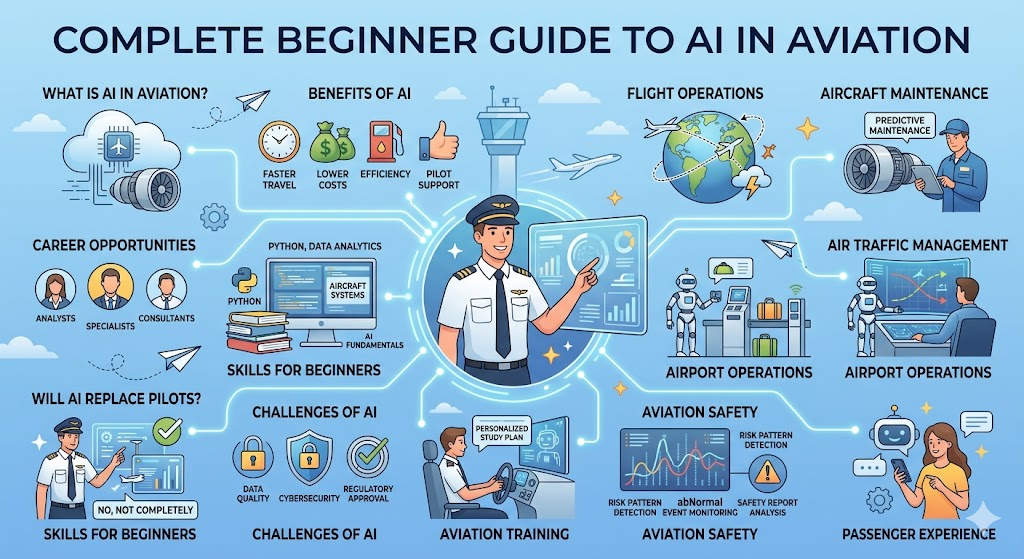
Artificial Intelligence is becoming one of the most important technologies in modern aviation. From helping airlines plan better routes to supporting aircraft maintenance teams, AI is slowly becoming part of the aviation ecosystem. For beginners, the topic may sound complex, but the basic idea is simple: AI helps aviation professionals use data, automation, and intelligent systems to make better decisions.
Aviation has always depended on safety, accuracy, planning, and skilled human judgment. AI does not remove the need for pilots, engineers, air traffic controllers, airport teams, or aviation trainers. Instead, it supports them by analyzing large amounts of information faster than humans can do manually. This can help improve safety, reduce delays, support maintenance planning, and make passenger services smoother.
For students, aspiring pilots, aviation learners, and technology beginners, understanding AI in aviation is a smart step. The aviation industry is becoming more digital, and future professionals will need to understand both aviation fundamentals and modern technologies. This beginner guide explains what AI in aviation means, where it is used, what benefits it offers, what challenges exist, and how beginners can start learning.
What Is AI in Aviation?
AI in aviation means using intelligent software and data-driven systems to support aviation-related tasks. These systems can study data, identify patterns, make predictions, give recommendations, and help humans make faster and more informed decisions.
In simple words, AI is like a smart assistant that can process large amounts of aviation data. For example, an aircraft produces data from engines, sensors, fuel systems, weather systems, navigation systems, and maintenance logs. AI can analyze this data and help aviation teams understand what is happening, what may happen next, and what action may be needed.
Some common AI concepts used in aviation include:
Machine learning
Machine learning allows systems to learn from data and improve over time. In aviation, it can help predict aircraft maintenance needs, flight delays, passenger demand, or operational risks.
Data analytics
Data analytics helps aviation teams study information from aircraft, airports, flights, passengers, and operations. It supports better planning and decision-making.
Automation
Automation helps reduce repetitive manual work. In aviation, it may support scheduling, baggage tracking, check-in processes, reporting, and operational monitoring.
Computer vision
Computer vision allows systems to understand images and videos. It can support airport security, runway monitoring, aircraft inspection, and passenger flow management.
Predictive systems
Predictive systems use data to estimate what may happen in the future. For example, they may predict engine performance issues, weather-related delays, or passenger traffic at an airport.
Decision support systems
These systems do not make final decisions on their own. Instead, they give useful information to pilots, engineers, airport managers, and aviation teams so they can make better decisions.
Why AI Is Important in Aviation
AI is important in aviation because the industry handles huge amounts of data every day. Airlines operate thousands of flights, airports manage large passenger volumes, aircraft generate technical data, and safety teams monitor many operational risks. Managing all this manually can be slow and difficult.
AI helps aviation professionals use this data more effectively. It can detect patterns, highlight risks, predict possible issues, and recommend actions. This is especially useful in a safety-focused industry where small improvements can make a big difference.
AI can support aviation in many ways:
Improved safety
AI can help identify unusual patterns in aircraft data, operational reports, weather conditions, and maintenance records. This allows aviation teams to respond earlier and reduce risk.
Better maintenance planning
Instead of waiting for a part to fail, AI can help maintenance teams predict when a component may need inspection or replacement.
Reduced delays
AI can support better scheduling, traffic flow, route planning, and airport resource management.
Fuel efficiency
AI can help airlines study routes, aircraft performance, weather, and fuel usage to improve efficiency.
Smarter airport operations
Airports can use AI to manage passenger queues, baggage systems, gate planning, security flow, and staff allocation.
Better passenger experience
AI-powered systems can help travelers with updates, support questions, check-in assistance, baggage tracking, and disruption alerts.
Improved aviation training
AI can support personalized learning, simulator feedback, progress tracking, and training recommendations for students and professionals.
How AI Is Used in Aviation
AI is used across many areas of aviation. It is not limited to aircraft or pilots. It can support airlines, airports, maintenance teams, air traffic operations, customer service teams, training academies, safety departments, and aviation software companies.
AI in Flight Operations
Flight operations involve planning, monitoring, and managing flights. This includes route planning, fuel planning, weather analysis, crew coordination, aircraft availability, schedule management, and operational decision-making.
AI can help flight operations teams analyze many factors at the same time. For example, it can study weather patterns, aircraft performance, airport congestion, airspace restrictions, fuel consumption, and historical delay data. Based on this information, AI systems can suggest better routes, identify possible delays, and support more efficient flight planning.
AI can also help operations teams during disruptions. If bad weather affects one airport, AI can help analyze alternate routes, aircraft availability, crew schedules, passenger connections, and gate changes. This helps airlines respond faster and reduce operational confusion.
For beginners, the key point is simple: AI helps flight operations teams make smarter decisions using data.
AI in Pilot Assistance
Pilots already work with advanced aircraft systems, navigation tools, weather displays, communication systems, autopilot systems, and cockpit alerts. AI can support pilots by helping them understand information more clearly and quickly.
AI may assist with:
- Weather interpretation
- Navigation support
- Flight path monitoring
- Alert prioritization
- Aircraft performance insights
- Workload reduction
- Decision support during complex situations
However, AI does not replace trained pilots. Pilots are responsible for judgment, communication, emergency handling, passenger safety, regulatory compliance, and final decision-making. In aviation, human responsibility remains extremely important.
AI can be viewed as an assistant in the cockpit environment. It may help organize data, detect unusual patterns, or provide recommendations, but it does not remove the need for professional pilot training and experience.
AI in Aircraft Maintenance
Aircraft maintenance is one of the most important areas where AI can create real value. Modern aircraft produce a large amount of technical data from engines, sensors, avionics, landing gear, fuel systems, and other components.
AI can study this data and help maintenance teams detect early signs of problems. This is called predictive maintenance.
Traditional maintenance often follows scheduled inspections and manual checks. Predictive maintenance adds another layer by using data to predict when a part may require attention. This can help airlines reduce unexpected aircraft downtime, improve safety, and manage maintenance costs more effectively.
AI can support aircraft maintenance through:
- Engine health monitoring
- Fault detection
- Sensor data analysis
- Component wear prediction
- Maintenance scheduling
- Spare parts planning
- Technical report analysis
- Aircraft reliability tracking
For beginners, predictive maintenance is one of the easiest AI aviation examples to understand. Instead of waiting for a problem to become serious, AI helps teams notice warning signs earlier.
AI in Air Traffic Management
Air traffic management involves guiding aircraft safely and efficiently through controlled airspace. Air traffic controllers handle aircraft movement, communication, separation, routing, landing flow, and runway usage.
AI can support air traffic management by helping analyze traffic patterns, weather conditions, runway capacity, flight delays, and airspace congestion. It can help predict busy periods, suggest better traffic flow, and support decision-making.
AI may help in areas such as:
- Traffic flow prediction
- Runway utilization
- Delay forecasting
- Airspace congestion analysis
- Controller workload support
- Weather impact analysis
- Airport arrival and departure planning
It is important to understand that AI supports controllers; it does not replace their professional responsibility. Air traffic control requires human judgment, communication, coordination, and safety-focused decision-making.
AI in Airport Operations
Airports are complex environments. They manage passengers, baggage, aircraft parking, gates, security checks, immigration, retail areas, ground handling, cleaning, fueling, and transport connections. AI can help airports operate more smoothly by analyzing real-time data and improving planning.
AI can be used in airport operations for:
- Passenger queue management
- Baggage tracking
- Security screening support
- Gate allocation
- Staff scheduling
- Passenger flow analysis
- Flight delay prediction
- Resource planning
- Airport cleaning and maintenance scheduling
- Ground vehicle coordination
For example, if AI detects that passenger traffic is increasing at a security checkpoint, airport teams can allocate more staff or open more counters. If baggage movement slows down, AI-based monitoring can help identify where the delay is happening.
AI can make airports more efficient, but human teams still manage operations, customer support, security decisions, and emergency response.
AI in Aviation Safety
Safety is the foundation of aviation. Every new technology in aviation must be carefully reviewed, tested, and controlled before it can be trusted for safety-related use.
AI can support aviation safety by identifying risks, monitoring unusual patterns, analyzing safety reports, and helping teams prevent incidents. It can study large volumes of operational data that humans may not be able to review quickly.
AI can support safety teams through:
- Risk pattern detection
- Abnormal event monitoring
- Safety report analysis
- Incident trend identification
- Maintenance risk alerts
- Weather-related risk analysis
- Flight data monitoring support
- Training performance review
However, AI must be reliable, explainable, secure, and properly validated. In aviation, safety cannot depend on black-box technology that no one understands. This is why regulators and aviation organizations focus heavily on trustworthy AI, human oversight, and proper assurance.
AI in Passenger Experience
Passengers may already interact with AI without realizing it. Many airlines and travel companies use AI-powered systems to improve customer service and communication.
AI can support passenger experience through:
- Chatbots for common travel questions
- Personalized flight updates
- Smart check-in assistance
- Baggage tracking updates
- Delay notifications
- Rebooking support
- Customer service automation
- Travel recommendation systems
- Passenger feedback analysis
For example, if a flight is delayed, an AI-powered system may help send updates, suggest alternate options, or guide passengers through the next steps. This improves communication and reduces stress.
Still, passengers often need human support for complex situations such as missed connections, special assistance, medical needs, refunds, and emergency travel changes.
AI in Aviation Training
AI can play an important role in aviation training. Students and professionals need continuous learning, practical feedback, and performance improvement. AI can help training academies create more personalized and effective learning experiences.
AI in aviation training can support:
- Personalized study plans
- Simulator performance analysis
- Virtual instructors
- Progress tracking
- Weak area identification
- Adaptive quizzes
- Scenario-based learning
- Safety training review
- Pilot decision-making practice
- Maintenance training support
For example, if a student struggles with weather interpretation or flight planning, an AI-based learning platform can suggest additional lessons, practice questions, and simulations. This helps learners improve step by step.
For AIAVIATIONACADEMY.COM, this is an important area because beginners need structured, simple, and practical aviation learning. AI can help students learn faster, but strong fundamentals and expert guidance are still essential.
Benefits of AI in Aviation
AI offers several practical benefits for aviation. These benefits are not only for airlines but also for airports, training academies, maintenance teams, safety departments, passengers, and future aviation professionals.
Improved Safety
AI can help aviation teams detect risks earlier by analyzing data from aircraft systems, maintenance records, weather reports, flight operations, and safety reports. Earlier detection allows teams to respond before a small issue becomes a bigger problem.
Reduced Operational Delays
Flight delays can happen because of weather, maintenance issues, airport congestion, crew scheduling problems, or air traffic restrictions. AI can help predict delays and support better planning.
Lower Maintenance Costs
Predictive maintenance can help airlines avoid unnecessary repairs and reduce unexpected aircraft downtime. When maintenance teams know which parts need attention, they can plan inspections and spare parts more efficiently.
Better Fuel Efficiency
Fuel is a major cost in aviation. AI can help analyze routes, aircraft weight, weather, altitude, and performance data to support better fuel planning.
Improved Pilot and Crew Support
AI can help pilots and crew by organizing information, prioritizing alerts, and reducing repetitive tasks. This can support better situational awareness and workload management.
Smarter Training Methods
AI can make aviation learning more personalized. Students can receive feedback based on their performance, learning speed, and weak areas.
Better Airport Management
AI can help airports manage passenger flow, baggage systems, security queues, gates, and staff planning. This can improve both efficiency and passenger satisfaction.
Enhanced Passenger Experience
AI-powered communication tools can help passengers receive faster updates, answers, and support during travel.
Challenges of AI in Aviation
Although AI has many benefits, aviation must use it carefully. Aviation is a safety-critical industry, so technology cannot be adopted casually. Every system must be tested, validated, monitored, and approved where required.
Data Quality
AI depends on data. If the data is incomplete, outdated, biased, or incorrect, the AI system may produce poor recommendations. Aviation data must be accurate, structured, and carefully managed.
Cybersecurity Risks
AI systems, aircraft systems, airport systems, and airline platforms must be protected from cyber threats. If aviation becomes more digital, cybersecurity becomes even more important.
Regulatory Approval
Aviation technologies often need approval from aviation authorities. AI systems used in safety-related areas must meet strict standards and provide evidence that they are reliable.
Human Trust
Pilots, engineers, controllers, and aviation managers must trust AI systems before they use them confidently. If an AI system gives recommendations without explanation, professionals may hesitate to rely on it.
High Implementation Cost
AI systems can require investment in software, infrastructure, training, data management, cybersecurity, and technical experts.
Need for Skilled Professionals
Aviation AI requires people who understand both aviation and technology. This creates a need for new skills and training programs.
Safety Validation
AI must be tested in many scenarios before being used in critical aviation operations. This includes normal operations, unusual situations, emergencies, and system failures.
Overdependence on Automation
Aviation professionals must avoid relying too much on automation. Human knowledge, situational awareness, and manual skills remain important.
Will AI Replace Pilots?
One of the most common questions beginners ask is whether AI will replace pilots. The simple answer is no, not completely.
AI can support pilots, but aviation still requires human judgment, responsibility, communication, and decision-making. Pilots are trained to handle complex situations, emergencies, passenger safety, communication with air traffic control, aircraft management, and regulatory procedures.
AI may reduce workload and improve decision support, but it does not replace the full role of a pilot. A pilot must understand aircraft systems, weather, navigation, emergency procedures, human factors, and real-time decision-making.
In the future, aircraft may become more automated, and AI may become more advanced. However, aviation will continue to need trained professionals who can supervise systems, make decisions, and take responsibility for safety.
For students and aspiring pilots, the best approach is not to fear AI. Instead, learn how AI works and how it can support aviation careers.
Skills Beginners Should Learn for AI in Aviation
Beginners who want to build a future in AI and aviation should develop a combination of aviation knowledge and technology skills.
Basic Aviation Knowledge
Start with the fundamentals of aviation. Learn about aircraft types, flight principles, airports, airlines, navigation, weather, safety, and aviation operations.
Artificial Intelligence Fundamentals
Understand basic AI concepts such as machine learning, automation, prediction, data models, and intelligent systems.
Data Analytics
AI works with data. Learn how to read, clean, analyze, and interpret data. This is useful for flight operations, maintenance, safety, and airport planning.
Machine Learning Basics
Machine learning helps systems learn from past data. Beginners should understand simple concepts such as training data, models, predictions, accuracy, and testing.
Python Basics
Python is one of the most popular programming languages for AI and data analytics. Beginners do not need to become expert programmers immediately, but basic Python knowledge is useful.
Aircraft Systems Knowledge
If you want to work in aviation AI, understanding aircraft systems is valuable. Learn about engines, avionics, sensors, navigation systems, and maintenance processes.
Airport Operations Understanding
AI is widely used in airport management. Learn how airports handle passengers, baggage, gates, security, ground handling, and flight schedules.
Cybersecurity Awareness
As aviation becomes more digital, cybersecurity becomes critical. Beginners should understand basic digital safety, data protection, and system security.
Simulation and Automation Tools
Aviation training often uses simulators and digital platforms. Learning simulation tools can help beginners understand real aviation scenarios.
Safety and Regulatory Awareness
Aviation is controlled by safety rules and regulations. Beginners should understand why approval, testing, documentation, and compliance matter.
Career Opportunities in AI and Aviation
AI in aviation can create many career opportunities for people with aviation knowledge, technology skills, or both.
AI Aviation Analyst
An AI aviation analyst studies aviation data and helps organizations understand how AI can improve operations, safety, training, or passenger services.
Aviation Data Analyst
Aviation data analysts work with flight data, airport data, passenger data, maintenance records, and operational reports to find useful insights.
Aircraft Predictive Maintenance Specialist
This role focuses on using aircraft data to predict maintenance needs and improve aircraft reliability.
Flight Operations Analyst
Flight operations analysts use data to support route planning, fuel efficiency, schedule management, and operational performance.
Airport Automation Specialist
This role focuses on digital systems used in airports, such as baggage handling, passenger flow, smart gates, and resource planning.
Aviation Software Support Engineer
Aviation software support engineers help airlines, airports, and aviation companies use digital systems correctly.
AI Training Content Developer
This role involves creating learning materials, simulations, quizzes, and training content for AI-powered aviation education platforms.
Aviation Safety Data Specialist
Safety data specialists analyze reports, incidents, trends, and operational data to support safer aviation practices.
Drone AI Operations Specialist
Drones are becoming important in logistics, inspection, agriculture, emergency response, and surveillance. AI can support drone navigation, object detection, and mission planning.
Aviation Technology Consultant
Aviation technology consultants help organizations choose, implement, and improve aviation software and AI-based systems.
How Beginners Can Start Learning AI in Aviation
Starting with AI in aviation may feel difficult, but it becomes easier when you follow a step-by-step path.
Step 1- Learn Aviation Basics
Begin with the foundation. Understand how aircraft fly, how airports work, what airlines do, how pilots operate, and why safety is so important.
Step 2- Understand What AI Is
Learn the meaning of AI, machine learning, automation, prediction, data, and algorithms. Keep it simple in the beginning.
Step 3- Learn Data and Analytics Basics
Practice reading tables, charts, and simple datasets. Learn how data is used to make decisions.
Step 4- Explore AI Use Cases in Aviation
Study examples such as predictive maintenance, airport queue management, flight delay prediction, passenger chatbots, and route optimization.
Step 5- Practice With Beginner Tools and Simulations
Use simple aviation simulators, data dashboards, or beginner AI tools to understand how technology supports aviation.
Step 6- Build Small Projects
Create small beginner projects such as:
- Flight delay prediction concept
- Airport passenger flow dashboard
- Aircraft maintenance checklist tracker
- Basic chatbot for aviation FAQs
- Weather and route planning study
- Aviation safety report analysis
Step 7- Follow Aviation Safety and Regulatory Updates
AI in aviation must follow safety and compliance expectations. Beginners should understand why rules and validation matter.
Step 8- Join Aviation and AI Learning Communities
Learning with others helps you stay motivated. Join aviation groups, AI learning communities, student forums, and professional networks.
Step 9- Create a Portfolio
Build a small portfolio showing your learning projects, notes, case studies, and aviation AI ideas. This can help with internships and entry-level opportunities.
Step 10- Apply for Internships, Training, or Entry-Level Roles
Once you understand the basics, look for internships, training programs, aviation technology roles, airline operations roles, or airport technology opportunities.
Examples of AI in Aviation
Here are some simple examples to understand AI in aviation better.
Predictive Engine Maintenance
Aircraft engines produce performance data. AI can study this data and identify early signs of wear or performance changes. Maintenance teams can then inspect the engine before a serious issue occurs.
Weather-Based Route Optimization
AI can analyze weather conditions, wind direction, storms, and route options to support better flight planning. This can help airlines reduce delays and improve fuel efficiency.
AI-Powered Customer Service Chatbots
Passengers often ask common questions about baggage, check-in, flight status, and travel rules. AI chatbots can answer simple questions quickly and guide passengers to the right information.
Automated Baggage Tracking
AI-based systems can help track baggage movement and detect delays in baggage handling. This improves passenger confidence and airport efficiency.
Airport Crowd Management
Airports can use AI to study passenger movement and identify crowded areas. This helps airport teams manage queues and improve passenger flow.
Flight Delay Prediction
AI can analyze weather, aircraft availability, airport congestion, crew schedules, and past delay patterns to predict possible delays.
AI in Aviation for Students and Beginners
Students should learn AI in aviation because the industry is becoming more technology-driven. Future aviation careers will not only require traditional aviation knowledge but also digital understanding.
Aspiring pilots can benefit from understanding AI because cockpit systems, flight planning tools, and operational platforms are becoming smarter. Aircraft maintenance students can benefit because predictive maintenance is growing. Airport operations students can benefit because airports are becoming more automated. Aviation management students can benefit because data-driven decision-making is becoming more common.
Beginners do not need to master everything at once. The best approach is to start with aviation basics, then learn AI concepts step by step. Over time, students can connect both fields and build strong career opportunities.
AIAVIATIONACADEMY.COM can help learners understand these topics in a structured way by offering beginner-friendly aviation knowledge, AI concepts, career guidance, and practical learning resources.
Future of AI in Aviation
The future of AI in aviation will likely focus on safer, smarter, and more efficient operations. AI may become more common in flight planning, maintenance, air traffic management, passenger communication, airport automation, and aviation training.
Future aviation may include:
- Smarter cockpit support systems
- Advanced predictive maintenance
- Intelligent airport operations
- AI-assisted pilot training
- Drone traffic management
- Better flight disruption management
- Automated passenger support
- Sustainable aviation planning
- Improved fuel and route optimization
- More advanced safety monitoring systems
However, the future of AI in aviation must remain human-centered. Aviation cannot depend only on automation. Safety, training, regulation, cybersecurity, and human judgment will continue to be essential.
Common Mistakes Beginners Should Avoid
Thinking AI Will Replace All Aviation Jobs
AI will change aviation jobs, but it will not remove the need for skilled professionals. People who understand both aviation and AI may have stronger career opportunities.
Ignoring Aviation Fundamentals
AI knowledge alone is not enough. Aviation professionals must understand aircraft, safety, operations, regulations, and human factors.
Learning Only Coding Without Understanding Aviation
Coding is useful, but aviation context is equally important. A good aviation AI learner should understand the real problem before building a technical solution.
Trusting AI Without Validation
AI recommendations must be checked, tested, and validated. In aviation, safety always comes first.
Ignoring Safety and Compliance
Aviation is highly regulated. Any AI system used in aviation must respect safety standards, documentation, and approval processes.
Not Building Practical Projects
Beginners should not only read theory. Small projects help learners understand how AI works in real aviation situations.
Using Too Much Technical Language
Beginners should focus on understanding concepts clearly before using complex AI terms.
Practical Tips for Learning AI in Aviation
Start with simple aviation topics before moving into advanced AI. Learn how flights operate, how aircraft are maintained, how airports function, and how safety systems work. Once you understand aviation basics, begin learning AI concepts such as data, machine learning, prediction, and automation.
Use beginner-friendly examples. For instance, imagine how AI can predict flight delays, help with baggage tracking, or support aircraft maintenance. These examples make learning easier.
Create small notes and diagrams. Aviation and AI both become easier when you break topics into small parts. Use flowcharts, checklists, and simple project ideas.
Avoid rushing into advanced coding. Learn the purpose of AI first. Later, you can learn Python, data analysis, and machine learning tools.
Most importantly, stay curious. AI in aviation is a growing field, and beginners who start early can build strong knowledge for future careers.
Frequently Asked Questions
1- What is AI in aviation?
AI in aviation means using intelligent software, data analysis, automation, and machine learning to support aviation tasks. It can help with flight operations, aircraft maintenance, airport management, passenger support, safety monitoring, and aviation training. AI does not replace aviation professionals; it helps them make better and faster decisions.
2- How is AI used in aircraft maintenance?
AI is used in aircraft maintenance through predictive maintenance, sensor data analysis, fault detection, and engine health monitoring. It helps maintenance teams identify possible problems before they become serious. This can reduce unexpected aircraft downtime and improve maintenance planning.
3- Can AI fly an aircraft without pilots?
AI and automation can support aircraft operations, but commercial aviation still depends on trained pilots. Pilots handle judgment, communication, emergencies, responsibility, and safety decisions. AI may assist pilots, but it does not fully replace the role of a professional pilot.
4- Will AI replace pilots in the future?
AI may change how pilots work, but it is not expected to completely replace pilots in normal commercial aviation. Pilots are responsible for safety, decision-making, passenger care, and handling unexpected situations. AI will likely become a support tool that helps pilots work more efficiently.
5- Is AI in aviation safe?
AI can support aviation safety, but it must be carefully tested, validated, monitored, and approved where required. Aviation is a safety-critical industry, so AI systems must be reliable, secure, explainable, and used with human oversight. Safety remains the highest priority.
6- What skills are needed for AI aviation careers?
Useful skills include aviation basics, data analytics, AI fundamentals, machine learning basics, Python basics, aircraft systems knowledge, airport operations understanding, cybersecurity awareness, and safety compliance knowledge. A combination of aviation and technology skills is highly valuable.
7- Can aviation students learn AI without coding experience?
Yes, aviation students can start learning AI without coding experience. They should begin with basic concepts such as what AI is, how data is used, and where AI supports aviation. Later, they can learn simple Python, analytics, and machine learning if they want to build technical skills.
8- How does AI improve airport operations?
AI improves airport operations by supporting passenger flow management, baggage tracking, security screening, gate planning, staff scheduling, and queue management. It helps airport teams understand real-time conditions and respond more efficiently to delays, crowding, or operational issues.
9- What are the best career options in AI aviation?
Good career options include aviation data analyst, AI aviation analyst, flight operations analyst, aircraft predictive maintenance specialist, airport automation specialist, aviation software support engineer, drone AI operations specialist, and aviation technology consultant. Beginners should choose based on their interest in aviation, data, operations, or software.
10- How can beginners start learning AI in aviation?
Beginners should first learn aviation basics, then understand AI fundamentals, data analytics, and common aviation use cases. After that, they can build small projects, follow industry updates, join learning communities, and create a portfolio. Step-by-step learning is the best approach.
Conclusion
AI in aviation is not just a future idea; it is already becoming part of modern flight operations, maintenance, airport management, passenger service, safety systems, and aviation training. For beginners, the best way to understand AI in aviation is to start with simple concepts and practical examples. AI helps aviation professionals analyze data, predict problems, reduce delays, improve efficiency, and support better decisions, but human knowledge and responsibility remain essential. Pilots, engineers, controllers, airport teams, and aviation trainers will continue to play a major role in keeping aviation safe and reliable. Students and beginners who learn both aviation fundamentals and AI concepts can prepare for exciting future career opportunities. Start with the basics, build your skills step by step, explore real-world use cases, and keep learning as aviation technology continues to grow.