Introduction
Weather is one of the most important factors affecting aviation safety. Strong winds, thunderstorms, wind shear, lightning, turbulence, and rapidly changing atmospheric conditions can influence flight routes, fuel planning, airport operations, and passenger comfort.
Traditional weather forecasting systems use radar, satellites, weather stations, and mathematical models to predict these conditions. However, aviation weather can change quickly, especially near airports or inside developing storm systems.
Artificial intelligence is helping aviation professionals interpret weather information faster and more accurately. AI systems can process large amounts of atmospheric data, identify hidden patterns, and provide early warnings about dangerous weather.
AI does not replace pilots, meteorologists, or air traffic controllers. Instead, it acts as an advanced decision-support tool that helps aviation teams understand weather risks and respond more effectively.
Why Accurate Storm and Wind Prediction Matters in Aviation
Aircraft operate in a constantly changing atmosphere. Even a small difference in wind speed or direction can affect takeoff, landing, fuel consumption, and flight duration.
Severe weather can create several operational risks, including:
- Flight delays and cancellations
- Turbulence and passenger injuries
- Wind shear during takeoff or landing
- Reduced visibility near airports
- Lightning and hail exposure
- Route deviations
- Increased fuel consumption
- Airport congestion
- Difficult runway selection
- Greater workload for pilots and controllers
Accurate forecasting gives airlines and flight crews more time to prepare. It can help them change routes, delay departures, select safer altitudes, carry additional fuel, or avoid dangerous areas completely.
How Artificial Intelligence Predicts Aviation Weather
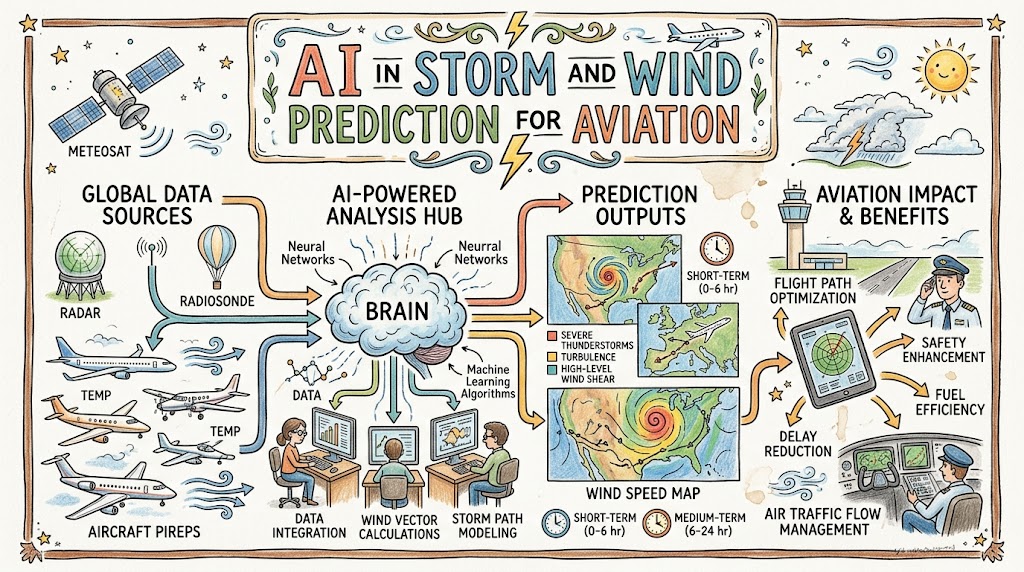
AI-based forecasting systems analyze large volumes of historical and real-time weather data. Machine learning models are trained to recognize relationships between atmospheric conditions and future weather events.
These systems may use data from:
- Weather satellites
- Ground-based radar
- Airport weather stations
- Aircraft sensors
- Wind profilers
- Lightning detection networks
- Numerical weather prediction models
- Pilot weather reports
- Air traffic information
- Historical storm records
The AI system compares current conditions with previously observed weather patterns. It then calculates the probability of storms, wind changes, turbulence, or other hazards.
The output may appear as a risk score, warning, forecast map, route recommendation, or airport weather alert.
Role of Machine Learning in Storm Forecasting
Machine learning allows computer systems to learn from weather data without relying only on manually programmed rules.
For example, a machine learning model can study thousands of past thunderstorms and identify the conditions that usually appear before a storm becomes severe.
These conditions may include:
- Rapid temperature changes
- Increasing atmospheric moisture
- Pressure variations
- Cloud growth patterns
- Wind direction changes
- Lightning activity
- Radar reflectivity
- Vertical air movement
Once trained, the model can monitor current weather and estimate whether a storm is likely to develop, strengthen, weaken, or move toward an airport or flight route.
This can provide aviation teams with earlier and more focused warnings.
AI-Based Wind Prediction
Wind is especially important during takeoff, approach, and landing. Pilots must consider headwinds, tailwinds, crosswinds, gusts, and changing wind direction.
AI can improve wind prediction by analyzing multiple layers of atmospheric information.
Surface Wind Prediction
Surface winds influence runway selection and airport operations. AI systems can estimate short-term changes in wind speed and direction near an airport.
This is useful when weather conditions are changing quickly.
Crosswind Prediction
Crosswinds can make takeoff and landing more difficult. Every aircraft has operational wind limits, and pilots must evaluate whether conditions remain safe.
AI forecasting tools can estimate future crosswind components and alert airport operators when winds may approach operational limits.
Upper-Level Wind Prediction
Winds at cruising altitude affect aircraft speed, fuel usage, route planning, and flight time.
Strong tailwinds can reduce fuel consumption and travel time, while headwinds can increase both. AI can help flight planners select efficient routes and altitudes based on expected wind conditions.
Wind Gust Prediction
Sudden gusts can affect aircraft control, especially during approach and landing. AI models can study local terrain, atmospheric pressure, temperature, and storm activity to predict gusty conditions.
AI and Wind Shear Detection
Wind shear is a rapid change in wind speed or direction over a short distance. It can be especially dangerous near the ground because it may cause a sudden loss of airspeed or lift.
Modern airports and aircraft already use wind shear warning systems. AI can strengthen these systems by combining data from several sources.
An AI model may analyze:
- Doppler weather radar
- Runway wind sensors
- Aircraft performance data
- Previous wind shear events
- Storm movement
- Temperature differences
- Terrain effects
The system can then identify patterns that may indicate developing wind shear.
Earlier warnings give pilots more time to delay departure, discontinue an approach, or perform a go-around.
Predicting Thunderstorms with AI
Thunderstorms are among the most serious weather hazards in aviation. They can contain strong turbulence, hail, heavy rain, lightning, icing, and powerful vertical air currents.
Aircraft generally avoid flying through severe thunderstorms. Therefore, predicting their location, movement, and intensity is essential.
AI can support thunderstorm prediction by analyzing radar images over time. Computer vision models can track storm cells and estimate how they may develop.
The system can help answer questions such as:
- Where is the storm moving?
- How quickly is it developing?
- Will it cross a major flight route?
- Is it likely to affect an airport?
- Could multiple storm cells combine?
- When might the storm weaken?
- Is severe turbulence likely nearby?
This information helps dispatchers, pilots, and controllers make more informed decisions.
Turbulence Forecasting Using Artificial Intelligence
Turbulence is difficult to predict because it may occur even when the sky appears clear.
Clear-air turbulence is often associated with jet streams, strong wind gradients, and atmospheric instability. It may not always appear clearly on traditional weather radar.
AI models can analyze:
- Wind speed at different altitudes
- Temperature gradients
- Jet stream position
- Aircraft motion data
- Pilot reports
- Atmospheric pressure
- Satellite observations
By combining these data sources, AI can identify areas where turbulence is more likely.
Airlines can use this information to adjust routes or altitudes. Pilots may also receive earlier warnings, allowing them to switch on seat belt signs and prepare the cabin.
Real-Time Weather Data from Aircraft
Aircraft can act as moving weather sensors. During flight, they collect information such as temperature, wind speed, air pressure, and aircraft movement.
When data from many aircraft is combined, AI systems can build a more detailed picture of atmospheric conditions.
This information can improve short-term forecasts, especially in areas where ground-based weather stations are limited.
Real-time aircraft data can support:
- Turbulence detection
- Wind speed estimation
- Temperature monitoring
- Storm tracking
- Route optimization
- Airport arrival planning
However, aviation organizations must manage this data carefully and ensure that systems remain secure and reliable.
AI in Airport Weather Management
Airports are highly sensitive to changing weather. Storms and strong winds can reduce runway capacity, delay ground operations, and create safety risks for aircraft and airport workers.
AI can help airport teams predict how weather may affect operations.
For example, an AI system may estimate:
- When runway conditions may become unsafe
- Which runway will be most suitable
- Whether lightning may affect ground handling
- How long a storm may remain near the airport
- Whether arrival rates should be reduced
- When de-icing operations may be required
- How weather may affect passenger delays
This allows airport operators to prepare equipment, staff, gates, and emergency resources in advance.
AI in Airline Flight Planning
Airlines use weather information before and during every flight. Dispatchers review forecasts, select routes, calculate fuel requirements, and identify alternate airports.
AI can improve flight planning by combining weather risks with operational information.
The system may consider:
- Expected storm locations
- Wind direction and speed
- Turbulence probability
- Aircraft type
- Fuel requirements
- Airspace restrictions
- Airport congestion
- Alternate airport weather
- Estimated departure time
It can then recommend a route that balances safety, fuel efficiency, flight time, and passenger comfort.
The final decision remains with qualified aviation professionals.
Benefits of AI Weather Prediction in Aviation
Earlier Warnings
AI can identify developing patterns before they become obvious through traditional observation.
Faster Data Processing
AI can examine large amounts of weather information much faster than a person.
Improved Route Planning
Better storm and wind forecasts can help airlines avoid dangerous or inefficient routes.
Reduced Fuel Consumption
Accurate upper-level wind forecasts can support more efficient altitude and route selection.
Better Passenger Comfort
Early turbulence warnings allow pilots and cabin crews to prepare passengers.
Improved Airport Efficiency
Airports can manage runways, gates, ground crews, and arrival rates more effectively.
Better Decision Support
Pilots, dispatchers, meteorologists, and controllers receive clearer information about weather risks.
Challenges of Using AI for Aviation Weather Forecasting
AI offers major benefits, but it also has limitations.
Quality of Weather Data
AI predictions depend on the quality of the data used for training and real-time analysis. Incomplete or inaccurate information can reduce forecast reliability.
Rare Weather Events
Some dangerous weather events occur infrequently. AI systems may have limited training data for these unusual situations.
Local Weather Complexity
Mountains, coastlines, buildings, and local terrain can produce highly complex wind patterns that are difficult to predict.
Model Transparency
Some AI models provide predictions without clearly explaining how they reached a result. Aviation systems require understandable and traceable decision support.
Cybersecurity Risks
Weather platforms and aircraft data networks must be protected against unauthorized access, manipulation, or system failure.
Human Overdependence
Pilots and aviation teams should not rely blindly on automated forecasts. Professional judgment remains essential.
Human Oversight in AI Weather Systems
AI should support human decision-making rather than replace it.
Meteorologists understand atmospheric science and can interpret unusual conditions. Pilots understand aircraft performance and operational limitations. Dispatchers evaluate route, fuel, and airport requirements. Air traffic controllers manage traffic flow and airspace safety.
An AI system may identify a high probability of severe wind, but trained professionals must decide what action is appropriate.
A safe system combines:
- Reliable data
- Validated AI models
- Clear alerts
- Human review
- Operational procedures
- Regular system testing
- Backup forecasting methods
AI Weather Prediction and Pilot Training
Future pilots must understand both traditional meteorology and modern AI-based tools.
Pilot training should include:
- Reading aviation weather reports
- Understanding radar imagery
- Recognizing thunderstorm hazards
- Calculating crosswind components
- Identifying wind shear risks
- Interpreting turbulence forecasts
- Understanding AI confidence levels
- Recognizing system limitations
- Making decisions when forecasts conflict
- Using automation without losing situational awareness
Pilots should know that AI predictions are based on probability. A forecast does not guarantee that an event will or will not happen.
Good pilots combine technology, training, observation, and judgment.
Future of AI in Aviation Weather Forecasting
AI weather technology is likely to become more integrated with airline operations, cockpit systems, airport control centers, and air traffic management.
Future systems may provide:
- Hyperlocal airport wind forecasts
- Minute-by-minute storm movement predictions
- Personalized turbulence forecasts for individual flights
- Automated route adjustment suggestions
- Better drone weather guidance
- Digital weather twins of major airports
- Improved climate risk planning
- Real-time weather updates from connected aircraft
- More accurate runway condition forecasts
AI may also become important for electric aircraft, urban air mobility, and autonomous aviation. These aircraft may be more sensitive to local winds, battery limitations, and rapidly changing weather.
Best Practices for Using AI Weather Tools
Aviation organizations should follow several best practices when introducing AI weather systems:
- Use verified and high-quality weather data.
- Test models under different operational conditions.
- Keep qualified meteorologists involved.
- Train pilots and dispatchers properly.
- Explain forecast confidence and uncertainty.
- Maintain backup systems.
- Monitor model performance regularly.
- Protect systems against cyber threats.
- Report incorrect predictions.
- Update AI models as new data becomes available.
AI should always be introduced through controlled testing and safety-focused procedures.
Frequently Asked Questions
What is AI-based weather prediction in aviation?
It is the use of artificial intelligence and machine learning to analyze weather data and predict storms, wind, turbulence, and other atmospheric hazards affecting flights.
Can AI predict thunderstorms accurately?
AI can improve thunderstorm prediction by identifying patterns in radar, satellite, lightning, and atmospheric data. However, no forecasting system can guarantee complete accuracy.
How does AI help pilots during strong winds?
AI can provide forecasts for crosswinds, gusts, wind shear, and upper-level winds. Pilots use this information to support takeoff, landing, altitude, and route decisions.
Can AI detect wind shear?
AI can assist wind shear detection by analyzing radar, airport sensors, storm movement, and aircraft data. It works alongside established wind shear warning systems.
Does AI replace aviation meteorologists?
No. AI supports meteorologists by processing data and identifying patterns, while trained professionals interpret the results and consider unusual atmospheric conditions.
How does AI improve turbulence forecasting?
AI combines wind, temperature, aircraft movement, pilot reports, and satellite data to identify areas where turbulence may be more likely.
Can AI reduce flight delays?
It can help reduce avoidable delays by providing earlier weather warnings and improving airport and airline planning. Severe weather may still require delays for safety.
Is AI weather forecasting completely reliable?
No forecasting method is completely reliable. AI predictions depend on data quality, model design, local weather complexity, and continuous system validation.
How does AI support airline fuel planning?
AI can help airlines predict headwinds, tailwinds, storms, and route changes. This allows dispatchers to estimate fuel requirements more accurately.
Why should student pilots learn about AI weather systems?
Student pilots will increasingly use AI-supported aviation tools. They must understand how these systems work, what their limitations are, and how to combine them with traditional weather knowledge.
Conclusion
AI is transforming storm and wind prediction by helping aviation professionals process weather data faster and identify risks earlier. It can improve route planning, airport operations, turbulence forecasting, fuel efficiency, and passenger safety. However, AI should remain a decision-support system rather than a replacement for pilots, meteorologists, dispatchers, or controllers. The safest aviation environment combines advanced technology with strong training, reliable procedures, and experienced human judgment.