Introduction
Weather affects almost every stage of a flight. Pilots, airline dispatchers, meteorologists, airport operators, and air traffic controllers must evaluate wind, visibility, thunderstorms, turbulence, icing, precipitation, and cloud conditions before making operational decisions.
Traditional aviation weather systems provide essential reports, forecasts, radar images, and satellite information. However, weather information may come from several different sources, making it difficult to evaluate everything quickly.
Artificial intelligence can support flight weather decision-making by analyzing large amounts of data, identifying developing hazards, and presenting useful information in a clearer form. AI can help aviation professionals understand what weather is expected, how it may affect a flight, and which operational options may be safer.
AI does not replace pilots, meteorologists, dispatchers, or controllers. It serves as a decision-support tool that helps trained professionals make more timely and informed choices.
What Is Flight Weather Decision-Making?
Flight weather decision-making is the process of evaluating atmospheric conditions before and during a flight.
It includes decisions related to:
- Flight departure
- Route selection
- Cruising altitude
- Fuel requirements
- Alternate airports
- Takeoff and landing
- Flight delays or cancellations
- Diversions
- Turbulence avoidance
- De-icing requirements
- Passenger and crew safety
Weather decisions are rarely based on a single forecast. Aviation professionals must compare current observations, future forecasts, aircraft limitations, airport conditions, and operational requirements.
AI can bring this information together and highlight the most important risks.
Why Weather Decision-Making Is Critical in Aviation
Weather can change quickly, and conditions may be different from what was originally forecast.
A flight may encounter:
- Developing thunderstorms
- Strong crosswinds
- Low visibility
- Wind shear
- Clear-air turbulence
- Heavy precipitation
- Icing conditions
- Dust or smoke
- Rapid pressure changes
- Closed or restricted airspace
Poor weather decisions can lead to delays, unnecessary fuel consumption, uncomfortable flights, unstable approaches, diversions, and serious safety risks.
Good weather decision-making allows aviation teams to anticipate hazards before they become emergencies.
How AI Supports Aviation Weather Decisions
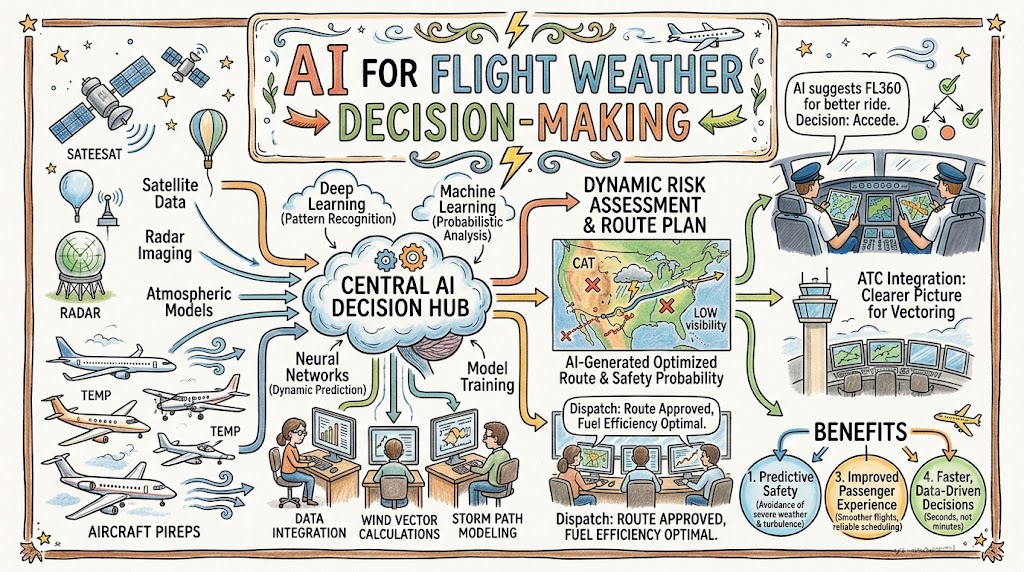
AI systems use machine learning, data analytics, computer vision, and predictive modelling to study weather conditions.
They can collect and compare information from:
- Weather radar
- Satellites
- Airport weather stations
- Aircraft sensors
- Lightning detection networks
- Pilot reports
- Wind profilers
- Numerical weather models
- Air traffic systems
- Historical flight records
AI can then identify patterns, calculate probabilities, and generate operational alerts.
For example, an AI system may warn that a thunderstorm is likely to affect an arrival route within 30 minutes. It may also suggest that a different route, altitude, or departure time could reduce the risk.
AI in Pre-Flight Weather Assessment
Before departure, pilots and dispatchers review weather information for the entire journey.
This normally includes:
- Departure airport conditions
- Weather along the route
- Destination weather
- Alternate airport conditions
- Winds at cruising altitude
- Thunderstorm activity
- Turbulence forecasts
- Icing risk
- Visibility and cloud levels
- Airport warnings
AI can organize this information into a single risk-based overview.
Instead of requiring users to examine several independent weather products, an AI system can highlight the conditions most likely to affect the planned flight.
Departure Decisions
AI can help determine whether conditions at the departure airport may affect takeoff.
It can assess:
- Crosswind strength
- Runway visibility
- Thunderstorm proximity
- Lightning activity
- Wind shear risk
- Runway surface conditions
- Expected weather changes
The final departure decision remains with authorized aviation professionals.
Route Selection
AI can compare multiple flight routes and evaluate the weather risk associated with each one.
A shorter route may pass near thunderstorms, while a slightly longer route may provide smoother and safer conditions.
The system can compare:
- Flight time
- Fuel consumption
- Storm exposure
- Turbulence probability
- Airspace restrictions
- Headwinds and tailwinds
This allows dispatchers and flight crews to balance safety, efficiency, and operational cost.
Alternate Airport Planning
Flights must often identify suitable alternate airports before departure.
AI can compare alternate airports based on:
- Forecast visibility
- Runway availability
- Wind conditions
- Thunderstorm probability
- Airport operating hours
- Fuel requirements
- Traffic congestion
This may help flight planners select an alternate that is both safe and operationally practical.
AI in Real-Time In-Flight Weather Decisions
Weather may change after an aircraft departs. Flight crews must continue monitoring updated forecasts and reports.
AI systems can process real-time information and alert the crew when conditions change.
They may support decisions such as:
- Changing altitude
- Altering the route
- Avoiding storm cells
- Preparing for turbulence
- Selecting a different approach
- Holding or diverting
- Returning to the departure airport
- Choosing a safer destination
Real-time AI tools can update recommendations as new radar, aircraft, and air traffic data become available.
Thunderstorm Avoidance Using AI
Thunderstorms are among the most dangerous weather hazards in aviation. They may contain severe turbulence, hail, lightning, heavy rain, icing, and strong vertical air currents.
AI can analyze radar and satellite images to:
- Detect developing storm cells
- Track storm direction
- Estimate storm speed
- Measure storm intensity
- Predict cell growth
- Identify possible route conflicts
- Estimate airport impact
Computer vision models can study how storms change from one radar image to the next. This can provide more detailed short-term forecasts.
However, AI route suggestions must never encourage aircraft to enter dangerous storm areas. Standard operating procedures and safe separation requirements remain essential.
Wind Assessment and Runway Decisions
Wind affects takeoff, landing, aircraft control, fuel use, and runway selection.
AI can provide short-term predictions for:
- Surface wind
- Crosswinds
- Tailwinds
- Wind gusts
- Wind direction changes
- Upper-level winds
- Wind shear
At airports with multiple runways, AI may help operators estimate which runway configuration will be most suitable.
For pilots, AI-generated wind information can support calculations and operational planning. Aircraft limitations, company procedures, and pilot judgment must still guide the final decision.
AI for Turbulence Decision-Making
Turbulence can occur inside clouds, near storms, over mountains, or in clear air.
AI models can analyze:
- Wind speed changes
- Jet stream location
- Atmospheric instability
- Temperature differences
- Aircraft movement data
- Pilot turbulence reports
- Satellite observations
- Mountain wave activity
The system can create a turbulence risk map for a specific flight.
Pilots and dispatchers may use this information to choose a different altitude or route. Cabin crews can also receive earlier warnings, giving them time to secure equipment and prepare passengers.
AI in Icing Risk Assessment
Aircraft icing occurs when supercooled water droplets freeze on aircraft surfaces. Ice accumulation can affect lift, drag, engine performance, sensors, and aircraft control.
AI can evaluate icing risk using:
- Air temperature
- Moisture levels
- Cloud type
- Precipitation
- Altitude
- Previous icing reports
- Satellite data
- Aircraft sensor information
An AI system can identify areas where icing may be more likely and recommend safer altitudes or routes.
It can also support airport decisions about ground de-icing before departure.
AI for Visibility and Low-Cloud Prediction
Low visibility and low cloud ceilings can affect airport operations, approaches, landings, and departures.
AI can improve short-term forecasting of:
- Fog formation
- Fog dissipation
- Low clouds
- Heavy rain
- Dust
- Smoke
- Snow
- Runway visual range
Hyperlocal AI models can be especially useful at airports where nearby water, hills, buildings, or terrain influence weather conditions.
Better visibility forecasting helps airlines decide whether to delay, divert, or continue a flight.
AI Weather Risk Scoring
One useful application of AI is weather risk scoring.
The system may combine several hazards into a single operational risk level.
| Risk Level | Possible Conditions | Typical Operational Response |
|---|---|---|
| Low | Light winds and good visibility | Normal monitoring |
| Moderate | Gusty winds or possible turbulence | Additional review and preparation |
| High | Strong crosswinds, icing, or nearby storms | Route, altitude, or timing changes |
| Severe | Dangerous thunderstorms or wind shear | Delay, diversion, cancellation, or avoidance |
Risk scores can make complex weather information easier to understand. However, they must include explanations so users know why a particular risk level was assigned.
Benefits of AI in Flight Weather Decision-Making
Faster Data Analysis
AI can review large amounts of weather data more quickly than manual analysis alone.
Earlier Hazard Detection
Machine learning can identify developing weather patterns and provide earlier warnings.
Better Route Planning
AI can compare routes based on wind, storms, turbulence, fuel use, and flight time.
Improved Fuel Efficiency
Accurate wind forecasts and route recommendations may reduce unnecessary fuel consumption.
Safer Airport Operations
Airports can prepare for runway changes, delays, lightning, low visibility, and ground handling restrictions.
Better Passenger Comfort
Early turbulence warnings help crews prepare the cabin and protect passengers.
Consistent Risk Assessment
AI can apply the same analytical standards across many flights and airports.
Improved Operational Coordination
Airlines, airports, and controllers can use shared weather intelligence to make coordinated decisions.
Limitations of AI Weather Decision Systems
AI tools have important limitations.
Dependence on Data Quality
Poor, incomplete, or delayed data can produce unreliable predictions.
Forecast Uncertainty
Weather is complex, and no model can predict every event with complete accuracy.
Limited Experience with Rare Events
AI systems may perform poorly when they encounter conditions that were uncommon in their training data.
Local Weather Complexity
Mountains, coastlines, cities, and valleys can create weather patterns that are difficult to predict.
Lack of Explainability
A recommendation is less useful when users cannot understand why the system produced it.
Cybersecurity Concerns
Connected aviation weather systems must be protected against data manipulation and unauthorized access.
Automation Bias
People may trust an automated recommendation too quickly, even when other evidence suggests that it may be wrong.
Human Judgment and AI Recommendations
AI should strengthen human decision-making, not replace it.
Pilots, dispatchers, meteorologists, and controllers bring experience, operational understanding, and professional judgment that AI systems do not possess.
A safe decision-making process should include:
- Reviewing official weather information
- Comparing multiple data sources
- Understanding model confidence
- Considering aircraft limitations
- Following standard operating procedures
- Checking airport and airspace conditions
- Preparing alternative plans
- Challenging unexpected AI recommendations
Professionals should be ready to reject an AI suggestion when it conflicts with safety requirements or reliable evidence.
AI Weather Tools and Pilot Training
Student pilots and professional crews need training on how to use AI-supported weather systems correctly.
Training should cover:
- Aviation weather fundamentals
- Weather report interpretation
- Radar and satellite imagery
- Thunderstorm avoidance
- Wind and crosswind assessment
- Turbulence and icing hazards
- AI forecast probabilities
- Model confidence levels
- Automation bias
- Human–machine decision-making
- Threat and error management
Pilots should first understand the weather itself. They should not depend on AI without knowing how to evaluate its output.
A Practical AI-Supported Decision Process
A responsible weather decision process may follow these steps:
Identify the Mission
Review the aircraft type, route, schedule, passengers, fuel requirements, and operational limitations.
Collect Weather Information
Gather current observations, forecasts, radar data, warnings, pilot reports, and airport information.
Review AI Risk Analysis
Check the hazards, probabilities, confidence levels, and recommendations highlighted by the AI system.
Compare Alternative Plans
Consider different departure times, routes, altitudes, destinations, and alternate airports.
Apply Operational Limits
Check aircraft, airport, company, regulatory, and crew limitations.
Make the Human Decision
The authorized pilot, dispatcher, controller, or operator makes the final decision.
Monitor Conditions
Continue checking weather throughout the flight and update the plan when necessary.
AI for General Aviation Weather Decisions
General aviation pilots may operate smaller aircraft with lower weather tolerance than commercial airliners.
AI tools can help general aviation pilots evaluate:
- Visual flight conditions
- Cloud ceilings
- Visibility
- Crosswinds
- Mountain weather
- Thunderstorm development
- Icing probability
- Suitable diversion airports
However, simplified weather apps should not replace official briefings, pilot training, or conservative decision-making.
A pilot should never allow technology to create pressure to continue a flight in unsafe conditions.
AI for Drone and Urban Air Mobility Operations
Drones and electric vertical takeoff and landing aircraft may be highly sensitive to local weather.
AI can support decisions involving:
- Low-level winds
- Building-related turbulence
- Rain intensity
- Battery performance
- Visibility
- Lightning
- Route obstacles
- Emergency landing areas
Highly localized weather forecasting will be important for future urban air mobility networks.
Automated aircraft will also require clear weather limits and reliable procedures for transferring control to human operators.
Future of AI-Based Flight Weather Decisions
Future aviation weather systems may become more predictive, personalized, and connected.
Possible developments include:
- Flight-specific turbulence forecasts
- Minute-by-minute airport weather predictions
- Automated weather-based route updates
- Digital twins of airport environments
- AI-powered cockpit weather assistants
- Real-time data sharing between aircraft
- Improved drone weather management
- Predictive runway condition analysis
- Climate-risk planning for airlines
- Explainable AI recommendations
These systems may help aviation organizations respond to weather earlier and more efficiently.
Their development must remain focused on validation, transparency, reliability, and safety.
Best Practices for Aviation Organizations
Organizations introducing AI weather decision tools should:
- Use accurate and verified data.
- Test systems under different weather conditions.
- Keep qualified professionals involved.
- Clearly display forecast uncertainty.
- Provide explanations with recommendations.
- Maintain independent backup systems.
- Monitor model performance.
- Train employees before operational use.
- Protect systems from cyber threats.
- Report and investigate incorrect predictions.
- Update models as new data becomes available.
- Introduce automation gradually.
Frequently Asked Questions
What is AI for flight weather decision-making?
It is the use of artificial intelligence to analyze weather information and support decisions involving departure, routing, altitude, landing, diversion, and airport operations.
Can AI make weather decisions for pilots?
AI can provide forecasts, warnings, and recommendations, but qualified pilots and aviation professionals remain responsible for operational decisions.
How does AI improve flight planning?
AI compares weather, routes, winds, fuel requirements, turbulence, airports, and airspace conditions to help identify suitable flight options.
Can AI predict thunderstorms?
AI can improve storm detection and short-term movement forecasts by analyzing radar, satellite, lightning, and atmospheric data. Predictions still contain uncertainty.
How does AI help with turbulence?
AI identifies atmospheric patterns associated with turbulence and can recommend alternative routes or altitudes.
Can AI predict airport visibility?
AI can support short-term forecasting of fog, low clouds, heavy rain, dust, smoke, and runway visibility.
Is AI useful for small-aircraft pilots?
Yes. It can help general aviation pilots understand weather risks, but it should not replace official forecasts, training, or conservative judgment.
What happens when AI and a weather forecast disagree?
Aviation professionals should review all available information, check data quality and forecast confidence, and follow the safest operational option.
Can AI reduce weather-related delays?
It may reduce avoidable delays through earlier warnings and better planning. Dangerous weather will still require delays or cancellations.
Is AI weather decision-making completely reliable?
No. AI depends on data, model quality, atmospheric complexity, and system validation. Human oversight and backup procedures remain necessary.
Conclusion
AI can improve flight weather decision-making by processing complex data, detecting hazards, predicting operational risks, and presenting useful recommendations. It supports safer routing, better fuel planning, improved turbulence avoidance, and more efficient airport operations. However, AI must remain a transparent and carefully validated support tool. The best decisions combine advanced technology with accurate weather information, strong procedures, and experienced human judgment.