Introduction
Weather is one of the most common causes of disruption in aviation. Thunderstorms, fog, strong winds, heavy rain, snow, icing, and poor visibility can slow airport operations, close runways, change flight routes, and create long passenger delays.
Airlines and airports cannot control the weather, but they can improve how they prepare for it.
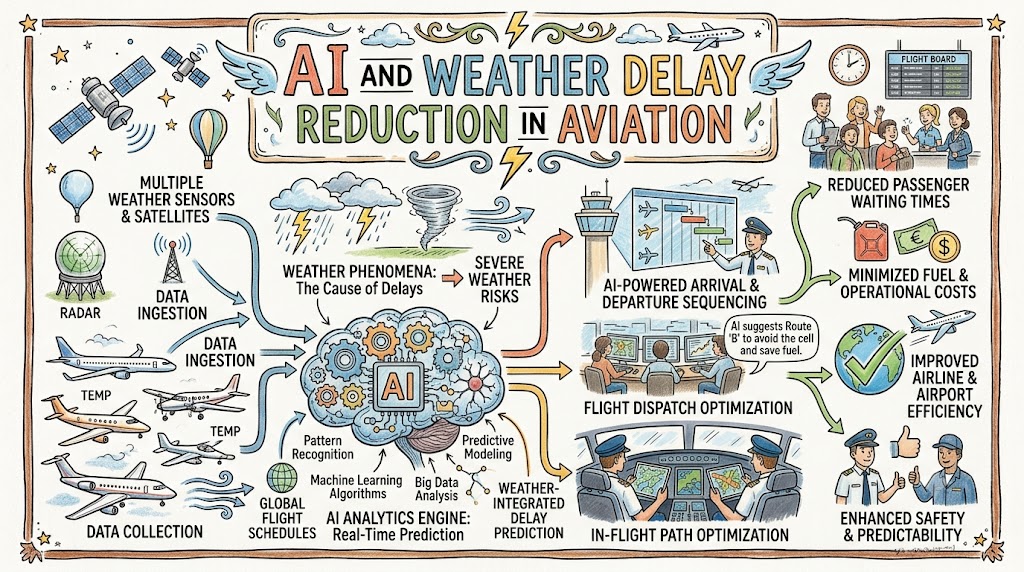
Artificial intelligence helps aviation organizations analyse weather information, predict operational problems, and make decisions before delays become severe. AI can compare weather forecasts with aircraft schedules, airport capacity, crew availability, passenger connections, and air traffic restrictions.
This allows airlines and airports to plan earlier, communicate more clearly, and recover more efficiently.
AI cannot remove every weather-related delay. Flights must still be delayed or cancelled whenever conditions are unsafe. However, intelligent planning can reduce avoidable disruption while keeping safety as the highest priority.
Why Weather Creates Aviation Delays
Aviation depends on carefully coordinated operations. Aircraft, pilots, cabin crew, airport workers, gates, runways, fuel services, baggage teams, and air traffic controllers must all be available at the correct time.
Bad weather can interrupt this coordination.
Common weather conditions causing delays include:
- Thunderstorms near airports
- Strong crosswinds
- Heavy rain
- Low visibility
- Fog
- Snow and ice
- Wind shear
- Lightning
- Extreme heat
- Dust storms
- Tropical storms
- Turbulence along flight routes
A weather event at one major airport can affect flights across an entire airline network. An aircraft delayed in one city may arrive late for its next flight, causing further delays throughout the day.
This effect is often called a delay cascade.
What Is AI-Based Weather Delay Reduction?
AI-based weather delay reduction is the use of artificial intelligence to predict weather disruption and improve operational responses.
AI systems can analyse:
- Current weather observations
- Short-term and long-term forecasts
- Weather radar images
- Satellite information
- Historical delay records
- Flight schedules
- Airport capacity
- Aircraft locations
- Crew availability
- Passenger connections
- Air traffic restrictions
- Ground handling resources
The system identifies situations where weather is likely to cause disruption. It can then recommend actions that may reduce the impact.
These actions may include:
- Changing departure times
- Adjusting flight routes
- Reassigning aircraft
- Selecting different gates
- Preparing de-icing teams
- Increasing ground staff
- Changing arrival sequences
- Protecting passenger connections
- Rebooking affected travellers
- Cancelling selected flights earlier
The final operational decisions remain with qualified airline, airport, and air traffic professionals.
How AI Predicts Weather-Related Flight Delays
Traditional forecasts explain what weather may occur. AI can go further by estimating how that weather may affect specific aviation operations.
For example, a forecast may predict thunderstorms near an airport. An AI system can compare this forecast with airport traffic and estimate:
- How many flights may be affected
- When runway capacity may decrease
- Whether arrival holding is likely
- How long delays may continue
- Which flights face the greatest risk
- Whether connecting passengers may miss flights
- When airport operations may return to normal
Machine learning models learn from previous weather events and operational records. They identify patterns connecting certain weather conditions with delays.
A model may discover that a particular combination of wind direction, visibility, runway configuration, and traffic volume usually causes significant congestion at a specific airport.
This allows the system to provide airport-specific delay predictions.
AI in Short-Term Weather Forecasting
Short-term forecasting is especially important for airport operations.
Weather conditions may change within minutes. A thunderstorm may develop near an arrival path, fog may reduce visibility, or strong winds may force an airport to change its active runway.
AI can analyse rapidly updated information from:
- Doppler weather radar
- Airport weather sensors
- Lightning detection systems
- Aircraft observations
- Satellite images
- Wind profilers
- Surface weather stations
The system can produce highly local forecasts for the next few minutes or hours.
This type of forecasting is sometimes called nowcasting. It helps airport and airline teams understand what may happen during the immediate operational period.
AI for Thunderstorm Delay Management
Thunderstorms are a major challenge for aviation because aircraft must maintain safe separation from dangerous storm cells.
Storms near busy airports may block departure and arrival routes. They can also reduce runway capacity and create long air traffic queues.
AI can support thunderstorm management by:
- Detecting developing storm cells
- Tracking storm movement
- Estimating storm intensity
- Predicting airport impact
- Identifying blocked flight routes
- Estimating when routes may reopen
- Suggesting alternative arrival paths
- Warning airlines before disruption becomes severe
Earlier predictions allow airlines to hold aircraft at departure airports rather than sending them into congested airspace.
A controlled delay on the ground is often safer and more efficient than extended airborne holding.
AI for Fog and Low-Visibility Delays
Fog can reduce runway visibility and limit the number of aircraft that can safely take off or land.
Low-visibility procedures may require greater spacing between aircraft. This reduces airport capacity and increases delays.
AI can improve fog prediction by analysing:
- Humidity
- Temperature
- Wind speed
- Surface pressure
- Cloud cover
- Soil moisture
- Nearby water conditions
- Historical fog patterns
The system may estimate when fog is likely to form, how thick it may become, and when it may clear.
This helps airports prepare lighting systems, runway procedures, staffing, and traffic flow plans.
Airlines can also adjust schedules before passengers arrive at the airport.
AI for Wind-Related Delay Reduction
Strong or changing winds can affect runway selection, aircraft performance, and airport capacity.
Crosswinds and tailwinds may make certain runways unsuitable. A sudden runway change can disrupt arrival and departure sequences.
AI systems can predict:
- Surface wind speed
- Wind direction
- Crosswind components
- Wind gusts
- Wind shear
- Upper-level winds
- Runway configuration changes
Airport operators can use these predictions to prepare for runway changes before the wind reaches operational limits.
Airlines can also adjust fuel plans, flight routes, and departure timing.
AI in Snow and Ice Operations
Winter weather creates several operational challenges.
Aircraft may require de-icing before departure. Runways and taxiways must be cleared. Ground operations may slow because of snow, freezing rain, or poor visibility.
AI can help airports and airlines predict:
- Snowfall timing
- Snow accumulation
- Freezing rain
- Runway contamination
- De-icing demand
- Equipment requirements
- Ground handling delays
- Recovery time
Airport managers can position snow-clearing equipment and staff before conditions worsen.
Airlines can estimate de-icing time more accurately and include it in departure planning.
This reduces unnecessary waiting and helps prevent aircraft from missing departure slots.
AI and Airport Capacity Prediction
Airport capacity is the number of aircraft that can safely arrive or depart during a given period.
Weather can reduce this capacity.
For example:
- Fog may increase aircraft spacing.
- Strong winds may close a runway.
- Thunderstorms may block arrival routes.
- Snow may slow taxiing and ground handling.
- Lightning may stop ramp operations.
AI can combine weather forecasts with airport traffic data to estimate future capacity.
| Weather Condition | Possible Operational Effect | AI-Supported Response |
|---|---|---|
| Thunderstorms | Arrival and departure routes blocked | Adjust traffic flow and reroute flights |
| Fog | Reduced runway visibility | Activate low-visibility planning early |
| Strong crosswinds | Limited runway availability | Prepare alternative runway configuration |
| Snow and ice | Slower ground operations | Position equipment and de-icing teams |
| Lightning | Ramp operations temporarily stopped | Reschedule baggage and ground services |
| Heavy rain | Reduced visibility and taxi speed | Increase spacing and revise turnaround times |
Accurate capacity predictions help airlines avoid scheduling more flights than an airport can handle safely.
AI in Airline Network Planning
Airline networks are highly connected. One delayed aircraft may affect several later flights.
AI can track aircraft, crews, passengers, gates, and schedules across the entire network.
When weather disruption is expected, the system can identify which flights are most important to protect.
It may recommend:
- Swapping aircraft
- Reassigning crews
- Delaying one flight to protect several connections
- Cancelling a flight with lower network impact
- Moving passengers to alternative routes
- Sending an aircraft to another airport
- Adjusting maintenance schedules
The objective is not only to reduce one delay. It is to prevent the disruption from spreading across the network.
Predictive Flight Delay Models
Predictive models estimate the probability and expected length of a delay.
They may consider:
- Departure and arrival weather
- Airport congestion
- Aircraft turnaround time
- Previous flight delays
- Air traffic restrictions
- Crew duty limits
- Runway availability
- Gate availability
- Seasonal weather patterns
The prediction may be presented as:
- Low, medium, or high delay risk
- Probability of departure delay
- Estimated delay duration
- Likelihood of cancellation
- Recommended operational action
These forecasts allow airlines to take action before the scheduled departure time.
AI for Better Flight Route Planning
Weather often forces aircraft to fly around storms, turbulence, or restricted airspace.
A longer route can increase flight time, fuel consumption, and delay risk.
AI can compare different routes based on:
- Thunderstorm location
- Wind direction
- Turbulence
- Fuel requirements
- Air traffic congestion
- Aircraft performance
- Available airspace
- Destination weather
The system may identify a route that is slightly longer in distance but faster in actual operation because it avoids congestion or strong headwinds.
Dynamic route planning can continue after departure as weather conditions change.
AI in Air Traffic Flow Management
Air traffic flow management coordinates large numbers of aircraft moving through shared airspace.
When weather reduces available routes or airport capacity, controllers may need to delay departures or limit arrivals.
AI can support traffic flow management by:
- Predicting congestion
- Estimating weather impact
- Comparing alternative routes
- Optimising departure sequences
- Identifying overloaded airspace
- Recommending ground delay programmes
- Estimating recovery times
These tools help decision-makers distribute delays more effectively instead of allowing congestion to build unexpectedly.
AI for Aircraft Turnaround Management
Aircraft turnaround includes all activities performed between arrival and the next departure.
These activities include:
- Passenger disembarkation
- Baggage unloading
- Refuelling
- Cleaning
- Catering
- Maintenance checks
- Passenger boarding
- Baggage loading
Weather can slow these processes.
Lightning may stop ramp activities. Heavy rain can delay baggage handling. Snow may require de-icing. Extreme heat may affect workers and equipment.
AI can adjust turnaround plans based on expected conditions.
For example, it may recommend completing certain outdoor tasks before a storm reaches the airport.
AI and Passenger Rebooking
Weather disruption affects passengers as well as aircraft.
When flights are delayed or cancelled, airlines must rebook passengers, protect connections, and provide updated information.
AI can help by:
- Identifying passengers likely to miss connections
- Finding available alternative flights
- Prioritising vulnerable travellers
- Rebooking passengers automatically
- Updating baggage routing
- Sending personalised notifications
- Estimating new arrival times
- Coordinating hotel or ground transport support
Early rebooking can reduce airport queues and passenger frustration.
Passengers receive better options when the airline acts before all alternative flights become full.
Benefits of AI for Weather Delay Reduction
Earlier Operational Decisions
AI can identify likely disruption before it becomes visible in normal operations.
More Accurate Delay Predictions
Machine learning can compare current conditions with thousands of historical events.
Better Use of Airport Resources
Airports can prepare staff, gates, equipment, and runways based on expected demand.
Reduced Delay Cascades
Airlines can prevent one weather delay from affecting many later flights.
Improved Passenger Communication
More accurate predictions allow airlines to provide timely and realistic updates.
Lower Fuel Consumption
Better routing and reduced airborne holding can save fuel.
Faster Recovery
AI can help airlines return to normal operations after the weather improves.
Improved Coordination
Airlines, airports, ground handlers, and air traffic teams can work from a shared operational picture.
Limits of AI in Delay Reduction
AI cannot remove all weather delays.
Some delays are necessary to protect passengers, crew, aircraft, and airport workers.
AI systems also have limitations.
Forecast Uncertainty
Weather predictions are never completely certain.
Poor Data Quality
Missing or delayed data can reduce the accuracy of AI recommendations.
Rare Weather Events
Models may have limited experience with unusual or extreme conditions.
Complex Airport Environments
Each airport has different runways, terrain, traffic patterns, and operating procedures.
Lack of Transparency
Users must understand why the system predicts a delay or recommends a particular action.
Cybersecurity Risks
Connected systems must be protected against interference and false data.
Automation Bias
Employees may accept an automated recommendation without applying independent judgment.
Human Oversight Remains Essential
AI should support operational teams rather than replace them.
Meteorologists interpret complex weather systems. Pilots understand aircraft limitations. Dispatchers manage routes and fuel. Controllers maintain safe traffic separation. Airport managers coordinate local resources.
A safe AI-supported process includes:
- Verified weather data
- Clear model confidence levels
- Human review
- Operational procedures
- Alternative plans
- Backup systems
- Continuous monitoring
- Regular model testing
Human professionals must remain responsible for safety-critical decisions.
A Practical AI-Supported Delay Reduction Process
Monitor Weather Continuously
Collect radar, satellite, airport, aircraft, and forecast information.
Predict Operational Impact
Estimate how the weather may affect runways, routes, gates, aircraft, crews, and passengers.
Identify High-Risk Flights
Find flights likely to experience long delays, missed connections, or cancellations.
Compare Response Options
Evaluate schedule changes, route adjustments, aircraft swaps, and early cancellations.
Coordinate Stakeholders
Share updated information with airlines, airports, air traffic teams, and ground handlers.
Communicate with Passengers
Provide realistic updates, connection information, and rebooking options.
Review Recovery Progress
Continue updating plans until normal operations return.
AI Training for Aviation Professionals
Aviation professionals using AI delay-management systems should understand:
- Aviation weather basics
- Forecast uncertainty
- Delay prediction models
- AI confidence scores
- Operational risk assessment
- Data quality issues
- Automation bias
- Human–machine coordination
- Cybersecurity awareness
- Emergency procedures
Employees should be trained to question recommendations that appear unsafe, unrealistic, or inconsistent with official information.
Future of AI in Weather Delay Management
Future AI systems may provide more detailed, real-time operational guidance.
Possible developments include:
- Airport digital twins
- Minute-by-minute capacity predictions
- Automatic passenger recovery plans
- More accurate storm movement forecasts
- Flight-specific delay risk scores
- Connected aircraft weather reporting
- Intelligent gate and runway planning
- Predictive de-icing management
- Automated network recovery options
- Personalised passenger notifications
Digital twins may allow airports and airlines to test different operational responses before applying them in the real world.
For example, an airport could simulate how a runway closure may affect traffic and compare several recovery plans.
Best Practices for Aviation Organisations
Airlines and airports adopting AI should:
- Use high-quality operational and weather data.
- Validate predictions under different conditions.
- Include pilots, meteorologists, and controllers in system design.
- Explain why recommendations are generated.
- Show uncertainty clearly.
- Maintain manual and backup procedures.
- Protect connected systems against cyber threats.
- Train employees before operational use.
- Monitor incorrect predictions.
- Update models regularly.
- Keep safety above punctuality and cost.
- Introduce AI gradually through controlled testing.
Frequently Asked Questions
How does AI reduce aviation weather delays?
AI predicts weather impact, airport congestion, flight delays, and network disruption. This allows airlines and airports to prepare earlier and choose better operational responses.
Can AI prevent all weather delays?
No. Dangerous weather will still require delays, diversions, or cancellations. AI mainly reduces delays caused by late planning and poor coordination.
How does AI predict flight delays?
AI compares weather forecasts, airport traffic, aircraft schedules, historical delays, and operational conditions to estimate delay probability and duration.
Can AI help during thunderstorms?
Yes. It can track storm cells, predict their movement, identify affected routes, and estimate when airport operations may improve.
How does AI support airports during fog?
AI can predict fog formation and clearance, helping airports prepare low-visibility procedures and adjust traffic capacity.
Can AI improve winter flight operations?
AI can estimate snow, ice, de-icing demand, runway conditions, and equipment requirements, allowing airports to prepare resources earlier.
Does AI decide which flights should be cancelled?
AI may recommend options, but authorised airline professionals make cancellation decisions after considering safety and operational factors.
How does AI help passengers during weather disruption?
AI can identify missed connections, locate alternative flights, support rebooking, and provide personalised travel updates.
Can AI reduce fuel consumption during weather delays?
Yes. Better route planning and reduced airborne holding can lower unnecessary fuel use.
Is human decision-making still required?
Yes. AI supports aviation professionals, but pilots, dispatchers, meteorologists, controllers, and airport managers remain responsible for final decisions.
Conclusion
AI can reduce the operational impact of aviation weather by improving forecasting, delay prediction, airport capacity planning, flight routing, passenger recovery, and network coordination. It cannot eliminate safety-related delays, but it can help airlines and airports act earlier and recover faster. The most effective approach combines intelligent technology, reliable weather information, strong procedures, and experienced human judgment.