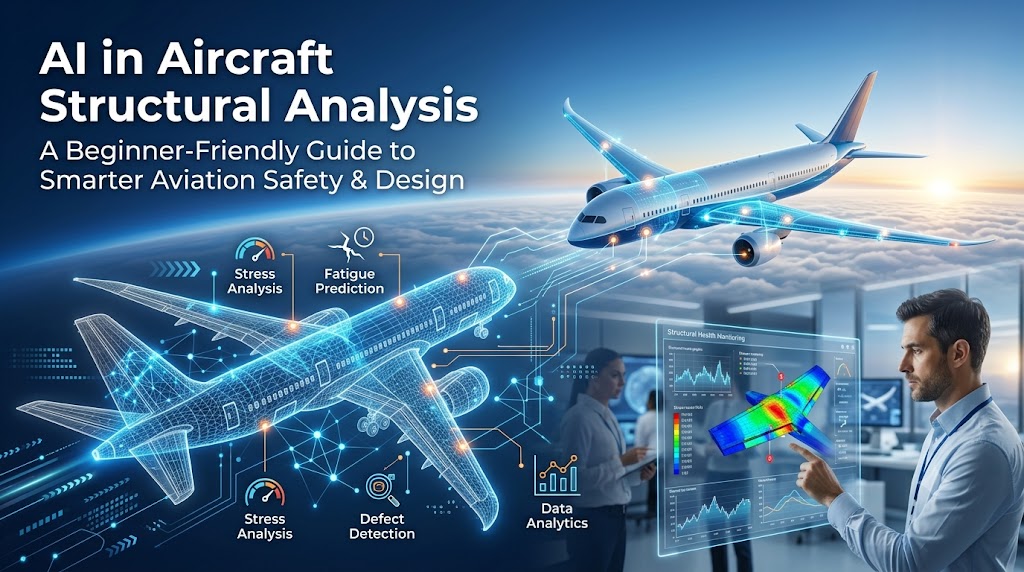
Introduction
Aircraft are designed to fly safely in many different conditions. During takeoff, cruising, turbulence, turning, landing, and emergency situations, every aircraft structure must handle strong forces. The wings, fuselage, tail, landing gear, engine mounts, and internal frames must all remain strong, stable, and reliable.
This is why aircraft structural analysis is so important. Engineers must check whether aircraft parts can carry loads, resist stress, avoid cracks, and perform safely for many years.
Today, Artificial Intelligence is becoming a powerful support tool in aircraft structural analysis. AI helps engineers study large amounts of data, predict weak points, detect early damage, analyze material behavior, and improve aircraft structure design.
In simple words, AI helps aircraft engineers understand how aircraft structures behave and how they can be made safer, lighter, and more reliable.
AI does not replace aircraft structural engineers. Instead, it works like a smart assistant that helps them make faster and better engineering decisions.
What Is Aircraft Structural Analysis?
Aircraft structural analysis is the process of studying aircraft parts to check whether they are strong and safe enough for flight.
Aircraft structures face many types of forces. These forces may come from air pressure, aircraft weight, engine vibration, landing impact, turbulence, fuel load, passengers, cargo, and flight maneuvers.
Structural analysis helps engineers understand:
- How much load a part can carry
- Where stress may build up
- How materials behave under pressure
- Whether cracks may appear over time
- How vibration affects aircraft parts
- Whether a structure can remain safe during flight
- How long a part may last before repair or replacement
For example, an aircraft wing must bend slightly during flight but should not fail. Landing gear must absorb strong landing forces. The fuselage must handle pressure changes at altitude.
Structural analysis helps engineers test these conditions before an aircraft is approved for use.
What Is AI in Aircraft Structural Analysis?
AI in aircraft structural analysis means using artificial intelligence, machine learning, data analysis, sensors, simulations, and predictive models to study aircraft structures more intelligently.
AI can study information from:
- Flight data
- Maintenance records
- Structural sensors
- Simulation results
- Material testing
- Previous aircraft designs
- Past damage reports
- Fatigue test data
By analyzing this data, AI can help engineers predict where damage may occur, how a structure may behave, and when maintenance may be needed.
For example, AI can help predict whether a small crack in an aircraft wing area may grow over time. It can also help identify stress zones in a fuselage or detect unusual vibration in landing gear.
AI supports better safety decisions by helping engineers find problems earlier.
Why Structural Analysis Is Important in Aviation
Structural analysis is one of the most important parts of aviation safety. An aircraft may look simple from outside, but inside it has thousands of structural parts that must work together.
If any important structure becomes weak, it can affect aircraft safety. That is why engineers carefully analyze every major aircraft component.
Structural analysis is important because it supports:
- Flight safety: It helps ensure aircraft parts can handle real flight conditions.
- Passenger protection: Strong structures protect passengers and crew.
- Aircraft lifespan: It helps estimate how long parts can safely be used.
- Maintenance planning: It helps decide when inspection or repair is needed.
- Fuel efficiency: Lighter but safe structures can reduce aircraft weight.
- Regulatory approval: Aircraft must meet strict safety standards before operation.
- Design confidence: Engineers can trust the aircraft design after proper analysis.
Without structural analysis, aircraft design would be unsafe and unreliable.
Traditional Structural Analysis vs AI-Powered Structural Analysis
| Area | Traditional Structural Analysis | AI-Powered Structural Analysis |
|---|---|---|
| Analysis Method | Uses engineering calculations, testing, and simulations | Uses simulations, data models, machine learning, and predictive analysis |
| Time Required | Can take longer for complex structures | Can support faster early-stage analysis |
| Data Handling | Engineers manually review limited data | AI can analyze large datasets quickly |
| Damage Prediction | Depends on inspections and test results | AI can predict possible damage patterns earlier |
| Fatigue Analysis | Uses test data and engineering models | AI can learn from repeated load and fatigue data |
| Stress Detection | Identified through analysis and simulation | AI can help locate stress zones faster |
| Maintenance Planning | Based on schedules and inspections | AI supports predictive maintenance decisions |
| Human Engineer Role | Performs and validates analysis | Guides AI, reviews results, and approves decisions |
| Cost Efficiency | Repeated testing may increase cost | Early prediction can reduce unnecessary testing |
| Safety Support | Strong safety process through engineering methods | Adds extra support through data-driven prediction |
Traditional methods remain essential. AI improves the process but does not remove the need for expert engineering judgment.
How AI Helps in Aircraft Structural Analysis
AI supports aircraft structural analysis in many useful ways. It helps engineers understand how aircraft parts behave under different conditions.
Stress and Strain Analysis
Stress is the internal force experienced by a material when a load is applied. Strain is the change in shape caused by that force.
In aircraft structures, stress and strain must be carefully controlled. If stress becomes too high, the part may bend, crack, or fail.
AI can help analyze stress and strain data from simulations and sensors. It can identify areas where stress is higher than expected and help engineers improve the design.
Load Prediction
Aircraft parts face different loads during different flight stages. Takeoff, landing, turbulence, climbing, turning, and cruising all create different forces.
AI can help predict how loads affect aircraft structures. This helps engineers design parts that can handle real operating conditions.
Fatigue Life Prediction
Fatigue happens when a material becomes weak because of repeated loading over time. Even if the load is not very high, repeated stress can slowly create cracks.
AI can study fatigue data and help predict how long a part may remain safe. This supports better inspection and maintenance planning.
Crack Detection
Small cracks can be difficult to detect in early stages. AI can help analyze sensor data, inspection images, and maintenance records to identify possible cracks.
Early crack detection is very important because small damage can become serious if ignored.
Damage Prediction
AI can help predict where damage may happen in the future. It can study patterns from previous damage cases and compare them with current aircraft data.
This helps maintenance teams act before a problem becomes bigger.
Vibration Analysis
Aircraft structures face vibration from engines, airflow, landing gear, and flight movement. Too much vibration can affect structural life and passenger comfort.
AI can analyze vibration data and detect unusual patterns. This can help identify loose parts, structural weakness, or possible fatigue problems.
Material Behavior Analysis
Aircraft use different materials such as aluminum alloys, titanium, carbon fiber, composites, and advanced lightweight materials.
AI can help study how these materials behave under stress, temperature changes, vibration, and fatigue.
Structural Health Monitoring
Structural health monitoring means continuously checking the condition of aircraft structures.
AI can analyze data from sensors placed on aircraft parts. These sensors may measure vibration, strain, temperature, pressure, or movement.
This helps detect early signs of damage.
Maintenance Decision Support
AI can support maintenance planning by predicting when parts may need inspection, repair, or replacement.
This helps reduce unexpected failures and improves aircraft availability.
Design Optimization
AI can help engineers improve aircraft structure design by finding lighter, stronger, and more efficient shapes.
This supports better performance without reducing safety.
Role of Machine Learning in Aircraft Structural Analysis
Machine learning is a part of AI that allows computers to learn from data and make predictions.
In aircraft structural analysis, machine learning can learn from:
- Sensor readings
- Flight operation data
- Maintenance reports
- Crack growth records
- Fatigue test results
- Simulation data
- Material behavior data
- Previous structural failures
After learning from this data, machine learning models can help predict future structural behavior.
For example, a machine learning model may study past wing fatigue data and then predict when a similar wing structure may need inspection.
Machine learning is useful because aircraft generate a large amount of data. Human engineers can study this data, but AI can process it faster and find hidden patterns.
However, machine learning must be trained carefully. Poor data can lead to wrong predictions. That is why engineers must always validate AI results.
AI and Finite Element Analysis
Finite Element Analysis, commonly called FEA, is a computer-based method used to study how a structure behaves under load.
In simple words, FEA breaks a large aircraft part into many small sections called elements. The software then studies how each small section reacts to stress, pressure, vibration, heat, and load.
FEA is widely used in aircraft structural analysis. It helps engineers test parts virtually before physical testing.
AI can support FEA by:
- Speeding up early analysis
- Identifying high-stress zones
- Helping compare design options
- Reducing unnecessary simulations
- Improving design validation
- Finding patterns in simulation results
For beginners, FEA is like a virtual stress test, and AI is like a smart assistant that helps engineers understand the results faster.
AI does not replace FEA. It makes FEA more useful and efficient.
AI for Stress and Load Analysis
Aircraft structures must handle many different loads. These loads change depending on flight condition.
During takeoff, the wings produce lift and carry heavy loads. During landing, the landing gear absorbs impact. During turbulence, the aircraft structure faces sudden forces. During cruising, the fuselage handles air pressure and aerodynamic loads.
AI can help predict how these loads affect aircraft parts.
It can analyze:
- Wing bending loads
- Landing impact loads
- Cabin pressure loads
- Engine vibration loads
- Tail loads
- Control surface loads
- Turbulence-related loads
By predicting stress and load behavior, AI helps engineers design safer and stronger aircraft parts.
AI for Fatigue and Crack Prediction
Fatigue is a major concern in aircraft structures. Aircraft parts experience repeated loading during every flight. Over time, repeated stress can create small cracks.
These cracks may start very small, but they can grow if not detected early.
AI can help predict fatigue and crack growth by studying:
- Flight cycles
- Load history
- Material behavior
- Previous crack data
- Maintenance inspection records
- Sensor readings
- Stress concentration areas
For example, if a certain area of the fuselage experiences repeated stress, AI can help predict whether that area needs closer inspection.
This supports safer maintenance and reduces the risk of unexpected structural problems.
AI in Structural Health Monitoring
Structural Health Monitoring, or SHM, is the process of checking the condition of aircraft structures during service.
Modern aircraft can use sensors to collect data from important structural areas. These sensors may track strain, vibration, temperature, pressure, and movement.
AI can analyze this sensor data and identify unusual behavior.
For example:
- A vibration pattern may suggest landing gear fatigue.
- A strain reading may show unusual stress on a wing.
- A temperature change may affect material performance.
- A pressure-related pattern may indicate fuselage stress.
AI-powered structural health monitoring helps maintenance teams detect issues earlier and make better decisions.
This is especially useful for modern aircraft, drones, and future electric aircraft.
AI in Material Behavior Analysis
Aircraft materials must be lightweight, strong, durable, and safe. Different materials behave differently under load, heat, vibration, and fatigue.
Common aircraft materials include:
- Aluminum alloys
- Titanium
- Carbon fiber composites
- Advanced polymers
- Lightweight metal alloys
- High-strength composites
AI can help study material behavior by analyzing test data and simulation results.
For example, AI can compare how aluminum and composite materials behave under repeated stress. It can also help predict how a material may respond to vibration, temperature changes, or impact.
This helps engineers choose better materials for wings, fuselage sections, landing gear parts, and internal structures.
Material behavior analysis is important because the wrong material choice can affect safety, weight, cost, and aircraft lifespan.
AI for Lightweight Aircraft Structure Design
Aircraft must be strong, but they should not be unnecessarily heavy. Extra weight increases fuel use and reduces efficiency.
AI can help engineers design lightweight structures by finding where material is needed and where it can be reduced safely.
This can support:
- Lower aircraft weight
- Better fuel efficiency
- Improved payload capacity
- Longer range
- Lower emissions
- Better performance
- More sustainable aviation
For example, AI may help optimize a wing support bracket by reducing unnecessary material while keeping strength in critical areas.
However, lightweight design must never reduce safety. Every AI-supported design must be tested and approved by engineers.
AI and Aircraft Safety
Safety is the main goal of aircraft structural analysis. AI supports aircraft safety by helping engineers and maintenance teams identify risks earlier.
AI can support safety by:
- Detecting early damage signs
- Predicting crack growth
- Improving fatigue analysis
- Supporting better maintenance planning
- Identifying high-stress areas
- Reducing unexpected failures
- Improving design reliability
For example, AI may help detect a structural issue before it becomes serious. This allows maintenance teams to inspect and repair the part at the right time.
AI can make safety processes stronger, but it must always be used with human supervision.
Aircraft safety depends on engineers, inspectors, pilots, regulators, and maintenance teams working together.
Benefits of AI in Aircraft Structural Analysis
AI offers many benefits for aircraft structural analysis.
- Faster structural analysis: AI can process large amounts of data quickly.
- Better damage prediction: AI can help predict where damage may occur.
- Improved safety: Early detection supports safer aircraft operation.
- Early crack detection: AI can help identify small cracks before they grow.
- Better fatigue analysis: AI can study repeated load patterns.
- Smarter maintenance planning: AI supports predictive maintenance.
- Lightweight structure support: AI helps reduce unnecessary material.
- Reduced testing cost: Early prediction can reduce repeated testing.
- Improved aircraft lifespan: Better monitoring supports longer safe use.
- Better design confidence: Engineers can make decisions with more data.
These benefits make AI a valuable tool in modern aerospace structural engineering.
Challenges of Using AI in Aircraft Structural Analysis
AI is useful, but it also has challenges. Aircraft structural analysis is a safety-critical area, so AI must be used carefully.
Need for High-Quality Data
AI depends on accurate and complete data. Poor data can lead to wrong predictions.
Complex Structural Behavior
Aircraft structures behave differently under different flight conditions. Modeling this behavior accurately is difficult.
Safety Certification Requirements
Aircraft structures must meet strict aviation safety standards. AI-supported results must still be verified and certified.
High Computing Power
AI models and structural simulations may need powerful computing systems.
Cost of Advanced AI Tools
Advanced AI, simulation, and monitoring tools can be expensive.
Human Expert Validation
AI results must be checked by experienced engineers. Human validation is essential.
Trust and Explainability
Engineers must understand why AI predicts a problem or recommends a design change.
Integration With Traditional Engineering Tools
AI must work smoothly with existing tools such as FEA software, CAD systems, maintenance platforms, and inspection methods.
These challenges show that AI should be used responsibly and carefully in aviation.
Real-World Examples of AI in Aircraft Structural Analysis
Here are some practical examples of how AI can support aircraft structural analysis.
1. Predicting Cracks in Aircraft Wings
AI can study wing stress data, flight cycles, and inspection records to predict where cracks may appear.
2. Monitoring Fuselage Stress
The fuselage handles pressure changes during flight. AI can help monitor stress and detect unusual patterns.
3. Detecting Landing Gear Fatigue
Landing gear faces strong forces during every landing. AI can help analyze vibration and load data to predict fatigue.
4. Analyzing Composite Material Damage
Composite materials can behave differently from metals. AI can help study hidden damage patterns in composite aircraft parts.
5. Supporting Predictive Aircraft Maintenance
AI can help maintenance teams decide when a part should be inspected, repaired, or replaced based on data.
These examples show how AI can support both aircraft design and maintenance.
Tools and Technologies Used in AI Structural Analysis
AI-powered aircraft structural analysis uses many tools and technologies together.
AI-Based Analysis Software
These tools help analyze structural data, predict risks, and support design decisions.
Machine Learning
Machine learning helps systems learn from structural data and predict future behavior.
Finite Element Analysis Tools
FEA tools help engineers test aircraft structures virtually under load and stress.
Digital Twins
A digital twin is a virtual model of a real aircraft part or system. AI can use digital twins to monitor and predict structural behavior.
Structural Health Monitoring Sensors
Sensors collect data from aircraft structures, such as strain, vibration, temperature, and pressure.
Simulation Platforms
Simulation platforms help test how structures behave in different flight conditions.
Predictive Analytics
Predictive analytics helps forecast damage, fatigue, and maintenance needs.
Data Analytics
Data analytics helps engineers understand patterns in structural and maintenance data.
Cloud Computing
Cloud computing provides computing power for large AI models and simulation tasks.
Together, these tools help make aircraft structural analysis smarter and more efficient.
Future of AI in Aircraft Structural Analysis
The future of AI in aircraft structural analysis is very promising. As aircraft become more advanced, engineers will need smarter ways to analyze structures.
AI may support future aircraft such as:
- Electric aircraft
- Hybrid aircraft
- Autonomous drones
- Air taxis
- Lightweight passenger aircraft
- Advanced cargo aircraft
- Space and aerospace vehicles
Electric aircraft and drones need lightweight structures because battery weight and efficiency are major concerns. AI can help design lighter structures while supporting safety.
AI may also improve digital twin systems. In the future, aircraft may have smarter monitoring systems that continuously analyze structural health and predict maintenance needs.
Smart maintenance will become more important. Instead of only following fixed schedules, maintenance teams may use AI-supported data to decide when inspection is actually needed.
However, human experts will remain essential. Aircraft structural safety will always require experienced engineers, inspectors, and regulatory approval.
Career Opportunities in AI and Aircraft Structural Analysis
AI in aircraft structural analysis creates many career opportunities for students and professionals.
Some possible career paths include:
- Aerospace structural engineer
- Aircraft design engineer
- Structural analysis engineer
- AI engineer for aviation
- FEA analyst
- Simulation engineer
- Aircraft maintenance data analyst
- Aviation safety analyst
- Drone structural design engineer
- Aerospace research engineer
To build a career in this field, students should learn aircraft structures, materials, stress analysis, fatigue analysis, AI, machine learning, simulation tools, and data analysis.
This field is suitable for people who enjoy aviation, engineering, problem-solving, safety, and modern technology.
Beginner Roadmap to Learn AI in Aircraft Structural Analysis
Beginners can follow a step-by-step roadmap to enter this field.
Step 1: Learn Basic Aviation Concepts
Start with aircraft parts, flight principles, wings, fuselage, tail, engines, and landing gear.
Step 2: Understand Aircraft Structures
Learn how aircraft structures are built and how different parts carry loads.
Step 3: Study Stress, Strain, Load, and Fatigue
These are important structural engineering concepts. Understand how forces affect materials.
Step 4: Learn Materials Used in Aircraft
Study aluminum, titanium, composites, carbon fiber, and advanced lightweight materials.
Step 5: Learn Mathematics and Physics Basics
Focus on mechanics, material strength, basic calculus, and statistics.
Step 6: Learn Programming Basics
Python is useful for AI, data analysis, and engineering calculations.
Step 7: Study AI and Machine Learning
Learn basic machine learning, prediction models, data training, and model evaluation.
Step 8: Learn FEA and Simulation Tools
Understand how FEA tools are used to test structural performance virtually.
Step 9: Practice Small Aircraft Structure Projects
Work on projects like bracket stress analysis, wing load prediction, or fatigue data analysis.
Step 10: Build a Project Portfolio
Create a portfolio with design models, simulation reports, AI analysis, and project explanations.
A strong portfolio can help show your practical skills.
Common Mistakes Beginners Should Avoid
Beginners should avoid these mistakes while learning AI in aircraft structural analysis.
Ignoring Structural Engineering Basics
AI tools are useful, but you must first understand structures, loads, stress, and fatigue.
Depending Only on AI Tools
AI gives predictions, but engineers must verify them through analysis and testing.
Not Understanding Stress and Fatigue
Stress and fatigue are core concepts in aircraft structures. Do not skip them.
Using Poor-Quality Data
AI needs accurate data. Bad data can lead to unreliable predictions.
Skipping Simulation Validation
AI results should be checked using simulation and engineering review.
Ignoring Safety and Certification Needs
Aircraft structures must follow strict safety requirements. Never ignore certification needs.
Not Learning Material Behavior
Different materials behave differently. Understanding material behavior is essential.
Expecting AI to Replace Engineers
AI supports engineers, but it cannot replace human responsibility, judgment, and safety approval.
Avoiding these mistakes will make your learning stronger and more practical.
FAQs About AI in Aircraft Structural Analysis
1. What is AI in aircraft structural analysis?
AI in aircraft structural analysis means using artificial intelligence to study aircraft structures, predict damage, detect stress, and support safer design decisions.
2. Why is structural analysis important in aircraft?
Structural analysis ensures aircraft parts are strong enough to handle loads, stress, vibration, fatigue, and real flight conditions safely.
3. Can AI detect cracks in aircraft structures?
AI can help detect and predict cracks by analyzing sensor data, inspection records, images, and maintenance history.
4. Does AI replace structural engineers?
No. AI supports structural engineers, but human experts are still needed for validation, safety approval, and final decisions.
5. What is fatigue in aircraft structures?
Fatigue is damage that happens when aircraft parts face repeated loading over time. It can lead to cracks if not monitored.
6. How does AI help in fatigue analysis?
AI studies repeated load data, flight cycles, material behavior, and past damage patterns to help predict fatigue risk.
7. What is structural health monitoring?
Structural health monitoring means using sensors and analysis tools to check the condition of aircraft structures during operation.
8. What is FEA in aircraft structural analysis?
FEA, or Finite Element Analysis, is a computer method used to test how aircraft structures behave under stress, load, vibration, and heat.
9. Is AI useful for drone structural analysis?
Yes. AI can help analyze drone frames, battery loads, vibration, material strength, and lightweight structural design.
10. What skills are needed to learn AI in aircraft structural analysis?
Important skills include aircraft structures, stress analysis, materials, programming, AI, machine learning, FEA, and simulation tools.
Conclusion
AI in aircraft structural analysis is becoming an important part of modern aerospace engineering. It helps engineers analyze aircraft structures faster, predict risks earlier, improve safety, reduce weight, and support smarter maintenance planning.
Aircraft structures must handle stress, load, vibration, fatigue, pressure, and repeated flight cycles. AI helps engineers understand these challenges more clearly through data, simulations, sensors, and predictive models.
However, AI is not a replacement for aircraft structural engineers. It is a powerful support tool that helps experts make better decisions. Human knowledge, safety testing, certification, and engineering judgment remain essential.
For students and beginners, this field offers exciting learning opportunities. It connects aircraft structures, artificial intelligence, materials, simulation, maintenance, and future aviation technology.
As aviation moves toward electric aircraft, drones, air taxis, smart maintenance, and sustainable design, AI will continue to play a growing role in aircraft structural analysis.
The future of safer and smarter aircraft will come from the strong combination of human engineering expertise and intelligent AI tools.