Introduction
Aviation analytics is the process of using data to understand, improve, and optimize different aspects of aviation operations such as flight safety, scheduling, maintenance, fuel usage, and passenger experience. In today’s aviation industry, decisions are no longer based only on experience or intuition—they are driven by data.
For beginners, aviation analytics may sound complex, but it is simply about learning how to collect aviation-related data, analyze it, and use it to make better decisions. This includes information from flight systems, weather reports, aircraft sensors, booking systems, and airport operations.
For students and beginners learning at AI Aviation Academy, aviation analytics is a powerful foundation that connects aviation knowledge with modern data-driven technologies. It helps build future-ready skills that are highly valued in airlines, airports, and aerospace companies.
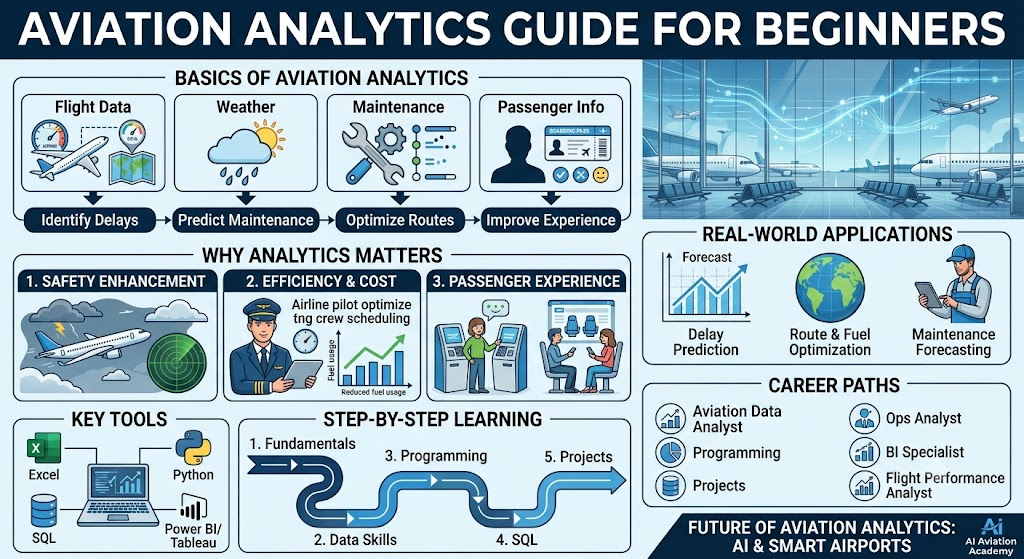
Basics of Aviation Analytics
Aviation analytics is a combination of aviation knowledge and data analysis techniques used to improve decision-making in the aviation sector.
What It Covers
Aviation analytics includes:
- Flight operations analysis
- Aircraft performance tracking
- Passenger behavior analysis
- Weather impact assessment
- Maintenance data evaluation
Types of Aviation Data
Aviation systems generate multiple types of data:
- Flight data (altitude, speed, route)
- Maintenance data (engine performance, repairs)
- Passenger data (bookings, preferences)
- Weather data (wind, storms, visibility)
- Airport operations data (delays, traffic flow)
Role in Decision-Making
Analytics helps aviation professionals:
- Identify patterns in flight delays
- Predict maintenance issues
- Optimize routes and schedules
- Improve passenger experience
Why Aviation Analytics Matters
Aviation analytics plays a critical role in making aviation safer, faster, and more efficient.
1. Flight Safety Improvement
Data analysis helps detect risks early by studying flight performance and historical incident data.
2. Operational Efficiency
Airlines can optimize crew scheduling, aircraft usage, and airport operations using analytics.
3. Cost Reduction
Fuel optimization and predictive maintenance help reduce unnecessary operational costs.
4. Better Passenger Experience
Analytics helps airlines understand customer behavior and improve services like booking, seating, and pricing.
Key Concepts Beginners Should Learn
To understand aviation analytics, beginners should start with basic concepts before moving to advanced topics.
Data Collection in Aviation
Understanding how aviation data is generated from aircraft systems, airports, and passengers.
Data Cleaning and Processing
Raw aviation data is often messy. Cleaning ensures accuracy and reliability.
Descriptive Analytics
Helps answer “what happened” using historical aviation data.
Predictive Analytics
Helps answer “what will happen” using machine learning models.
Data Visualization
Transforms complex aviation data into charts and dashboards for easier understanding.
Tools Used in Aviation Analytics
Beginners should become familiar with simple tools before moving to advanced systems.
Excel
Used for basic data analysis, sorting, filtering, and reporting aviation data.
Python
A powerful programming language used for data analysis and machine learning in aviation.
SQL
Used to manage and extract structured aviation data from databases.
Power BI and Tableau
Visualization tools used to create dashboards for airline operations and performance tracking.
Real-World Applications of Aviation Analytics
Aviation analytics is widely used in real industry operations.
Flight Delay Prediction
Analytics models predict delays based on weather, air traffic, and operational conditions.
Fuel Optimization
Airlines use data to find the most fuel-efficient flight routes.
Aircraft Maintenance Forecasting
Sensors collect data that helps predict when aircraft parts need servicing.
Airline Demand Analysis
Helps airlines understand peak travel seasons and adjust pricing strategies.
Career Opportunities in Aviation Analytics
Aviation analytics offers several career paths for beginners who build the right skills.
Aviation Data Analyst
Analyzes flight and operational data to improve airline performance.
Airline Operations Analyst
Focuses on improving efficiency in scheduling and resource allocation.
Business Intelligence Specialist
Creates dashboards and reports for airline decision-makers.
Flight Performance Analyst
Evaluates aircraft performance using real-time and historical data.
Step-by-Step Learning Path for Beginners
Beginners can follow a structured approach to learn aviation analytics effectively.
Step 1: Learn Aviation Fundamentals
Understand how aircraft systems, airports, and flight operations work.
Step 2: Learn Basic Data Skills
Start with Excel and basic statistics to understand data handling.
Step 3: Learn Programming Basics
Begin learning Python for data analysis.
Step 4: Study SQL and Databases
Learn how aviation data is stored and accessed.
Step 5: Work on Beginner Projects
Examples:
- Flight delay analysis
- Simple fuel consumption study
- Weather impact on flights
Challenges in Aviation Analytics
While aviation analytics is powerful, it also comes with challenges.
Complex Data Structures
Aviation data comes from multiple systems and is often unstructured.
Real-Time Processing
Many aviation decisions must be made instantly using live data.
Safety-Critical Environment
Errors in analysis can directly affect safety and operations.
Data Privacy and Compliance
Aviation data must follow strict international regulations.
Future of Aviation Analytics
Aviation analytics is evolving rapidly with the help of artificial intelligence and automation.
AI-Powered Aviation Systems
AI will help automate decision-making in flight operations.
Smart Airports
Airports will use real-time analytics to manage passenger flow and security.
Autonomous Aircraft Support Systems
Future aircraft may rely on analytics for navigation and safety support.
Predictive Aviation Ecosystems
Entire aviation networks will become predictive and self-optimizing.
Frequently Asked Questions (FAQs)
1. What is aviation analytics in simple terms?
Aviation analytics is the use of data to understand and improve aviation operations such as flight safety, scheduling, maintenance, fuel efficiency, and passenger experience. It helps airlines make smarter, data-driven decisions.
2. Why should beginners learn aviation analytics?
Beginners should learn aviation analytics because it builds a strong foundation for modern aviation careers. It helps students understand real-world airline operations and opens opportunities in data-driven aviation roles.
3. Do I need coding knowledge to start aviation analytics?
No, you can start with basic tools like Excel. However, learning Python and SQL later will help you handle larger datasets and perform advanced analysis in aviation projects.
4. What are the main data sources in aviation analytics?
Aviation analytics uses data from aircraft sensors, flight records, passenger booking systems, weather reports, airport operations, and maintenance logs.
5. How is aviation analytics used in airlines?
Airlines use analytics to reduce flight delays, optimize fuel consumption, improve scheduling, predict maintenance needs, and enhance passenger experience.
6. What tools are commonly used in aviation analytics?
Common tools include Excel for basic analysis, Python for data processing, SQL for databases, and visualization tools like Power BI and Tableau.
7. Can aviation analytics improve flight safety?
Yes, it plays a major role in safety by analyzing historical incidents, monitoring aircraft performance, and identifying risks before they become serious issues.
8. What jobs are available in aviation analytics?
Career options include aviation data analyst, airline operations analyst, business intelligence specialist, and flight performance analyst.
9. Is aviation analytics difficult for beginners?
It may seem complex at first, but beginners can easily learn it step-by-step by starting with basic aviation concepts and simple data tools before moving to advanced analytics.
10. What is the future of aviation analytics?
The future includes AI-powered aviation systems, smart airports, predictive maintenance, and real-time decision-making systems that make aviation safer and more efficient.
Conclusion
Aviation analytics is one of the most important future skills for anyone entering the aviation industry. It helps improve safety, reduce costs, and enhance operational efficiency across airlines and airports.
For beginners, the journey may seem challenging at first, but with a structured learning path and consistent practice, it becomes highly rewarding. By combining aviation knowledge with analytics skills, students can build strong careers in a rapidly evolving industry.
Institutions like AI Aviation Academy play an important role in guiding students toward these modern aviation technologies, helping them become future-ready professionals in aviation analytics and data-driven decision-making.