Introduction
Artificial Intelligence (AI) is rapidly reshaping the aviation industry, creating new possibilities in aircraft design, flight operations, safety systems, and air traffic management. For aviation engineering students, this transformation is not just an upgrade in technology—it is a complete shift in how aviation systems are designed, analyzed, and operated.
AI in aviation engineering refers to the use of intelligent algorithms, machine learning models, and automation systems to improve decision-making and operational efficiency in aircraft and aerospace systems. From predicting aircraft failures to enabling autonomous flight systems, AI is becoming deeply integrated into aviation engineering workflows.
For students learning at AI Aviation Academy, understanding AI is a major advantage. It connects traditional aerospace engineering concepts with modern computational intelligence, preparing students for future aviation careers where data, automation, and engineering work together.
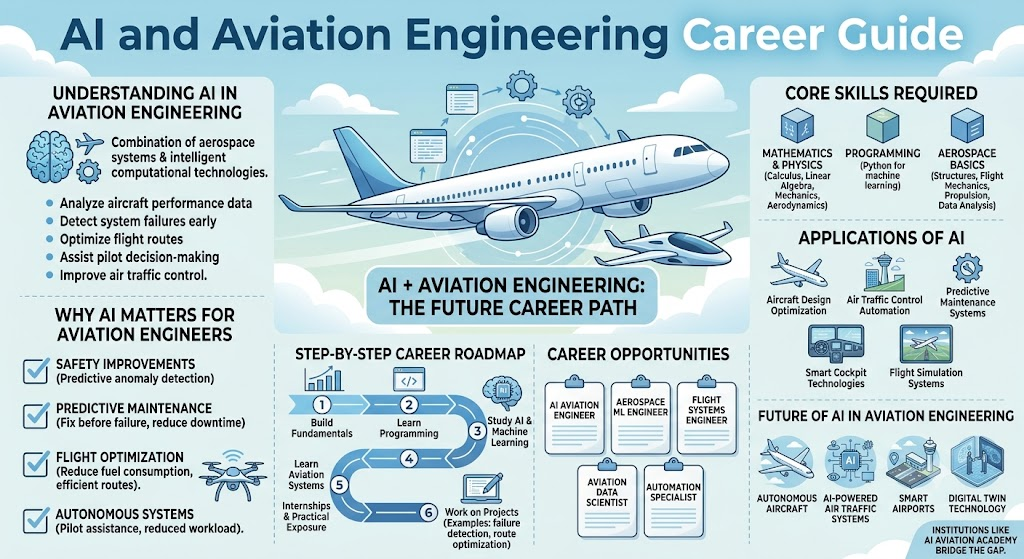
Understanding AI in Aviation Engineering
AI in aviation engineering is the combination of aerospace systems and intelligent computational technologies that can analyze data, learn patterns, and make decisions with minimal human intervention.
What AI Does in Aviation Systems
AI systems in aviation can:
- Analyze aircraft performance data
- Detect system failures early
- Optimize flight routes
- Assist pilots with decision-making
- Improve air traffic control systems
Automation in Aviation
Automation plays a key role in modern aircraft. AI enhances automation by making systems more adaptive, predictive, and intelligent rather than purely rule-based.
Integration with Aerospace Engineering
AI is integrated into:
- Aircraft design simulations
- Structural analysis
- Navigation systems
- Flight control systems
Why AI Matters for Aviation Engineers
AI is not replacing aviation engineers—it is empowering them with advanced tools and capabilities.
1. Safety Improvements
AI systems detect anomalies in aircraft behavior and help prevent accidents by providing early warnings.
2. Predictive Maintenance
Instead of fixing aircraft after failure, AI predicts when components might fail and suggests maintenance in advance.
3. Flight Optimization
AI helps calculate the most efficient flight paths, reducing fuel consumption and improving travel time.
4. Autonomous Systems
AI enables the development of partially or fully autonomous aircraft systems that assist pilots or reduce human workload.
Core Skills Required for AI + Aviation Careers
To build a strong career in AI-driven aviation engineering, students need a mix of engineering and technical skills.
Mathematics and Physics
Strong understanding of:
- Calculus
- Linear algebra
- Mechanics
- Aerodynamics
Programming Skills
Python is the most important language for AI applications in aviation.
Machine Learning Fundamentals
Understanding:
- Supervised learning
- Unsupervised learning
- Neural networks
Aerospace Engineering Basics
Knowledge of:
- Aircraft structures
- Flight mechanics
- Propulsion systems
Data Analysis Skills
Ability to interpret aviation datasets and draw meaningful conclusions.
Applications of AI in Aviation Engineering
AI is used across multiple aviation engineering domains.
Aircraft Design Optimization
AI helps engineers simulate and optimize aircraft structures for better performance and safety.
Air Traffic Control Automation
AI systems manage air traffic flow, reduce congestion, and improve flight coordination.
Predictive Maintenance Systems
Sensors combined with AI detect early signs of mechanical issues in aircraft components.
Smart Cockpit Technologies
Modern cockpits use AI-assisted systems to support pilot decision-making.
Flight Simulation Systems
AI improves flight simulators used for pilot training and system testing.
Tools and Technologies
AI-powered aviation engineering relies on several advanced tools.
Python Libraries
- NumPy for numerical analysis
- TensorFlow for machine learning models
- Scikit-learn for predictive systems
Simulation Software
Used for aircraft design, testing, and performance modeling.
CAD Tools
Computer-aided design tools help engineers build and analyze aircraft structures.
Data Visualization Tools
Tools like dashboards help interpret complex aviation data clearly.
Career Opportunities
AI is opening new and exciting career paths in aviation engineering.
AI Aviation Engineer
Works on integrating AI systems into aviation technologies.
Aerospace Machine Learning Engineer
Builds intelligent models for aircraft systems and flight optimization.
Flight Systems Engineer
Focuses on designing and improving aircraft control systems.
Aviation Data Scientist
Analyzes aviation data to improve safety and efficiency.
Automation Specialist in Aviation
Develops automated systems for airports and airlines.
Step-by-Step Career Roadmap
Students can follow a structured path to enter AI-based aviation engineering careers.
Step 1: Build Engineering Fundamentals
Focus on physics, mathematics, and basic aerospace concepts.
Step 2: Learn Programming
Start with Python and gradually move to AI frameworks.
Step 3: Study AI and Machine Learning
Understand how algorithms learn from data.
Step 4: Learn Aviation Systems
Gain knowledge of aircraft systems and aviation operations.
Step 5: Work on Projects
Examples include:
- Flight delay prediction models
- Aircraft failure detection systems
- Route optimization simulations
Step 6: Internships and Real Exposure
Gain practical experience through aviation or AI-focused internships.
Challenges in AI Aviation Engineering
Despite its benefits, AI in aviation engineering comes with challenges.
Complex Systems
Aviation systems are highly complex and require precise modeling.
Safety-Critical Decisions
Even small errors in AI systems can have serious consequences.
Real-Time Processing
Aviation decisions must often be made instantly using live data.
Regulatory Compliance
Aviation systems must follow strict international safety standards.
Future of AI in Aviation Engineering
The future of aviation engineering is strongly connected to AI innovation.
Autonomous Aircraft
Aircraft may become partially or fully autonomous in the future.
AI-Powered Air Traffic Systems
AI will manage global air traffic more efficiently than traditional systems.
Smart Airports
Airports will use AI for passenger flow management, security, and operations.
Digital Twin Technology
Virtual models of aircraft and systems will simulate real-world performance for testing and optimization.
Frequently Asked Questions (FAQs)
1. What is AI in aviation engineering?
AI in aviation engineering refers to the use of intelligent systems and machine learning to improve aircraft design, flight operations, safety, maintenance, and air traffic management. It helps engineers make faster and smarter decisions.
2. Why is AI important for aviation engineering students?
AI is important because it is shaping the future of aviation. Students who learn AI alongside aerospace engineering gain better career opportunities in modern airlines, aircraft manufacturing, and aviation technology companies.
3. Do I need strong coding skills to work in AI aviation engineering?
Basic coding knowledge, especially Python, is enough to start. As you grow, you can learn machine learning frameworks and advanced AI tools used in aviation systems.
4. How is AI used in aircraft systems?
AI is used in aircraft systems for predictive maintenance, navigation support, fuel optimization, flight path planning, and smart cockpit assistance for pilots.
5. What are the career options in AI aviation engineering?
Career options include AI aviation engineer, aerospace machine learning engineer, flight systems engineer, aviation data scientist, and automation specialist in aviation.
6. Can beginners from non-AI backgrounds enter this field?
Yes, beginners can enter this field by starting with basic mathematics, physics, programming, and aviation fundamentals before moving into AI and machine learning.
7. What tools are used in AI aviation engineering?
Common tools include Python libraries like TensorFlow and Scikit-learn, simulation software, CAD tools, and data visualization platforms.
8. How does AI improve aviation safety?
AI improves safety by detecting anomalies in aircraft systems, predicting failures in advance, and assisting pilots with real-time decision-making.
9. Is AI replacing aviation engineers?
No, AI is not replacing engineers. Instead, it supports them by automating complex tasks and improving accuracy in engineering decisions.
10. What is the future of AI in aviation engineering?
The future includes autonomous aircraft, AI-powered air traffic systems, smart airports, and digital twin technology for advanced aircraft simulation and optimization.
Conclusion
AI is transforming aviation engineering into a more intelligent, efficient, and automated field. It is not only improving existing systems but also creating entirely new career opportunities for future engineers.
For students, combining traditional aviation engineering knowledge with AI skills is one of the most powerful career paths today. With the right foundation in mathematics, programming, and aerospace principles, learners can prepare themselves for high-demand roles in the aviation industry.
Institutions like AI Aviation Academy are helping bridge the gap between aviation engineering and artificial intelligence, enabling students to become future-ready professionals in this evolving industry.