Introduction
Aircraft engines must work reliably during every flight. Even small changes in engine performance can need careful attention. Artificial intelligence (AI) can help engineers understand these changes by analyzing engine data. It supports early fault detection, better maintenance planning, and informed technical decisions.
What Is Aircraft Engine Health Monitoring?
Aircraft engine health monitoring is the process of checking an engine’s condition and performance over time. It helps maintenance teams identify changes that may point to wear, damage, or another technical problem.
Aircraft engines operate under high temperatures, pressure, and mechanical stress. Their condition can change with operating hours, weather, flight conditions, and maintenance history. Regular inspections and engine monitoring help teams understand these changes.
AI adds another way to study engine performance. It can analyze large amounts of data and identify patterns that may be difficult to notice manually. For example, an AI system may detect a gradual change in engine temperature across several flights.
However, finding an unusual pattern does not automatically confirm a fault. Engineers must review the information and follow approved maintenance procedures before deciding what action is needed.
Traditional monitoring relies on established instruments, maintenance checks, and engineering rules. AI can add data-driven insights to these methods. Both approaches can work together to support reliable engine maintenance.
How AI Works in Aircraft Engine Health Monitoring
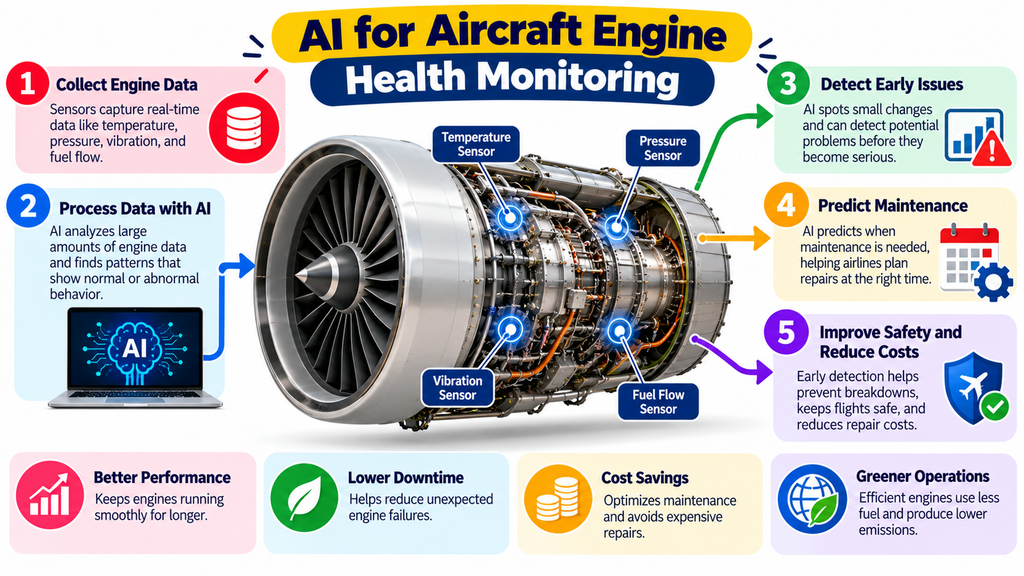
AI-based engine monitoring follows several steps. Each step helps turn raw engine data into useful information for maintenance teams.
1. Collecting Engine Data
Sensors and aircraft systems collect information about engine operation. Depending on the engine and its equipment, this may include temperature, pressure, vibration, fuel flow, and rotational speed.
The system may also use flight conditions and historical maintenance records. These details help provide context because an engine’s readings can change during different stages of flight.
2. Preparing the Data
Before analysis, the data must be checked for missing readings, errors, and unusual measurement conditions. Poor-quality data can lead to misleading results.
Engineers and data specialists prepare the information so that the AI model can analyze it more reliably. They must also account for differences in engine type, operating conditions, and sensor design.
3. Identifying Patterns
Machine learning models study engine data to identify relationships and changes. They may compare current readings with historical patterns or expected behavior under similar conditions.
For example, an AI model might identify a gradual rise in temperature when other operating conditions remain comparable. This change may deserve further investigation, but it does not prove that a particular component has failed.
4. Generating Alerts and Insights
When a system detects an unusual pattern, it may generate an alert or report. The report can help maintenance teams decide what information to review next.
Engineers then assess the alert alongside technical records, operating conditions, and inspection findings. AI supports this process, but qualified professionals remain responsible for maintenance decisions.
Types of AI Used for Engine Health Monitoring
Different AI techniques help analyze different types of engine data. The right method depends on the monitoring goal, the available data, and the engine system.
Machine Learning
Machine learning allows computer systems to learn patterns from data. In engine monitoring, models can study historical measurements and identify relationships between operating conditions and engine performance.
For example, a model may learn how temperature readings usually behave under comparable conditions. It can then flag readings that differ from the expected pattern. Engineers review these findings to decide whether further investigation is necessary.
Anomaly Detection
Anomaly detection helps identify unusual behavior in engine data. It is useful when the system needs to recognize changes that do not match normal operating patterns.
For example, a sudden change in vibration readings may trigger an alert. However, the change could have several causes, including sensor problems or operating conditions. Further checks are needed to understand the reason.
Predictive Analytics
Predictive analytics uses historical and current data to estimate possible future outcomes. In aviation maintenance, it can help teams assess developing risks and plan inspections.
Its usefulness depends on the quality of available data and the reliability of the model. It cannot predict every fault or provide an exact failure date for every engine component.
Deep Learning and Time-Series Analysis
Deep learning uses complex models to identify patterns in large datasets. It may be useful when engine data contains many interacting variables.
Time-series analysis examines how measurements change over time. It can help identify gradual performance changes that a single reading might not reveal. These methods require suitable data, careful testing, and validation before operational use.
Key Engine Parameters Monitored by AI
AI systems can examine several engine measurements to understand performance. The available data depends on the engine design, installed sensors, and monitoring equipment.
Common parameters include:
- Exhaust gas temperature: Helps engineers assess the temperature of gases leaving the engine and identify unusual trends.
- Pressure measurements: Provide information about engine operating conditions and pressure changes within relevant systems.
- Vibration levels: Help identify unusual mechanical behavior that may need further investigation.
- Oil pressure and temperature: Can provide information about the condition and operation of the lubrication system.
- Fuel flow: Helps engineers assess fuel use in relation to engine operating conditions.
- Rotational speed: Shows how quickly relevant engine shafts or components are rotating.
- Engine performance trends: Help reveal changes across flights or operating periods.
These measurements are more useful when interpreted in context. For example, a temperature reading may vary with engine power, outside air temperature, altitude, and other operating conditions.
AI models can compare readings across time and account for relevant operating factors when their design supports it. This can help maintenance teams distinguish expected changes from patterns that deserve attention.
However, no single measurement provides a complete picture of engine health. Engineers must consider multiple data sources, applicable limits, and the manufacturer’s maintenance guidance.
How AI Helps Detect Aircraft Engine Problems
AI can help identify patterns associated with possible engine deterioration. It can also alert engineers when measurements differ from expected behavior.
For example, a gradual change in exhaust gas temperature under comparable operating conditions may indicate that an engine requires closer assessment. A change in vibration may also point to a condition that needs investigation.
AI can help connect these observations with historical data. This may allow maintenance teams to recognize developing trends before they become obvious during routine data reviews.
Still, an alert is not the same as a confirmed diagnosis. A temperature change may have several explanations, while a vibration alert could result from a sensor issue or a mechanical condition. Engineers must investigate the evidence before drawing conclusions.
AI also has limitations. It may generate false alarms, and it may fail to recognize a problem that differs from the patterns in its training data. For this reason, AI monitoring should complement established inspections, approved diagnostic methods, and maintenance procedures.
AI and Predictive Aircraft Engine Maintenance
Predictive maintenance uses available information to help estimate when maintenance attention may be needed. AI can support this process by analyzing sensor readings, operating history, and previous maintenance findings.
To understand its value, it helps to compare three maintenance approaches.
- Reactive maintenance: A problem is addressed after it occurs or becomes apparent.
- Scheduled maintenance: Tasks are performed at planned intervals or according to approved requirements.
- Predictive maintenance: Data analysis helps identify developing concerns and supports decisions about when further checks may be appropriate.
These approaches can work together. Predictive maintenance does not remove the need for scheduled inspections or required maintenance tasks.
For example, an AI system may identify a gradual change in engine performance across several flights. The maintenance team can review the trend and determine whether an inspection or additional analysis is needed.
This may help teams plan work, prepare parts, and reduce unexpected disruption. However, the final maintenance plan must follow the applicable maintenance program, technical instructions, and regulatory requirements.
AI predictions also depend on reliable data. If a model has limited examples of a particular fault, its estimates may be less dependable. Maintenance teams must understand these limitations before relying on its output.
Benefits of AI for Aircraft Engine Health Monitoring
AI can improve how maintenance teams study engine data. Its main value comes from supporting informed decisions rather than replacing established engineering practices.
Earlier Identification of Unusual Trends
AI can review large datasets and identify changes that may otherwise take time to notice. Earlier identification can give engineers more time to investigate a possible problem.
However, early detection depends on the type of fault, the available data, and the system’s ability to recognize the relevant pattern.
Better Maintenance Planning
Engine monitoring can help maintenance teams understand which issues may need attention. This information can support work planning, parts preparation, and coordination with other maintenance activities.
It can also help teams prioritize investigations based on available evidence and the urgency of a concern.
Improved Use of Data
Aircraft generate large amounts of operational information. AI can help organize and analyze these records to reveal performance trends.
Engineers can use these insights alongside maintenance history and inspection findings. This may support better-informed technical decisions.
Potential Reduction in Disruption
When developing issues are identified early enough, teams may have more time to plan maintenance. This can sometimes reduce avoidable delays or unplanned work.
The results vary by aircraft, engine, operating environment, and maintenance process. AI does not guarantee lower costs, fewer delays, or improved safety on its own.
Limitations and Challenges of Using AI
AI can be useful, but aircraft engine monitoring presents several technical challenges. Understanding these limitations is essential before applying AI to real maintenance decisions.
Data Quality
AI models need suitable data to produce useful results. Missing readings, inaccurate sensors, and inconsistent records can affect their performance.
Data preparation and quality checks are therefore important parts of the monitoring process.
False Alarms and Missed Faults
An AI model may flag normal behavior as unusual. It may also fail to detect a real problem, especially if that problem differs from patterns seen during training.
Both situations matter in aviation. Teams need suitable validation, clear alert procedures, and established methods for checking concerns.
Different Engines and Operating Conditions
Aircraft engines differ in design, instrumentation, and operating characteristics. A model developed for one engine type may not work reliably on another without suitable evaluation and adaptation.
Altitude, temperature, power settings, and other operating factors can also influence measurements. Models must account for relevant conditions when interpreting engine data.
Cybersecurity and Data Protection
Engine monitoring may involve connected systems, data transfers, and maintenance networks. These systems require appropriate security controls to protect data and prevent unauthorized access or interference.
Organizations must also manage access, data quality, and the integrity of information used for maintenance decisions.
Validation and Regulatory Requirements
AI systems intended for aviation use need appropriate evaluation for their intended purpose. Depending on the application, relevant engineering assurance, certification, and regulatory requirements may apply.
A model that performs well in a research test is not automatically suitable for operational use. Its limitations, reliability, and role in the maintenance process must be understood.
The Role of Engineers and Maintenance Professionals
AI can help maintenance teams interpret engine data, but it cannot take over every engineering responsibility. Aircraft maintenance requires technical knowledge, approved procedures, and careful judgment.
Maintenance professionals review AI alerts and compare them with engine records, operating conditions, and inspection results. They may use approved diagnostic tools or carry out further inspections to identify the cause of a concern.
Engineers must also understand the limitations of the monitoring system. An AI model may produce a useful warning, but its output does not automatically establish that a component is damaged or safe to use.
Qualified personnel must follow the applicable maintenance instructions and regulatory requirements. AI should support their decisions rather than replace professional responsibility.
Similarly, an AI-generated result does not authorize an aircraft to continue operating or return to service. Those decisions must follow the applicable operational and maintenance requirements.
A Practical Example of AI-Based Engine Monitoring
Consider an illustrative example involving an aircraft engine that shows a gradual rise in exhaust gas temperature across several flights.
An AI monitoring system reviews temperature readings alongside engine power settings and other relevant operating conditions. It identifies a trend that differs from the expected pattern and sends an alert for review.
Maintenance engineers examine the alert and compare it with historical records. They also check whether differences in flight conditions, sensor behavior, or other factors could explain the change.
If the concern remains, the team follows approved maintenance procedures to investigate the engine. Further checks may identify a technical issue, a measurement problem, or another explanation.
The maintenance team then determines the appropriate action based on verified findings and applicable instructions. The AI system has helped highlight a possible concern, but it has not independently diagnosed the cause.
This example shows how AI can support engine monitoring. Its value lies in identifying patterns and directing attention toward issues that deserve further investigation.
Future of AI in Aircraft Engine Health Monitoring
AI may play a growing role in aviation maintenance as data analysis tools improve. However, progress will depend on reliable systems, suitable data, and careful testing.
Digital Twins
A digital twin is a digital representation of a physical system. Depending on its design, it may use operational data and engineering models to help assess system behavior.
For aircraft engines, digital twins may support performance analysis and maintenance planning. Their usefulness depends on the accuracy of the underlying models and the quality of the data they receive.
More Integrated Maintenance Systems
Future monitoring systems may combine engine data with maintenance records and other relevant information. This could help engineers build a clearer picture of engine condition.
Better integration may also support more efficient communication between engineering, maintenance planning, and operational teams. Data compatibility and security will remain important challenges.
Improved Fault Prediction
Research continues into methods that can identify unusual patterns and estimate the development of certain faults. Better models and more representative data may improve performance for suitable applications.
However, not every fault can be predicted reliably. New systems must be tested carefully before their outputs are used to support operational maintenance decisions.
Continued Human Oversight
Even as AI tools become more capable, qualified professionals will remain important. They must interpret findings, verify concerns, and apply the correct technical procedures.
The future of engine health monitoring is likely to involve cooperation between data analysis systems and experienced aviation personnel.
Important Considerations
Organizations considering AI for aircraft engine health monitoring should evaluate several practical factors.
- Data reliability: Sensors and records must provide suitable information for analysis.
- Engine-specific requirements: Models must be appropriate for the engine and its operating conditions.
- Model validation: Systems need suitable testing to understand their strengths and limitations.
- Human oversight: Qualified professionals must review findings and follow approved procedures.
- Cybersecurity: Monitoring systems and maintenance data need appropriate protection.
- Regulatory compliance: Applicable aviation rules and technical requirements must be followed.
- Maintenance documentation: AI insights must be assessed alongside approved manuals and maintenance programs.
These considerations help ensure that AI is used responsibly. A system’s value depends not only on its analytical capabilities but also on how it fits into established maintenance practices.
AI can support better monitoring, but it does not replace required inspections, engineering judgment, or regulatory compliance.
Frequently Asked Questions
1. What is AI in aircraft engine health monitoring?
AI in aircraft engine health monitoring uses computer models to analyze engine data and identify patterns that may indicate a change in condition. It helps maintenance teams investigate potential problems and understand engine performance over time.
2. How does AI detect aircraft engine problems?
AI analyzes measurements such as temperature, pressure, vibration, and fuel flow when these data are available. It compares readings with learned patterns or expected behavior and may flag unusual changes. Engineers must investigate the findings to confirm whether a problem exists.
3. Which engine parameters can AI monitor?
Depending on the engine and monitoring equipment, AI may analyze exhaust gas temperature, pressure measurements, vibration, oil temperature, oil pressure, fuel flow, and rotational speed. It can also examine performance trends over time.
4. What is predictive maintenance in aviation?
Predictive maintenance uses available data to help estimate when a system or component may need attention. In aviation, AI can support this process by identifying developing trends and helping maintenance teams plan investigations. It does not replace scheduled maintenance requirements.
5. Can AI predict aircraft engine failure?
AI can help estimate certain maintenance risks and identify patterns associated with developing faults. However, it cannot reliably predict every engine failure or provide an exact failure date for every component. Results depend on data quality, model performance, and the type of problem.
6. How does AI help aircraft maintenance teams?
AI can help teams analyze large datasets, recognize unusual performance trends, and prioritize issues for review. It may also support maintenance planning and improve the use of historical records. Final decisions depend on qualified professionals and approved procedures.
7. What are the limitations of AI-based engine monitoring?
Common limitations include poor-quality data, false alarms, missed faults, limited training examples, and differences between engine types. Cybersecurity and system validation are also important. These challenges must be managed before AI output can be used reliably.
8. Can AI replace aircraft maintenance engineers?
No. AI can support data analysis and help identify possible concerns, but it cannot replace the full responsibilities of qualified maintenance professionals. Engineers and technicians must assess findings, conduct required inspections, and follow applicable maintenance and safety requirements.
Conclusion
AI for aircraft engine health monitoring offers useful ways to study engine performance and identify unusual patterns. It can help maintenance teams analyze sensor readings, recognize developing trends, and plan investigations more effectively.
Its benefits depend on reliable data, suitable models, and careful validation. AI alerts must also be reviewed by qualified professionals before maintenance decisions are made.
As aviation technology develops, AI may become a more valuable part of engine monitoring and maintenance planning. Its most effective role is to support established engineering practices, not replace them.