Introduction
Aircraft design is one of the most complex areas of engineering. Every aircraft must be safe, strong, efficient, and reliable before it can fly. Engineers need to test aircraft shape, structure, systems, engines, materials, and performance under many different conditions.
Earlier, many design tests depended heavily on physical models, wind tunnels, and prototype testing. These methods are still important, but modern aviation now uses powerful digital tools to make the process faster and smarter.
One of the most important technologies in this area is Digital Twins in Aircraft Design. A digital twin allows engineers to create a virtual version of an aircraft, aircraft part, or aircraft system. This virtual model can be tested, monitored, improved, and studied before or after the real aircraft is built.
What Are Digital Twins in Aircraft Design?
A digital twin is a virtual copy of a real object, system, or process. In aircraft design, a digital twin can represent a complete aircraft, a wing, an engine, a landing gear system, a fuel system, or even a production process.
In simple words, it is like creating a digital version of an aircraft that behaves like the real one.
A digital twin may use:
- Aircraft design data
- Sensor data
- Simulation models
- Flight performance data
- Material information
- Maintenance records
- AI and machine learning
- Engineering calculations
The purpose of a digital twin is to help engineers understand how an aircraft or aircraft part will perform in real conditions.
Why Aircraft Design Needs Digital Twins
Aircraft design requires very careful testing because aircraft operate in demanding environments. They face changing air pressure, temperature, vibration, speed, load, and weather conditions.
Digital twins help because aircraft design involves many challenges, such as:
- High safety requirements
- Expensive physical testing
- Complex aircraft systems
- Strict certification rules
- Long development timelines
- Need for fuel efficiency
- Material performance testing
- Structural strength analysis
- Maintenance planning
A mistake in aircraft design can be very costly. Digital twins help engineers identify possible issues earlier, before they become major problems.
How Digital Twins Work in Aircraft Design
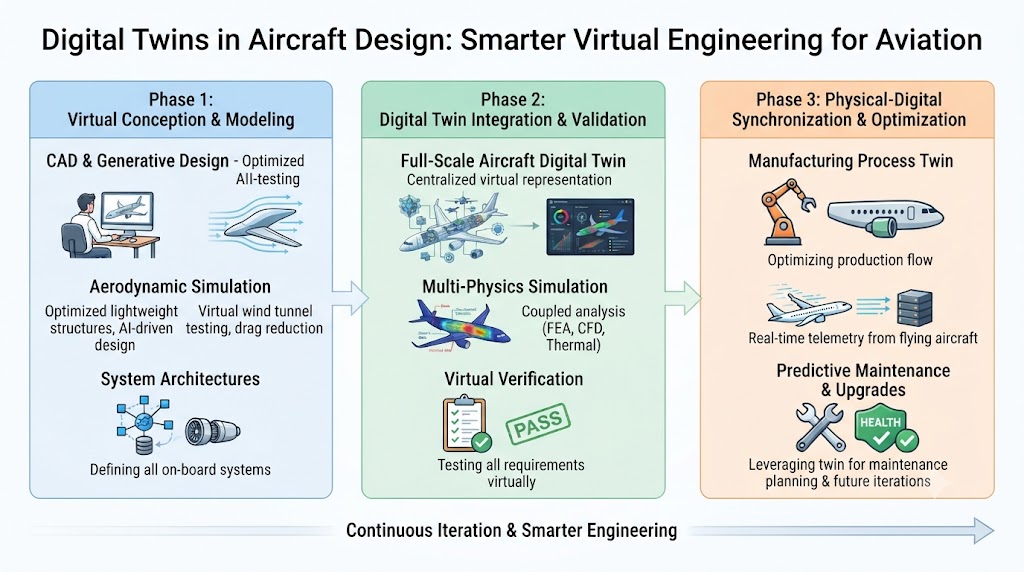
Digital twins work by combining virtual models with real or simulated data. Engineers first create a digital model of the aircraft or component. Then they test that model using different conditions.
The process usually includes:
- Creating a 3D or simulation model
- Adding material and structural data
- Running virtual tests
- Comparing results with real-world data
- Improving the design
- Updating the model as new data becomes available
For example, if engineers are designing a new aircraft wing, they can create a digital twin of the wing and test how it performs under different speeds, loads, and weather conditions.
If the model shows too much stress in one area, engineers can adjust the design before building a physical prototype.
Digital Twins for Aircraft Aerodynamics
Aerodynamics is one of the most important parts of aircraft design. It studies how air moves around the aircraft.
Digital twins help engineers study:
- Lift
- Drag
- Airflow
- Wing shape
- Fuselage design
- Tail performance
- Wingtip behavior
- Flight stability
A digital twin can simulate how air flows over the aircraft at different speeds and altitudes. This helps engineers find areas where drag can be reduced.
Lower drag means the aircraft may need less fuel, fly more efficiently, and perform better.
Digital twins can also support wing design. Engineers can test different wing shapes virtually and choose the design that offers the best balance of lift, strength, and efficiency.
Digital Twins for Structural Design
Aircraft structures must be strong enough to handle flight loads, landing forces, vibration, and long-term use. Digital twins help engineers test aircraft structures before they are physically built.
They can be used to study:
- Stress points
- Load distribution
- Fatigue life
- Crack development
- Vibration behavior
- Material strength
- Wing bending
- Fuselage pressure loads
For example, a digital twin of a wing structure can show how the wing bends during flight. If the model shows too much stress in a certain area, engineers can strengthen that area or change the design.
This helps create aircraft structures that are both safe and efficient.
Digital Twins for Engine and System Performance
Aircraft are not only made of wings and bodies. They also include engines, fuel systems, electrical systems, cooling systems, avionics, landing gear, and control systems.
Digital twins can help simulate these systems and understand how they behave under real operating conditions.
They can support:
- Engine performance testing
- Fuel system analysis
- Electrical load management
- Cooling system design
- Hydraulic system behavior
- Avionics performance
- Landing gear operation
For example, an engine digital twin can help engineers study temperature, vibration, pressure, fuel flow, and performance. This can help improve engine reliability and efficiency.
Digital Twins and AI in Aircraft Design
Artificial Intelligence makes digital twins more powerful. A normal digital model can simulate aircraft behavior, but AI can analyze large amounts of data and find useful patterns.
AI can help digital twins by:
- Predicting future problems
- Finding design weaknesses
- Studying performance trends
- Suggesting better design options
- Detecting unusual behavior
- Improving simulation accuracy
- Supporting faster decision-making
For example, if a digital twin receives performance data from test flights, AI can study that data and predict which part may need design improvement.
This makes digital twins more than static models. They become intelligent engineering tools.
Digital Twins for Virtual Testing
Virtual testing is one of the biggest advantages of digital twins. Before building a real prototype, engineers can test the aircraft digitally.
Virtual testing can include:
- Takeoff performance
- Landing performance
- Cruise efficiency
- Structural loads
- Engine response
- Control surface movement
- Fuel usage
- Emergency conditions
- Weather impact
This saves time and cost because engineers can test many design ideas without building every version physically.
Physical testing is still necessary in aviation, but digital twins reduce unnecessary trial-and-error work. They help engineers reach a better design before the aircraft enters real testing.
Digital Twins for Predictive Maintenance
Digital twins are useful not only during aircraft design but also after the aircraft enters service.
A digital twin can be connected with real aircraft data from sensors. It can monitor aircraft condition and help predict future maintenance needs.
It can help identify:
- Engine wear
- Structural fatigue
- Unusual vibration
- System performance changes
- Landing gear stress
- Component aging
- Possible failure signs
This is called predictive maintenance. Instead of waiting for a part to fail, engineers can predict when maintenance may be needed.
This improves safety, reduces downtime, and helps airlines manage aircraft more efficiently.
Digital Twins in Aircraft Manufacturing
Digital twins can also help during aircraft production. A digital twin of a manufacturing process can show how parts should be assembled, inspected, and tested.
In aircraft manufacturing, digital twins can support:
- Production planning
- Assembly simulation
- Quality inspection
- Robot movement planning
- Material tracking
- Factory workflow improvement
- Defect detection
- Process optimization
For example, before changing an assembly line, engineers can test the change in a digital twin. This reduces risk and helps avoid production delays.
Benefits of Digital Twins in Aircraft Design
Digital twins offer many benefits for modern aircraft design.
Faster Design Process
Engineers can test many design ideas digitally before choosing the best option.
Better Safety Analysis
Digital twins help identify stress, failure risks, and system problems early.
Lower Testing Cost
Virtual testing reduces the need for repeated physical prototypes in early design stages.
Improved Aircraft Performance
Digital twins help optimize aerodynamics, structure, fuel efficiency, and system behavior.
Early Problem Detection
Possible issues can be found before manufacturing or flight testing.
Better Maintenance Planning
Digital twins can predict wear, fatigue, and future maintenance needs.
Smarter Engineering Decisions
Engineers can use data, simulation, and AI to make better design choices.
Challenges of Using Digital Twins in Aircraft Design
Digital twins are powerful, but they also come with challenges.
Some common challenges include:
- High setup cost
- Need for accurate data
- Complex simulation models
- Skilled workforce requirement
- Cybersecurity risks
- Data integration issues
- Certification and validation needs
- Dependence on expert review
A digital twin is only useful when the data and model are accurate. If the model is wrong, the results may also be wrong.
This is why human engineers must review digital twin results carefully.
Role of Engineers in Digital Twin-Based Aircraft Design
Digital twins do not replace aircraft engineers. They support them.
Engineers are still needed to:
- Define design goals
- Build accurate models
- Select correct data
- Review simulation results
- Validate safety
- Follow aviation rules
- Make final design decisions
- Approve physical testing
A digital twin can show useful information, but engineers must decide whether the results make sense in the real world.
The future of aircraft design will need engineers who understand both traditional aerospace principles and digital technologies.
Digital Twins for Sustainable Aviation
Sustainability is becoming very important in aviation. Aircraft designers are working to reduce fuel use, emissions, waste, and maintenance costs.
Digital twins can support sustainable aviation by helping engineers design:
- Lighter aircraft structures
- More fuel-efficient aircraft
- Better engine systems
- Improved aerodynamic shapes
- Electric aircraft systems
- Hybrid aircraft designs
- Smarter maintenance plans
By testing these improvements digitally, engineers can reduce waste and speed up the development of cleaner aviation technologies.
Future of Digital Twins in Aviation
The future of digital twins in aviation is very promising. As aircraft become more connected and data-driven, digital twins will become more important.
In the future, digital twins may support:
- Smart aircraft design
- Electric aircraft development
- Autonomous aircraft systems
- Real-time aircraft health monitoring
- AI-powered maintenance
- Smart manufacturing
- Safer flight testing
- Sustainable aircraft design
Aviation students who learn digital twins, AI, simulation, and aircraft design will be better prepared for the future of aerospace engineering.
FAQs
1. What are digital twins in aircraft design?
Digital twins in aircraft design are virtual models of aircraft, aircraft parts, or aircraft systems used for testing, simulation, monitoring, and design improvement.
2. How do digital twins help aircraft engineers?
Digital twins help engineers test aircraft performance, study structures, improve aerodynamics, predict problems, and reduce design errors.
3. Are digital twins used only before aircraft are built?
No. Digital twins can be used during design, manufacturing, flight testing, operation, and maintenance.
4. How does AI improve digital twins?
AI helps digital twins analyze large data sets, detect patterns, predict failures, and suggest better design or maintenance decisions.
5. Can digital twins replace physical aircraft testing?
No. Digital twins reduce early testing cost and improve design decisions, but physical testing is still required for safety and certification.
Conclusion
Digital Twins in Aircraft Design are changing how aircraft are developed, tested, improved, and maintained. They allow engineers to create virtual aircraft models, test designs digitally, study performance, predict problems, and make smarter decisions.
Digital twins help improve safety, reduce cost, speed up design, support maintenance, and improve aircraft performance. When combined with AI, they become even more powerful because they can analyze data and predict future issues.
However, digital twins are not a replacement for real testing or human expertise. Aircraft design still needs skilled engineers, safety checks, certification, and physical validation.
For aviation learners and aerospace students, digital twins are an important technology to understand. They represent the future of aircraft design, where engineering, data, AI, simulation, and real-world testing work together.