Introduction
Aircraft engineering is changing very quickly. In the past, aircraft design and development depended mainly on manual calculations, physical testing, engineering experience, and traditional simulation tools. These methods are still important, but modern aviation now needs faster, safer, smarter, and more sustainable solutions.
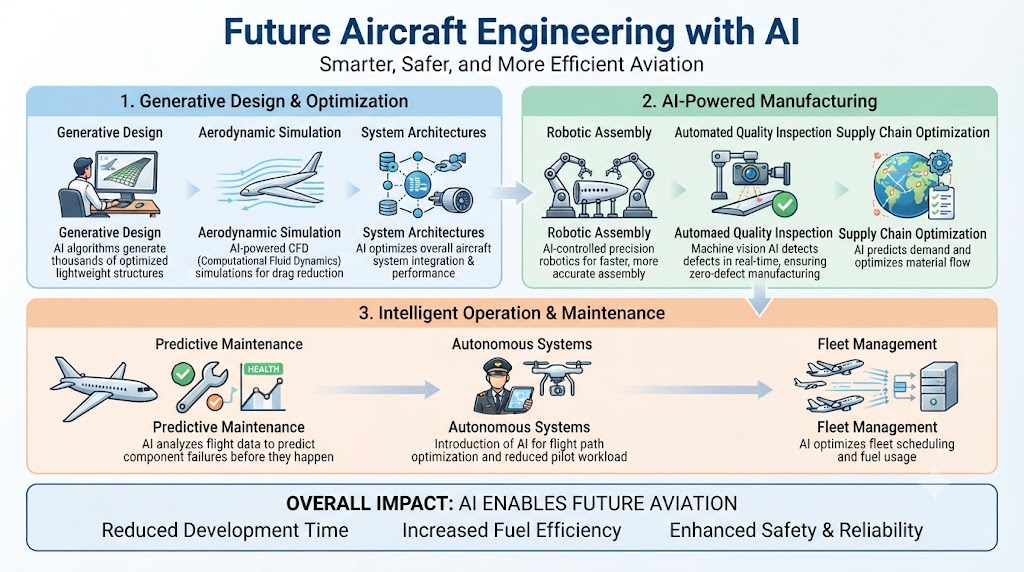
This is where Future Aircraft Engineering with AI becomes important. Artificial Intelligence is helping engineers design better aircraft, reduce weight, improve fuel efficiency, test aircraft digitally, inspect parts, predict maintenance needs, and support smarter flight systems.
AI is not replacing aircraft engineers. Instead, it is becoming a powerful tool that helps them make better decisions with data, simulation, and automation.
For aviation students and aerospace learners, understanding AI in aircraft engineering is important because the future of aviation will depend on both engineering knowledge and intelligent digital technologies.
What Is Future Aircraft Engineering with AI?
Future aircraft engineering with AI means using Artificial Intelligence to support different stages of aircraft development and operation.
AI can help in:
- Aircraft design
- Aerodynamic testing
- Material selection
- Lightweight structure development
- Digital simulation
- Aircraft manufacturing
- Quality inspection
- Predictive maintenance
- Flight performance optimization
- Sustainable aviation development
In simple words, AI helps engineers study large amounts of data, find better solutions, detect problems early, and improve aircraft performance.
Aircraft engineering is not only about building aircraft. It also includes designing, testing, producing, operating, maintaining, and improving aircraft systems. AI can support all these areas.
Why AI Matters in Future Aircraft Engineering
Aviation faces many modern challenges. Aircraft must be safer, lighter, more fuel-efficient, more reliable, and more environmentally friendly. At the same time, aircraft development is expensive and time-consuming.
AI matters because it can help engineers solve these challenges faster and more accurately.
AI can support aircraft engineering by helping with:
- Faster aircraft development
- Better design decisions
- Reduced fuel consumption
- Lower emissions
- Improved safety analysis
- Smarter maintenance planning
- Better manufacturing quality
- Lower operating cost
- More efficient flight operations
Future aircraft will need advanced systems, intelligent monitoring, cleaner propulsion, and better performance. AI can help engineers manage this complexity.
AI in Aircraft Design
Aircraft design is one of the most important areas where AI is useful. Engineers must design aircraft that are strong, safe, efficient, and stable.
AI can help aircraft designers explore many design options quickly. Instead of testing only a few shapes or structures, AI can compare thousands of possibilities.
AI can support:
- Wing design
- Fuselage shape
- Cabin structure
- Landing gear components
- Engine mounting systems
- Control surfaces
- Internal aircraft frames
AI can also help with generative design. In generative design, engineers give the AI tool a goal, such as reducing weight or improving strength. The AI then creates many possible design options.
This helps engineers find smarter designs that may not be easy to create manually.
AI in Aerodynamic Optimization
Aerodynamics is the study of how air moves around an aircraft. Good aerodynamics helps aircraft fly smoothly, use less fuel, and perform better.
AI can help improve aerodynamics by analyzing airflow, drag, lift, pressure, and aircraft shape.
AI can help optimize:
- Wing shape
- Winglets
- Nose design
- Fuselage shape
- Tail section
- Air intake systems
- Control surfaces
If an aircraft has too much drag, it needs more power and burns more fuel. AI can help engineers find small design changes that reduce drag and improve flight efficiency.
This is very important for future aircraft because airlines and manufacturers are working to reduce fuel costs and emissions.
AI for Lightweight Aircraft Structures
Aircraft weight has a direct impact on performance. A lighter aircraft usually needs less fuel, can fly longer distances, and may carry more useful payload.
AI helps engineers reduce aircraft weight without reducing safety.
AI can study:
- Material strength
- Load paths
- Stress points
- Fatigue behavior
- Structural shape
- Weight distribution
AI can also help select better materials such as aluminum alloys, titanium, carbon fiber composites, and advanced lightweight materials.
The goal is not simply to make aircraft lighter. The real goal is to remove unnecessary weight while keeping the aircraft strong, safe, and reliable.
Digital Twins in Future Aircraft Engineering
A digital twin is a virtual copy of a real aircraft, aircraft part, or aircraft system. It allows engineers to test and monitor aircraft performance digitally.
Digital twins are becoming very important in future aircraft engineering because they help engineers understand how aircraft behave before and after they are built.
Digital twins can be used for:
- Virtual aircraft testing
- Structural analysis
- Engine performance simulation
- Fuel system testing
- Flight performance prediction
- Maintenance planning
- Manufacturing process testing
For example, engineers can create a digital twin of an aircraft wing and test how it performs under different flight conditions. If the digital model shows stress in one area, engineers can improve the design before building the actual part.
When AI is added to digital twins, the system becomes even smarter. AI can analyze data, predict problems, and suggest improvements.
AI in Aircraft Manufacturing
Aircraft manufacturing requires high accuracy. Every part must be produced, assembled, inspected, and tested carefully.
AI is helping aircraft factories become smarter and more efficient.
AI can support:
- Production planning
- Robotic assembly
- Quality inspection
- Defect detection
- Material tracking
- Machine monitoring
- Predictive maintenance of factory equipment
- Supply chain management
AI-powered computer vision can inspect aircraft parts and detect cracks, scratches, missing fasteners, surface defects, or alignment problems.
Robots combined with AI can help with drilling, fastening, painting, material handling, and assembly support. This improves accuracy and reduces repetitive errors.
AI in Aircraft Maintenance
Aircraft maintenance is another major area where AI is useful. Aircraft must be checked regularly to ensure safety and reliability.
Traditional maintenance often follows fixed schedules. AI supports predictive maintenance, where data is used to predict when a part may need service.
AI can analyze:
- Engine temperature
- Vibration
- Pressure
- Fuel flow
- Flight cycles
- Sensor readings
- Maintenance history
- Component wear
If AI detects unusual behavior, it can alert maintenance teams early. This helps prevent unexpected failures and reduces aircraft downtime.
For airlines, predictive maintenance can improve safety, save cost, and keep aircraft available for service.
AI in Flight Systems and Automation
AI is also becoming useful in flight systems and aircraft operations. It can help pilots, engineers, and operators make better decisions.
AI can support:
- Route planning
- Weather analysis
- Fuel optimization
- Cockpit assistance
- Flight performance monitoring
- Safety alerts
- Autonomous aircraft systems
- Air traffic support
For example, AI can help suggest a more fuel-efficient route based on wind, weather, aircraft weight, and traffic conditions.
In future aircraft, AI may support more advanced automation. However, aviation safety will always require strong testing, certification, and human oversight.
AI for Sustainable Aviation
Sustainability is one of the biggest goals in future aviation. Aircraft manufacturers and airlines are working to reduce fuel use, emissions, waste, and environmental impact.
AI can support sustainable aviation by helping engineers develop:
- Fuel-efficient aircraft
- Lightweight structures
- Electric aircraft
- Hybrid aircraft
- Hydrogen-powered aircraft
- Better battery systems
- Improved aerodynamic designs
- Smarter maintenance systems
AI can also help reduce waste in manufacturing by improving material usage and detecting defects early.
Future aircraft engineering will focus not only on performance but also on environmental responsibility.
Benefits of AI in Future Aircraft Engineering
AI offers many benefits for future aviation and aerospace engineering.
Faster Aircraft Development
AI can test many design ideas quickly and help engineers reach better solutions faster.
Better Safety Analysis
AI can detect weak points, predict failures, and support early risk identification.
Improved Fuel Efficiency
AI can improve aerodynamics, reduce weight, optimize engines, and support better flight planning.
Lower Operating Cost
Better design, smarter maintenance, and improved fuel efficiency can reduce long-term aircraft costs.
Better Manufacturing Quality
AI can improve inspection, reduce errors, and support smarter production systems.
Smarter Maintenance
Predictive maintenance helps detect problems before they become serious.
More Sustainable Aircraft
AI supports cleaner designs, lower emissions, and better energy efficiency.
Challenges of Using AI in Aircraft Engineering
AI has great potential, but aircraft engineering is a safety-critical field. Every AI-based decision must be tested and reviewed carefully.
Some major challenges include:
- Need for accurate data
- High development cost
- Cybersecurity risks
- Complex certification rules
- Human expert review
- Trust in AI results
- Skilled workforce requirement
- Integration with old systems
- Safety validation
If AI receives poor-quality data, it may produce poor results. This is why engineers must always check AI recommendations.
AI should support aircraft engineering, not replace safety standards.
Role of Engineers in AI-Powered Aircraft Engineering
AI is a tool. Engineers are still responsible for final decisions.
Aircraft engineers are needed to:
- Define design goals
- Understand aircraft physics
- Review AI suggestions
- Validate simulation results
- Follow aviation regulations
- Check safety risks
- Approve designs
- Manage testing and certification
AI may suggest a better wing shape or lighter structure, but engineers must decide whether it is safe, practical, and certifiable.
The future engineer will need both traditional aerospace knowledge and digital skills.
Future Career Opportunities in AI and Aircraft Engineering
AI is creating new career opportunities in aviation and aerospace.
Students and professionals can explore roles such as:
- Aerospace AI engineer
- Aircraft design engineer
- Digital twin specialist
- Simulation engineer
- Robotics engineer
- Predictive maintenance analyst
- Aircraft data analyst
- Smart manufacturing engineer
- Autonomous systems engineer
- Sustainable aviation engineer
For aviation students, learning AI, aircraft systems, data analysis, simulation, and automation can be very helpful for future careers.
The aviation industry will need professionals who understand both engineering and intelligent technologies.
Future of Aircraft Engineering with AI
The future of aircraft engineering will be more connected, digital, and intelligent. AI will become part of design labs, manufacturing lines, maintenance systems, and flight operations.
Future aircraft may include:
- Smarter flight systems
- Real-time health monitoring
- AI-supported cockpit tools
- Lightweight AI-designed structures
- Electric and hybrid propulsion
- Autonomous support systems
- Digital twin-based maintenance
- Smart aerospace factories
However, human expertise will remain essential. Aviation will always need skilled engineers, pilots, inspectors, technicians, and safety experts.
AI will make aircraft engineering smarter, but people will make sure it remains safe.
FAQs
1. What is future aircraft engineering with AI?
Future aircraft engineering with AI means using Artificial Intelligence to improve aircraft design, testing, manufacturing, maintenance, flight systems, and sustainability.
2. How does AI help aircraft engineers?
AI helps aircraft engineers analyze data, test design options, reduce weight, improve aerodynamics, detect defects, and predict maintenance needs.
3. Can AI replace aircraft engineers?
No. AI supports aircraft engineers, but human experts are still needed for safety, testing, certification, and final decision-making.
4. Is AI useful in aircraft manufacturing?
Yes. AI helps aircraft manufacturing through robotics, quality inspection, production planning, defect detection, and predictive maintenance.
5. Why is AI important for sustainable aviation?
AI supports sustainable aviation by improving fuel efficiency, reducing emissions, optimizing materials, supporting electric aircraft, and improving maintenance planning.
Conclusion
Future Aircraft Engineering with AI is changing the way aircraft are designed, built, tested, maintained, and operated. AI helps engineers create smarter designs, improve aerodynamics, reduce aircraft weight, support digital twins, improve manufacturing, predict maintenance needs, and develop sustainable aviation solutions.
AI is not a replacement for aerospace engineers. It is a powerful support system that helps experts work faster and make better decisions.
For aviation students and engineering learners, AI is an important subject to understand. The future of aircraft engineering will belong to those who can combine aircraft knowledge with AI, simulation, data, automation, and safety-focused thinking.
AI is helping aviation move toward a future that is safer, cleaner, smarter, and more efficient.