Introduction
AI-Based Ground School Training is changing the way future pilots learn aviation theory. Ground school has always been one of the most important parts of pilot training because it builds the knowledge foundation every student pilot needs before entering the cockpit with confidence.
From air navigation and meteorology to aircraft systems, flight planning, air regulations, and aviation safety, ground school helps students understand how flying works beyond basic control handling. Traditionally, students depended heavily on classroom lectures, textbooks, instructor notes, and repeated manual practice. While these methods are still valuable, Artificial Intelligence is now making aviation education more personalized, interactive, and efficient.
AI aviation training helps students learn at their own pace, identify weak areas faster, receive instant feedback, and prepare better for aviation exams. Instead of offering the same study path to every learner, AI-powered systems can adapt lessons based on individual performance, learning speed, and subject understanding.
For aspiring pilots, AI-Based Ground School Training is not just a modern learning option. It is becoming a smarter way to prepare for the demanding world of aviation.
What Is Ground School Training?
Ground school training is the theoretical part of pilot education. Before a student pilot can safely operate an aircraft, they must understand aviation rules, aircraft behavior, weather, navigation, communication procedures, flight planning, and safety principles.
The purpose of ground school is to prepare students for written examinations, oral checks, simulator sessions, and real flight training. It teaches the science, rules, procedures, and decision-making skills required for safe flying.
Ground school is required for many aviation learners, including:
- Private Pilot License students
- Commercial Pilot License students
- Airline cadets
- Flight instructor candidates
- Aviation diploma students
- Drone and remote pilot learners
- Aviation professionals upgrading their knowledge
Traditional ground school usually includes classroom lectures, printed manuals, instructor presentations, assignments, mock tests, and group discussions. These methods are useful, but they may not always match each student’s learning style. Some learners need more time with meteorology, while others may struggle with navigation, flight planning, or aircraft technical subjects.
This is where AI-based aviation education adds real value.
What Is AI-Based Ground School Training?
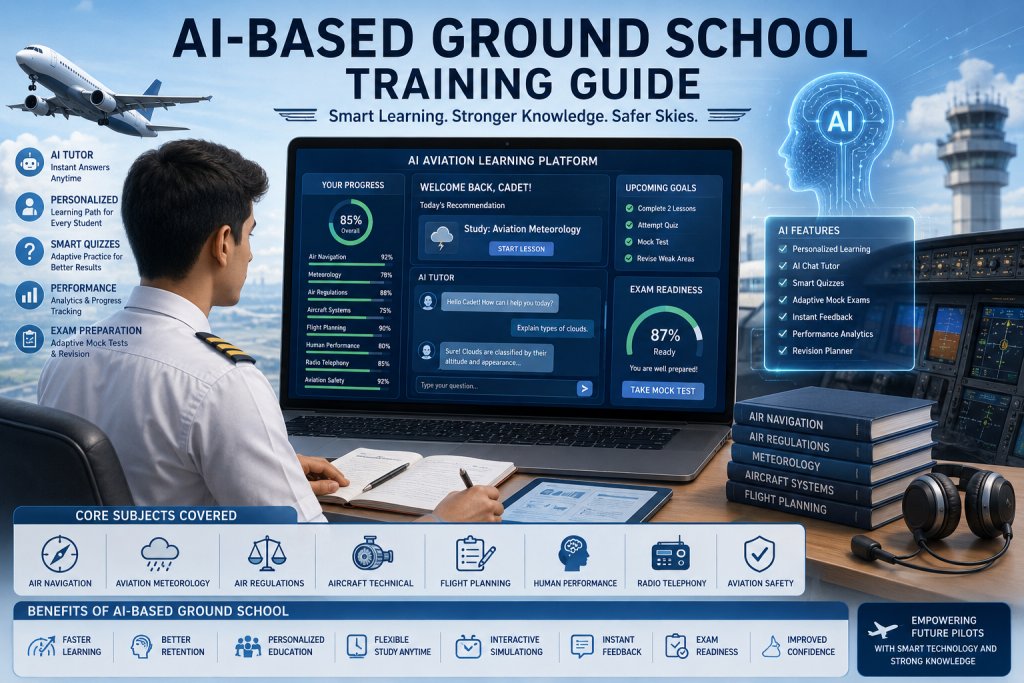
AI-Based Ground School Training uses Artificial Intelligence to make pilot theory learning smarter, more personalized, and more interactive. Instead of giving every student the same course path, AI systems can study the learner’s progress and recommend the right lessons, quizzes, revisions, and practice tests.
An AI-powered aviation learning platform may include:
- Personalized learning dashboards
- AI tutors
- Smart quizzes
- Adaptive mock exams
- Voice-based doubt solving
- Performance analytics
- Subject-wise progress tracking
- Automated revision plans
- Exam readiness scoring
For example, if a student performs poorly in aviation meteorology, the system can automatically suggest extra lessons, practice questions, diagrams, and revision exercises for weather theory. If another student is strong in air regulations but weak in navigation, the AI can adjust the study plan accordingly.
This creates a more focused and efficient learning experience.
How AI Is Transforming Aviation Education
Artificial Intelligence is helping aviation academies, flight schools, and online pilot training platforms deliver better learning outcomes. It supports both students and instructors by providing real-time insights into learning performance.
Personalized Learning Paths
Every pilot student learns differently. Some understand aircraft systems quickly but take longer to master navigation calculations. Others may be confident in theory but weak in exam-style questions.
AI can analyze performance and create a customized learning path for each student. This helps learners spend more time on weak areas and avoid wasting time on topics they already understand well.
Smart Quizzes and Adaptive Exams
AI-powered quizzes can change difficulty based on student performance. If a learner answers basic questions correctly, the system can move to more advanced questions. If the learner struggles, it can return to simpler concepts and explanations.
This makes practice more useful than fixed question banks.
AI Chat Tutors
AI chat tutors can help students ask aviation-related questions anytime. A student studying late at night can ask about cloud types, radio communication, fuel calculations, or airspace classification and receive an instant explanation.
This does not replace certified instructors, but it gives students additional support between classes.
Intelligent Revision
AI systems can identify topics a student is likely to forget and schedule revision at the right time. This improves long-term retention and helps students prepare better for exams.
Learning Analytics
AI can track:
- Subject-wise performance
- Time spent on lessons
- Mock test scores
- Repeated mistakes
- Exam readiness
- Learning consistency
This helps instructors identify students who need extra support before they fall behind.
Core Subjects Covered in AI Ground School
AI-Based Ground School Training can support all major aviation theory subjects. These subjects form the foundation of pilot knowledge.
Air Navigation
Air navigation teaches students how to plan and follow a route safely. It includes map reading, compass headings, wind correction, distance calculation, position fixing, radio navigation, and flight route planning.
AI tools can help students practice navigation problems step by step and explain mistakes instantly.
Aviation Meteorology
Weather plays a major role in aviation safety. Meteorology covers clouds, pressure systems, wind, visibility, thunderstorms, icing, turbulence, and weather reports.
AI can make weather learning easier through diagrams, scenario-based questions, and interactive explanations.
Air Regulations
Air regulations teach students the rules of flying. This includes licensing, airspace, right-of-way rules, flight rules, aircraft documents, and safety responsibilities.
AI-based systems can help students remember regulations through smart flashcards and exam-style questions.
Aircraft Technical General
This subject explains the technical principles behind aircraft structure, engines, instruments, electrical systems, hydraulics, fuel systems, and flight controls.
AI tools can simplify complex aircraft systems using visual explanations and interactive modules.
Flight Planning
Flight planning includes route selection, fuel calculation, alternate airport planning, performance checks, weather analysis, and navigation logs.
AI can guide students through planning exercises and highlight errors in calculations.
Human Performance
Human performance covers pilot health, fatigue, stress, decision-making, vision, oxygen use, and human limitations.
AI can use scenario-based learning to teach students how human factors affect flight safety.
Radio Telephony
Radio telephony teaches pilots how to communicate clearly with air traffic control and other aircraft.
AI speech recognition can help students practice aviation phraseology and improve pronunciation, confidence, and communication accuracy.
Aviation Safety
Aviation safety focuses on risk management, standard operating procedures, accident prevention, emergency handling, and decision-making.
AI can create realistic safety scenarios to help students think like professional pilots.
Benefits of AI-Based Ground School
AI-Based Ground School Training offers several important benefits for student pilots and aviation academies.
Faster Learning
AI helps students focus on what they need most. Instead of reviewing every topic equally, learners can spend more time on weak areas and move faster through familiar subjects.
Better Retention
AI-based revision tools can remind students to review important topics before they forget them. This improves memory and exam readiness.
Personalized Education
Traditional classrooms often follow one pace for everyone. AI allows each student to learn according to their own speed, skill level, and progress.
Study Anytime
Students can access AI learning platforms from laptops, tablets, or mobile devices. This makes aviation education more flexible for working professionals and busy learners.
Reduced Training Cost
AI can reduce repeated classroom dependency by offering digital lessons, automated quizzes, and self-paced revision. This can help students manage their learning more affordably.
Interactive Simulations
AI-powered tools can include simulations, visual modules, and scenario-based training that make difficult aviation concepts easier to understand.
Instant Feedback
Instead of waiting for an instructor to check answers, students can receive immediate feedback on quizzes, calculations, and mock exams.
Progress Tracking
Students and instructors can track performance through dashboards, reports, and score summaries.
Better Exam Preparation
AI mock tests can help students practice under exam-like conditions and identify the exact areas that need improvement.
Improved Confidence
When students understand their progress clearly, they feel more prepared for exams and flight training.
Traditional Ground School vs AI-Based Ground School
| Feature | Traditional Ground School | AI-Based Ground School |
|---|---|---|
| Learning Style | Fixed classroom-based learning | Personalized and adaptive learning |
| Instructor Dependency | High dependency on instructor availability | Supports self-learning with AI assistance |
| Personalization | Limited personalization | Highly personalized study path |
| Study Speed | Same pace for most students | Learner can move at individual speed |
| Feedback | Delayed feedback after tests or assignments | Instant feedback after quizzes and practice |
| Cost | May require repeated classroom sessions | Can reduce extra revision and support costs |
| Accessibility | Usually location-based | Accessible online from anywhere |
| Flexibility | Fixed class schedule | Flexible learning anytime |
| Progress Monitoring | Manual tracking | Automated analytics and dashboards |
| Exam Preparation | Standard mock tests | Adaptive mock exams and weak-area analysis |
AI Technologies Used in Aviation Ground School
AI aviation education uses several technologies to improve the learning experience.
Machine Learning
Machine Learning helps platforms understand student performance and recommend better learning paths.
Natural Language Processing
Natural Language Processing allows students to ask questions in normal language and receive helpful explanations.
Speech Recognition
Speech recognition helps students practice radio telephony, pronunciation, and aviation communication.
Computer Vision
Computer vision can support visual learning through diagrams, instrument recognition, chart reading, and aircraft component identification.
Large Language Models
Large Language Models can act as AI tutors by explaining aviation topics, creating summaries, generating quizzes, and supporting revision.
Virtual Reality
Virtual Reality can create immersive cockpit and aviation training environments.
Augmented Reality
Augmented Reality can help students understand aircraft parts, cockpit instruments, and technical systems through visual overlays.
Predictive Analytics
Predictive analytics can estimate student readiness, exam risk, and learning gaps.
Intelligent Recommendation Systems
These systems recommend lessons, quizzes, videos, and revision tasks based on student progress.
Features of a Modern AI Aviation Learning Platform
A strong AI aviation learning platform should include useful features for both students and instructors.
Important features include:
- Personalized dashboard
- AI tutor support
- Smart aviation quizzes
- Interactive videos
- Exam simulator
- Progress reports
- Performance analytics
- Mobile-friendly access
- Cloud-based learning
- Certification tracking
- Subject-wise study plans
- Revision reminders
- Aviation glossary
- Radio communication practice
- Instructor monitoring tools
These features help students stay organized and help instructors provide better guidance.
How Students Can Learn More Effectively Using AI
AI tools are powerful, but students must use them correctly. The best results come when AI is combined with discipline, instructor guidance, and regular practice.
Students can improve learning by following these tips:
- Set a clear weekly study target.
- Use AI quizzes after every lesson.
- Review weak subjects regularly.
- Practice aviation calculations step by step.
- Ask the AI tutor questions, but confirm critical topics with instructors.
- Use mock exams before final testing.
- Track progress through dashboards.
- Practice radio communication aloud.
- Revise aviation regulations frequently.
- Avoid depending only on shortcuts or summaries.
AI should support deep learning, not replace serious study.
Common Challenges and Limitations
AI-Based Ground School Training has many benefits, but students should also understand its limitations.
Internet Dependency
Most AI learning platforms require stable internet access. Poor connectivity can affect learning consistency.
Data Privacy
Student performance data must be handled carefully. Aviation academies should use platforms with strong privacy and security practices.
Over-Reliance on AI
AI can explain concepts, but students should not depend on it blindly. Aviation requires discipline, judgment, and instructor-supervised learning.
Instructor Interaction
Human instructors bring real-world experience, practical examples, and professional judgment. AI should enhance instructor-led training, not replace it.
Practical Flight Limitations
Ground school teaches theory, but flying skills must be developed in aircraft and approved simulators under qualified supervision.
AI Accuracy
AI systems can sometimes provide incomplete or incorrect explanations. Critical aviation knowledge should always be verified through approved training material and instructors.
Future of AI in Pilot Training
The future of aviation training will likely combine AI, simulation, analytics, and instructor-led education.
AI may support:
- Virtual AI instructors
- Smart cockpit simulations
- VR-based flight scenarios
- Personalized airline cadet training
- Predictive student performance tracking
- Competency-based learning
- Automated revision planning
- Intelligent simulator feedback
- Real-time training analytics
Flight schools and aviation academies that adopt AI responsibly can provide better learning support, improved student performance, and more flexible training models.
Who Should Choose AI-Based Ground School?
AI-Based Ground School Training is useful for many types of aviation learners.
Beginners
New aviation students can use AI tools to understand basic concepts clearly and build confidence.
PPL Students
Private Pilot License students can benefit from flexible theory learning, quizzes, and subject-wise revision.
CPL Students
Commercial Pilot License students need strong theoretical knowledge. AI-based tools can help with deeper preparation and exam practice.
Airline Cadets
Cadets can use AI training to improve consistency, discipline, and technical understanding.
Working Professionals
Learners with limited time can study at flexible hours using online AI aviation platforms.
International Students
AI-based platforms can help international learners access structured ground school support from anywhere.
Frequently Asked Questions
1. What is AI-Based Ground School Training?
AI-Based Ground School Training is a modern aviation learning method that uses Artificial Intelligence to teach pilot theory subjects. It helps students learn through personalized lessons, smart quizzes, AI tutors, and progress tracking. The goal is to make ground school more flexible, interactive, and effective. It supports students in preparing for aviation exams and flight training.
2. Can AI replace aviation instructors?
No, AI cannot fully replace certified aviation instructors. Instructors provide real-world experience, professional judgment, safety guidance, and regulatory training. AI can support learning by explaining concepts, offering practice questions, and tracking progress. The best training model combines AI technology with expert instructor supervision.
3. Is AI-based ground school useful for beginner pilots?
Yes, AI-based ground school is very useful for beginner pilots. It can explain difficult topics in simple language and provide step-by-step learning support. Beginners can use AI tools to ask questions, review lessons, and practice quizzes. This helps them build confidence before moving deeper into flight training.
4. What subjects can I study in AI ground school?
Students can study air navigation, aviation meteorology, air regulations, aircraft systems, flight planning, human performance, radio telephony, and aviation safety. AI tools can also help with exam preparation, revision, and mock tests. These subjects are essential for pilot training and aviation knowledge development.
5. How does AI improve pilot exam preparation?
AI improves exam preparation by identifying weak areas and recommending focused revision. It can generate smart quizzes, adaptive mock exams, and performance reports. Students can see which subjects need more attention before the final exam. This makes preparation more structured and effective.
6. Is online AI aviation training flexible?
Yes, online AI aviation training is highly flexible. Students can study from home, during travel, or after regular classes. The platform can be accessed through mobile, tablet, or computer depending on availability. This flexibility is helpful for working professionals and students with busy schedules.
7. Does AI help with aviation communication practice?
Yes, AI can support radio telephony and aviation communication practice. Speech recognition tools can help students improve pronunciation, phraseology, and confidence. Learners can practice standard aviation calls and receive instant feedback. This is useful before real communication with air traffic control.
8. Is AI-Based Ground School Training safe and reliable?
AI-based training can be reliable when used as a support tool with approved aviation learning material and instructor guidance. Students should not depend only on AI for critical aviation knowledge. Important concepts should always be confirmed through instructors and official training resources. Responsible use makes AI a valuable learning partner.
9. Who can benefit most from AI aviation education?
Aspiring pilots, PPL students, CPL students, airline cadets, flight schools, and aviation instructors can benefit from AI aviation education. It is also helpful for international students and working professionals. Anyone who wants flexible, structured, and personalized aviation theory training can use AI-based learning.
10. What is the future of AI in pilot training?
The future of AI in pilot training will include intelligent simulators, AI tutors, VR cockpits, predictive analytics, and personalized learning paths. Aviation academies may use AI to improve student tracking and training quality. However, human instructors and practical flight experience will remain essential. AI will enhance pilot training rather than replace it.
Conclusion
AI-Based Ground School Training is reshaping aviation education by making pilot theory learning more personalized, interactive, and accessible. Through intelligent learning paths, adaptive assessments, AI tutors, and performance analytics, students can build a stronger understanding of aviation concepts while studying at a pace that matches their individual needs.
Although Artificial Intelligence offers significant advantages in improving learning efficiency and exam preparation, it should complement—not replace—the expertise of certified flight instructors and practical flight training. Ground school remains the foundation of safe and professional flying, and AI serves as a valuable tool to enhance that foundation.
As aviation technology continues to evolve, AI-powered ground school platforms are expected to become an integral part of pilot education. Students who combine AI-assisted learning with disciplined study habits, instructor guidance, simulator practice, and real-world flight experience will be better prepared for successful aviation careers and the challenges of modern flight operations.