Introduction
Aviation training has always been one of the most structured and disciplined forms of education. From air navigation and meteorology to aircraft systems and flight simulation, students must master a wide range of complex subjects. Traditionally, this learning depended heavily on classroom teaching, printed manuals, and instructor-led flight training.
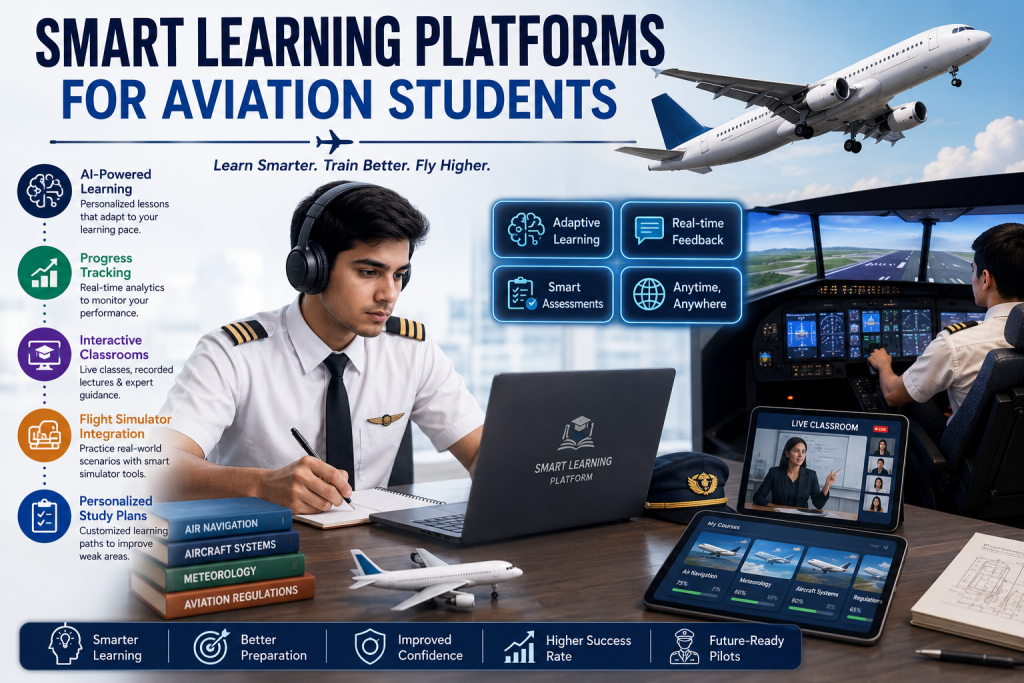
Today, the aviation industry is undergoing a major transformation. Smart learning platforms for aviation students are changing how future pilots study, practice, and prepare for real-world flying. These platforms combine Artificial Intelligence, digital classrooms, and simulation technology to create a more personalized and efficient learning experience.
In this blog, we will explore how smart learning platforms are shaping the future of aviation education and why they are becoming essential for pilot training.
What Are Smart Learning Platforms in Aviation?
Smart learning platforms are digital education systems designed to enhance aviation training using technology such as Artificial Intelligence, data analytics, and simulation-based learning.
Unlike traditional methods, these platforms:
- Adapt to each student’s learning speed
- Provide real-time feedback
- Track performance continuously
- Offer interactive aviation content
- Integrate flight simulation practice
In simple terms, a smart learning platform acts like a digital aviation instructor that guides students throughout their learning journey.
Why Aviation Students Need Smart Learning Platforms
Pilot training is not like regular academic learning. It requires precision, repetition, and real-time decision-making skills. Every student learns differently, and traditional classroom systems often follow a fixed pace.
Smart learning platforms help solve this problem by:
- Personalizing study paths for each student
- Identifying weak areas early
- Reducing training delays
- Improving exam preparation
- Supporting simulator-based learning
- Making complex topics easier to understand
For example, one student may struggle with navigation calculations, while another may find meteorology difficult. A smart platform can automatically adjust lessons for each student individually.
Core Features of Aviation Smart Learning Platforms
Modern aviation learning platforms include several powerful features that support student pilots throughout their training.
Adaptive Learning Systems
These systems adjust lesson difficulty based on student performance. If a student performs well, the system increases difficulty. If the student struggles, it provides additional practice.
AI-Based Progress Tracking
AI continuously monitors:
- Quiz results
- Simulator performance
- Study time
- Weak topics
- Improvement trends
This helps instructors and students understand progress clearly.
Interactive Digital Classrooms
Students can attend:
- Live aviation classes
- Recorded lectures
- Group discussions
- Q&A sessions with instructors
This makes learning more flexible and accessible.
Flight Simulation Integration
Smart platforms often connect with flight simulators to provide:
- Realistic training scenarios
- Emergency handling practice
- Weather-based flying conditions
- Performance scoring
This bridges the gap between theory and real flying.
Role of AI in Aviation Education
Artificial Intelligence plays a central role in smart aviation learning systems. It improves training efficiency by analyzing student data and offering personalized recommendations.
AI helps by:
- Detecting learning gaps
- Predicting exam readiness
- Suggesting revision topics
- Providing instant feedback
- Creating customized learning plans
AI does not replace instructors; instead, it supports them by providing deeper insights into student performance.
Flight Simulators and Smart Learning Integration
Flight simulators are one of the most important tools in pilot training. When combined with smart learning platforms, they become even more powerful.
Students can practice:
- Takeoff and landing
- Navigation procedures
- Emergency situations
- Air traffic communication
- Instrument flying
Smart systems evaluate performance in real time and highlight areas that need improvement. This allows students to learn from mistakes in a safe environment.
Personalized Pilot Training Experience
One of the biggest advantages of smart learning platforms is personalization.
Each student receives:
- Customized study plans
- Topic-based recommendations
- Difficulty-adjusted lessons
- Individual performance reports
- Targeted practice exercises
For example, if a student struggles with air regulations, the system automatically assigns extra quizzes and video explanations for that topic.
This makes learning more efficient and focused.
Digital Aviation Classrooms
Digital classrooms allow aviation students to learn from anywhere in the world.
These platforms offer:
- Live instructor-led sessions
- Recorded training modules
- Interactive diagrams and charts
- Global instructor access
- Flexible study schedules
This is especially helpful for students in remote locations or those balancing multiple commitments.
Data-Driven Learning in Aviation
Smart platforms use data to improve training outcomes.
They track:
- Performance in exams
- Simulator accuracy
- Time spent on topics
- Learning consistency
- Improvement trends
Using this data, the system predicts whether a student is ready for the next stage of training or needs additional practice.
Benefits of Smart Learning Platforms
Smart learning platforms provide many advantages for aviation students:
- Faster learning progress
- Better exam preparation
- Real-time feedback
- Personalized learning experience
- Improved retention of knowledge
- Reduced training delays
- Better understanding of complex topics
- Flexible learning schedules
These benefits make pilot training more structured and efficient.
Challenges and Limitations
While smart learning platforms offer many benefits, they also have some limitations:
- High technology setup cost
- Dependence on internet connectivity
- Need for instructor training
- Data privacy concerns
- Risk of over-reliance on automation
Despite these challenges, the benefits continue to grow as technology improves.
Traditional vs Smart Learning Platforms
| Feature | Traditional Training | Smart Learning Platforms |
|---|---|---|
| Learning Style | Fixed pace | Adaptive learning |
| Feedback | Delayed | Real-time |
| Practice Method | Manual | AI-driven simulation |
| Performance Tracking | Limited | Advanced analytics |
| Personalization | Low | High |
| Accessibility | Classroom-based | Global digital access |
Smart platforms clearly offer a more flexible and data-driven learning experience.
Future of Aviation Learning Technology
The future of aviation education is becoming more digital and intelligent. Smart learning platforms are expected to evolve further with:
- Virtual reality flight training
- AI copilots for learning
- Digital twin aircraft simulations
- Fully automated performance tracking
- Global online aviation academies
These innovations will make pilot training more accessible, efficient, and safer.
Common Myths About Smart Learning in Aviation
| Myth | Fact |
|---|---|
| AI replaces flight instructors | AI supports instructors, not replaces them |
| Online learning cannot train pilots | It enhances theory and simulation training |
| Simulators are not real training | They are essential for safe skill practice |
| Only airlines use AI systems | Flight schools also use smart platforms |
| Smart learning is too complex | It simplifies learning for students |
Tips for Aviation Students Using Smart Platforms
To get the best results from smart learning platforms:
- Study regularly using the platform
- Follow AI feedback carefully
- Practice simulator sessions consistently
- Focus on weak subjects first
- Combine theory with practical training
- Track your performance weekly
- Ask instructors for clarification when needed
Consistency is the key to success in aviation training.
Frequently Asked Questions
1. What are smart learning platforms for aviation students?
They are digital systems that use AI, simulation, and data analytics to personalize aviation training and improve student performance.
2. How does AI help in pilot training?
AI analyzes student performance, identifies weak areas, and provides personalized learning recommendations and feedback.
3. Can simulators replace real flying?
No. Simulators are used for practice and skill development but cannot fully replace real aircraft experience.
4. Are smart learning platforms useful for beginners?
Yes. They help beginners understand complex aviation topics step by step with personalized guidance.
5. What subjects can be learned on these platforms?
Subjects like navigation, meteorology, air regulations, aircraft systems, and performance can be effectively learned.
6. Do airlines use smart training systems?
Yes, many airlines use advanced training systems for pilot assessment and simulation-based training.
7. Is online aviation training effective?
Yes, especially for theoretical subjects and simulator-based learning when combined with instructor guidance.
8. How does personalization work in aviation learning?
The system tracks student performance and adjusts lessons, difficulty levels, and practice sessions accordingly.
9. What skills improve the most?
Students improve in navigation, decision-making, exam preparation, and simulator performance.
10. What is the future of aviation EdTech?
It includes AI tutors, VR simulation, digital twin aircraft, and fully adaptive aviation learning systems.
Conclusion
Smart learning platforms for aviation students are transforming the way future pilots are trained. By combining Artificial Intelligence, simulation technology, and data-driven learning, these systems make aviation education more personalized, efficient, and accessible.
Instead of replacing instructors, these platforms support them by providing deeper insights into student performance and improving training quality. As aviation continues to evolve, smart learning systems will play a major role in shaping safer and better-prepared pilots for the future.