Introduction
Pilot training has always required discipline, practice, instructor guidance, and strong decision-making. Traditionally, every student followed a similar training structure, even though each learner had different strengths, weaknesses, speed, confidence level, and learning style.
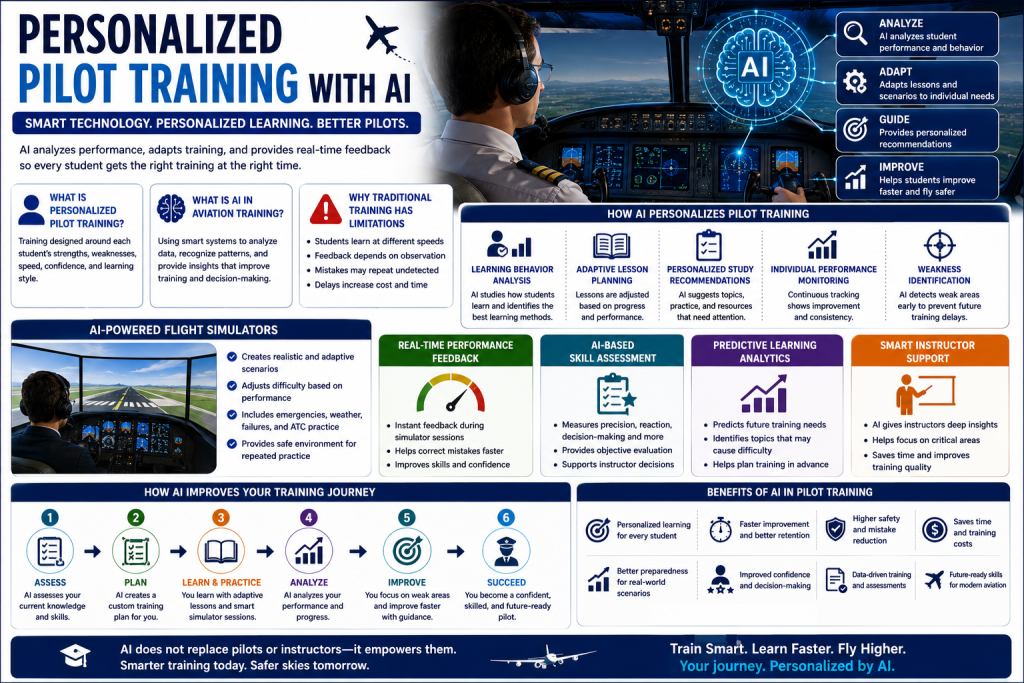
Today, Artificial Intelligence is changing how aviation academies train future pilots. AI can study student performance, identify weak areas, recommend custom practice, support simulator learning, and provide faster feedback. This creates a more personalized training experience for every student pilot.
Personalized pilot training with AI does not replace human instructors. Instead, it supports instructors and students with smarter data, better learning insights, and more focused training.
What Is Personalized Pilot Training?
Personalized pilot training means designing the learning journey around the individual student.
Instead of giving every student the same lesson plan at the same speed, personalized training adjusts based on:
- Student progress
- Learning speed
- Weak areas
- Confidence level
- Simulator performance
- Ground school results
- Flight training behavior
- Communication skills
- Decision-making ability
For example, one student may need more help with radio communication, while another may struggle with landing approach. AI can help identify these patterns and recommend focused practice.
What Is AI in Aviation Training?
Artificial Intelligence means using smart computer systems that can analyze data, recognize patterns, and make useful recommendations.
In aviation training, AI can support:
- Flight simulator analysis
- Ground school learning
- Student progress tracking
- Performance scoring
- Scenario-based training
- Error detection
- Personalized revision plans
- Virtual tutoring
- Predictive learning analytics
AI helps convert training data into useful learning guidance.
Why Traditional Pilot Training Has Limitations
Traditional pilot training is effective, but it can have some limitations.
Common challenges include:
- Students learn at different speeds
- Instructors may not always have time for deep data analysis
- Feedback may depend on observation alone
- Some mistakes may repeat without early detection
- Ground school and flight training may not always connect smoothly
- Training delays can increase cost
- Students may not know exactly where they are weak
AI helps solve these challenges by tracking performance continuously and giving more detailed insights.
How AI Personalizes Pilot Training
AI can personalize pilot training in several ways.
Learning Behavior Analysis
AI can analyze how a student studies, practices, answers questions, and performs in simulator sessions.
It can identify whether the student learns better through:
- Visual lessons
- Practice questions
- Simulator repetition
- Scenario-based learning
- Instructor explanations
- Step-by-step revision
This helps create a better learning path.
Adaptive Lesson Planning
AI can adjust lesson plans based on student progress.
If a student performs well in navigation but struggles with weather interpretation, the system can recommend more meteorology practice. If a student needs more landing practice, simulator scenarios can be adjusted accordingly.
This saves time and makes training more focused.
Personalized Study Recommendations
AI can recommend topics for revision.
For example, if a student repeatedly makes mistakes in fuel calculations, the system may suggest:
- Extra fuel planning lessons
- Practice questions
- Video explanations
- Instructor review
- Simulator scenarios involving fuel decisions
This helps students study smarter.
Individual Performance Monitoring
AI can track performance over time.
It can show whether a student is improving, repeating mistakes, or losing consistency. This gives instructors a clearer picture of the student’s development.
Weakness Identification
One of the biggest benefits of AI is early weakness detection.
AI can identify issues such as:
- Poor approach stability
- Late checklist completion
- Weak radio calls
- Unstable altitude control
- Slow emergency response
- Navigation confusion
- Poor situational awareness
Early detection helps prevent small problems from becoming serious training delays.
AI-Powered Flight Simulators
Flight simulators are already important in pilot training. With AI, simulators can become even more powerful.
AI-powered simulators can create:
- Weather challenges
- Engine failure scenarios
- Navigation problems
- Emergency situations
- Crosswind landings
- Poor visibility training
- Air traffic communication practice
- Adaptive difficulty levels
If a student performs well, the simulator can increase difficulty. If the student struggles, it can slow down and provide more guided practice.
Real-Time Performance Feedback
AI can provide real-time feedback during simulator training.
It can evaluate:
- Flight path
- Altitude control
- Speed management
- Landing alignment
- Checklist usage
- Radio communication
- Navigation accuracy
- Decision-making
- Fuel management
- Situational awareness
Immediate feedback helps students correct mistakes faster.
AI-Based Skill Assessment
AI can help assess student performance more objectively.
It can measure:
- Reaction time
- Flight precision
- Procedure following
- Cockpit workload handling
- Risk awareness
- Communication clarity
- Landing consistency
- Emergency response
- Checklist discipline
- Route accuracy
This gives instructors stronger data to support their judgment.
Predictive Learning Analytics
Predictive learning means using past performance data to estimate future training needs.
AI can help predict:
- Which topic may cause difficulty
- Which skill needs more practice
- Whether the student is ready for the next stage
- Whether exam preparation is strong enough
- Whether simulator performance is improving
- Whether training delays may occur
This allows aviation academies to support students before problems grow.
Virtual AI Flight Instructor
A virtual AI flight instructor is a digital assistant that helps students outside normal classroom hours.
It can support students by:
- Answering aviation questions
- Explaining difficult topics
- Giving practice quizzes
- Reviewing procedures
- Helping with checklist memorization
- Supporting exam revision
- Explaining simulator mistakes
- Creating study plans
However, AI should support human instructors, not replace them. Real instructors provide judgment, mentorship, discipline, emotional support, and real-world flying experience.
Human Instructor vs AI Training System
| Human Instructor | AI Training System |
|---|---|
| Gives real-world flying judgment | Analyzes performance data |
| Provides mentorship | Tracks progress continuously |
| Understands student emotions | Gives instant feedback |
| Teaches cockpit discipline | Finds repeated error patterns |
| Handles real aircraft training | Supports simulator and study practice |
| Builds confidence | Recommends personalized lessons |
| Makes final training decisions | Provides data-driven insights |
The best pilot training model combines both human instructors and AI systems.
Benefits of Personalized Pilot Training with AI
AI can improve pilot training in many ways.
Faster Learning
Students can focus on weak areas instead of repeating topics they already understand. This can make learning more efficient.
Better Feedback
AI can give detailed feedback after every simulator session, quiz, or training activity.
Improved Confidence
When students know exactly what to improve, they feel more confident and less confused.
Reduced Training Delays
Early weakness detection can reduce repeated mistakes and training gaps.
Better Exam Preparation
AI can recommend revision topics, practice tests, and customized study plans.
Objective Assessment
AI can support fairer evaluation by using performance data, not only memory or general observation.
Improved Safety Awareness
Scenario-based AI training can expose students to emergencies and decision-making situations in a safe simulator environment.
Cost Efficiency
Focused training can help reduce unnecessary repetition and improve training planning, which may help manage costs.
AI in Ground School Training
AI is useful not only in flying but also in ground school.
It can help students learn:
- Air navigation
- Meteorology
- Air regulations
- Aircraft systems
- Human performance
- Radio communication
- Flight planning
- Aerodynamics
- Emergency procedures
AI can create custom quizzes, explain wrong answers, and track topic-wise performance.
AI in Simulator-Based Emergency Training
Emergency training is one of the strongest use cases for AI.
Students can practice:
- Engine failure
- Electrical failure
- Bad weather diversion
- Communication failure
- Runway change
- Low visibility approach
- Fuel emergency
- Unstable approach
- Traffic conflict
- Go-around decision
AI can adjust scenarios based on student performance and help build better decision-making.
Challenges of AI in Pilot Training
AI has many benefits, but it also has limitations.
Common challenges include:
- High setup cost
- Need for quality data
- Data privacy concerns
- Technology dependence
- Instructor training requirements
- Software maintenance
- Possible AI bias
- Regulatory acceptance
- Infrastructure needs
- Student overdependence on automation
AI should be used carefully and responsibly in aviation education.
Why AI Cannot Replace Human Flight Instructors
Flying is not only about data. It also requires judgment, confidence, discipline, communication, and real-world experience.
Human instructors teach:
- Real aircraft handling
- Safety mindset
- Cockpit discipline
- Weather judgment
- Professional attitude
- Emotional confidence
- Emergency decision-making
- Real-world flying habits
AI can support learning, but final flight training must remain guided by qualified human instructors.
Future of AI in Pilot Training
The future of pilot training may include:
- AI-powered flight simulators
- Virtual aviation tutors
- Personalized training dashboards
- Predictive student progress systems
- Mixed reality cockpit training
- Voice-based AI instructors
- Smart ground school platforms
- AI-supported safety analysis
- Digital twin aircraft training
- Automated performance reports
Aviation academies that use AI responsibly can provide more modern, efficient, and student-focused training.
Common Myths About AI Pilot Training
| Myth | Fact |
|---|---|
| AI will replace flight instructors | AI supports instructors but cannot replace real flying judgment |
| AI makes pilot training easy | AI makes training more focused, but students still need discipline |
| AI can train pilots without real aircraft | Real flying remains essential |
| AI is only useful for airlines | Flight schools and student pilots can also benefit |
| AI removes human decision-making | Pilots must still make safe decisions |
| AI feedback is always perfect | AI must be reviewed and guided by experts |
| AI training is only for advanced pilots | Beginners can also benefit from adaptive learning |
Tips for Students Using AI-Based Training
Students should use AI wisely.
Helpful tips include:
- Treat AI as a learning assistant
- Review feedback after every session
- Ask instructors about repeated mistakes
- Practice regularly
- Do not skip aviation fundamentals
- Combine simulator learning with real flying
- Use AI quizzes for revision
- Track your progress
- Stay disciplined
- Build decision-making skills
AI can guide you, but your effort decides your progress.
Frequently Asked Questions
1. What is AI-based pilot training?
AI-based pilot training uses artificial intelligence to analyze student performance, provide feedback, recommend lessons, and personalize learning. It can support simulator training, ground school, and progress tracking.
2. Can AI replace flight instructors?
No. AI can support flight instructors, but it cannot replace human judgment, mentorship, real aircraft training, and safety decision-making.
3. How does AI personalize pilot training?
AI studies student performance and identifies strengths and weaknesses. It then recommends customized lessons, extra practice, quizzes, or simulator scenarios.
4. Are AI flight simulators realistic?
AI-powered simulators can create realistic training situations such as weather problems, emergencies, navigation tasks, and landing challenges. They are useful for practice but do not replace real flight experience.
5. Does AI improve flight safety?
AI can improve safety awareness by helping students practice emergencies, detect mistakes early, and learn better decision-making in a controlled environment.
6. Can beginners benefit from AI training?
Yes. Beginners can benefit from personalized study plans, step-by-step feedback, simulator practice, and topic-wise learning support.
7. Is AI expensive for aviation academies?
AI systems can require investment in software, simulators, data systems, and instructor training. However, they may improve efficiency and training quality over time.
8. What skills can AI evaluate?
AI can evaluate speed control, altitude management, landing accuracy, checklist usage, navigation, radio communication, decision-making, and simulator performance.
9. What is predictive learning in pilot training?
Predictive learning uses past performance data to estimate future training needs. It helps identify weak areas early and recommends focused practice.
10. What is the future of AI in aviation education?
The future may include AI tutors, smart simulators, personalized dashboards, mixed reality training, digital twins, and advanced performance analytics.
Conclusion
Personalized pilot training with AI is changing how students learn aviation. By analyzing performance, identifying weaknesses, creating adaptive lessons, and giving faster feedback, AI helps make training more focused and student-friendly.
The strongest approach is not AI alone, but AI combined with experienced human instructors. Together, they can create safer, smarter, and more efficient pilot training for the next generation of aviation professionals.