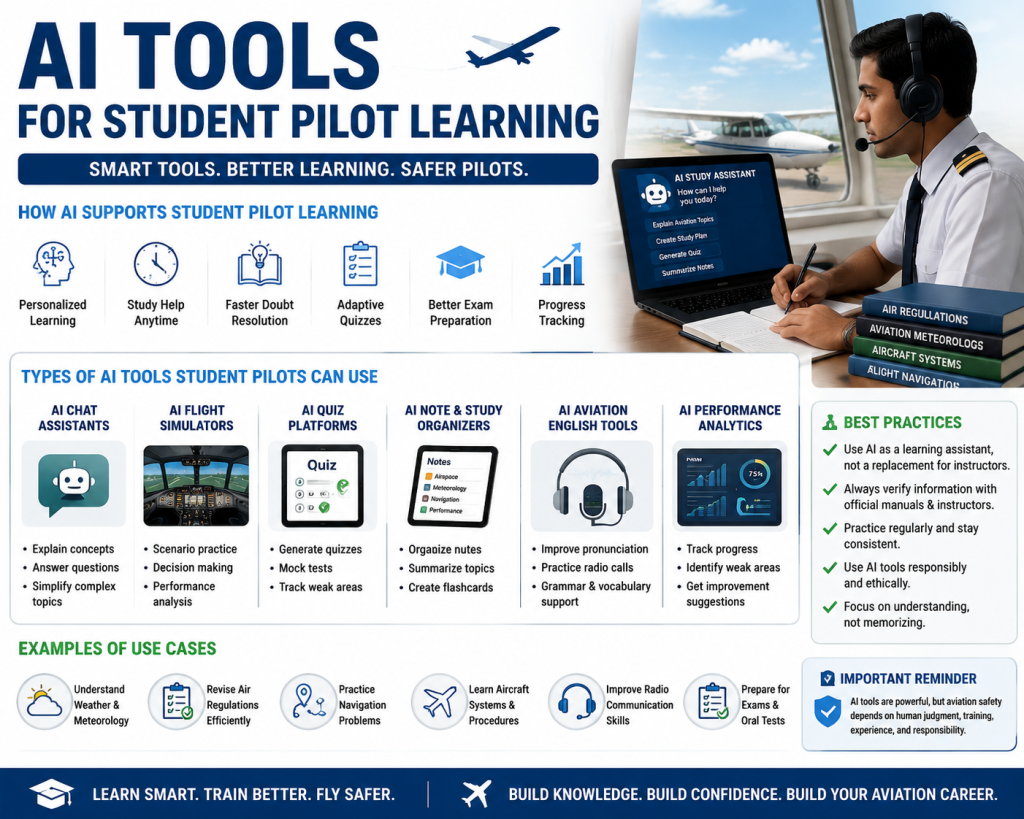
Introduction
Aviation training is becoming smarter, faster, and more technology-driven. Student pilots no longer depend only on textbooks, classroom notes, and simulator sessions. Today, AI tools can help learners understand difficult aviation topics, revise faster, practice decision-making, organize study plans, and receive instant feedback during preparation.
Artificial Intelligence is also becoming more important across the aviation industry. Aviation organizations are exploring AI for training, safety analysis, performance monitoring, and risk identification, while experts continue to emphasize safety, trust, and human oversight in aviation AI systems.
For student pilots, AI should not replace instructors, official manuals, or real flight training. Instead, it should work as a smart learning assistant. This guide explains how AI tools can support student pilot learning, what tools are useful, where AI helps most, and how to use it responsibly.
What Are AI Tools for Student Pilots?
AI tools for student pilots are digital learning systems that use artificial intelligence to support aviation education. These tools can answer questions, summarize topics, create quizzes, generate study plans, explain procedures, analyze weak areas, and help students revise difficult subjects.
For example, a student pilot can use an AI assistant to understand aviation meteorology, create flashcards for air regulations, summarize navigation notes, or practice mock oral questions before an exam.
AI tools may support:
- Personalized learning
- Doubt solving
- Ground school revision
- Flight simulator practice
- Aviation English improvement
- Exam preparation
- Note organization
- Performance tracking
The main goal is simple: help student pilots learn better and with more confidence.
Why AI Is Transforming Pilot Training
AI is changing pilot training because it can make learning more personalized and data-driven. Traditional training often follows the same pace for every student. AI can adjust learning based on the student’s strengths, weaknesses, and progress.
In simulator-based training, AI can help analyze performance data and identify areas where a student needs improvement. Some aviation training discussions highlight AI-enabled simulators that can collect and analyze training data to support personalized learning programs.
AI can also support training by:
- Identifying repeated mistakes
- Creating custom revision plans
- Giving instant explanations
- Improving knowledge retention
- Supporting scenario-based learning
- Helping instructors understand student performance
This makes AI a useful support system for modern aviation education.
Benefits of AI Tools for Student Pilot Learning
Personalized Learning Experience
Every student pilot learns differently. Some students understand aircraft systems quickly but struggle with navigation. Others may be strong in theory but weak in meteorology. AI tools can create personalized study plans based on individual learning needs.
This helps students focus more time on weak areas instead of repeating topics they already understand.
Study Help Anytime
AI tools are available anytime. A student can revise late at night, ask questions after ground school, or review concepts before a simulator session. This 24/7 availability makes learning more flexible.
However, students should still confirm technical aviation information with instructors and official training material.
Faster Doubt Resolution
Student pilots often face doubts while studying topics such as airspace, wind correction, aircraft instruments, or radio communication. AI tools can explain these topics in simple language and provide examples.
This helps students avoid long learning gaps.
Adaptive Quizzes
AI quiz tools can generate practice questions based on weak topics. If a student performs poorly in meteorology, the tool can create more questions on clouds, pressure systems, visibility, and weather interpretation.
This makes revision more focused and effective.
Better Exam Preparation
Pilot exams require consistent preparation. AI can help students create mock tests, flashcards, oral exam questions, and revision schedules. It can also explain why an answer is correct or incorrect.
This improves confidence before exams.
Improved Aviation English
Clear communication is essential in aviation. AI writing and speaking tools can help students improve aviation English, pronunciation, grammar, and radio communication practice.
This is especially useful for students who are not fully confident in English.
Progress Tracking
Some AI-powered learning platforms can track progress and show which topics need more attention. This helps students study with a clear plan instead of random revision.
Types of AI Tools Student Pilots Can Use
AI Chat Assistants
AI chat assistants can explain aviation concepts in simple words. Students can ask questions such as:
- What is lift?
- How does weather affect flying?
- What is controlled airspace?
- How do I remember emergency checklist steps?
- What is the difference between true heading and magnetic heading?
Tools like ChatGPT, Microsoft Copilot, and Google Gemini can be helpful for concept explanation, but aviation facts should always be verified from official sources and instructors.
AI Flight Simulators
AI-powered simulators can support scenario-based learning. They may help students practice decision-making, checklist discipline, weather-related decisions, and emergency procedures.
Modern discussions around pilot training mention AI-enabled simulators that assess response time, adaptability, and learning performance.
Simulators cannot replace real flying, but they can improve confidence before actual aircraft training.
AI Quiz Platforms
AI quiz platforms help students test their knowledge. They can create practice questions for air regulations, navigation, meteorology, aircraft systems, and human factors.
These tools are useful for daily revision and exam preparation.
AI Flashcard Tools
Flashcards help students remember aviation terms, formulas, definitions, and procedures. AI-powered flashcard tools can automatically generate cards from notes and help students revise using spaced repetition.
This is useful for subjects that require memory and repeated revision.
AI Note-Taking Tools
Student pilots often attend ground classes, simulator briefings, and instructor sessions. AI note-taking tools can summarize lectures, organize points, and create revision notes.
This saves time and makes study material easier to review.
AI Language Learning Tools
Aviation requires clear English communication. AI language tools can help students practice grammar, pronunciation, listening, and speaking.
They can also help students write better notes, prepare answers, and improve confidence in aviation conversations.
AI Study Planners
AI study planners can create daily or weekly study schedules. For example, a student preparing for a pilot exam can ask AI to divide topics across available days.
This helps avoid last-minute pressure.
AI Performance Analytics
AI analytics tools can help identify weak areas. In simulator training, performance analytics may highlight checklist errors, delayed responses, poor decision-making, or repeated mistakes.
This allows students to improve with better focus.
Best AI Tools for Student Pilot Learning
| AI Tool | Best For | Key Features |
|---|---|---|
| ChatGPT | Concept explanation | Doubt solving, study notes, mock questions |
| Microsoft Copilot | Research and productivity | Summaries, writing help, learning support |
| Google Gemini | Learning assistance | Topic explanation, study planning, research support |
| Notion AI | Study organization | Notes, summaries, study database |
| Grammarly | Aviation English | Grammar, clarity, professional writing |
| Quizlet AI | Flashcards and revision | Practice sets, memory-based learning |
| Anki | Spaced repetition | Long-term memory and flashcards |
| Khanmigo | Learning support | Guided explanations and tutoring style help |
| Canva AI | Visual learning | Diagrams, presentations, study graphics |
| Otter AI | Lecture notes | Transcription, summaries, class notes |
Students should use these tools as learning support only. Aviation regulations, aircraft procedures, emergency actions, and flight decisions must always be verified with approved instructors, official manuals, and current aviation authority guidance.
How AI Helps During Ground School
Ground school is where student pilots build their theoretical foundation. AI can make ground school subjects easier to understand and revise.
Air Regulations
AI can simplify complex aviation rules and help students create summaries. It can also generate practice questions for revision.
Aviation Meteorology
Weather is one of the most important topics for pilots. AI can explain clouds, wind, visibility, pressure, thunderstorms, fog, and weather-related flight risks in simple terms.
Navigation
AI tools can explain basic navigation concepts, route planning, headings, bearings, and map reading. Students can also use AI to create practice problems.
Aircraft Systems
Aircraft systems can feel technical for beginners. AI can break down topics like engine systems, fuel systems, instruments, electrical systems, and flight controls.
Principles of Flight
AI can explain lift, drag, thrust, weight, angle of attack, stalls, and aircraft stability with examples.
Human Factors
Human factors include fatigue, stress, decision-making, communication, and situational awareness. AI can help students understand real-world pilot behavior and safety lessons.
Flight Planning
AI can help students understand the basic logic of flight planning, including fuel, route, weather, alternate planning, and time calculation.
Aviation Safety
AI can explain safety culture, checklist discipline, threat management, and error prevention. Aviation safety experts are also exploring AI for risk identification and safety analysis across the industry.
AI for Flight Simulator Practice
Flight simulators are already important in pilot training. AI can make simulator practice more intelligent by tracking performance and creating realistic scenarios.
AI may help with:
- Checklist practice
- Emergency procedure training
- Weather decision-making
- Radio communication practice
- Landing approach review
- Scenario-based learning
- Mistake analysis
- Post-session feedback
For example, AI-driven debriefing tools can examine simulator sessions and identify issues such as missed callouts, checklist deviations, or unstable approaches.
This type of feedback can help students understand not only what went wrong, but why it happened.
AI for Pilot Exam Preparation
Pilot exams require discipline, consistency, and repeated revision. AI tools can help students prepare more efficiently.
AI can support exam preparation through:
- Mock exams
- Topic-wise quizzes
- Flashcards
- Short summaries
- Weak area analysis
- Daily revision plans
- Oral exam practice
- Time management
A student preparing for aviation meteorology can ask AI to create 30 practice questions. A student preparing for navigation can ask AI to explain common mistakes. A student preparing for oral exams can ask AI to act like an examiner and ask questions.
This makes learning more interactive.
Limitations of AI in Pilot Training
AI is powerful, but it has limits. Student pilots must understand these limits clearly.
AI Cannot Replace Flight Instructors
Flying is a practical skill. Only trained instructors can properly evaluate aircraft handling, cockpit discipline, decision-making, and real-time performance.
AI Can Make Mistakes
AI may generate incorrect or outdated information. This is risky in aviation because procedures and regulations must be accurate.
AI Cannot Replace Official Manuals
Students must always study approved manuals, school material, aircraft handbooks, and aviation authority guidance.
AI Cannot Replace Real Flying
Simulator and AI learning are useful, but real aircraft training is essential for developing pilot judgment and control skills.
AI Requires Human Oversight
Aviation regulators and safety organizations continue to emphasize trust, safety, certification, and human oversight in AI adoption.
Tips for Using AI Effectively
Student pilots should use AI smartly and responsibly.
Follow these tips:
- Use AI for daily revision
- Ask AI to explain difficult concepts simply
- Create topic-wise quizzes
- Make flashcards from ground school notes
- Practice aviation English
- Use AI to summarize long notes
- Verify every technical answer
- Confirm procedures with instructors
- Do not use AI as a shortcut
- Keep official manuals as the main source
AI works best when it supports disciplined learning.
Common Mistakes to Avoid
Avoid these mistakes while using AI tools:
- Blindly trusting AI answers
- Ignoring instructor guidance
- Using AI instead of official manuals
- Depending only on summaries
- Skipping practical training
- Not verifying aviation regulations
- Asking vague questions
- Using AI only before exams
- Forgetting checklist discipline
- Treating AI like a certified aviation authority
AI can help you learn, but responsibility remains with the student and instructor.
Future of AI in Aviation Education
The future of aviation education will likely include more AI-powered learning systems. Student pilots may see smarter simulators, virtual instructors, adaptive classrooms, AI-based performance dashboards, and personalized aviation learning platforms.
Future AI tools may help students:
- Learn with virtual aviation tutors
- Practice emergency scenarios safely
- Receive detailed simulator feedback
- Track skill development
- Improve communication
- Build stronger decision-making habits
- Prepare better for exams
AI and VR are also being discussed as important technologies in pilot training because they can support realistic practice and personalized learning experiences.
However, aviation will always require human judgment, instructor supervision, safety discipline, and real-world flying experience.
Frequently Asked Questions
1. Can AI replace flight instructors?
No, AI cannot replace flight instructors. It can explain topics, create quizzes, and support revision, but it cannot fully evaluate real flying skills, cockpit behavior, or safety judgment. Student pilots should always train under approved instructors.
2. Is ChatGPT useful for pilot students?
Yes, ChatGPT can be useful for explaining aviation concepts, creating study notes, generating practice questions, and helping with revision. However, students must verify aviation rules, procedures, and technical information with instructors and official sources.
3. Which AI tool is best for aviation study?
There is no single best tool for every student. ChatGPT is useful for explanations, Quizlet and Anki are useful for revision, Grammarly helps with English, and Notion AI helps organize notes. The best choice depends on the student’s learning need.
4. Can AI improve pilot exam preparation?
Yes, AI can improve exam preparation by creating quizzes, mock tests, summaries, flashcards, and study schedules. It can also identify weak topics and help students revise more effectively before exams.
5. Are AI flight simulators accurate?
AI flight simulators can be useful for practice and scenario-based learning, but accuracy depends on the simulator quality, software, aircraft model, and training setup. Students should treat simulators as learning tools, not replacements for real aircraft training.
6. Can AI help with aviation English?
Yes, AI tools can help students improve grammar, pronunciation, vocabulary, and communication confidence. They can also help students practice aviation-related conversations and radio communication basics.
7. Can AI help in DGCA exam preparation?
AI can support DGCA exam preparation by explaining topics, creating practice questions, and organizing revision. However, students should always study official syllabus, approved books, instructor notes, and current DGCA guidance.
8. Are AI study tools free?
Some AI tools offer free versions, while others require paid plans for advanced features. Student pilots can begin with free tools and upgrade only when they need extra features such as advanced summaries, analytics, or larger study databases.
9. What are the risks of using AI in pilot learning?
The biggest risks are incorrect answers, outdated information, overdependence, and ignoring instructor guidance. Aviation learning must be accurate, so every important answer should be verified before use.
10. How should student pilots use AI responsibly?
Student pilots should use AI as a study assistant, not as an authority. They should verify technical details, follow instructor guidance, study official materials, and use AI mainly for revision, explanation, practice, and organization.
Key Takeaways
- AI tools can make student pilot learning more personalized and interactive.
- AI can help with ground school, exam preparation, notes, quizzes, and aviation English.
- AI-powered simulators can support decision-making and scenario practice.
- Student pilots should never replace instructors or official manuals with AI.
- AI is useful for revision, but aviation safety requires verified knowledge.
- Smart use of AI can save time and improve confidence.
- The future of pilot training will include more AI-based learning support.
- Responsible AI use is essential in aviation education.
Conclusion
AI tools are changing how student pilots learn, revise, and prepare for aviation training. From chat assistants and flashcards to simulator feedback and study planners, AI can make learning more organized, interactive, and personalized. It can help students understand difficult concepts, prepare for exams, improve English communication, and build stronger confidence before practical training.
At the same time, aviation is a safety-critical field. Student pilots must use AI responsibly and never treat it as a replacement for instructors, official manuals, or real flight experience. The best approach is to combine AI-powered learning with disciplined study, instructor guidance, simulator practice, and approved aviation training. When used correctly, AI can become a powerful learning partner for the next generation of pilots.
SEO Meta Title
AI Tools for Student Pilot Learning
Meta Description
Learn how AI tools help student pilots with ground school, flight simulator practice, exam preparation, aviation English, and smarter pilot learning.
Suggested URL Slug
ai-tools-for-student-pilot-learning
Image Suggestions
- Student pilot using AI tools on a laptop
- AI-powered flight simulator training setup
- Digital aviation classroom with smart learning screen
- Pilot trainee studying with virtual assistant
- Aviation academy using modern AI learning technology
Hashtags
#AIAviation, #StudentPilot, #PilotTraining, #ArtificialIntelligence, #AviationEducation