Introduction
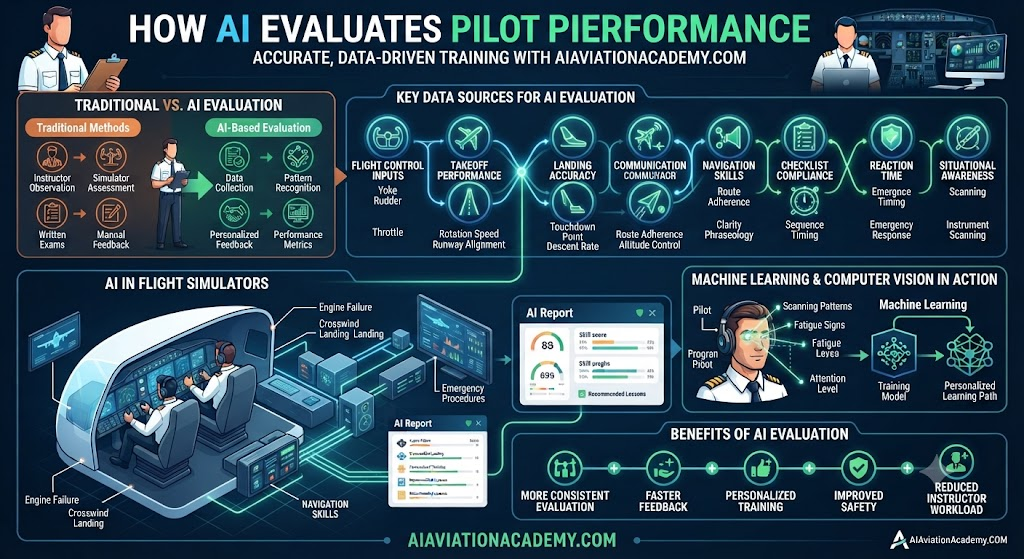
Pilot training has always depended on skill, discipline, practice, and expert instruction. Traditionally, flight instructors evaluated pilot performance through observation, simulator sessions, flight checks, written tests, and manual feedback. While this method remains valuable, modern aviation is becoming more data-driven.
Artificial Intelligence is now helping flight schools, aviation academies, airlines, and training organizations evaluate pilot performance more accurately. AI can study flight data, identify patterns, detect mistakes, measure decision-making, and provide personalized feedback.
This blog from AIAVIATIONACADEMY.COM explains how AI evaluates pilot performance in a simple and beginner-friendly way.
Why Pilot Performance Evaluation Matters
Pilot performance evaluation is important because aviation safety depends on well-trained pilots. A pilot must handle normal flights, emergencies, weather changes, communication, navigation, and cockpit workload.
Good evaluation helps identify:
- Strengths
- Weaknesses
- Training gaps
- Safety risks
- Decision-making quality
- Technical flying skills
- Communication ability
- Situational awareness
The goal is not only to pass exams but to build safe, confident, and professional pilots.
Traditional Pilot Evaluation
Before AI, pilot performance was mostly evaluated by human instructors. This included:
Instructor Observation
The instructor watched the student during flight and noted mistakes, confidence, control handling, and decision-making.
Simulator Assessment
Students practiced normal and emergency scenarios in flight simulators. Instructors judged their response.
Written Exams
Students completed theory exams on navigation, weather, regulations, aircraft systems, and flight planning.
Flight Checks
A practical flight test measured whether the pilot could safely operate the aircraft.
Traditional evaluation is still very important, but it can have limitations. Different instructors may judge performance differently. Some small mistakes may be missed. Feedback may not always be based on detailed data. This is where AI can help.
What Is AI-Based Pilot Evaluation?
AI-based pilot evaluation uses computer systems to collect, analyze, and understand training data. Instead of relying only on human observation, AI studies thousands of data points from simulators, aircraft systems, sensors, and training records.
AI can evaluate:
- How smoothly a pilot controls the aircraft
- How accurately a landing is performed
- How quickly the pilot responds to emergencies
- Whether checklists are followed correctly
- How well the pilot communicates
- How effectively the pilot manages workload
- Whether the pilot improves over time
AI does not replace flight instructors. It supports them with deeper data and more consistent analysis.
Data AI Uses to Evaluate Pilots
AI can analyze many types of data during flight training.
Flight Control Inputs
AI studies how the pilot uses the yoke, sidestick, rudder pedals, throttle, and trim controls.
Takeoff Performance
AI checks runway alignment, rotation speed, climb angle, and control smoothness.
Landing Accuracy
AI evaluates touchdown point, descent rate, runway centerline tracking, flare timing, and braking.
Navigation Skills
AI reviews whether the pilot follows the correct route, altitude, heading, and procedures.
Communication
AI can analyze radio communication clarity, timing, and correct phraseology.
Checklist Compliance
AI checks whether the pilot follows required checklists at the right time.
Reaction Time
During emergency training, AI measures how quickly and correctly the pilot responds.
Situational Awareness
AI studies whether the pilot monitors instruments, traffic, weather, and aircraft condition effectively.
AI in Flight Simulators
Flight simulators are one of the best places to use AI. Simulators already generate large amounts of data, and AI can study this data in detail.
AI can evaluate performance during:
- Engine failure
- Crosswind landing
- Instrument flying
- Poor visibility
- Emergency descent
- System failure
- Weather deviation
- Go-around procedure
- Crew coordination
- Air traffic control communication
After the session, AI can produce a detailed report showing what the pilot did well and where improvement is needed.
Machine Learning in Pilot Training
Machine learning allows AI systems to learn from large amounts of flight data. Over time, these systems can identify patterns in pilot behavior.
For example, AI may notice that a student often approaches the runway too high, reacts late during simulated engine failure, or uses excessive control inputs during turns.
Machine learning can help create personalized training plans. Instead of giving every student the same lesson, AI can recommend practice based on individual performance.
Computer Vision in Pilot Assessment
Computer vision allows AI to analyze visual information. In aviation training, it can be used to study pilot attention and cockpit behavior.
AI may evaluate:
- Eye movement
- Head movement
- Instrument scanning
- Cockpit workload
- Fatigue signs
- Attention during critical phases
- Checklist behavior
For example, if a student does not scan instruments properly during instrument flight, AI can detect the pattern and suggest improvement.
AI Performance Reports
AI-generated performance reports can help both students and instructors. These reports may include:
- Overall score
- Skill-wise performance
- Mistake patterns
- Improvement areas
- Landing analysis
- Emergency response quality
- Checklist accuracy
- Training progress
- Recommended next lessons
This makes feedback more specific and useful.
Benefits of AI in Pilot Evaluation
More Consistent Evaluation
AI applies the same standards every time, reducing inconsistency.
Faster Feedback
Students can receive detailed feedback soon after training.
Personalized Training
AI helps create training plans based on each student’s strengths and weaknesses.
Better Safety
AI can identify risky habits early before they become serious problems.
Reduced Instructor Workload
AI can handle data analysis while instructors focus on teaching and mentoring.
Progress Tracking
AI can compare performance over multiple sessions and show improvement clearly.
Challenges of AI Pilot Evaluation
AI is powerful, but it also has limitations.
Data Privacy
Pilot training data must be protected carefully.
AI Bias
If AI is trained on limited or poor-quality data, its evaluation may not be fair.
Human Oversight
AI feedback should always be reviewed by experienced instructors.
Cost
Advanced AI systems can be expensive for smaller flight schools.
Technology Dependence
Students should not depend only on AI feedback. Human judgment remains essential.
Regulatory Acceptance
Aviation authorities may require careful validation before AI tools are used officially.
AI and Human Instructors
AI should be seen as a support tool, not a replacement for instructors. Human instructors understand emotions, confidence, stress, judgment, and real-world flying experience in ways AI cannot fully replace.
The best training model combines:
- Human instruction
- AI data analysis
- Simulator practice
- Real flight experience
- Personalized feedback
This combination can make pilot training safer and more effective.
Future of AI in Pilot Training
AI will continue to shape the future of aviation education. Future systems may include:
- Real-time cockpit coaching
- Adaptive flight simulators
- AI-based safety prediction
- Virtual instructors
- Advanced fatigue monitoring
- Personalized aviation learning paths
- Integration with VR and AR training
- Predictive skill assessment
As aviation becomes more digital, AI will play a larger role in helping pilots learn faster and fly safer.
Tips for Pilot Students Using AI Feedback
Students should treat AI feedback as a learning tool. Review the data carefully. Compare AI suggestions with instructor comments. Focus on repeated mistakes. Track progress over time. Ask questions when feedback is unclear.
AI can show what happened, but students must still build discipline, judgment, confidence, and professionalism.
FAQs
1. How does AI evaluate pilot performance?
AI evaluates pilot performance by analyzing flight data, simulator data, control inputs, checklist behavior, communication, reaction time, and decision-making patterns.
2. Can AI replace flight instructors?
No. AI supports instructors but does not replace them. Human judgment, experience, and mentoring remain essential in pilot training.
3. Is AI useful in flight simulators?
Yes. AI is very useful in simulators because it can analyze detailed training data and provide accurate feedback after each session.
4. What pilot skills can AI measure?
AI can measure landing accuracy, takeoff performance, navigation, emergency response, checklist use, communication, and aircraft control.
5. Does AI improve aviation safety?
Yes. AI can help identify risky habits early and support safer pilot training through better feedback and performance tracking.
6. Can AI detect pilot fatigue?
Some AI systems can use computer vision and behavior analysis to detect possible signs of fatigue or reduced attention.
7. Is AI-based evaluation fair?
AI can be fair when trained on quality data and monitored by humans. However, poor data or weak design can create bias.
8. Can beginner pilots use AI feedback?
Yes. Beginner pilots can benefit from AI feedback because it helps them understand mistakes clearly and improve step by step.
9. What is the role of machine learning in pilot training?
Machine learning helps AI identify performance patterns, predict training needs, and recommend personalized improvement plans.
10. Is AI the future of pilot training?
AI will become an important part of pilot training, but it will work best when combined with experienced instructors and real flight practice.
Conclusion
Artificial Intelligence is changing how pilot performance is evaluated. It helps instructors and students understand flight behavior through data, patterns, and detailed feedback.
AI can evaluate landings, takeoffs, emergency responses, communication, checklist use, and decision-making. It makes training more consistent, personalized, and safety-focused.
However, AI should not replace human instructors. The future of pilot training will depend on a smart balance between human expertise and intelligent technology.
AIAVIATIONACADEMY.COM can use this topic to educate aviation students, training professionals, and technology learners about the growing role of AI in modern aviation.