Introduction
Aircraft manufacturing is one of the most advanced and careful production processes in the world. Every part of an aircraft must be built with high accuracy because even a small mistake can affect safety, performance, and reliability.
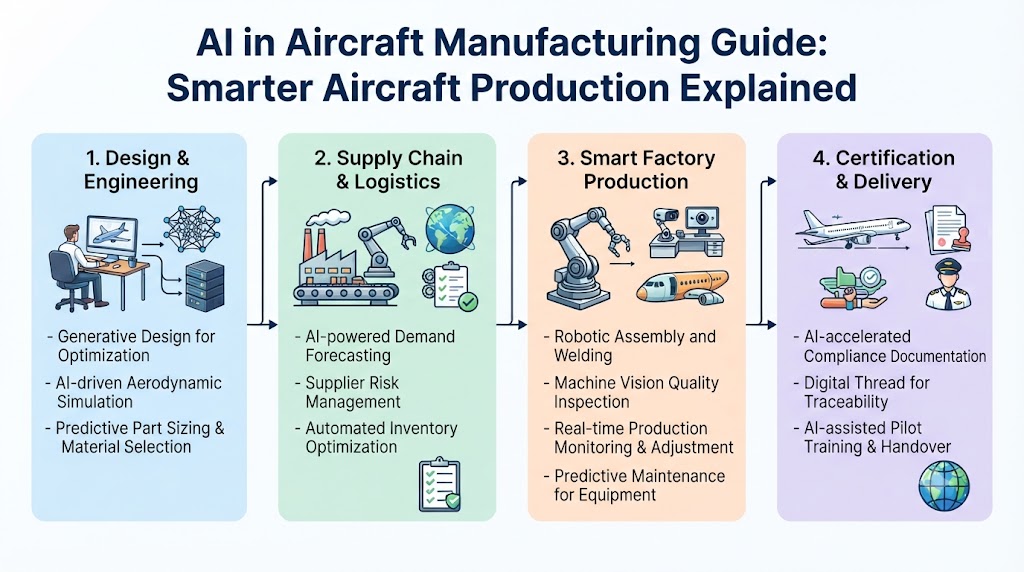
This is why AI in Aircraft Manufacturing Guide is an important topic for aviation students and engineering learners. Artificial Intelligence is helping aircraft manufacturers improve production planning, automate repetitive tasks, inspect parts, predict machine failures, and manage complex supply chains.
AI does not remove the need for skilled engineers. Instead, it gives them better tools to make aircraft production safer, faster, and more accurate.
What Is AI in Aircraft Manufacturing?
AI in aircraft manufacturing means using Artificial Intelligence tools to support aircraft production work. These tools can study data, identify patterns, detect errors, make predictions, and help engineers take better decisions.
In aircraft factories, AI can be used for:
- Production planning
- Robotic assembly
- Quality inspection
- Defect detection
- Machine monitoring
- Material tracking
- Digital simulation
- Supply chain management
- Maintenance of factory equipment
Aircraft manufacturing includes thousands of parts, strict safety rules, and detailed testing. AI helps manage this complexity by making the process more data-driven and efficient.
Why Aircraft Manufacturing Is Complex
Aircraft are not like regular machines. They fly at high speed, face pressure changes, carry passengers or cargo, and must work safely in different weather conditions.
Aircraft manufacturing is complex because it requires:
- High precision
- Strong quality control
- Certified materials
- Accurate documentation
- Skilled workers
- Advanced machinery
- Safety testing
- Regulatory approval
- Part traceability
Each aircraft component must meet strict standards. A wing panel, engine mount, landing gear part, or cabin structure must be manufactured exactly as designed.
Because of this, aircraft production takes time and careful checking. AI helps by supporting engineers and factory teams at every stage.
How AI Helps in Aircraft Manufacturing
AI helps aircraft manufacturers by collecting and analyzing production data. It can find patterns that humans may miss and warn teams before problems become serious.
For example, AI can check whether a machine is producing parts within the correct tolerance. It can identify surface defects using cameras. It can also predict when a production tool may fail.
AI supports aircraft manufacturing by helping with:
- Faster decision-making
- Better production accuracy
- Reduced human error
- Early defect detection
- Improved factory scheduling
- Lower machine downtime
- Better use of materials
- Safer manufacturing processes
This makes aircraft factories smarter and more reliable.
AI in Aircraft Production Planning
Aircraft manufacturing involves many departments working together. Materials, machines, engineers, suppliers, and inspection teams must be properly coordinated.
AI can help production managers plan factory work more effectively. It can study past production data and suggest better schedules.
AI can help answer questions such as:
- Which parts should be produced first?
- Which machines are available?
- Where can delays happen?
- Which supplier may cause a shortage?
- How can factory time be used better?
This helps reduce delays and improves overall production flow.
AI-Powered Robotics in Aircraft Manufacturing
Robots are already used in modern aircraft manufacturing. When combined with AI, they become more flexible and intelligent.
AI-powered robots can support tasks such as:
- Drilling holes
- Fastening parts
- Painting aircraft surfaces
- Moving heavy components
- Cutting materials
- Inspecting parts
- Supporting assembly work
Aircraft parts are often large and complex. AI helps robots understand position, alignment, and movement more accurately.
For example, a robot working on an aircraft fuselage must drill holes with very high precision. AI can help the robot adjust its movement and reduce mistakes.
AI in Quality Inspection
Quality inspection is one of the most important areas where AI is useful.
Aircraft parts must be checked carefully before they are approved. Traditionally, inspection requires trained professionals, measuring tools, cameras, and manual review. AI can make this process faster and more accurate.
AI-based computer vision can inspect:
- Cracks
- Surface defects
- Incorrect fittings
- Paint issues
- Missing fasteners
- Material damage
- Alignment problems
- Welding defects
AI can compare a real part with the correct design and highlight any difference. This helps inspectors focus on the most important issues.
However, human experts are still needed. AI can detect a possible defect, but aviation inspectors and engineers must confirm whether it is acceptable or needs correction.
Digital Twins in Aircraft Manufacturing
A digital twin is a virtual model of a real object, system, or process. In aircraft manufacturing, a digital twin can represent an aircraft part, a production line, or even a complete factory process.
In simple words, it is like creating a digital copy of the manufacturing system.
Digital twins help engineers:
- Test production steps virtually
- Find design or assembly problems early
- Study machine performance
- Improve factory layout
- Reduce trial-and-error work
- Predict production issues
- Improve safety and quality
For example, before a new aircraft part is manufactured, engineers can test the process digitally. They can see whether a machine can produce the part correctly or whether changes are needed.
This saves time and reduces costly mistakes.
AI for Predictive Maintenance of Factory Equipment
Aircraft factories use expensive machines and tools. If one important machine stops working, production can be delayed.
AI helps through predictive maintenance. This means AI studies machine data and predicts when maintenance may be needed.
AI can analyze:
- Vibration
- Temperature
- Pressure
- Noise
- Tool wear
- Machine speed
- Energy use
- Past failure records
If AI detects unusual behavior, it can alert the maintenance team before the machine breaks down.
This helps aircraft manufacturers reduce downtime, avoid emergency repairs, and keep production moving smoothly.
AI in Supply Chain and Material Management
Aircraft manufacturing depends on thousands of parts from many suppliers. A delay in one part can affect the entire production schedule.
AI can help manage supply chains by tracking materials, predicting demand, and identifying possible risks.
AI can support:
- Inventory planning
- Supplier performance tracking
- Material shortage prediction
- Part traceability
- Delivery planning
- Cost control
- Demand forecasting
For aircraft manufacturing, material traceability is very important. Manufacturers must know where each part came from, when it was made, and whether it meets quality standards.
AI can help organize this information and reduce supply chain confusion.
AI in Additive Manufacturing
Additive manufacturing, also known as 3D printing, is becoming useful in aerospace production. It can create complex parts with less material waste.
AI can improve additive manufacturing by helping engineers choose the best design, material, printing method, and quality checks.
AI can help with:
- Lightweight part design
- Print quality control
- Material usage optimization
- Defect prediction
- Shape optimization
- Production cost reduction
This is useful for aircraft parts that need to be light, strong, and complex in shape.
Benefits of AI in Aircraft Manufacturing
AI brings many benefits to aircraft production.
Better Accuracy
AI helps machines and teams produce parts with higher precision.
Faster Inspection
AI-based inspection can check parts quickly and highlight possible defects.
Reduced Manufacturing Errors
AI can detect problems early, before they become costly.
Lower Downtime
Predictive maintenance helps prevent sudden machine breakdowns.
Improved Safety
Better inspection and process control support safer aircraft manufacturing.
Better Material Usage
AI can help reduce waste and improve material planning.
Cost Efficiency
By reducing delays, defects, and waste, AI can help control production costs.
Smarter Decision-Making
AI gives engineers better data for planning, inspection, and improvement.
Challenges of Using AI in Aircraft Manufacturing
AI has many benefits, but it also comes with challenges.
Some common challenges include:
- High implementation cost
- Need for accurate data
- Skilled workforce requirement
- Cybersecurity risks
- Integration with older machines
- Certification and compliance needs
- Human expert review
- Trust in AI results
Aircraft manufacturing is safety-critical. AI systems must be tested carefully before they are used in important production decisions.
Companies must also train workers to understand AI tools and use them correctly.
Role of Engineers in AI-Based Aircraft Manufacturing
AI supports engineers, but it does not replace them.
Engineers are still needed to:
- Understand aircraft design requirements
- Set manufacturing standards
- Review AI recommendations
- Check quality results
- Approve production changes
- Follow aviation safety rules
- Solve real manufacturing problems
AI can suggest that a part has a defect, but an engineer must decide what action is required. AI can recommend a production schedule, but managers must review real factory conditions.
The best aircraft manufacturing future will combine human expertise with AI-powered tools.
Future of AI in Aircraft Manufacturing
The future of aircraft manufacturing will become more digital, connected, and intelligent.
AI may support:
- Smart aircraft factories
- Autonomous inspection systems
- Advanced robotics
- Digital twin-based production
- AI-supported 3D printing
- Sustainable manufacturing
- Real-time factory monitoring
- Smarter aerospace supply chains
Future aviation professionals will need knowledge of aircraft systems, manufacturing processes, data, automation, and AI tools.
For students, this is a good time to start learning how AI works in aerospace production.
FAQs
1. What is AI in aircraft manufacturing?
AI in aircraft manufacturing means using Artificial Intelligence to improve aircraft production, inspection, robotics, planning, and quality control.
2. How does AI help in aircraft factories?
AI helps by detecting defects, improving production schedules, monitoring machines, supporting robots, and reducing manufacturing errors.
3. Is AI used in aircraft quality inspection?
Yes, AI is used with computer vision and machine learning to detect cracks, surface defects, missing parts, and other manufacturing issues.
4. Can AI replace aircraft manufacturing engineers?
No, AI cannot fully replace engineers. It supports them with data and automation, but human experts are needed for safety, approval, and final decisions.
5. What is the future of AI in aircraft manufacturing?
The future includes smart factories, advanced robotics, digital twins, AI-based inspection, predictive maintenance, and more efficient aerospace production.
Conclusion
AI in Aircraft Manufacturing Guide shows how Artificial Intelligence is changing the way aircraft are built. AI supports production planning, robotic automation, quality inspection, predictive maintenance, digital twins, supply chain management, and additive manufacturing.
But AI is not a replacement for human skill. Aircraft manufacturing still needs trained engineers, inspectors, technicians, and safety experts.
AI makes the process smarter, faster, and more accurate. Human experts make sure the final aircraft is safe, reliable, and ready for real flight.
For aviation learners and engineering students, AI in aircraft manufacturing is one of the most important topics to understand for the future of aerospace technology.