Introduction
The aviation industry has always embraced technological innovation to improve safety, efficiency, and operational excellence. Today, Artificial Intelligence (AI) is transforming another critical area of aviation—pilot assessment and recruitment. Flight academies and airlines are increasingly using AI-powered tools to evaluate pilot candidates more objectively, consistently, and efficiently.
Traditional pilot assessments relied heavily on written examinations, simulator checks, interviews, and psychological evaluations. While these methods remain important, AI introduces advanced data analysis, behavioral insights, and predictive modeling to help identify candidates with the skills and potential required for a successful aviation career.
Whether you’re preparing for admission to a flight school or applying to an airline cadet program, understanding AI-based assessments can give you a competitive advantage. This guide explains how AI-powered pilot assessments work, the technologies involved, the skills they measure, their benefits and limitations, and practical strategies to help you prepare.
What Is an AI-Based Pilot Assessment?
An AI-Based Pilot Assessment is a technology-driven evaluation process that uses Artificial Intelligence and data analytics to assess a candidate’s aptitude, cognitive abilities, personality, technical skills, and decision-making capabilities.
Rather than relying solely on human observation, AI systems analyze vast amounts of assessment data to identify patterns that correlate with successful pilot performance. These assessments are designed to provide fair, consistent, and evidence-based evaluations while reducing human bias.
Many modern flight training organizations and airlines integrate AI into their recruitment process to enhance candidate selection and improve training outcomes.
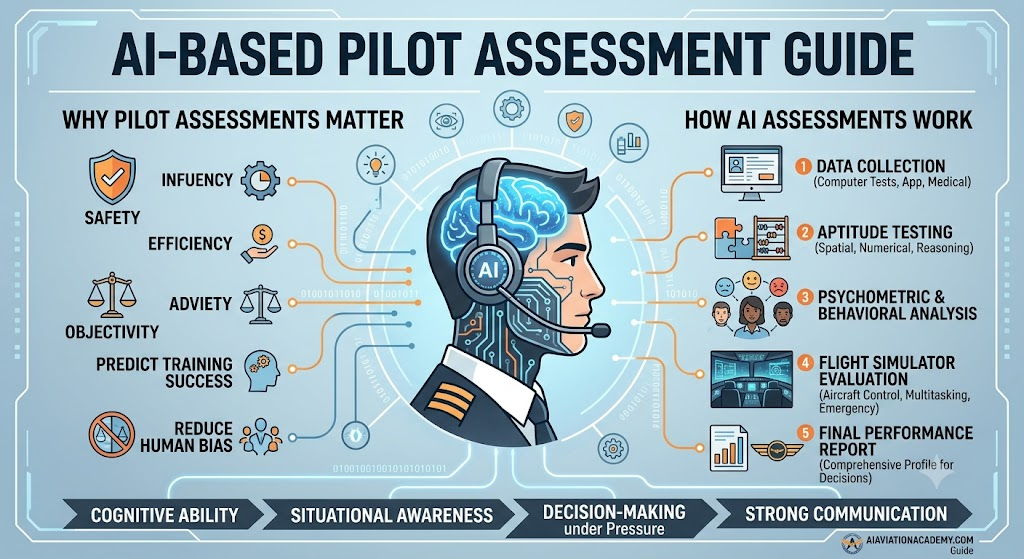
Why Pilot Assessments Matter
Flying an aircraft requires much more than technical knowledge. Pilots operate in dynamic environments where quick thinking, sound judgment, and effective communication are essential.
Pilot assessments help determine whether candidates possess the competencies needed to perform safely under varying conditions.
Key Skills Evaluated
- Cognitive ability
- Logical reasoning
- Situational awareness
- Decision-making under pressure
- Communication skills
- Emotional stability
- Leadership potential
- Teamwork
- Multitasking ability
- Technical aptitude
- Stress management
By assessing these areas, flight academies can identify candidates who are well-suited for the demands of professional aviation.
How AI-Based Pilot Assessments Work
AI-powered assessments combine multiple evaluation methods into a comprehensive selection process.
Step 1: Candidate Registration
Applicants create an online profile and provide academic, medical, and personal information required for the assessment.
Step 2: AI-Powered Aptitude Testing
Candidates complete computer-based tests measuring:
- Numerical reasoning
- Logical reasoning
- Spatial awareness
- Pattern recognition
- Memory
- Reaction time
The AI system evaluates not only correct answers but also response speed, consistency, and problem-solving strategies.
Step 3: Psychometric Assessment
AI analyzes personality traits through scientifically designed questionnaires that evaluate:
- Leadership
- Emotional intelligence
- Adaptability
- Motivation
- Team orientation
- Risk tolerance
Step 4: Behavioral Analysis
Some platforms monitor how candidates interact with assessment tasks, including:
- Decision-making patterns
- Confidence levels
- Error correction
- Time management
- Learning adaptability
Step 5: Flight Simulator Evaluation
Advanced simulators assess a candidate’s ability to:
- Maintain aircraft control
- Follow procedures
- Respond to emergencies
- Manage workload
- Demonstrate situational awareness
AI can analyze simulator performance by tracking hundreds of performance parameters simultaneously.
Step 6: Video and Voice Assessment
Some organizations use AI-assisted video interviews to evaluate:
- Communication clarity
- Verbal reasoning
- Professional presentation
- Structured thinking
While AI may assist in organizing or summarizing interview data, important hiring decisions are typically reviewed by human assessors.
Step 7: Final Performance Report
The AI platform combines results from all assessments into a comprehensive performance profile that helps instructors and recruiters make informed decisions.
Technologies Used in AI Pilot Assessments
Artificial Intelligence
AI processes large volumes of candidate data to identify performance patterns.
Machine Learning
Machine learning models improve assessment accuracy by learning from historical performance data.
Computer Vision
Computer vision can support simulator analytics or analyze visual attention in research and training settings.
Natural Language Processing (NLP)
NLP helps evaluate written and spoken communication during language-based assessments.
Predictive Analytics
Predictive models estimate how candidates may perform during training based on assessment data. These predictions support, rather than replace, human judgment.
Big Data
Large datasets enable more comprehensive benchmarking across candidate populations.
Flight Simulation Software
Modern simulators generate detailed performance metrics for AI-assisted analysis.
Eye-Tracking Systems
Some advanced training environments use eye-tracking technology to study visual scanning patterns and cockpit awareness.
Voice Recognition
Speech analysis tools may assess communication clarity and consistency in standardized exercises.
Behavioral Analytics
Behavioral analytics evaluate how candidates solve problems, adapt to challenges, and manage workload.
Skills Measured During AI Assessments
AI systems evaluate a broad range of competencies important for pilot training.
Cognitive Skills
- Numerical reasoning
- Logical reasoning
- Memory
- Spatial awareness
- Mental calculation
- Information processing
Operational Skills
- Reaction time
- Hand-eye coordination
- Multitasking
- Workload management
- Situational awareness
Soft Skills
- Communication
- Leadership
- Teamwork
- Emotional intelligence
- Adaptability
- Professionalism
Decision-Making Skills
- Risk assessment
- Judgment
- Problem-solving
- Prioritization
- Emergency response
Benefits of AI-Based Pilot Assessments
1. Reduced Human Bias
Standardized AI-supported scoring helps promote consistency across candidates.
2. Faster Evaluation
Automated systems process assessment data much more quickly than manual reviews.
3. Consistent Assessment Standards
Every candidate is evaluated using the same criteria.
4. Better Data Analysis
AI identifies performance trends that might not be immediately obvious to human evaluators.
5. Improved Candidate Experience
Many assessments can be completed online with structured feedback.
6. Cost Efficiency
Automation can reduce administrative workload and streamline recruitment.
7. Enhanced Aviation Safety
Better candidate selection contributes to stronger training outcomes and long-term operational safety.
Challenges and Limitations
Although AI offers many advantages, it is not without challenges.
Algorithm Bias
AI systems can reflect biases present in training data if they are not carefully designed and monitored.
Privacy Concerns
Assessment systems collect sensitive personal and performance data, making strong privacy protections essential.
Data Security
Organizations must safeguard candidate information against unauthorized access.
High Implementation Costs
Developing and maintaining advanced AI platforms requires significant investment.
Human Oversight
AI should support—not replace—experienced recruiters, instructors, and psychologists.
Ethical Considerations
Transparency, fairness, and accountability are essential when AI influences recruitment decisions.
AI vs Traditional Pilot Assessment
| Feature | AI-Based Assessment | Traditional Assessment |
|---|---|---|
| Evaluation Speed | Fast | Slower |
| Consistency | High | Depends on evaluator |
| Human Bias | Reduced | Higher possibility |
| Data Analysis | Extensive | Limited |
| Scalability | Excellent | Moderate |
| Personalized Feedback | Often available | Varies |
| Cost Over Time | Lower after implementation | Higher manual effort |
| Human Judgment | Supports decisions | Central to decisions |
How Candidates Can Prepare
Success begins with preparation.
Practice Aptitude Tests
Improve numerical, logical, and spatial reasoning through regular practice.
Strengthen Mathematics
Review arithmetic, algebra, percentages, ratios, and mental calculations.
Improve Logical Thinking
Solve puzzles, reasoning exercises, and analytical questions.
Learn Aviation Fundamentals
Understand basic aerodynamics, navigation, meteorology, and aviation terminology.
Use Flight Simulators
Desktop simulators can help build procedural awareness and familiarity with cockpit tasks.
Develop Communication Skills
Practice speaking clearly, confidently, and professionally.
Stay Physically and Mentally Fit
Healthy sleep, exercise, and stress management contribute to optimal performance.
Take Mock Assessments
Simulating assessment conditions improves confidence and time management.
Future of AI in Pilot Recruitment
Artificial Intelligence is expected to play an increasingly supportive role in aviation recruitment.
Future developments may include:
- Adaptive assessments tailored to individual performance
- AI-assisted interview scheduling and candidate support
- Virtual Reality (VR) assessment environments
- Personalized training recommendations
- Learning analytics for continuous improvement
- Predictive models to identify training support needs
- Enhanced simulator feedback
- Integration with digital training records
Despite these advances, human expertise will remain essential for interpreting results and making final selection decisions.
Common Mistakes Candidates Make
Avoid these common errors:
- Beginning preparation too late
- Neglecting psychometric assessments
- Weak communication during interviews
- Ignoring time management
- Limited simulator practice
- Overconfidence
- Inadequate understanding of aviation basics
- Failing to review assessment instructions carefully
Frequently Asked Questions (FAQ)
1. What is an AI-Based Pilot Assessment?
It is a technology-supported evaluation process that uses AI to assess aptitude, cognitive abilities, behavioral traits, and other competencies relevant to pilot training.
2. Are AI pilot assessments accurate?
AI can improve consistency and identify useful performance patterns, but results are most effective when combined with expert human evaluation.
3. Can AI replace human interviewers?
No. AI is generally used to assist with assessment and analysis, while final decisions are typically made by qualified recruiters and instructors.
4. Which organizations use AI in pilot recruitment?
Some airlines, flight academies, and aviation organizations are adopting AI-assisted recruitment tools, though implementation varies widely.
5. How should I prepare for an AI pilot assessment?
Practice aptitude tests, strengthen mathematics and reasoning skills, study aviation fundamentals, and participate in mock assessments.
6. Are psychometric tests difficult?
They are designed to evaluate personality and behavioral characteristics rather than technical knowledge, so there are no simple “right” answers.
7. Is simulator performance evaluated using AI?
Some advanced simulators incorporate AI-assisted analytics to provide detailed performance insights.
8. How long does an AI-based assessment take?
The duration varies depending on the organization and the number of assessment stages.
9. What skills are most important?
Situational awareness, decision-making, communication, logical reasoning, multitasking, and emotional stability are among the most important.
10. Is AI the future of pilot recruitment?
AI is likely to become an increasingly valuable tool in pilot recruitment, working alongside experienced aviation professionals rather than replacing them.
Key Takeaways
- AI is transforming pilot assessment through data-driven evaluation.
- Modern assessments examine cognitive, technical, and behavioral competencies.
- AI helps improve consistency, efficiency, and objectivity.
- Human oversight remains essential for fair recruitment decisions.
- Proper preparation significantly improves assessment performance.
Featured Snippet
An AI-Based Pilot Assessment uses artificial intelligence to evaluate a pilot candidate’s aptitude, cognitive abilities, technical skills, and behavioral traits. By combining data analysis with standardized testing and simulator performance, AI helps flight academies and airlines make more informed and consistent recruitment decisions while supporting human evaluators.
Conclusion
Artificial Intelligence is reshaping how the aviation industry identifies and develops future pilots. By combining advanced technologies with evidence-based assessment methods, AI helps flight schools and airlines evaluate candidates more consistently and efficiently while supporting better training outcomes.
For aspiring pilots, understanding the structure of AI-based assessments is an important step toward successful preparation. Building strong cognitive skills, practicing aptitude tests, improving communication, and gaining simulator experience can enhance your readiness for modern pilot selection processes.
As AI continues to evolve, it will complement—not replace—the expertise of aviation professionals, creating a more data-informed and effective approach to pilot recruitment. At AIAVIATIONACADEMY.COM, we’re committed to helping aspiring aviators navigate these advancements with trusted resources, practical guidance, and expert insights.