Introduction
Aircraft design has always focused on one major goal: building aircraft that are strong, safe, efficient, and light. A lighter aircraft needs less fuel, can fly longer distances, may carry better payloads, and can reduce operating costs.
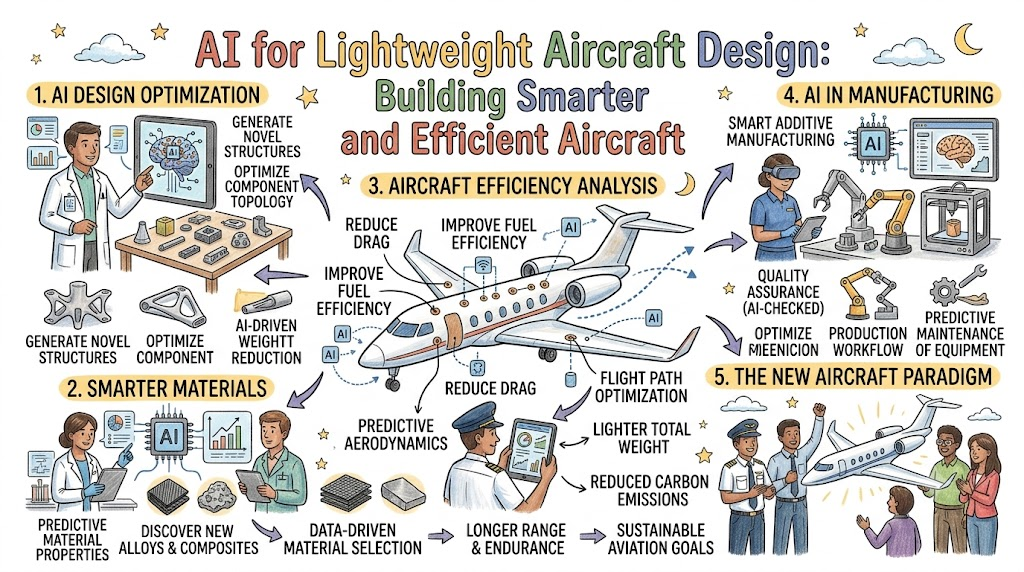
This is where AI for lightweight aircraft design is becoming important. Artificial Intelligence helps engineers study thousands of design options, test aircraft structures digitally, choose better materials, and improve aerodynamic performance before physical prototypes are built.
For aviation students and aerospace beginners, this topic is very useful because future aircraft design will not depend only on manual calculations. It will combine engineering knowledge, simulation tools, data, and AI-powered decision-making.
What Is Lightweight Aircraft Design?
Lightweight aircraft design means creating an aircraft structure that uses less material without reducing safety, strength, or performance.
It includes careful design of:
- Wings
- Fuselage
- Tail structure
- Landing gear parts
- Internal frames
- Engine mounts
- Cabin structures
- Control surfaces
The goal is not simply to remove weight. The real goal is to reduce unnecessary weight while keeping the aircraft safe, stable, and reliable.
Modern aircraft already use advanced materials such as composites to reduce weight. NASA has explained that composite structures can help make aircraft lighter and improve fuel efficiency and emissions performance.
Why Aircraft Weight Matters
Aircraft weight affects almost every part of aviation performance. Even a small weight reduction can make a big difference over thousands of flights.
A lighter aircraft can help with:
- Lower fuel consumption
- Longer flying range
- Better climb performance
- Reduced emissions
- Lower operating cost
- Improved payload capacity
- Better energy efficiency in electric aircraft
For airlines, aircraft weight directly affects cost. For aircraft designers, it affects structure, engine power, fuel storage, safety margins, and maintenance planning.
This is why engineers spend a lot of time studying how to make each component lighter without making it weaker.
How AI Helps in Lightweight Aircraft Design
AI helps aircraft designers by processing large amounts of design data faster than traditional methods.
Earlier, engineers had to test limited design options because every calculation and simulation required time. With AI, design teams can compare many shapes, materials, and structures quickly.
AI can support engineers in:
- Finding lighter structural patterns
- Predicting stress points
- Comparing material performance
- Reducing drag
- Improving wing shapes
- Testing design ideas digitally
- Finding weak areas before manufacturing
AI does not replace engineers. It works like a smart assistant that helps engineers make faster and better design decisions.
Generative Design in Aviation
Generative design is one of the most important uses of AI in lightweight aircraft design.
In simple words, engineers give the AI tool a design goal. For example:
“Create a wing bracket that is strong enough to carry load but uses minimum material.”
The AI then creates many possible designs. Some may look unusual, but they are often inspired by efficient natural shapes, such as bones, trees, and honeycomb structures.
Generative design can help reduce weight in:
- Brackets
- Mounting parts
- Seat frames
- Cabin components
- Drone structures
- Engine support parts
- Internal aircraft frames
The biggest advantage is that AI can explore design possibilities that humans may not think of manually.
AI for Material Selection
Choosing the right material is a major part of lightweight aircraft design.
Aircraft materials must be:
- Light
- Strong
- Durable
- Heat-resistant
- Corrosion-resistant
- Safe under repeated stress
- Suitable for manufacturing
AI can compare different materials such as aluminum alloys, titanium, carbon fiber composites, and advanced lightweight materials.
NASA has also studied superlightweight aerospace composites, including carbon nanotube-based materials, where engineers estimated major mass-saving potential compared with traditional materials.
AI can help engineers answer questions like:
- Which material gives the best strength-to-weight ratio?
- Which material performs better under heat?
- Which material is suitable for long-term fatigue resistance?
- Which material reduces weight without increasing cost too much?
This makes material selection faster and more data-driven.
AI in Aerodynamic Optimization
A lightweight aircraft must also move smoothly through the air. If the shape creates too much drag, the aircraft will need more energy or fuel.
AI helps engineers improve aerodynamics by studying airflow around the aircraft. It can help optimize:
- Wing shape
- Wingtip design
- Fuselage shape
- Air intake design
- Tail structure
- Control surfaces
- Drone body shapes
Machine learning is increasingly used in aerodynamic shape optimization because it can help with faster analysis, better design-space exploration, and improved optimization workflows. Research also notes that large-scale aerodynamic optimization still has challenges, especially because training advanced ML models can be costly.
For students, this means AI is not magic. It needs good data, good physics knowledge, and expert validation.
AI-Based Structural Simulation
Before an aircraft part is manufactured, engineers must test whether it can handle real flight loads.
AI-based simulation can help predict:
- Stress points
- Fatigue failure
- Vibration behavior
- Crack development
- Heat effects
- Load distribution
- Long-term durability
Traditional simulation is powerful, but it can take time. AI can speed up early design analysis by learning from previous simulations and test data.
For example, if a structure is too heavy, AI can suggest where material can be reduced. If an area is weak, AI can highlight where reinforcement may be needed.
This helps engineers create designs that are both lighter and safer.
AI and Composite Aircraft Structures
Composite materials are important in modern aviation because they can offer high strength with lower weight.
AI can improve composite design by helping engineers decide:
- Fiber direction
- Layer thickness
- Load paths
- Structural layout
- Manufacturing process
- Damage prediction
NASA’s HiCAM project focuses on advanced composite technologies and lightweight composite vehicles that can help reduce fuel consumption and carbon emissions.
This shows that lightweight aircraft design is not only about performance. It is also connected to sustainability and cleaner aviation.
Benefits of AI for Lightweight Aircraft Design
AI brings many benefits to aircraft design and engineering.
1. Faster Design Process
AI can check many design options quickly. This reduces the time needed in early design stages.
2. Better Weight Reduction
AI can identify unnecessary material and suggest lighter structures while maintaining strength.
3. Improved Fuel Efficiency
A lighter aircraft usually needs less energy to fly. This can help reduce fuel cost and emissions.
4. Smarter Material Usage
AI can compare materials and suggest the best option based on strength, weight, cost, and durability.
5. Better Safety Analysis
AI can detect possible weak areas early in the design process.
6. Support for Electric Aircraft
Electric aircraft need lightweight structures because batteries add weight. AI can help balance structure, battery weight, range, and performance.
7. Lower Development Risk
By testing ideas digitally, engineers can reduce costly design mistakes before physical production.
Challenges of Using AI in Aircraft Design
AI has great potential, but aircraft design is a safety-critical field. Every AI-supported design must be checked carefully.
Some major challenges include:
- AI needs high-quality data.
- Wrong data can produce wrong design suggestions.
- Aviation certification is strict.
- AI-generated designs must be explainable.
- Human engineers must verify the results.
- Physical testing is still required.
- AI tools can be expensive.
- Safety approval can take time.
The FAA has a dedicated technical discipline for Artificial Intelligence and Machine Learning that focuses on safely integrating AI technologies in aviation systems and supporting policy, guidance, and training.
This means AI in aviation must follow strict safety thinking. Speed is useful, but safety always comes first.
Role of Engineers in AI-Powered Aircraft Design
AI is a tool, not a replacement for aerospace engineers.
Engineers are still needed to:
- Define design goals
- Understand flight requirements
- Check AI results
- Apply aviation regulations
- Validate safety
- Review manufacturing feasibility
- Make final engineering decisions
AI can suggest a lightweight structure, but an engineer must decide whether that structure is practical, safe, certifiable, and manufacturable.
This is why future aviation professionals should understand both engineering fundamentals and AI-based tools.
AI for Drones and Small Aircraft
AI for lightweight aircraft design is especially useful in drones, UAVs, and small aircraft.
These aircraft often need:
- Longer battery life
- Lower structural weight
- Better payload capacity
- Compact design
- Efficient aerodynamics
For drones, reducing weight can directly improve flight time. For small electric aircraft, weight reduction can improve range and energy performance.
AI can help designers create lighter frames, better propeller layouts, improved battery placement, and stronger body structures.
Future of AI in Lightweight Aircraft Design
The future of aircraft design will become more digital, automated, and data-driven.
AI may support the development of:
- Electric aircraft
- Hydrogen-powered aircraft
- Urban air mobility vehicles
- Advanced drones
- Lightweight business jets
- Sustainable passenger aircraft
- Smart composite structures
- Morphing wings
- AI-assisted maintenance systems
In the coming years, aviation students may use AI tools the same way engineers today use CAD and simulation software.
The best future aircraft designers will not only know aerodynamics and structures. They will also understand data, AI, simulation, materials, and certification requirements.
FAQs
1. What is AI for lightweight aircraft design?
AI for lightweight aircraft design means using Artificial Intelligence to help engineers reduce aircraft weight while maintaining safety, strength, and performance.
2. How does AI reduce aircraft weight?
AI studies design options, material choices, stress points, and aerodynamic shapes to suggest lighter and stronger aircraft structures.
3. Can AI replace aircraft design engineers?
No. AI supports engineers, but human experts are still needed for safety checks, certification, testing, and final design decisions.
4. Why is lightweight design important in aviation?
Lightweight design helps reduce fuel use, improve range, lower emissions, and increase aircraft efficiency.
5. Is AI useful for drone design?
Yes. AI is very useful for drones because lighter drone structures can improve flight time, payload capacity, and battery performance.
Conclusion
AI for lightweight aircraft design is changing how engineers think about aircraft development. It helps reduce weight, improve fuel efficiency, optimize materials, test structures digitally, and create smarter designs.
However, AI is not a shortcut around aviation safety. Every design must still be reviewed, tested, certified, and approved by experts.
For students and beginners, this is an exciting area to learn. The future of aviation will belong to engineers who understand both aircraft fundamentals and intelligent design technologies.
AI is helping aircraft become lighter, cleaner, safer, and more efficient. That makes it one of the most important technologies in the future of aviation design.