Introduction
Flight simulation has always been a foundational part of aviation training, allowing pilots to practice complex maneuvers, emergency procedures, and navigation skills in a safe and controlled environment. Traditionally, simulators have played a supporting role in bridging classroom theory with real-world flying experience.
However, modern aviation demands more than static training systems. Real-world flying conditions are dynamic, unpredictable, and highly data-driven. Traditional simulators often struggle to replicate this level of complexity.
This is where Artificial Intelligence (AI) is transforming aviation education. AI is making flight simulation smarter, adaptive, and highly personalized. Instead of relying on fixed scenarios, AI systems continuously analyze pilot behavior, adjust training difficulty, and generate realistic flying conditions in real time.
For aviation learners and institutions like AIAVIATIONACADEMY.COM, understanding how AI improves flight simulation is essential for preparing the next generation of pilots.
What is Flight Simulation in Aviation?
Flight simulation is a training method that uses virtual environments and mechanical systems to replicate real aircraft operations. It allows pilots to experience flying without leaving the ground.
Traditional Flight Simulation
Traditional simulators generally include:
Predefined flight scenarios
Manual instructor supervision
Fixed difficulty levels
Repetitive training modules
Limited adaptability to individual learners
These systems are useful but not fully aligned with modern aviation complexity.
Key Limitations of Traditional Systems
Lack of real-time adaptability
Minimal personalization for trainees
Delayed performance feedback
High dependency on instructor evaluation
Limited scenario unpredictability
These gaps created the need for intelligent systems powered by AI.
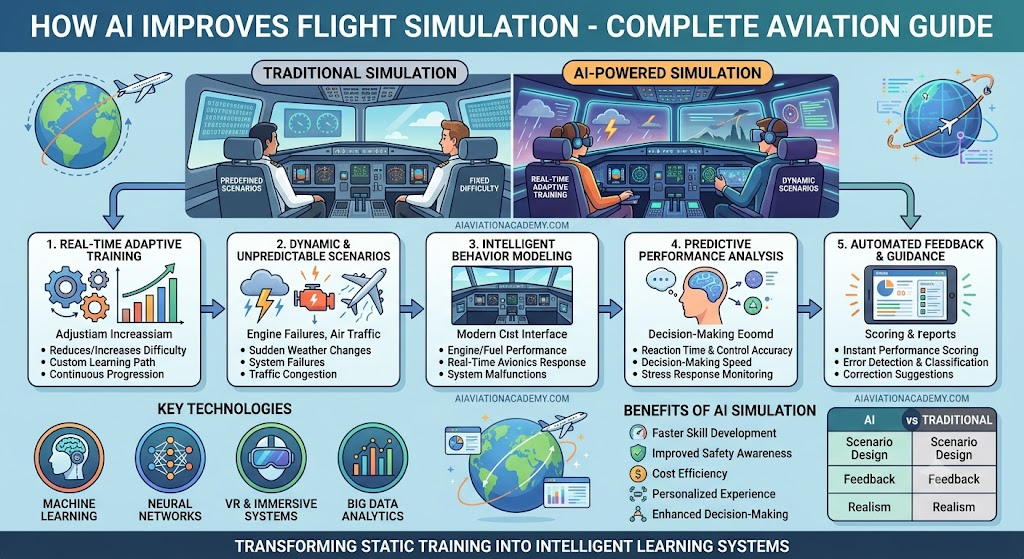
How AI Improves Flight Simulation
AI significantly enhances flight simulation by making it dynamic, adaptive, and performance-driven.
Real-Time Adaptive Training
AI continuously monitors pilot actions and adjusts training in real time:
Reduces difficulty when learners struggle
Increases complexity for advanced users
Creates a customized learning path for each pilot
This ensures continuous skill progression.
AI-Generated Dynamic Scenarios
Instead of repetitive exercises, AI generates unpredictable flight situations such as:
Sudden weather changes
Engine failure events
Air traffic congestion
Navigation system disruptions
This prepares pilots for real-world uncertainty.
Intelligent Aircraft Behavior Modeling
AI simulates how real aircraft systems respond under different conditions:
Engine performance variations
Fuel efficiency behavior
System malfunctions based on usage patterns
Real-time avionics response
This creates a highly realistic cockpit experience.
Predictive Performance Analysis
AI evaluates pilot performance using advanced data models:
Reaction time measurement
Control accuracy tracking
Decision-making evaluation
Stress response monitoring
It then predicts future weaknesses and training needs.
Automated Feedback and Guidance
AI provides instant feedback after every simulation:
Performance scoring reports
Error detection and classification
Step-by-step correction suggestions
Personalized improvement plans
This reduces learning delays and improves efficiency.
Key Technologies Behind AI Flight Simulation
AI-powered flight simulators rely on multiple advanced technologies working together.
Machine Learning Systems
Machine learning enables simulators to:
Learn from pilot behavior
Improve training accuracy over time
Identify performance patterns
Neural Networks
Neural networks help replicate:
Complex flight decision-making
Human-like cognitive responses
Multi-variable aviation conditions
VR and Immersive Systems
Virtual Reality combined with AI provides:
Full cockpit immersion
Real-time spatial awareness
Interactive training environments
Big Data Analytics
AI processes large amounts of training data:
Flight logs and performance history
Behavioral patterns
Scenario outcomes
This improves overall training effectiveness.
Benefits of AI in Flight Simulation
AI-driven simulation offers several advantages for aviation training.
Faster Skill Development
Real-time corrections improve learning speed
Continuous practice enhances retention
Improved Safety Awareness
Safe simulation of critical emergencies
Better preparation for real flight risks
Cost Efficiency
Reduces aircraft flying hours
Lowers fuel and maintenance costs
Enables unlimited practice sessions
Personalized Training Experience
Custom learning paths for each pilot
Focused improvement on weak areas
Enhanced Decision-Making Skills
Better situational awareness
Stronger emergency handling ability
AI vs Traditional Flight Simulation
Feature Traditional Simulation AI-Powered Simulation
Scenario Design Fixed and repetitive Dynamic and adaptive
Learning Approach One-size-fits-all Personalized learning
Feedback System Instructor-based AI-driven real-time feedback
Cost Efficiency High long-term cost Optimized training cost
Realism Level Moderate realism Highly realistic and evolving
Real-World Applications
AI flight simulation is widely used across aviation industries.
Airline Training Academies
Pilot certification preparation
Recurrent training programs
Skill evaluation systems
Military Aviation Training
Tactical mission simulations
Combat readiness training
Emergency response drills
Private Pilot Training
License preparation
Navigation practice
Basic flight maneuvers
Emergency Response Training
Disaster scenario simulation
Rescue operations training
Crisis aviation handling
Challenges and Limitations
Despite its advantages, AI flight simulation has certain limitations.
High Initial Cost
Advanced systems require significant investment in infrastructure and software.
Hardware Dependency
High realism often depends on VR and motion-based equipment.
Data Quality Issues
AI performance depends heavily on the quality of training data.
Over-Reliance on Simulation
Real-world flying experience remains essential for complete pilot training.
Future of AI Flight Simulation
AI is expected to play an even bigger role in aviation training in the coming years.
AI Training Copilots
AI will act as real-time virtual copilots guiding trainees during simulation.
Automated Pilot Evaluation
Pilot certification may become more data-driven and AI-assessed.
Fully Immersive Training Academies
VR and AI will combine to create complete virtual aviation training environments.
Predictive Learning Systems
AI will predict pilot weaknesses before they occur and design targeted training programs.
Frequently Asked Questions
- What is AI flight simulation in aviation training?
AI flight simulation uses artificial intelligence to create adaptive and intelligent training environments for pilots, improving realism and learning outcomes.
- How does AI improve flight simulation?
AI improves simulation by generating dynamic scenarios, analyzing pilot performance, and providing real-time feedback.
- Is AI simulation better than traditional training systems?
Yes, AI simulation offers more personalization, better adaptability, and real-time feedback compared to traditional systems.
- Can AI replace real flight training?
No, AI simulation supports training but cannot fully replace real aircraft flying experience.
- What skills can be improved using AI flight simulators?
Pilots can improve navigation, decision-making, emergency response, and cockpit coordination skills.
- Are AI flight simulators expensive?
High-end systems are costly, but there are also scalable and cloud-based solutions available.
- Do aviation academies use AI simulation?
Yes, many aviation academies and airlines are adopting AI-based simulators for training and evaluation.
- What technologies power AI flight simulation?
AI simulation uses machine learning, neural networks, VR systems, and big data analytics.
- What are the main benefits of AI simulation?
Key benefits include faster learning, improved safety, cost efficiency, and personalized training paths.
- What is the future of AI in aviation training?
The future includes AI copilots, predictive training systems, and fully immersive virtual aviation academies.
Conclusion
AI is fundamentally reshaping the future of flight simulation and aviation training. By transforming static simulators into intelligent, adaptive learning systems, AI enables pilots to train more effectively, safely, and efficiently.
The integration of AI into simulation systems enhances every aspect of training—from scenario generation and performance analysis to personalized learning and real-time feedback. This results in better-prepared pilots who are ready to handle real-world aviation challenges.
For institutions like AIAVIATIONACADEMY.COM, adopting AI-powered flight simulation is no longer optional—it is a necessary step toward building future-ready aviation professionals.
Hashtags
HowAIImprovesFlightSimulation, AIFlightSimulation, AviationTrainingTechnology, PilotSimulationSystems, SmartAviationTraining