Introduction
AI flight simulator training is redefining how modern pilots are trained and evaluated. Traditional aviation training relies heavily on classroom theory, fixed simulator exercises, and real aircraft flying hours. While these methods remain essential, they are often expensive, time-consuming, and limited in personalization.
With the rise of AI flight simulator training, aviation education has become more adaptive, intelligent, and data-driven. These systems simulate real-world flying conditions while using artificial intelligence to analyze pilot behavior, provide instant feedback, and create dynamic training scenarios.
For aviation learners and institutions like AIAVIATIONACADEMY.COM, this technology is becoming a core part of next-generation pilot training systems.
What is AI Flight Simulator Training?
AI flight simulator training is an advanced aviation learning method that uses artificial intelligence to enhance flight simulation systems. Instead of relying only on pre-programmed scenarios, AI-based simulators continuously adapt based on pilot performance and environmental conditions.
Unlike traditional simulators, AI systems can:
- Adjust difficulty levels automatically
- Generate real-time flight scenarios
- Analyze pilot actions instantly
- Provide personalized feedback and recommendations
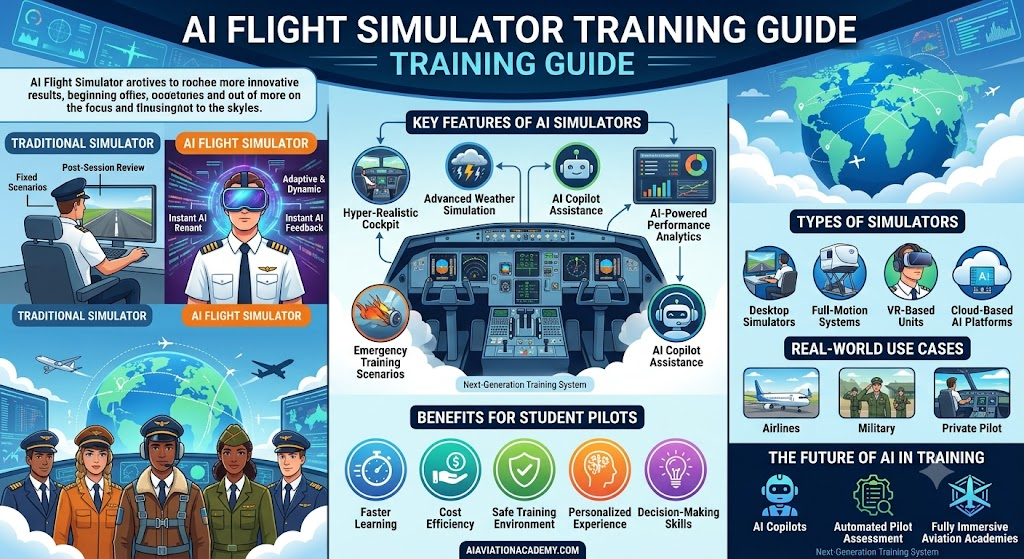
Traditional vs AI Flight Simulation
| Feature | Traditional Simulator | AI Flight Simulator |
|---|---|---|
| Scenario Design | Fixed and preloaded | Dynamic and adaptive |
| Learning Style | One-size-fits-all | Personalized learning |
| Feedback System | Instructor dependent | AI-powered real-time feedback |
| Error Detection | Post-session review | Instant detection |
| Training Efficiency | Moderate | High and scalable |
How AI is Used in Flight Simulation
AI plays a critical role in improving the quality and realism of flight training.
Real-Time Scenario Generation
AI systems create unpredictable flight conditions such as:
- Sudden weather turbulence
- Engine or system failures
- Air traffic congestion
- Navigation disruptions
This prepares pilots for real-world flying challenges.
Adaptive Learning Systems
AI adjusts training based on performance:
- Beginners receive guided assistance
- Intermediate learners face mixed scenarios
- Advanced pilots are trained with emergency simulations
Predictive Performance Analysis
AI tracks and analyzes:
- Reaction time
- Flight control accuracy
- Decision-making speed
- Fuel and navigation efficiency
This helps identify skill gaps early.
Automated Feedback Systems
AI provides:
- Immediate performance reports
- Error identification and classification
- Corrective training suggestions
- Skill improvement pathways
Key Features of AI Flight Simulators
AI-powered flight simulators offer advanced capabilities that significantly improve training outcomes.
Hyper-Realistic Cockpit Environment
- Accurate aircraft instrument replication
- Real-time system behavior simulation
- Multi-aircraft training compatibility
Advanced Weather Simulation
- Storm and turbulence modeling
- Wind shear and visibility changes
- Global environmental replication
Emergency Training Scenarios
- Engine failure simulations
- Hydraulic and electrical system failures
- Emergency landing procedures
AI Copilot Assistance
- Voice-guided training support
- Checklist assistance
- Communication simulation with air traffic control
Performance Analytics Dashboard
- Pilot scoring systems
- Flight behavior tracking
- Progress visualization reports
Benefits for Student Pilots
AI flight simulator training provides significant advantages for aviation students.
Faster Learning Development
- Continuous feedback improves learning speed
- Repetition strengthens core flying skills
Cost Efficiency
- Reduces aircraft flying hours
- Lowers fuel and maintenance costs
- Enables unlimited simulation practice
Safe Training Environment
- No real-world risk during training
- Allows repeated failure-based learning
- Builds confidence before actual flight
Personalized Learning Experience
- Customized training based on performance
- Focused improvement on weak areas
Strong Decision-Making Skills
- Improves situational awareness
- Enhances cockpit judgment
- Builds emergency handling capability
Types of AI Flight Simulation Systems
Different simulation systems are used depending on training needs and budget.
Desktop Simulators
- Software-based training tools
- Ideal for beginners
- Cost-effective learning solution
Full-Motion Simulators
- Hardware-based realistic systems
- Used in professional pilot academies
- Provides physical motion feedback
VR-Based Simulators
- Immersive virtual reality training
- Real cockpit experience simulation
- High engagement learning model
Cloud-Based AI Simulators
- Remote access training platforms
- Scalable for institutions
- AI-powered performance tracking
Real-World Use Cases
AI flight simulation is widely used across aviation sectors.
Airline Training Academies
- Cadet pilot training programs
- Recurrent pilot certification
- Skill assessment and validation
Military Aviation Training
- Combat scenario simulation
- Tactical mission preparation
- Emergency response training
Private Pilot License Training
- Basic flight maneuver practice
- Navigation and communication training
- Emergency handling preparation
Crisis and Emergency Training
- Disaster response simulation
- Rescue mission preparation
- High-risk scenario training
Challenges and Limitations
Despite its advantages, AI flight simulation also has some limitations.
High Initial Cost
Advanced simulators require significant investment in hardware and software.
Hardware Dependency
Full realism often depends on expensive motion and VR systems.
Data Accuracy Issues
AI performance depends on the quality of training data used.
Limited Real-World Exposure
Simulators cannot fully replicate real-life flying unpredictability.
Future of AI in Flight Training
The future of aviation training will be deeply influenced by artificial intelligence.
AI Training Copilots
AI will act as real-time assistants inside virtual cockpits.
Automated Pilot Assessment
Pilot certification may increasingly rely on AI-based performance evaluation.
Fully Immersive Training Environments
VR and AI will combine to create fully simulated aviation academies.
Predictive Skill Development
AI will identify weaknesses before they appear and create targeted training plans.
Frequently Asked Questions
1. What is AI flight simulator training?
AI flight simulator training is a modern aviation learning method that uses artificial intelligence to simulate flight conditions and provide adaptive training feedback.
2. How is AI simulation different from traditional flight simulators?
Traditional simulators use fixed scenarios, while AI simulators adjust difficulty and training based on pilot performance and behavior.
3. Is AI flight simulator training useful for beginners?
Yes, it is highly useful because it provides guided learning, real-time feedback, and safe practice environments.
4. Can AI simulators replace real flying experience?
No, they complement real flying but cannot fully replace actual flight hours required for certification.
5. What skills can be improved using AI flight simulators?
Skills like navigation, decision-making, emergency handling, and cockpit coordination can be significantly improved.
6. Are AI flight simulators expensive?
High-end systems can be expensive, but desktop and cloud-based options are more affordable.
7. Do airlines use AI flight simulators?
Yes, many airlines use AI-based simulation for pilot training, evaluation, and recurrent certification.
8. What technologies power AI flight simulators?
They use artificial intelligence, machine learning, VR systems, and advanced simulation engines.
9. Can AI simulate emergency flight conditions?
Yes, AI can simulate engine failures, weather disruptions, and other emergency scenarios safely.
10. What is the future of AI in aviation training?
The future includes AI copilots, automated assessments, and fully immersive VR-based aviation academies.
Conclusion
AI flight simulator training is transforming aviation education by making pilot training more intelligent, efficient, and accessible. It bridges the gap between theoretical knowledge and real-world flying experience through adaptive learning, real-time feedback, and immersive simulation environments.
For modern aviation institutions like AIAVIATIONACADEMY.COM, adopting AI-based simulation is a strategic necessity rather than an option. It helps produce safer, more confident, and better-prepared pilots.
As technology continues to evolve, AI will play an even greater role in shaping the future of pilot training, making aviation education more predictive, personalized, and globally scalable.