Introduction
Aerodynamics is one of the most important parts of aircraft design. Every aircraft must move smoothly through the air, stay stable during flight, produce enough lift, and reduce unnecessary drag. If the aerodynamic design is poor, the aircraft may use more fuel, face performance issues, or become less efficient.
For many years, aerospace engineers have used wind tunnel testing, calculations, computer simulations, and flight data to improve aircraft shapes. These methods are still very important. But today, Artificial Intelligence is making aerodynamic design faster, smarter, and more accurate.
AI for aerodynamic design optimization helps engineers study airflow, compare different design options, predict performance, and find better aircraft shapes. It can support better wing design, improved fuselage shape, reduced drag, better lift, and higher fuel efficiency.
For beginners, this may sound technical. But in simple words, AI helps aircraft engineers understand how air moves around an aircraft and how the design can be improved for better performance.
AI is not replacing aerodynamic engineers. It is helping them make better decisions with data, simulations, and intelligent analysis.
What Is Aerodynamic Design Optimization?
Aerodynamic design optimization means improving the shape of an aircraft so it can fly more efficiently through the air.
When an aircraft flies, air flows around its wings, nose, fuselage, tail, engines, and other parts. Engineers must design these parts carefully so the aircraft can produce enough lift and reduce drag.
In simple terms:
- Lift helps the aircraft rise and stay in the air.
- Drag is the air resistance that slows the aircraft down.
- Thrust moves the aircraft forward.
- Weight pulls the aircraft downward.
A good aerodynamic design balances these forces properly.
Aerodynamic optimization helps improve:
- Aircraft speed
- Fuel efficiency
- Flight stability
- Takeoff and landing performance
- Passenger comfort
- Engine performance
- Overall aircraft safety
The goal is to make the aircraft shape as efficient as possible while keeping it safe and practical.
What Is AI for Aerodynamic Design Optimization?
AI for aerodynamic design optimization means using artificial intelligence, machine learning, simulations, and data analysis to improve aircraft aerodynamic performance.
AI can study large amounts of data from wind tunnel tests, flight records, CFD simulations, previous aircraft designs, and performance results. It can then help engineers predict which design changes may improve airflow.
For example, AI can help answer questions like:
- Which wing shape can reduce drag?
- Which airfoil design can improve lift?
- How can turbulence be reduced?
- How should the nose shape be improved?
- Can winglets improve fuel efficiency?
- How does engine inlet design affect airflow?
Instead of testing only a few design options manually, AI can help compare many options quickly. This gives engineers more choices and better direction.
AI does not make final aircraft design decisions alone. Human engineers still check, test, validate, and approve the results.
Why AI Matters in Aerodynamic Optimization
AI matters because aircraft design is becoming more complex. Modern aviation needs aircraft that are safer, lighter, quieter, more fuel-efficient, and more environmentally friendly.
Aerodynamic design affects almost every part of aircraft performance. A small improvement in airflow can support better fuel use, lower emissions, and smoother flight.
AI helps aerodynamic optimization because it can:
- Analyze complex airflow data faster
- Compare many design options
- Reduce early design mistakes
- Improve simulation speed
- Support fuel-efficient aircraft design
- Help reduce development cost
- Improve aircraft performance prediction
- Support sustainable aviation goals
Traditional aerodynamic testing can take a lot of time. AI can help engineers narrow down the best design options before expensive physical testing begins.
This makes aircraft development more efficient and more data-driven.
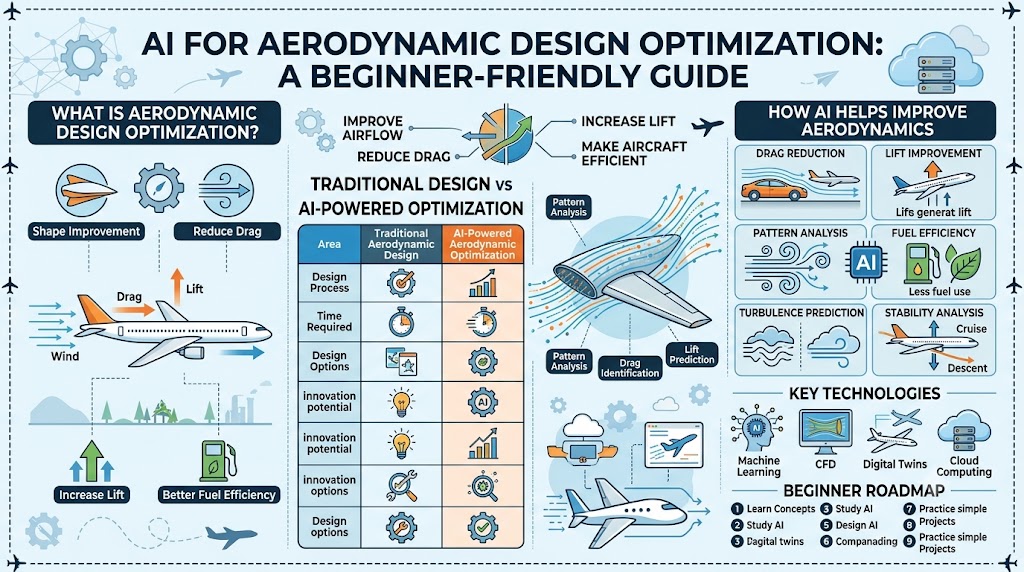
Traditional Aerodynamic Design vs AI-Powered Aerodynamic Optimization
| Area | Traditional Aerodynamic Design | AI-Powered Aerodynamic Optimization |
|---|---|---|
| Design Process | Engineers manually create and test design options | AI helps generate, compare, and improve design options |
| Time Required | Can take longer due to repeated testing | Can reduce early design exploration time |
| Number of Design Options | Limited options are tested | Many design options can be compared quickly |
| Airflow Analysis | Uses wind tunnel testing and CFD analysis | Uses CFD, data models, and AI prediction |
| Drag Reduction | Depends on testing and expert improvement | AI can identify drag reduction opportunities faster |
| Lift Improvement | Improved through manual analysis and testing | AI can compare airfoil and wing shapes efficiently |
| Simulation Speed | Simulations may take more time | AI can speed up prediction and design filtering |
| Human Engineer Role | Creates, tests, and validates designs | Sets goals, reviews AI results, and validates final designs |
| Cost Efficiency | More testing may increase cost | Early prediction can reduce unnecessary testing |
| Innovation Potential | Based mainly on human experience | AI can explore new and unexpected design possibilities |
Both traditional methods and AI-powered methods are important. AI improves the process, but it does not remove the need for engineering knowledge.
How AI Helps Improve Aircraft Aerodynamics
AI can support aerodynamic design in many practical ways. It helps engineers understand airflow better and make smarter design improvements.
Airflow Pattern Analysis
Airflow around an aircraft can be very complex. Air moves differently around the wings, nose, tail, fuselage, and engines.
AI can study airflow data and detect patterns. It can help engineers understand where airflow is smooth and where it becomes disturbed.
This helps improve aircraft shape and reduce performance problems.
Drag Reduction
Drag is the force that resists aircraft movement through the air. More drag means the aircraft needs more power and fuel.
AI can help identify areas where drag is high. It can suggest better shapes, smoother surfaces, improved wing designs, and cleaner airflow paths.
Reducing drag is one of the most important goals of aerodynamic optimization.
Lift Improvement
Lift keeps an aircraft in the air. The wings must be designed to create enough lift during takeoff, cruising, and landing.
AI can help compare different airfoil shapes, wing angles, and control surface designs. This can support better lift performance.
Wing Shape Optimization
The wing is one of the most important aerodynamic parts of an aircraft. Small changes in wing shape can affect lift, drag, fuel use, and stability.
AI can test different wing curves, winglets, airfoils, and angles through simulations. It can help engineers choose designs that perform better in different flight conditions.
Nose and Fuselage Design Improvement
The nose and fuselage shape affect how air flows around the aircraft body. A smoother body shape can reduce airflow resistance.
AI can help engineers improve fuselage design by studying how air moves across the aircraft body.
Tail and Control Surface Optimization
The tail and control surfaces help keep the aircraft stable and controllable. These include the elevator, rudder, and ailerons.
AI can help improve the shape and position of these surfaces so the aircraft responds better during flight.
Engine Inlet Airflow Improvement
Aircraft engines need smooth airflow for better performance. Poor airflow into the engine inlet can affect efficiency and stability.
AI can help study engine inlet airflow and suggest improvements to make engine performance more efficient.
Turbulence Prediction
Turbulence can affect comfort, stability, and performance. AI can help predict areas where airflow may become unstable or turbulent around aircraft parts.
This helps engineers make design changes before physical testing.
Fuel Efficiency Improvement
Good aerodynamics reduces drag and improves performance. When drag is reduced, the aircraft may need less fuel to fly the same distance.
AI supports fuel efficiency by helping improve aircraft shape, wing design, and airflow behavior.
Aircraft Stability Analysis
A stable aircraft is easier and safer to control. AI can help study how design changes affect aircraft stability during different flight phases.
This includes takeoff, climb, cruise, descent, and landing.
Role of Machine Learning in Aerodynamic Design
Machine learning is a part of AI. It allows computers to learn from data and improve predictions.
In aerodynamic design, machine learning can learn from:
- Wind tunnel test data
- Flight test data
- CFD simulation results
- Aircraft performance records
- Previous aircraft designs
- Airfoil data
- Drag and lift measurements
After learning from this data, machine learning models can predict how a new design may perform.
For example, if engineers create a new wing shape, machine learning can compare it with past data and estimate its lift and drag performance.
This helps engineers make faster decisions during the early design stage.
However, machine learning depends on good data. If the data is poor, incomplete, or incorrect, the prediction may not be reliable. That is why aerospace engineers must carefully check AI results.
AI and Computational Fluid Dynamics
Computational Fluid Dynamics, also called CFD, is a computer-based method used to study how fluids move. In aircraft design, the fluid is air.
CFD helps engineers see how air flows around an aircraft. It can show pressure, velocity, turbulence, lift, and drag.
CFD is very useful, but complex CFD simulations can take time and computing power. AI can help improve the CFD process.
AI can support CFD by:
- Speeding up early airflow predictions
- Reducing unnecessary simulations
- Finding patterns in simulation results
- Helping choose better design options
- Improving design comparison
- Supporting faster decision-making
AI does not replace CFD. Instead, it works with CFD to make aerodynamic design more efficient.
For beginners, think of CFD as a virtual wind tunnel, and AI as a smart assistant that studies the results and helps engineers choose better designs.
AI for Drag Reduction in Aircraft
Drag is one of the biggest challenges in aircraft aerodynamics. It is the force that pushes against the aircraft as it moves through the air.
More drag means the aircraft needs more thrust. More thrust usually means more fuel consumption. This is why drag reduction is very important.
AI can help reduce drag by studying:
- Wing shape
- Fuselage shape
- Surface smoothness
- Winglet design
- Tail design
- Engine placement
- Airflow separation
- Turbulence areas
For example, AI may identify that a certain wingtip shape creates less drag. It may also suggest a smoother transition between the wing and body.
Even small drag improvements can help aircraft performance over long flights.
AI for Lift Improvement
Lift is the force that allows an aircraft to fly. Wings are designed to create lift by changing the speed and pressure of air moving over and under the wing.
AI can help improve lift by testing many wing and airfoil shapes virtually.
It can support:
- Better airfoil design
- Improved wing curvature
- Better wing angle
- Control surface optimization
- Takeoff lift improvement
- Landing performance improvement
- Cruise efficiency
Lift improvement is important because aircraft must perform safely in different flight conditions.
For example, an aircraft needs strong lift during takeoff and landing, but it also needs efficient lift during cruise. AI can help engineers find the right balance.
AI in Wing Design Optimization
Wing design is one of the most important areas of aerodynamic optimization.
A wing must create lift, reduce drag, handle structural loads, and support aircraft stability. Its design affects fuel efficiency, speed, range, and safety.
AI can help optimize:
- Wing span
- Wing shape
- Airfoil profile
- Wing curvature
- Winglets
- Flaps and slats
- Wing thickness
- Wing surface flow
AI can compare many wing designs and predict which option gives better aerodynamic performance.
For example, AI can help decide whether a winglet shape reduces drag or whether a different airfoil improves lift. These insights help engineers improve aircraft performance before final testing.
AI in Fuselage and Aircraft Body Design
The fuselage is the main body of the aircraft. It carries passengers, cargo, cockpit systems, and many internal structures.
The fuselage shape affects drag and airflow. A poorly designed aircraft body may create unnecessary resistance.
AI can help improve fuselage design by studying how air flows around the nose, body, and tail sections.
It can help engineers improve:
- Nose shape
- Body curves
- Tail connection
- Surface flow
- Cabin shape efficiency
- External component placement
A better fuselage design can reduce drag and improve overall aircraft efficiency.
AI and Sustainable Aviation
Sustainable aviation focuses on reducing fuel use, emissions, noise, and environmental impact. Aerodynamic optimization plays a major role in this goal.
If an aircraft moves through the air more efficiently, it can use less energy. This can reduce fuel consumption and emissions.
AI supports sustainable aviation by helping engineers:
- Reduce drag
- Improve lift-to-drag ratio
- Design more efficient wings
- Improve aircraft body shape
- Support electric aircraft design
- Improve drone and air taxi performance
- Reduce material and testing waste
AI-powered aerodynamic optimization can support the development of future aircraft that are cleaner, quieter, and more energy-efficient.
Benefits of AI for Aerodynamic Design Optimization
AI provides many benefits in aerodynamic design.
- Faster design testing: AI can compare many design options quickly.
- Better airflow analysis: AI can study complex airflow patterns.
- Reduced drag: AI can help find shapes that lower air resistance.
- Improved lift: AI can support better wing and airfoil design.
- Better fuel efficiency: Improved aerodynamics can reduce fuel use.
- Lower emissions: Efficient aircraft can support cleaner aviation.
- Improved aircraft performance: AI helps improve speed, stability, and range.
- Reduced development cost: Early prediction can reduce unnecessary testing.
- Better simulation accuracy: AI can support smarter interpretation of simulation results.
- Support for future aircraft designs: AI is useful for drones, electric aircraft, and air taxis.
These benefits make AI an important tool for modern aircraft design.
Challenges of Using AI in Aerodynamic Optimization
AI is useful, but it also has challenges. Aerospace engineering is a safety-critical field, so AI must be used carefully.
Need for High-Quality Data
AI needs accurate data to give useful results. Poor data can lead to wrong predictions.
Complex Airflow Behavior
Airflow can be very complex, especially around wings, engines, and control surfaces. AI models must be carefully trained and tested.
Cost of Advanced Tools
AI software, CFD tools, and high-performance computing systems can be expensive.
High Computing Power Requirement
Aerodynamic simulations and AI models may require strong computing resources.
Need for Expert Validation
AI results must be reviewed by aerodynamic engineers. Human experts must confirm whether a design is safe and practical.
Safety and Certification Requirements
Aircraft designs must meet strict safety and certification standards. AI-supported designs must still go through proper approval.
Trust and Explainability
Engineers must understand why AI suggests a design. If the AI result is unclear, it may be difficult to trust.
Integration With Traditional Engineering
AI must work with existing design tools, testing methods, and engineering processes. This integration can take time.
These challenges show why AI should be treated as a support tool, not a replacement for engineering judgment.
Real-World Examples of AI in Aerodynamic Optimization
Here are some simple examples of how AI can be used in aerodynamic design.
1. Optimizing Aircraft Wing Shape
AI can test different wing shapes and identify which design gives better lift and lower drag.
2. Improving Winglet Design
Winglets help reduce drag at the tips of wings. AI can compare different winglet shapes and suggest better options.
3. Reducing Drag in Aircraft Body Design
AI can study airflow around the fuselage and help improve the aircraft body shape to reduce resistance.
4. Improving Drone Aerodynamics
Drones need efficient aerodynamics for better battery life and flight time. AI can help optimize drone frames, propeller airflow, and body shape.
5. Enhancing Airflow Around Engine Inlets
Smooth airflow into engine inlets improves engine performance. AI can help engineers design better inlet shapes.
These examples show how AI can support both large aircraft and smaller flying vehicles.
Tools and Technologies Used in AI Aerodynamic Optimization
AI-powered aerodynamic optimization uses several tools and technologies together.
AI-Based Design Software
These tools help generate, compare, and improve design options.
Machine Learning
Machine learning helps systems learn from aerodynamic data and predict design performance.
CFD Tools
CFD tools help simulate airflow around aircraft parts.
Digital Twins
A digital twin is a virtual model of an aircraft or component. It helps engineers test and monitor performance.
Simulation Platforms
Simulation platforms help test aircraft behavior before physical testing.
Generative Design
Generative design can create many possible shapes based on design goals and constraints.
Data Analytics
Data analytics helps engineers understand patterns in flight, wind tunnel, and simulation data.
Cloud Computing
Cloud computing provides computing power for large AI and simulation tasks.
Optimization Algorithms
Optimization algorithms help search for better design solutions based on performance goals.
Together, these technologies make aerodynamic design more intelligent and efficient.
Future of AI in Aerodynamic Design
The future of AI in aerodynamic design is very promising. As aviation moves toward cleaner and smarter aircraft, AI will become even more important.
AI may support the design of:
- Electric aircraft
- Hybrid aircraft
- Autonomous drones
- Air taxis
- High-speed aircraft
- Long-range aircraft
- Sustainable aviation systems
- Advanced aerospace vehicles
Electric aircraft and air taxis need efficient aerodynamics because battery weight and energy use are major challenges. AI can help improve their shapes for better performance.
Drones also benefit from AI-based aerodynamic optimization because better airflow can improve stability, range, and battery life.
In the future, AI may help engineers create aircraft designs that are lighter, quieter, cleaner, and more efficient.
However, human expertise will remain essential. Engineers will still guide the process, check the results, and ensure safety.
Career Opportunities in AI and Aerodynamics
AI and aerodynamics together create exciting career opportunities for students and professionals.
Some possible career paths include:
- Aerospace engineer
- Aerodynamics engineer
- Aircraft design engineer
- AI engineer for aviation
- CFD analyst
- Simulation engineer
- Aviation data scientist
- Drone design engineer
- Aircraft performance analyst
- Research engineer in aerospace technology
To build a career in this field, students should learn aviation basics, aerodynamics, mathematics, programming, AI, machine learning, CFD, and simulation tools.
This field is ideal for people who enjoy aircraft, engineering, data, and advanced technology.
Beginner Roadmap to Learn AI for Aerodynamic Design Optimization
Beginners can follow a step-by-step path to learn this field.
Step 1: Learn Basic Aviation Concepts
Start with aircraft parts, flight controls, engines, wings, fuselage, and basic flight principles.
Step 2: Understand Lift, Drag, Thrust, and Weight
These four forces are the foundation of flight. Learn how they affect aircraft movement.
Step 3: Study Aircraft Aerodynamics
Learn airflow, pressure, airfoils, wing design, drag types, lift generation, and stability.
Step 4: Learn Mathematics and Physics Basics
Focus on mechanics, fluid behavior, basic calculus, and statistics.
Step 5: Learn Programming Basics
Python is a useful programming language for AI, data analysis, and simulations.
Step 6: Study AI and Machine Learning
Learn basic machine learning concepts, data training, prediction models, and model evaluation.
Step 7: Learn CFD and Simulation Tools
Understand how CFD tools simulate airflow and help in aircraft design.
Step 8: Practice Small Aircraft Design Projects
Work on simple projects like airfoil comparison, wing drag analysis, or drone body optimization.
Step 9: Build a Portfolio
Create a portfolio with your projects, design reports, simulation results, and explanations.
This roadmap can help beginners move from basic learning to practical aerospace AI projects.
Common Mistakes Beginners Should Avoid
Beginners should avoid these common mistakes while learning AI for aerodynamic design optimization.
Ignoring Basic Aerodynamics
AI tools are useful, but you must first understand airflow, lift, drag, and stability.
Depending Only on AI Tools
AI can suggest designs, but engineers must validate the results.
Not Understanding Lift and Drag
Lift and drag are core concepts. Without them, aerodynamic optimization becomes difficult to understand.
Using Poor-Quality Data
AI needs accurate data. Bad data can produce wrong predictions.
Skipping Simulation Validation
AI predictions must be checked using simulation and engineering review.
Ignoring Safety Standards
Aircraft design must always follow safety requirements.
Not Learning CFD Basics
CFD is important in aerodynamic analysis. Beginners should understand at least the basic idea of CFD.
Expecting AI to Replace Engineers
AI supports engineers. It does not replace human knowledge, experience, or responsibility.
Avoiding these mistakes can make learning easier and more practical.
FAQs About AI for Aerodynamic Design Optimization
1. What is AI for aerodynamic design optimization?
AI for aerodynamic design optimization means using artificial intelligence to improve aircraft shapes, airflow, lift, drag, and performance.
2. How does AI help in aerodynamics?
AI studies airflow data, simulation results, and design options to help engineers find better aerodynamic shapes.
3. Can AI reduce aircraft drag?
Yes. AI can help identify design areas that create drag and suggest better shapes to reduce air resistance.
4. Can AI improve lift?
Yes. AI can help optimize wing shape, airfoil design, and control surfaces to improve lift performance.
5. Does AI replace aerodynamic engineers?
No. AI supports aerodynamic engineers, but human experts are still needed for testing, validation, and safety approval.
6. What is CFD in aircraft design?
CFD stands for Computational Fluid Dynamics. It is a computer-based method used to study airflow around aircraft.
7. How does AI work with CFD?
AI can analyze CFD results, speed up design comparison, and help engineers choose better aerodynamic options.
8. Is AI useful for drone aerodynamics?
Yes. AI can help improve drone shape, airflow, stability, battery efficiency, and flight performance.
9. What skills are needed to learn AI in aerodynamics?
Important skills include aviation basics, aerodynamics, mathematics, programming, machine learning, CFD, and simulation tools.
10. Is AI important for future aircraft design?
Yes. AI will support future aircraft design, including electric aircraft, drones, air taxis, and sustainable aviation technologies.
Conclusion
AI for aerodynamic design optimization is becoming an important part of modern aircraft engineering. It helps engineers understand airflow, reduce drag, improve lift, and design more efficient aircraft.
Aerodynamic design affects fuel efficiency, aircraft stability, speed, range, and overall performance. By using AI, engineers can compare more design options, improve simulations, and make smarter design decisions.
However, AI is not a replacement for aerodynamic engineers. It is a powerful support tool. Human experts still need to guide the process, check the results, validate safety, and approve final designs.
For students and beginners, this is an exciting field that combines aviation, artificial intelligence, aerodynamics, simulations, and future aircraft technology.
As aviation moves toward cleaner, smarter, and more efficient aircraft, AI will continue to play a major role in aerodynamic design optimization. The future of aircraft design will depend on the strong partnership between human engineering knowledge and intelligent AI tools.