Introduction
Modern IT environments are no longer simple, static systems. They are distributed, cloud-native, and built on microservices, containers, APIs, and hybrid infrastructures. As a result, IT operations teams face massive complexity, thousands of alerts, and constant performance challenges.
This is where AIOps Training becomes essential.
AIOps (Artificial Intelligence for IT Operations) combines machine learning, data analytics, and automation to transform traditional IT operations into intelligent, proactive, and self-healing systems. Instead of reacting to incidents after they occur, AIOps enables teams to predict, detect, and resolve issues before users are impacted.
The growing adoption of observability platforms, cloud computing, and automation frameworks has made AIOps Certification one of the most valuable career pathways for DevOps, SRE, and IT professionals.
A structured AIOps Course helps learners understand monitoring, anomaly detection, event correlation, root cause analysis, and predictive operations. These skills are now essential for enterprise IT environments that demand high availability and rapid incident resolution.
AIOps is no longer optional—it is a core capability for modern IT operations teams.
What is AIOps?
AIOps (Artificial Intelligence for IT Operations) refers to the application of artificial intelligence, machine learning, and big data analytics to automate and enhance IT operations.
Definition of AIOps Training Perspective
From a learning perspective, AIOps Training focuses on teaching professionals how to:
- Analyze IT operational data (logs, metrics, traces)
- Detect anomalies using machine learning
- Correlate events across systems
- Identify root causes automatically
- Enable predictive and automated remediation
Evolution of AIOps
AIOps evolved from traditional IT monitoring systems:
- Rule-based monitoring tools
- Manual incident management
- Basic alerting systems
- Modern AI-driven observability platforms
Today, AIOps integrates with DevOps, SRE, and cloud-native architectures to deliver intelligent automation.
Core Principles of AIOps
- Data-driven decision making
- Real-time analytics
- Automation-first operations
- Continuous learning from system behavior
- End-to-end observability
AIOps represents the shift from reactive IT operations to proactive and predictive operations.
Why Organizations Need AIOps Training and Solutions
Enterprises are rapidly adopting AIOps because traditional monitoring is no longer sufficient.
1. Increasing Infrastructure Complexity
Modern systems include microservices, Kubernetes clusters, APIs, and distributed databases, making manual monitoring ineffective.
2. Cloud-Native Environments
Cloud platforms generate massive telemetry data that requires intelligent processing.
3. Alert Fatigue Reduction
Operations teams often receive thousands of alerts daily. AIOps reduces noise and prioritizes critical issues.
4. Faster Incident Resolution
AIOps helps reduce MTTR (Mean Time to Resolve) through automated root cause analysis.
5. Improved Operational Efficiency
Automation reduces manual workload and increases system reliability.
Organizations investing in AIOps Certification gain professionals capable of managing these modern challenges efficiently.
Key Components of AIOps
Understanding AIOps requires knowledge of its core building blocks.
1. Data Collection
Collects logs, metrics, traces, and events from IT systems.
2. Event Correlation
Groups related alerts to reduce noise and identify patterns.
3. Anomaly Detection
Uses machine learning to identify abnormal system behavior.
4. Root Cause Analysis
Automatically identifies the underlying cause of incidents.
5. Predictive Analytics
Forecasts potential failures before they occur.
6. Automation and Remediation
Triggers automated workflows to fix issues.
7. Observability
Provides complete visibility into system health and performance.
These components form the backbone of any modern AIOps Course curriculum.
AIOps Use Cases in Real-World IT Operations
AIOps is widely used across enterprise IT environments.
Infrastructure Monitoring
Ensures servers, containers, and cloud resources are healthy.
Application Performance Monitoring
Tracks application latency, errors, and throughput.
Incident Management
Automates alert triaging and incident resolution.
Capacity Planning
Predicts resource usage and scaling requirements.
Security Operations
Detects unusual behavior and potential threats.
Network Operations
Identifies network bottlenecks and failures.
Cloud Operations
Optimizes cloud cost and performance.
SRE Operations
Supports reliability engineering through proactive insights.
AIOps for SRE Teams
Site Reliability Engineering teams benefit significantly from AIOps.
Reducing Mean Time to Detect (MTTD)
AI-driven monitoring detects issues faster than manual systems.
Reducing Mean Time to Resolve (MTTR)
Automated diagnostics accelerate resolution.
Intelligent Alerting
Filters noise and highlights meaningful alerts.
Reliability Engineering
Ensures system stability through predictive insights.
Proactive Operations
Prevents incidents before they impact users.
AIOps enables SRE teams to focus on engineering rather than firefighting.
AIOps Tools List
A strong AIOps Training program includes hands-on experience with industry tools.
1. Dynatrace
A full-stack observability and AI-powered monitoring platform used for application performance and infrastructure analytics.
2. Datadog
Provides monitoring, tracing, and AI-driven alerting across cloud environments.
3. Splunk ITSI
Offers advanced analytics for IT operations and event correlation.
4. New Relic
Delivers application performance monitoring and real-time observability.
5. Moogsoft
Specializes in event correlation and noise reduction using AI.
6. BigPanda
Focuses on incident automation and alert correlation.
7. PagerDuty
Automates incident response workflows and alert routing.
8. LogicMonitor
Provides cloud-based infrastructure monitoring and analytics.
9. AppDynamics
Delivers application monitoring and business performance insights.
10. Elastic Observability
Combines logs, metrics, and traces for unified observability.
AIOps vs DevOps
Goals
- DevOps: Speed up software delivery
- AIOps: Improve IT operations intelligence
Responsibilities
- DevOps: CI/CD pipelines, automation
- AIOps: Monitoring, anomaly detection, incident automation
Monitoring Approach
- DevOps: Traditional monitoring tools
- AIOps: AI-powered observability
Incident Response
- DevOps: Manual + automated
- AIOps: Intelligent automation
Team Structure
Both collaborate but focus on different layers of the IT lifecycle.
AIOps vs MLOps
Purpose
- AIOps: IT operations optimization
- MLOps: Machine learning model lifecycle management
Users
- AIOps: SREs, DevOps engineers
- MLOps: Data scientists, ML engineers
Workflows
- AIOps: Incident management and monitoring
- MLOps: Model training and deployment
Business Outcomes
- AIOps: System reliability
- MLOps: AI model performance
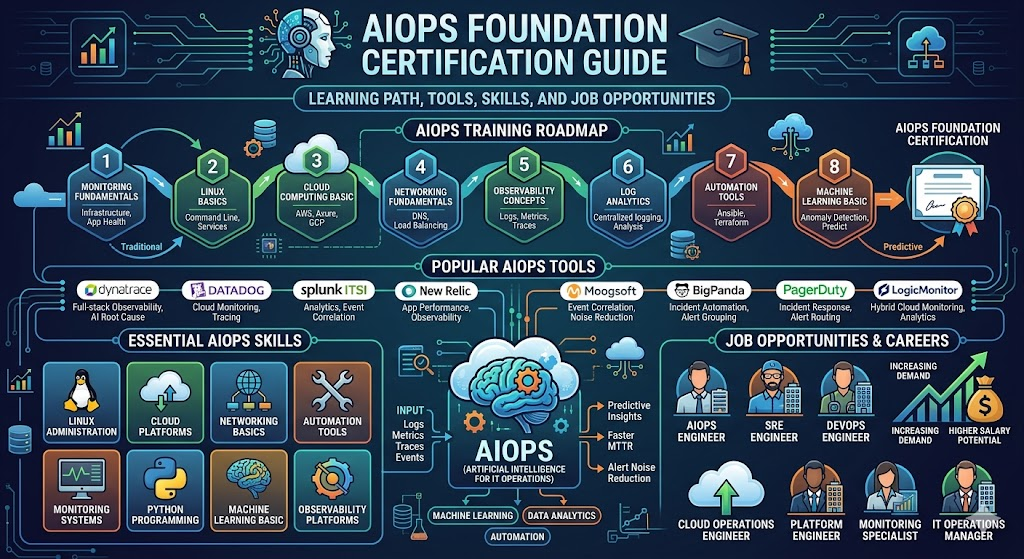
AIOps Training Roadmap
A structured AIOps Training journey includes:
- Monitoring fundamentals
- Linux basics
- Cloud computing basics
- Networking fundamentals
- Observability concepts
- Log analytics
- Automation tools
- Machine learning basics
- AIOps platforms training
This roadmap ensures strong foundational knowledge before advanced AIOps concepts.
AIOps Course Curriculum
A professional AIOps Course typically includes:
- Foundations of AIOps
- Event correlation techniques
- Root cause analysis
- Observability tools
- Incident response workflows
- Predictive analytics
- Automation strategies
- Hands-on labs
- Enterprise case studies
This curriculum prepares learners for real-world IT operations challenges.
AIOps Certification Guide
Why Certification Matters
AIOps Certification validates practical and theoretical knowledge.
Benefits
- Industry recognition
- Career advancement
- Skill validation
- Higher salary potential
Career Opportunities
Certified professionals are highly valued in DevOps and SRE roles.
AIOps Foundation Certification
The AIOps Foundation Certification focuses on:
- Core AIOps concepts
- Observability principles
- Event correlation techniques
- Incident automation
- Predictive operations
Exam Preparation
- Study monitoring tools
- Practice real-world scenarios
- Learn automation workflows
This certification is ideal for beginners entering AIOps Training.
Career Opportunities in AIOps
After completing AIOps Training and Certification, professionals can pursue roles like:
- AIOps Engineer
- SRE Engineer
- DevOps Engineer
- Cloud Operations Engineer
- Platform Engineer
- Monitoring Specialist
- IT Operations Manager
Demand for these roles is rapidly increasing across enterprises.
Skills Required to Become an AIOps Engineer
To succeed in AIOps, professionals should learn:
- Linux fundamentals
- Cloud platforms (AWS, Azure, GCP)
- Networking basics
- Automation tools
- Monitoring systems
- Python programming
- Machine learning basics
- Observability platforms
These skills form the foundation of advanced AIOps capabilities.
Future of AIOps
The future of AIOps is driven by automation and intelligence.
Generative AI in Operations
AI assistants will help troubleshoot incidents automatically.
Autonomous IT Operations
Systems will self-diagnose and self-heal.
Predictive Operations
Failures will be detected before they occur.
Intelligent Automation
Workflows will be fully automated using AI.
AIOps will become the backbone of enterprise IT operations.
Why Learn AIOps from AIOpsSchool
AIOpsSchool provides a structured learning experience for beginners and professionals.
- Step-by-step training path
- Real-world project exposure
- Industry-aligned curriculum
- Certification-focused learning
- Expert-led instruction
This makes it an ideal platform for mastering AIOps Training.
Frequently Asked Questions (FAQs)
1. What is AIOps?
AIOps is the use of artificial intelligence to improve IT operations through automation, monitoring, and predictive analytics.
2. Is AIOps a good career option?
Yes, AIOps is a high-demand career with strong growth in cloud and DevOps environments.
3. How long does it take to learn AIOps?
Typically, 2–4 months of structured learning is enough for foundational understanding.
4. Which certification is best for beginners?
The AIOps Foundation Certification is ideal for beginners.
5. AIOps vs DevOps?
DevOps focuses on software delivery, while AIOps focuses on IT operations intelligence.
6. AIOps vs MLOps?
AIOps manages IT operations; MLOps manages machine learning lifecycle.
7. What are the best AIOps tools?
Dynatrace, Datadog, Splunk ITSI, and New Relic are widely used.
8. What salary can I expect in AIOps roles?
AIOps professionals often earn competitive salaries due to high demand.
9. Is coding required for AIOps?
Basic scripting knowledge like Python is helpful but not always mandatory.
10. What is included in AIOps Training?
Monitoring, observability, automation, and machine learning basics.
11. Can beginners learn AIOps?
Yes, beginners with IT basics can start learning AIOps easily.
12. What industries use AIOps?
Finance, healthcare, telecom, e-commerce, and cloud industries.
13. What is anomaly detection in AIOps?
It is the process of identifying unusual system behavior using AI.
14. What is root cause analysis?
It is identifying the main source of system issues automatically.
15. Why is AIOps important today?
Because modern IT systems require automation, speed, and intelligence.
Conclusion
AIOps is transforming the way modern IT operations are managed. With increasing complexity in cloud environments, microservices, and distributed systems, traditional monitoring is no longer enough. AIOps Training equips professionals with the skills needed to build intelligent, automated, and self-healing systems.
An AIOps Certification not only validates your expertise but also opens doors to high-demand roles in DevOps, SRE, and cloud operations. Organizations are actively investing in AIOps to reduce downtime, improve performance, and increase operational efficiency.
For learners, this is the perfect time to start an AIOps journey. With the right training, tools, and certification path, professionals can build future-ready careers in AI-driven IT operations and become key contributors to enterprise transformation.