Introduction
Artificial Intelligence is rapidly reshaping the aviation industry, making it safer, smarter, and more efficient. From airlines and airports to aircraft systems and air traffic control, AI is now deeply integrated into nearly every part of modern aviation.
The aviation industry generates massive amounts of data every second—from flight paths and weather updates to engine performance and passenger behavior. AI helps convert this data into meaningful insights, enabling faster decisions, improved safety, and reduced operational costs.
For students and professionals, understanding AI in aviation is essential because it represents the future of both aerospace engineering and airline operations. This guide explains how AI is transforming aviation in simple, practical terms.
What Is AI in Aviation?
AI in aviation refers to the use of machine learning, automation systems, and data analytics to improve how airlines, airports, and aircraft operate.
It helps in:
- Processing large volumes of aviation data
- Automating repetitive airline operations
- Improving safety through predictive systems
- Enhancing passenger experience
- Optimizing flight performance
In simple terms, AI acts as a “smart brain” that helps aviation systems make better and faster decisions.
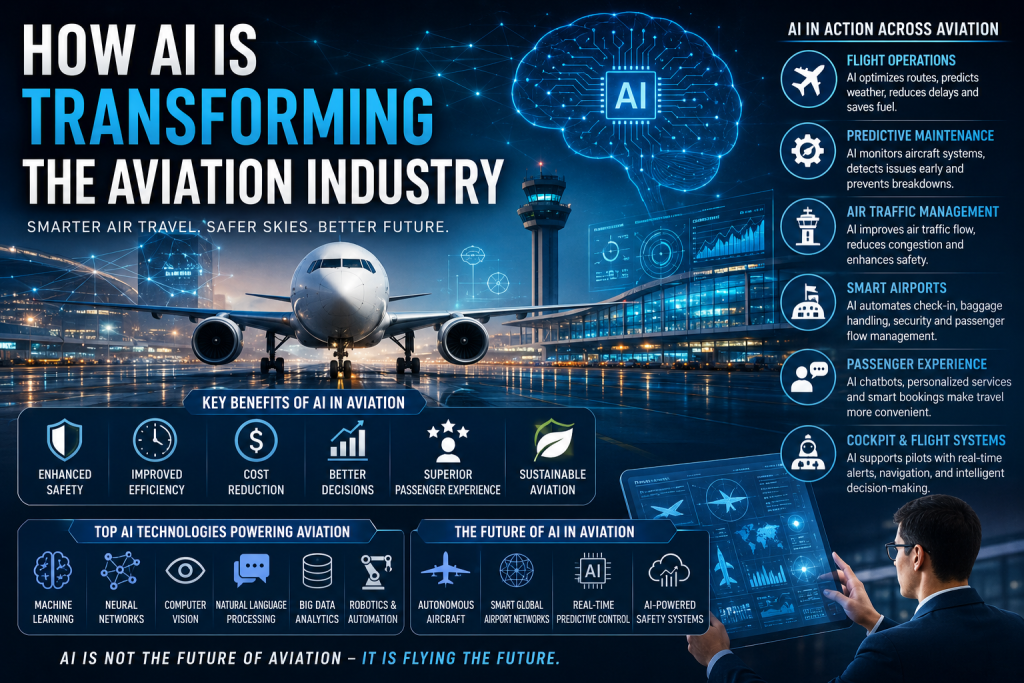
Key Areas Where AI Is Transforming Aviation
AI is not limited to one area—it is transforming the entire aviation ecosystem.
Flight Operations Optimization
AI helps airlines improve flight planning and operational efficiency.
It is used for:
- Optimal route selection
- Fuel consumption reduction
- Real-time weather adjustments
- Delay prediction and avoidance
By analyzing live data, AI ensures flights are more efficient and cost-effective.
Predictive Maintenance
One of the most powerful uses of AI in aviation is predictive maintenance.
AI systems monitor aircraft health and:
- Detect early signs of mechanical issues
- Predict component failures before they occur
- Reduce unexpected breakdowns
- Lower maintenance costs
- Improve aircraft availability
This significantly improves safety and operational reliability.
Air Traffic Management
Air traffic control is becoming more advanced with AI support.
AI helps:
- Manage air traffic congestion
- Improve runway scheduling
- Reduce flight delays
- Support controllers in decision-making
- Enhance overall flight safety
This leads to smoother and safer skies.
Smart Airports
Airports are becoming highly automated through AI systems.
Common AI applications include:
- Facial recognition for passenger check-in
- Automated baggage handling
- Smart security screening
- Passenger flow tracking
- Queue management systems
Smart airports improve efficiency and reduce waiting times.
Passenger Experience
AI is improving how passengers interact with airlines.
It is used in:
- AI chatbots for customer support
- Personalized travel recommendations
- Smart booking systems
- Automated check-in assistance
- Real-time travel updates
This makes air travel more convenient and user-friendly.
Cockpit and Flight Systems
Modern aircraft use AI-powered systems to assist pilots.
These include:
- Intelligent navigation support
- Real-time system alerts
- Weather prediction tools
- Decision support systems
- Automated flight optimization
AI does not replace pilots but enhances their decision-making capability.
Why AI Is Important in Aviation
AI plays a critical role in improving aviation performance across multiple dimensions:
- Increased flight safety
- Reduced human error
- Faster operational decisions
- Lower fuel and maintenance costs
- Improved passenger satisfaction
- Better airline efficiency
These benefits make AI a core technology in modern aviation.
AI in Airlines vs Traditional Aviation Systems
| Factor | Traditional Systems | AI-Driven Systems |
|---|---|---|
| Decision Making | Human-based | Data-driven |
| Efficiency | Moderate | High |
| Maintenance | Reactive | Predictive |
| Operations | Manual processes | Automated systems |
| Safety Monitoring | Periodic checks | Real-time monitoring |
AI transforms aviation from reactive systems to predictive and intelligent systems.
Top AI Technologies Used in Aviation
Several advanced AI technologies power modern aviation systems:
- Machine Learning
- Neural Networks
- Computer Vision
- Natural Language Processing
- Big Data Analytics
- Robotics and Automation
These technologies work together to improve aviation efficiency and safety.
Career Opportunities in AI Aviation Industry
AI is creating new career paths in aviation technology.
AI Aviation Data Analyst
Analyzes aviation data to improve performance and safety.
Machine Learning Engineer in Aviation
Builds AI models for aviation systems and prediction tools.
Aviation Software Developer
Develops applications for airlines and airports.
Predictive Maintenance Engineer
Uses AI to detect aircraft issues early.
Smart Airport Systems Specialist
Manages automated airport systems.
Air Traffic AI Engineer
Develops AI systems for air traffic control.
Aerospace AI Research Scientist
Works on future aviation AI innovations.
Skills Required for AI in Aviation Careers
To build a career in this field, students need:
- Programming knowledge (Python)
- Machine learning fundamentals
- Data analysis skills
- Aviation system understanding
- Cloud computing basics
- Problem-solving ability
- Analytical thinking
A combination of aviation and AI knowledge is highly valuable.
Challenges in AI Adoption in Aviation
Despite its benefits, AI implementation has challenges:
- High development and deployment cost
- Data privacy and security concerns
- Regulatory restrictions in aviation
- Integration with old systems
- Need for skilled professionals
These challenges require careful planning and global cooperation.
Future of AI in Aviation
The future of aviation will be highly intelligent and automated.
Key developments include:
- Fully AI-powered airlines
- Autonomous aircraft systems
- Smart global airport networks
- Real-time predictive aviation control
- AI-based safety monitoring systems
- Advanced air traffic automation
AI will become a core foundation of future aviation systems.
How AIAVIATIONACADEMY.COM Helps Students
AIAVIATIONACADEMY.COM supports learners by providing:
- AI + aviation educational content
- Beginner-friendly explanations
- Career guidance in aviation technology
- Industry insights and updates
- Future job preparation resources
It helps students understand how AI is shaping aviation careers.
Frequently Asked Questions
1- How is AI used in aviation?
AI is used in flight operations, maintenance, air traffic control, and passenger services.
2- What are examples of AI in airlines?
Route optimization, chatbots, predictive maintenance, and smart booking systems.
3- Can AI fly aircraft?
AI assists pilots but does not fully replace them in commercial aviation.
4- What is predictive maintenance in aviation?
It uses AI to detect aircraft issues before they happen.
5- How do smart airports use AI?
They use AI for check-in, baggage handling, security, and passenger flow.
6- Is AI replacing pilots?
No, AI supports pilots and enhances decision-making.
7- What careers exist in AI aviation?
AI engineers, data analysts, software developers, and automation specialists.
8- What skills are needed for AI aviation jobs?
Programming, machine learning, data analysis, and aviation knowledge.
9- How does AI improve flight safety?
By detecting risks early and assisting real-time decision-making.
10- What is the future of AI in aviation?
It includes autonomous aircraft, smart airports, and fully automated systems.
Conclusion
Artificial Intelligence is transforming the aviation industry into a smarter, safer, and more efficient ecosystem. From predictive maintenance and smart airports to air traffic optimization and passenger services, AI is improving every stage of aviation operations.
As the industry continues to evolve, the demand for professionals who understand both aviation and AI will grow rapidly. Students who prepare early in these fields will be well-positioned for future careers in one of the most advanced and fast-growing industries in the world.
#AIinAviation, #FutureOfAviation, #AviationTechnology, #SmartAirports, #AIAviationAcademy