Introduction
Artificial Intelligence is rapidly changing the aviation industry, making it smarter, safer, and more efficient. From flight operations to airport management, AI is becoming a core part of modern aviation systems. For students and professionals, this shift is creating new and exciting career opportunities that did not exist a few years ago.
Today’s aviation industry is no longer only about pilots and aircraft engineers. It now includes data scientists, AI engineers, automation specialists, and intelligent systems developers who work behind the scenes to improve flight safety, reduce delays, and optimize operations.
This guide explains how Artificial Intelligence is transforming aviation careers and what students can do to prepare for future opportunities in this fast-growing field.
What Is AI in Aviation?
AI in aviation refers to the use of machine learning, automation systems, and data-driven technologies to improve different parts of the aviation ecosystem.
AI helps aviation systems:
- Analyze large volumes of flight data
- Improve decision-making in real time
- Predict technical failures before they happen
- Automate airport and airline operations
- Enhance passenger experience
In simple terms, AI acts like a smart assistant for airlines, airports, and aircraft systems.
Key Applications of AI in Aviation
Flight Operations Optimization
AI helps airlines plan efficient flight routes, reduce fuel consumption, and avoid weather disruptions. It processes real-time data to suggest the best possible flight paths.
Predictive Maintenance
Aircraft systems generate massive amounts of data. AI analyzes this data to predict possible technical issues before they occur, reducing maintenance costs and improving safety.
Air Traffic Management
AI improves air traffic control by managing flight schedules, reducing congestion, and helping controllers make faster decisions.
Smart Airports
Modern airports use AI for:
- Passenger flow management
- Baggage handling automation
- Security screening systems
- Facial recognition check-ins
Passenger Experience Systems
AI enhances passenger experience through chatbots, smart booking systems, personalized travel suggestions, and automated customer support.
Autonomous Aircraft Research
AI is also being used in research for autonomous and semi-autonomous aircraft systems, improving navigation and control systems.
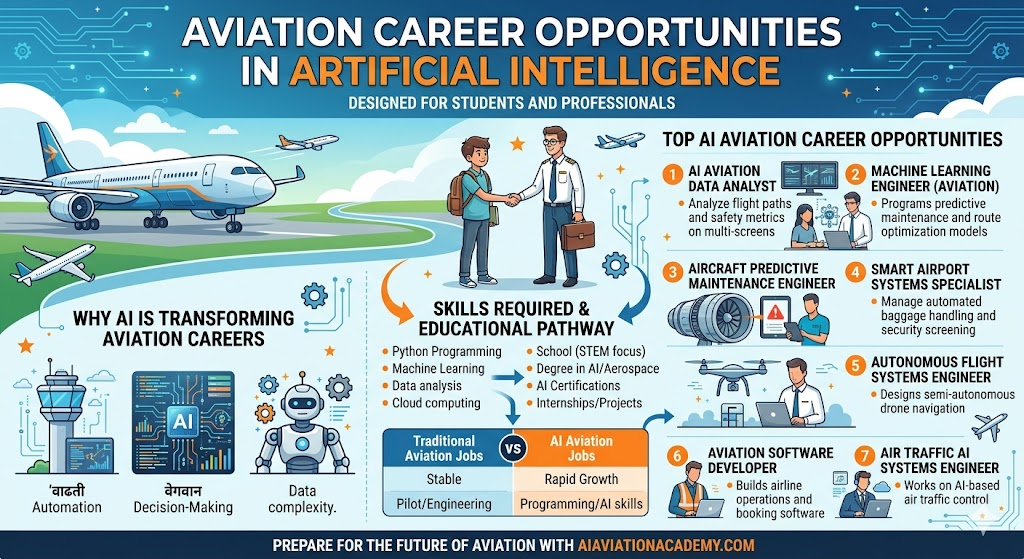
Why AI Is Transforming Aviation Careers
AI is not replacing aviation jobs; instead, it is transforming them into more advanced and technical roles.
Key reasons include:
- Increasing use of automation in airlines
- Need for faster decision-making systems
- Growing aviation data complexity
- Demand for safety and efficiency improvements
- Expansion of digital aviation infrastructure
This transformation is creating hybrid roles where aviation knowledge and AI skills work together.
Top Aviation Career Opportunities in Artificial Intelligence
AI is opening multiple career paths in the aviation industry. Below are the most important roles:
AI Aviation Data Analyst
Works on analyzing flight data, operational performance, and safety metrics to improve airline efficiency.
Machine Learning Engineer (Aviation)
Develops AI models that predict maintenance issues, optimize routes, and improve aviation systems.
Aircraft Predictive Maintenance Engineer
Uses AI tools to predict mechanical failures in aircraft before they happen.
Smart Airport Systems Specialist
Manages AI-powered airport systems such as baggage automation, passenger tracking, and security systems.
Aviation Software Developer
Builds software solutions for airlines, airports, and aviation service providers.
Flight Operations AI Specialist
Improves flight scheduling, fuel optimization, and operational efficiency using AI tools.
Air Traffic AI Systems Engineer
Works on AI-based air traffic control systems for safer and more efficient flight management.
Autonomous Flight Systems Engineer
Develops AI systems for semi-autonomous and autonomous aircraft technologies.
Aviation Cybersecurity AI Expert
Protects aviation systems from cyber threats using AI-based security tools.
Aerospace Robotics Engineer
Works on robotics and automation systems used in aircraft manufacturing and maintenance.
Skills Required for AI Aviation Careers
To build a career in AI-powered aviation, students need a combination of technical and aviation knowledge.
Key skills include:
- Python programming
- Machine learning fundamentals
- Data analysis and visualization
- Cloud computing basics
- Artificial intelligence concepts
- Aviation system understanding
- Problem-solving abilities
- Analytical thinking
Strong communication skills are also important for working in global aviation environments.
Educational Pathway for Students
Students can follow a structured learning path to enter AI aviation careers:
Step 1: School Education (STEM Focus)
Students should focus on Science, Mathematics, and Computer Science to build a strong foundation.
Step 2: Degree in AI or Aerospace
Choose fields like:
- Artificial Intelligence
- Data Science
- Aerospace Engineering
- Computer Engineering
Step 3: Aviation Fundamentals Learning
Understand aviation basics such as aircraft systems, airline operations, and aviation safety.
Step 4: AI Certifications
Gain certifications in:
- Machine Learning
- Data Science
- Cloud Platforms
- AI Development Tools
Step 5: Internships and Projects
Work on real-world aviation AI projects to gain industry experience.
AI in Aviation vs Traditional Aviation Jobs
| Factor | Traditional Aviation Jobs | AI Aviation Jobs |
|---|---|---|
| Focus | Flying and operations | Data and automation |
| Skills | Pilot/engineering skills | Programming and AI skills |
| Technology | Mechanical systems | Digital systems |
| Growth | Stable | Rapidly growing |
| Future Scope | Established | Expanding quickly |
AI aviation careers complement traditional aviation roles instead of replacing them.
Future of AI in Aviation Industry
The future of aviation will be highly automated and data-driven.
Key developments include:
- Fully AI-powered airports
- Smart cockpit assistance systems
- Predictive airline operations
- Autonomous flight research
- AI-based safety monitoring
- Digital air traffic systems
These innovations will create new job opportunities for skilled professionals.
Challenges in AI Aviation Careers
While the future is promising, there are challenges:
- High technical complexity
- Need for both aviation and AI knowledge
- Strict safety regulations
- Data security concerns
- Continuous learning requirements
Students must be prepared for lifelong learning in this field.
Why Choose AIAVIATIONACADEMY.COM
AIAVIATIONACADEMY.COM helps students and professionals understand the future of aviation by combining AI and aerospace knowledge.
It supports learners with:
- Aviation AI career guidance
- Skill development resources
- Industry-focused learning content
- Future aviation job awareness
- Beginner-friendly AI aviation education
This makes it easier for students to prepare for modern aviation careers.
Frequently Asked Questions
1- What is AI in aviation?
AI in aviation refers to the use of artificial intelligence technologies to improve airline operations, aircraft systems, airport management, and passenger services.
2- What jobs are available in aviation AI?
Jobs include AI engineers, data analysts, predictive maintenance specialists, airport automation experts, and aviation software developers.
3- Do pilots need AI skills?
Pilots do not need advanced AI skills, but understanding AI-based cockpit systems can be beneficial for modern aviation.
4- Is AI replacing aviation jobs?
No, AI is transforming aviation jobs by making them more efficient rather than replacing them completely.
5- What should I study for AI aviation careers?
Students should study AI, data science, computer engineering, or aerospace engineering along with aviation basics.
6- How is AI used in airports?
AI is used for baggage handling, security screening, passenger flow management, and automated check-in systems.
7- What is predictive maintenance?
It is the use of AI to predict aircraft technical issues before they occur, improving safety and reducing downtime.
8- Can AI fly aircraft fully?
AI can assist in flying systems, but fully autonomous passenger aircraft are still in development and testing stages.
9- What salary can AI aviation jobs offer?
Salaries vary depending on role, experience, and country, but AI aviation roles are generally high-paying due to technical expertise.
10- Is AI aviation a good career choice?
Yes, it is a strong future career option due to rapid growth in aviation automation and smart systems.
Conclusion
Artificial Intelligence is reshaping the aviation industry by introducing smarter systems, automation, and data-driven decision-making. This transformation is creating new career opportunities that combine aviation knowledge with advanced technology skills. Students who prepare early by learning AI, data science, and aviation fundamentals will be well-positioned for future jobs in this evolving industry.
AIAVIATIONACADEMY.COM plays an important role in guiding learners toward these future-ready aviation careers by simplifying complex concepts and helping them understand real-world opportunities in AI-powered aviation systems.