Introduction
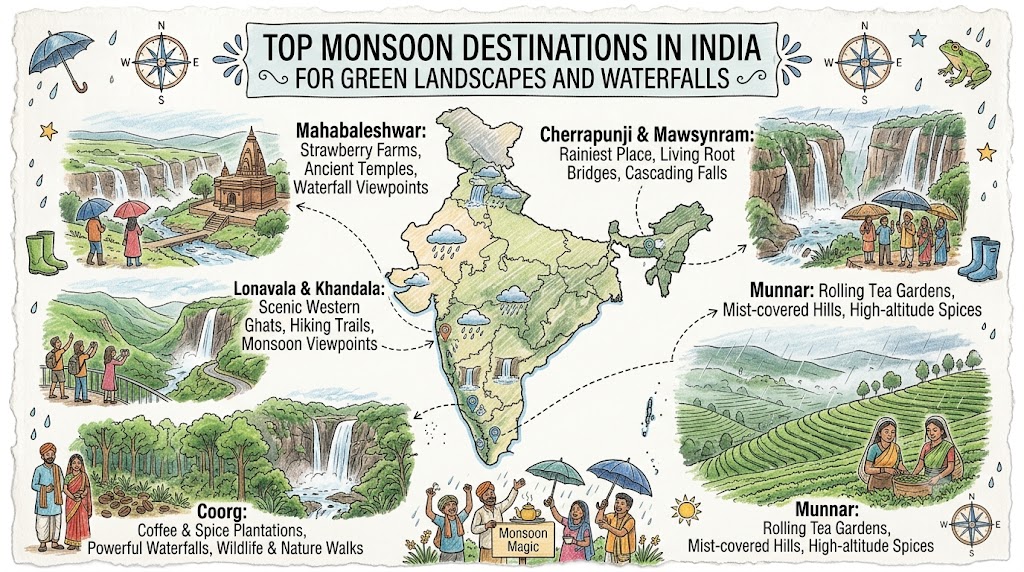
The Indian monsoon changes the character of many familiar destinations. Dry hills become bright green, seasonal streams return, waterfalls gain strength and clouds settle over mountain roads. For travellers who enjoy misty landscapes, local food and quiet nature stays, the rainy season can offer a refreshing way to explore the country.
However, monsoon travel requires more preparation than an ordinary holiday. Roads may be slippery, viewpoints can disappear behind clouds and waterfall trails may close temporarily after heavy rain. A flexible plan is therefore more useful than a tightly packed sightseeing schedule.
This guide covers some of the top monsoon destinations in India, including Meghalaya, Maharashtra, Karnataka, Kerala, Goa and Madhya Pradesh. It explains what to see, how long to stay, suitable activities, transport considerations, accommodation choices, estimated costs and basic safety precautions.
HolidayLandmark can support this planning process by helping travellers research destinations, compare local experiences, discover homestays, understand seasonal conditions and find knowledgeable local guides.
Destination Overview
India’s strongest monsoon landscapes are often found in the Western Ghats, the Khasi Hills and forested parts of Central India. These areas receive seasonal rain that strengthens waterfalls, fills rivers and covers valleys with dense vegetation.
The experiences vary considerably. Sohra offers dramatic cliffs and powerful waterfalls, Malshej Ghat is suited to short road trips, Coorg combines plantations with nature stays, and Pachmarhi offers forest trails, waterfalls and spiritual sites.
| Destination | Main Monsoon Appeal | Suggested Stay | Suitable For | Important Consideration |
|---|---|---|---|---|
| Sohra and Shillong, Meghalaya | High cliffs, waterfalls, mist and Khasi culture | 4–5 days | Couples, photographers, cultural travellers | Heavy rain may interrupt outdoor plans |
| Malshej Ghat, Maharashtra | Seasonal roadside waterfalls and green valleys | 2–3 days | Weekend travellers, families, photographers | Avoid stopping on unsafe road sections |
| Lonavala and Rajmachi, Maharashtra | Forts, misty hills and trekking routes | 2–3 days | Groups, trekkers, history lovers | Popular locations become crowded |
| Amboli Ghat, Maharashtra | Dense forest, waterfalls and biodiversity | 2–3 days | Nature lovers, couples, birdwatchers | Roads and trails can become slippery |
| Coorg, Karnataka | Coffee estates, forests and waterfalls | 3–4 days | Families, couples, slow travellers | Some outdoor activities may be limited |
| Jog Falls, Karnataka | Large waterfall and Sharavathi landscapes | 2–3 days | Families, photographers, nature travellers | Visibility changes with mist and rainfall |
| Athirappilly, Kerala | Powerful waterfall and forest scenery | 2–3 days | Families, couples, nature lovers | Riverbanks can be hazardous after rain |
| Munnar, Kerala | Tea hills, mist, streams and plantation stays | 3–4 days | Couples, families, slow travellers | Mountain roads require cautious driving |
| Dudhsagar, Goa | Forest waterfall and inland Goa scenery | 2–3 days | Adventure travellers, groups | Access is regulated and may change |
| Pachmarhi, Madhya Pradesh | Satpura forests, caves and waterfalls | 3–4 days | Families, walkers, spiritual travellers | Some sites require local transport or guides |
Official tourism sources describe Sohra’s rain-fed waterfalls, Malshej Ghat’s seasonal cascades, Coorg’s monsoon greenery, Jog Falls’ stronger rainy-season appearance and Pachmarhi’s collection of forest waterfalls.
Why These Top Monsoon Destinations in India Stand Out
Landscapes become greener
Rain revives mountain vegetation, forest streams and plantation landscapes. Tea gardens around Munnar, coffee estates in Coorg and the Sahyadri slopes of Maharashtra appear especially fresh during this period. Kerala Tourism describes Munnar as a landscape of misty valleys, tea plantations, waterfalls and mountain streams, while Karnataka Tourism identifies the monsoon as an attractive season for Coorg’s greenery and waterfalls.
Waterfalls become more impressive
Many Indian waterfalls depend heavily on seasonal rain. Athirappilly, Jog Falls, Nohkalikai, Nohsngithiang and the seasonal falls of Malshej Ghat are among the most rewarding examples. Their flow can vary from day to day, and viewing conditions depend on rain, mist and local safety restrictions.
Monsoon trips can support slower travel
Rain encourages travellers to reduce the number of daily activities. A holiday may include a long breakfast at a homestay, a short nature walk, local food, village interaction and one major viewpoint rather than constant sightseeing.
Local culture becomes part of the journey
Khasi food in Meghalaya, Kodava traditions in Coorg, plantation communities in Kerala and rural Maharashtrian cuisine can add meaning to a nature-focused trip. Staying locally also gives travellers a better understanding of how communities live with seasonal rainfall.
Best Places to Visit
Sohra and Shillong, Meghalaya
Sohra, also known as Cherrapunji, is known for steep valleys, living root bridges and waterfalls descending from high plateaus. Nohkalikai and Nohsngithiang are major attractions, while the road from Shillong passes through misty hills and open viewpoints. Sohra lies roughly 50 kilometres by road from Shillong, although travel time can increase considerably in bad weather.
What to experience: Waterfall viewpoints, short forest walks, caves where open, Khasi food and rural landscapes.
Suggested duration: Three nights in Shillong and Sohra combined, with an additional day for Mawphlang or another village experience.
Practical advice: Keep one flexible day because clouds can temporarily hide major waterfalls. Avoid entering caves, rivers or forest trails during severe weather without local guidance.
Suitable for: Photographers, couples, cultural travellers and nature-focused families.
Malshej Ghat, Maharashtra
Malshej Ghat is a convenient monsoon escape from Mumbai and Pune. Seasonal waterfalls appear along the cliffs, while Pimpalgaon Joga Dam, viewpoints and nearby hill routes provide a mixture of scenery and outdoor activity. Maharashtra Tourism identifies June to September as the principal waterfall season and advises visitors to carry rain protection and sturdy footwear.
What to experience: Misty road journeys, valley views, seasonal waterfalls, birdwatching and short nature walks.
Suggested duration: One full day for the main ghat area or two nights for a slower trip.
Practical advice: Do not stop on blind curves or crowded highway edges. Use designated parking and established viewpoints.
Suitable for: Weekend travellers, families, couples and beginner photographers.
Lonavala and Rajmachi, Maharashtra
Lonavala offers green valleys, Buddhist caves, historic forts and access to popular monsoon trekking routes. Rajmachi Fort is surrounded by mist and seasonal waterfalls during the rainy season, while Lohagad offers a combination of history and open hill views.
What to experience: Fort walks, Karla or Bhaja Caves, valley viewpoints, local chikki and countryside drives.
Suggested duration: Two nights, with one day for Lonavala attractions and another for a fort or countryside route.
Practical advice: Start early to avoid weekend congestion. Long treks should be attempted only when the weather and trail conditions are suitable.
Suitable for: Groups, history enthusiasts, active couples and travellers from Mumbai or Pune.
Amboli Ghat, Maharashtra
Amboli lies in the southern part of Maharashtra close to Goa and the Konkan region. It is known for heavy rainfall, forest vegetation, wildlife, viewpoints and seasonal cascades. Strong winds can occasionally create the appearance of upward-flowing or “reverse” waterfalls. Maharashtra Tourism warns that roads may become slippery during the June-to-September monsoon.
What to experience: Guided nature walks, waterfall viewpoints, forest photography and quiet hill-station stays.
Suggested duration: Two nights.
Practical advice: Avoid touching unfamiliar insects or amphibians. A trained nature guide is useful for wildlife walks, especially after dark.
Suitable for: Birdwatchers, wildlife photographers, couples and travellers seeking a quieter alternative to Lonavala.
Coorg, Karnataka
Coorg combines coffee plantations, forested hills, local homestays and waterfalls. During the monsoon, the region becomes lush, although heavy rain can restrict trekking and reduce the number of outdoor activities available. Coorg has no railway station or airport of its own, so the final stage of the journey is completed by road.
What to experience: Plantation walks, local meals, short waterfall visits, coffee experiences and relaxed countryside drives.
Suggested duration: Three nights.
Practical advice: Choose one part of Coorg rather than repeatedly crossing the district. Confirm whether plantation walks are operating before arrival.
Suitable for: Families, couples, food travellers and visitors interested in homestays.
Jog Falls and the Sharavathi Region, Karnataka
Jog Falls is among Karnataka’s best-known waterfalls. It lies in a densely vegetated landscape and becomes especially impressive when seasonal water flow is strong. Viewing decks allow visitors to see the falls without undertaking a difficult walk, while nearby Sharavathi experiences may include nature walks, birdwatching and water-based activities when permitted. Karnataka Tourism generally identifies August to December as a favourable viewing period.
What to experience: Main waterfall viewpoints, forest scenery, photography and nature-based stays.
Suggested duration: Two nights.
Practical advice: Steps leading towards the lower sections can be tiring and slippery. Visitors with mobility limitations can enjoy the principal viewpoints without descending.
Suitable for: Families, photographers, senior travellers using accessible viewpoints and nature lovers.
Athirappilly and Vazhachal, Kerala
Athirappilly is Kerala’s largest and most famous waterfall. It forms part of the Chalakudy River and lies near the Sholayar forest ranges. Vazhachal is located nearby and adds a forested river landscape to the trip. Kerala Tourism notes that the two sites are only a short distance apart, making them suitable for the same day when conditions allow.
What to experience: Designated waterfall viewpoints, forest scenery, birdwatching and a peaceful nature stay.
Suggested duration: One or two nights.
Practical advice: Remain behind safety barriers. Wet rocks and strong water currents make informal bathing or climbing especially dangerous.
Suitable for: Families, couples, photographers and travellers beginning a Kerala road trip.
Munnar, Kerala
Munnar is known for rolling tea estates, mist-covered valleys, reservoirs and smaller waterfalls. Kerala Tourism identifies attractions including Mattupetty, Chinnakanal, Anayirangal and the Tea Museum, although weather or local operating conditions can affect access.
What to experience: Tea landscapes, plantation stays, viewpoints, short walks, local food and quiet time in the hills.
Suggested duration: Three nights.
Practical advice: Avoid trying to cover every viewpoint in one day. Mountain roads can be slow, and fog may reduce visibility.
Suitable for: Couples, families, photographers and travellers seeking relaxation.
Dudhsagar and Inland Goa
Dudhsagar is a four-tiered waterfall inside the forested interior of Goa. It is part of the Bhagwan Mahavir Wildlife Sanctuary landscape and is one of the state’s most recognisable natural attractions. Access arrangements are regulated and may vary with forest conditions, weather and seasonal operating rules.
Travellers unable to undertake the Dudhsagar route can consider Arvalem Falls, which Goa Tourism describes as easier to access and popular during the monsoon.
What to experience: Forest scenery, authorised waterfall visits, spice-growing areas and inland Goan villages.
Suggested duration: Two or three nights in inland or central Goa.
Practical advice: Use only authorised operators and approved routes. Railway tracks should never be treated as walking trails.
Suitable for: Groups, active travellers and visitors interested in a different side of Goa.
Pachmarhi, Madhya Pradesh
Pachmarhi is a forested hill station in the Satpura region. Bee Falls, Apsara Vihar and Rajat Prapat are among its principal waterfall attractions. The destination also offers caves, viewpoints, heritage buildings and spiritual locations such as Jata Shankar.
What to experience: Waterfall walks, forest routes, viewpoints, caves and slow sightseeing.
Suggested duration: Three nights.
Practical advice: Some attractions may require authorised local vehicles or guides. Plan one geographical area each day rather than crossing the region repeatedly.
Suitable for: Families, walkers, spiritual travellers and couples.
Things to Do
Watch waterfalls from recognised viewpoints
A waterfall does not need to be approached closely to be appreciated. Designated decks at Jog Falls and established viewpoints at Sohra, Athirappilly and Pachmarhi provide safer ways to enjoy the landscape.
Join a guided nature walk
Guided walks are valuable in Amboli, Mawphlang, Coorg and forested parts of Kerala. A local naturalist can explain plants, birds, insects and community conservation practices while helping visitors remain on suitable paths.
Experience plantation life
Coorg and Munnar offer coffee- and tea-related experiences. A responsible plantation visit should explain cultivation, labour, processing and the relationship between farming and the local environment.
Explore forts and heritage sites
Lohagad and Rajmachi add history to a Maharashtra monsoon trip. Wet stone steps require good footwear and a slow walking pace.
Try regional food
Monsoon travel is well suited to warm local meals, fresh snacks and homestay cooking. Travellers should ask about spice levels, meat ingredients, allergies and cooking methods before ordering.
Practise rain photography
Clouds, reflections, waterfalls and green valleys create strong photographic opportunities. Protect cameras and mobile phones with waterproof covers and avoid taking pictures while standing near road traffic or cliff edges.
Spend time in a village or homestay
A village visit should be based on genuine interaction rather than staged observation. Purchase food, crafts or locally produced goods fairly and ask permission before photographing residents.
Suggested Travel Itineraries
Since these destinations are located in different parts of India, trying to cover all of them in one journey would be tiring and expensive. Choose one regional itinerary instead.
Four-Day Meghalaya Monsoon Itinerary
Day One: Arrive in Shillong, settle into the accommodation and explore a local market or cultural attraction.
Day Two: Travel to Sohra and visit one or two major waterfall viewpoints. Remain overnight in Sohra rather than returning late.
Day Three: Explore another viewpoint, a suitable cave or a short guided nature trail, depending on the weather.
Day Four: Return through Mawphlang for a guided sacred-grove or village experience before continuing to Shillong.
Four-Day Maharashtra Sahyadri Itinerary
Day One: Reach Lonavala, visit a nearby viewpoint and keep the afternoon relaxed.
Day Two: Choose Lohagad, Bhaja Caves or an organised Rajmachi experience. Do not combine multiple long treks.
Day Three: Travel towards Malshej Ghat during daylight and check into a nature-oriented stay.
Day Four: Explore designated viewpoints and seasonal waterfalls before returning to Mumbai or Pune.
Four-Day Kerala Waterfall and Tea-Hill Itinerary
Day One: Travel from Kochi towards Athirappilly and spend the evening near the forested countryside.
Day Two: Visit Athirappilly and Vazhachal using recognised viewpoints. Avoid adding a long onward journey on the same day.
Day Three: Travel to Munnar, allowing extra time for rain and mountain-road conditions.
Day Four: Explore tea landscapes, a museum or a nearby viewpoint before extending the stay or returning towards Kochi.
Four-Day Karnataka Waterfall Itinerary
Day One: Reach Shivamogga or the Jog Falls region and rest after the road journey.
Day Two: Visit the main Jog Falls viewpoints and spend time in the surrounding landscape.
Day Three: Join an available nature experience around the Sharavathi region or enjoy a slow forest stay.
Day Four: Begin the return journey during daylight.
Best Time to Visit
The Indian monsoon does not arrive or withdraw at exactly the same time everywhere. Conditions can also change significantly within a single week.
| Season | Typical Conditions | Suitable Experiences | Travel Advice |
|---|---|---|---|
| Early monsoon, usually June | Fresh greenery, increasing rain and fewer visitors | Short road trips, photography and plantation stays | Some waterfalls may not have reached strong flow |
| Peak monsoon, usually July–August | Heavy rain, mist and powerful waterfalls | Waterfall viewing, forest stays and slow travel | Expect closures, delays and slippery roads |
| Late monsoon, usually September | Green landscapes with occasional clearer periods | Families, photography and moderate outdoor activity | Continue checking rain and road advisories |
| Post-monsoon, usually October–November | Strong remaining water flow with more stable weather | Trekking, sightseeing and longer road journeys | Popular destinations may become busier |
| Winter, usually December–February | Drier and clearer conditions | Outdoor exploration and comfortable road trips | Some seasonal waterfalls become weaker |
Sohra’s main monsoon period is associated with powerful rain-fed waterfalls, while Coorg experiences heavy rain and reduced outdoor activity from June to September. Jog Falls is commonly recommended from August into the post-monsoon months, showing why the ideal timing differs between destinations.
How to Reach and Travel Locally
Meghalaya
Guwahati is the main air and rail gateway for many travellers visiting Shillong and Sohra. From Shillong, road transport is needed for Sohra, Mawphlang and most waterfall areas. Local taxis or a hired vehicle are more practical than depending on multiple shared transfers during heavy rain.
Maharashtra
Lonavala has direct railway and road connectivity on the Mumbai–Pune corridor. Malshej Ghat is mainly reached by road; Maharashtra Tourism lists Kalyan as the nearest major railway gateway and describes road access from Mumbai and Pune. Amboli can be approached through Sawantwadi Road railway station or from Goa by road.
Karnataka
Coorg does not have its own railway station or airport, so travellers normally continue by road from Mysuru, Mangaluru or Bengaluru. For Jog Falls, Talaguppa is the closest railway station listed by Karnataka Tourism, while road connections operate through the Shivamogga region.
Kerala
Kochi is a practical gateway for both Athirappilly and Munnar. Chalakudy is a useful railway point for Athirappilly, while Munnar requires a mountain-road journey from the Kochi or Ernakulam side.
Goa
Dudhsagar is approached through authorised forest-tourism or trekking arrangements. The permitted route and operating process can change, particularly during severe weather, so travellers should confirm current requirements through official tourism or forest channels.
Madhya Pradesh
Pipariya is the most commonly used railway gateway for Pachmarhi, followed by a road transfer. Bhopal and Jabalpur are the principal airport options, although each requires a longer onward journey.
Accommodation and Homestays
Monsoon accommodation should be selected for practical comfort rather than views alone. Confirm road access, drainage, electricity backup, hot water, mobile connectivity and the availability of meals during severe rain.
Budget travellers can consider hostels, simple guest houses and family-operated homestays near town centres.
Families may prefer properties with vehicle access, an in-house restaurant and fewer exposed steps.
Couples can choose plantation stays, forest lodges or small hillside properties, provided the approach road is reliable.
Solo travellers should avoid isolated stays unless local transport and communication arrangements are clear.
Nature and cultural travellers can consider Coorg plantation homestays, Khasi community-based stays and locally operated accommodation near Munnar or Amboli.
Karnataka Tourism specifically highlights local homestays and plantation stays as places to experience Coorg food and regional hospitality. HolidayLandmark can help travellers discover such stays and compare them according to location, experience type and traveller needs.
Local Tour Guides
A knowledgeable local guide can improve a monsoon trip by helping visitors understand the landscape and avoid unsuitable routes. Guides are especially useful for:
- Forest and biodiversity walks
- Village and cultural visits
- Fort trekking
- Plantation experiences
- Sacred groves
- Less familiar waterfall routes
Before booking, confirm the guide’s name, identity, experience, language, total charges, meeting point, route, transport and included services. Ask whether the activity will be cancelled or modified during heavy rain.
A responsible guide should never pressure travellers to cross flooded streams, enter restricted areas or approach unsafe waterfall edges.
Village Tourism and Local Experiences
Mawphlang in Meghalaya offers an opportunity to learn about Khasi heritage, sacred groves, monoliths and community relationships with the forest. The experience is more meaningful with a local guide who can explain cultural rules and environmental importance.
Coorg and Munnar provide plantation-based experiences where visitors can learn about coffee or tea cultivation. Travellers should select experiences that explain local livelihoods rather than presenting plantations only as photographic settings.
During village visits:
- Ask before entering homes or farms.
- Do not photograph people without permission.
- Pay fairly for guides, food and handmade products.
- Avoid distributing sweets or money directly to children.
- Keep noise low near homes and religious places.
- Carry reusable bottles and take non-biodegradable waste away.
Pilgrimage and Spiritual Travel
Pachmarhi combines natural attractions with spiritual locations such as Jata Shankar Cave. Rain can make cave approaches and stone paths wet, so footwear and steady walking are important.
Sacred groves in Meghalaya should also be treated as protected cultural spaces. Follow the guide’s instructions, avoid removing plants or stones and respect local beliefs even when they differ from your own.
At temples, churches, shrines or sacred natural sites, wear suitable clothing, maintain silence where requested and avoid blocking paths for photography.
Adventure Activities
Monsoon adventure activities may include trekking, cycling, forest walks, kayaking, fort climbing and plantation trails. Availability depends on rainfall, river conditions and local permissions.
Beginners should choose short guided activities rather than isolated routes. At Jog Falls, for example, the principal viewing decks offer a more manageable experience, while the long descent towards the lower area demands greater fitness and caution.
Basic precautions include:
- Wear shoes with strong grip.
- Avoid cotton clothing on long wet walks.
- Carry drinking water and simple food.
- Keep electronics in dry bags.
- Never cross a fast-flowing stream.
- Stop an activity when visibility becomes poor.
- Follow forest, police and local authority instructions.
No adventure activity should be described as completely safe. Weather and terrain can change rapidly.
Local Food and Shopping
Regional food adds warmth and variety to a monsoon journey.
In Meghalaya, travellers may find Khasi dishes such as jadoh and tungrymbai. Ingredients and preparation styles vary, so vegetarian travellers should confirm whether meat, fish or fermented products are included.
Coorg is known for kadambuttu, akki rotti and meat dishes such as pandi curry. Plantation homestays often provide the clearest introduction to local cooking.
Kerala offers appam with stew, puttu with kadala curry, idiyappam and a wide range of vegetarian and non-vegetarian meals.
In Maharashtra, travellers can try warm bhakri, pithla, seasonal snacks and Lonavala chikki. Maharashtra Tourism also identifies local Maharashtrian food as part of the Malshej experience.
Purchase coffee, tea, spices, honey and crafts from recognised local producers. Check packaging, ingredients and transport restrictions before buying food products.
Estimated Travel Budget
The following figures are broad planning estimates in Indian rupees. They are not fixed prices or booking quotations. Long-distance flights and trains are excluded.
| Expense Category | Budget Travel | Mid-Range Travel | Comfortable Travel |
|---|---|---|---|
| Accommodation per room/night | ₹1,200–₹2,500 | ₹3,000–₹6,000 | ₹7,000–₹15,000 |
| Food per person/day | ₹600–₹1,200 | ₹1,200–₹2,500 | ₹2,500–₹5,000 |
| Local transport per person/day | ₹700–₹1,800 | ₹1,800–₹4,000 | ₹4,000–₹8,000 |
| Guides and activities per person/day | ₹300–₹1,500 | ₹1,500–₹3,500 | ₹3,500–₹7,000 |
| Approximate daily total per person | ₹2,000–₹4,500 | ₹4,500–₹9,000 | ₹9,000–₹18,000 |
Transport costs are generally higher for solo travellers because taxis and hired vehicles cannot be shared. Groups may reduce per-person transport costs, although larger vehicles may cost more.
Prices can change according to destination, weekend demand, weather, accommodation availability, group size and personal choices. Travellers should obtain written quotations showing taxes, permits, vehicle charges and guide fees.
Safety and Responsible Travel
Monsoon destinations are enjoyable when travellers respect water, weather and terrain.
Check weather and road conditions
Review official weather forecasts and local advisories before travelling. Recheck conditions each morning rather than depending on a forecast viewed several days earlier.
Stay away from dangerous water
Do not swim below waterfalls, climb wet rocks or stand in a river for photographs. A calm-looking stream can rise quickly after rain upstream.
Travel during daylight
Mountain roads are easier to manage during daylight. Fog, potholes, fallen branches and poor drainage become harder to identify after dark.
Protect belongings
Carry a waterproof document pouch, dry bags, an extra phone-charging option and sealed covers for medicines.
Respect barriers and closures
Temporary closures are usually introduced because of water flow, landslides, wildlife movement or damaged trails. Never enter a closed route simply because other visitors are doing so.
Reduce waste
Carry reusable bottles, refuse unnecessary plastic and take snack wrappers back to the nearest proper waste point.
Seek photography permission
Ask before photographing villagers, workers, religious ceremonies or private plantation areas.
Practical Travel Tips
- Keep at least one flexible half-day in the itinerary.
- Pack a lightweight raincoat instead of relying only on an umbrella.
- Carry an extra pair of footwear and several pairs of socks.
- Choose quick-drying clothes.
- Store identification and tickets in waterproof covers.
- Carry personal medicines and a basic first-aid kit.
- Download maps for offline use.
- Confirm whether the accommodation serves meals during bad weather.
- Avoid hotels directly beside swollen rivers or visibly unstable slopes.
- Start road journeys early and avoid rushing between destinations.
- Keep emergency contact details written separately from the phone.
- Check cancellation conditions for guided walks and outdoor activities.
How HolidayLandmark Supports Better Travel Planning
HolidayLandmark can help travellers organise a monsoon journey without treating every destination in the same way.
The platform can be used to research waterfall destinations, compare seasonal experiences and understand how many days a region may require. Travellers can also explore suggested itineraries, homestays, local guides, village tourism opportunities, pilgrimage routes and adventure activities.
For a Meghalaya holiday, a traveller might use HolidayLandmark to compare Sohra, Shillong and village experiences. Someone planning Kerala could study how Athirappilly fits with Munnar. Maharashtra travellers could compare a relaxed Malshej stay with a more active Lonavala trekking trip.
HolidayLandmark can also help users identify local travel providers. Before confirming any service, travellers should still verify current availability, written prices, cancellation conditions, permits and weather-related policies directly with the provider.
This approach makes the platform a useful starting point for creating a personal and responsible itinerary rather than a rigid package.
Frequently Asked Questions
1. Which Indian monsoon destination is best mainly for waterfalls?
Sohra, Jog Falls, Athirappilly and Pachmarhi are strong choices for waterfall-focused travel. The final choice should depend on your starting city, available days and comfort with heavy rainfall.
2. Is July or September better for a first monsoon holiday?
July usually brings heavier rain and stronger waterfalls, but it also creates a greater possibility of delays and closures. September may offer a better balance of green scenery, waterfall flow and comparatively manageable travel conditions.
3. Are monsoon waterfall destinations suitable for children?
Many recognised viewpoints are suitable for families, particularly when they do not require long treks. Children should remain behind barriers and must not be allowed to play on wet rocks, riverbanks or roadside waterfall sections.
4. How many days are needed for a regional monsoon trip?
Three to five days are generally enough for one region. This allows travellers to keep the itinerary flexible and avoid combining distant destinations during unstable weather.
5. Is self-driving advisable on mountain roads during the monsoon?
Experienced drivers may use a well-maintained vehicle, provided the route is open and the journey takes place during daylight. Travellers unfamiliar with foggy roads, steep slopes or heavy rain may be more comfortable hiring a local driver.
6. Does monsoon travel cost less than winter travel?
Some properties offer lower weekday prices during rainy periods, but weekend destinations near major cities may remain expensive. Taxi charges can also increase when road conditions make journeys slower.
7. Should waterfall trails be booked with a local guide?
A guide is strongly recommended for forest trails, fort treks, sacred groves and unfamiliar routes. Simple visits to recognised viewing decks may not require one, but local advice remains valuable.
8. What type of accommodation is best during heavy rain?
Choose a property with reliable road access, proper drainage, power backup, hot water and in-house meals. Avoid isolated accommodation unless transport and emergency communication are clearly arranged.
9. Is vegetarian food available in these destinations?
Vegetarian food is widely available, but local dishes may include meat, fish, fermented products or shared cooking ingredients. Explain dietary needs clearly and confirm ingredients before ordering.
10. How can travellers make a monsoon trip more environmentally responsible?
Use reusable bottles, avoid disposable plastic, stay on recognised paths and never leave waste near waterfalls. Support local guides, homestays, food producers and craft workers through fair purchases.
Conclusion
The top monsoon destinations in India reveal a side of the country that is very different from the dry-season travel experience. Waterfalls gain strength, forests appear denser, plantations look fresher and mountain roads pass through shifting clouds. Sohra offers dramatic rain-fed cliffs, Maharashtra provides convenient Sahyadri escapes, Karnataka combines waterfalls with plantations, Kerala brings together forest rivers and tea hills, while Pachmarhi offers a quieter mixture of nature and spirituality.
A successful monsoon journey depends less on covering many attractions and more on choosing the right region. Travellers should allow extra time, keep daily plans manageable and accept that a viewpoint or trail may close because of severe weather. That flexibility is part of travelling responsibly during the rainy season.
Local guides can make forest walks, cultural visits and trekking routes more meaningful. Homestays and plantation properties can introduce travellers to regional meals, livelihoods and customs that may be missed during a rushed hotel-based holiday. Supporting community-run experiences also helps tourism income remain within the destination.
HolidayLandmark can assist travellers in researching destinations, exploring practical itineraries, discovering homestays and comparing local guides or activities. Current road conditions, permissions, prices and operating schedules should always be confirmed before departure.
With thoughtful planning, suitable rain protection and respect for local safety rules, a monsoon holiday can become a slower and more personal journey through some of India’s greenest landscapes.