Introduction
Aviation is one of the safest modes of transportation because it follows strict safety procedures, advanced technology, skilled professionals, and continuous improvement practices. However, aviation operations involve complex systems, changing weather conditions, technical challenges, and human decision-making factors. Managing these risks requires constant monitoring and better ways to predict and prevent potential problems.
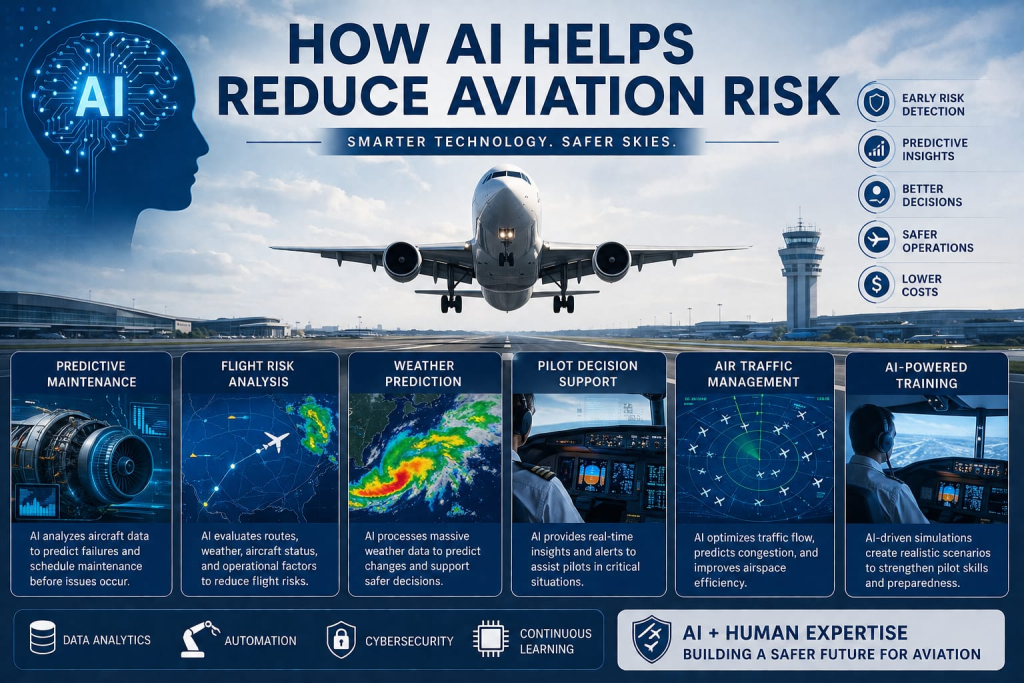
Artificial Intelligence (AI) is becoming an important technology in aviation safety by helping airlines, pilots, engineers, airports, and aviation organizations analyze large amounts of information and identify possible risks earlier. AI can process aircraft data, weather information, operational patterns, and maintenance records to provide useful insights that support safer decisions.
AI does not replace pilots, engineers, or aviation professionals. Instead, it works as a supporting technology that helps humans make faster, more informed, and data-driven decisions.
From predicting aircraft maintenance needs to improving pilot training simulations, AI is helping create a more proactive approach to aviation safety. Instead of only responding to problems after they occur, AI enables aviation teams to identify warning signs and take preventive actions.
Real-world examples:
- AI systems analyze aircraft sensor data to identify unusual patterns that may indicate future maintenance requirements.
- Airlines use AI-supported weather analysis to help evaluate safer flight routes.
- Pilot training programs use AI-powered simulations to create realistic emergency practice scenarios.
Evaluation Criteria for Understanding AI in Aviation Safety
When evaluating the role of AI in aviation risk reduction, several important factors should be considered.
Accuracy of AI Predictions
AI systems depend on data analysis to identify patterns and possible risks. Accurate predictions require reliable information and properly trained models.
Quality of Aviation Data
Aircraft systems generate large amounts of operational data. The quality and reliability of this data directly affect AI performance.
Real-Time Monitoring Capability
Aviation requires quick decisions. AI solutions should be capable of analyzing information efficiently and providing timely insights.
Integration With Aviation Systems
AI technologies must work effectively with existing aircraft systems, airport operations, maintenance platforms, and safety processes.
Human Decision-Making Support
AI should assist aviation professionals by providing recommendations and insights while keeping human expertise central to decision-making.
Reliability and Security
Aviation systems require high reliability. AI technologies must be secure, stable, and carefully tested.
Regulatory Compliance
AI solutions used in aviation must follow strict safety standards and operational requirements.
Explainability of AI Decisions
Aviation professionals need to understand why AI provides specific recommendations, especially in safety-critical situations.
What Is AI in Aviation Safety?
AI in aviation safety refers to the use of artificial intelligence technologies to analyze information, identify patterns, support decisions, and improve risk management.
Traditional aviation safety methods often rely on scheduled inspections, established procedures, and human analysis. AI adds another layer by processing large amounts of data and identifying patterns that may not be easily visible through manual analysis.
AI technologies used in aviation may include:
- Machine learning
- Predictive analytics
- Data pattern recognition
- Automation systems
- Intelligent monitoring tools
These technologies help aviation professionals understand operational conditions and respond more effectively to potential risks.
For example, an aircraft generates information from multiple systems during operation. AI can analyze this information to detect unusual behavior and provide early warnings.
Why Reducing Aviation Risk Is Important
Passenger Safety
The primary goal of aviation safety is protecting passengers and crew members. Reducing risks helps create safer flight experiences.
AI supports this goal by helping aviation teams identify possible issues before they become serious problems.
Operational Reliability
Airlines and airports manage complex operations involving aircraft, passengers, weather, and infrastructure.
AI helps improve operational planning by identifying patterns and supporting better decisions.
Aircraft Maintenance
Aircraft maintenance is essential for safe operations. AI helps maintenance teams understand aircraft conditions and plan inspections more effectively.
Better Decision-Making
Pilots, engineers, and aviation managers often need to make decisions using large amounts of information.
AI helps organize and analyze data, allowing professionals to focus on important factors.
Emergency Preparedness
AI-supported systems can help identify unusual situations and support faster responses during emergencies.
How AI Helps Reduce Aviation Risk
1. Predictive Aircraft Maintenance
Aircraft contain thousands of components that require regular monitoring and maintenance. Traditional maintenance schedules are important, but AI allows aviation teams to move toward more predictive approaches.
AI analyzes information from:
- Aircraft sensors
- Engine performance data
- System monitoring information
- Historical maintenance records
By identifying unusual patterns, AI can help maintenance teams understand when a component may require attention.
Benefits include:
- Early identification of possible issues
- Better maintenance planning
- Reduced unexpected equipment problems
- Improved aircraft availability
Predictive maintenance allows aviation organizations to take preventive action rather than waiting for failures.
2. AI-Based Flight Risk Analysis
Every flight involves multiple factors, including weather conditions, aircraft performance, air traffic, and operational limitations.
AI can analyze different sources of information to support flight risk assessment.
AI-based flight analysis can help with:
- Route evaluation
- Operational planning
- Risk identification
- Decision support
For example, AI tools can analyze flight conditions and provide information that helps aviation teams evaluate potential challenges before departure.
3. Weather Prediction and Analysis
Weather is one of the major factors affecting aviation operations. Storms, strong winds, visibility issues, and changing atmospheric conditions can influence flight decisions.
AI helps analyze large amounts of weather information from different sources.
AI-supported weather analysis can assist with:
- Identifying weather patterns
- Understanding changing conditions
- Supporting route planning
- Improving weather-related decisions
Pilots and aviation teams can use these insights along with professional judgment to make safer decisions.
4. AI-Assisted Pilot Decision Support
Pilots manage many responsibilities during flight operations. AI can support pilots by organizing information and highlighting important factors.
AI-assisted systems can help with:
- Situational awareness
- Data analysis
- Operational recommendations
- Workload management
During complex situations, AI can provide additional information that helps pilots evaluate available options.
However, final decisions remain the responsibility of trained aviation professionals.
5. Air Traffic Management Optimization
Air traffic management involves coordinating thousands of aircraft movements while maintaining safety and efficiency.
AI can support air traffic operations through:
- Traffic pattern analysis
- Congestion prediction
- Better resource planning
- Improved coordination
AI-based systems can help controllers and aviation organizations understand traffic conditions and improve operational flow.
6. Airport Safety Management
Airports involve many activities beyond aircraft movement. Passenger operations, ground vehicles, security systems, and equipment management all require careful monitoring.
AI can support airport safety through:
- Equipment monitoring
- Passenger flow analysis
- Ground operation support
- Security assistance
These capabilities help airports improve efficiency while maintaining safety standards.
7. AI-Based Simulation and Training
Training is a major part of aviation safety. Pilots and aviation professionals must practice different situations before handling them in real operations.
AI-powered training systems can create realistic learning environments.
Applications include:
- Flight simulations
- Emergency scenario practice
- Performance analysis
- Personalized training support
AI helps identify learning areas and provides additional insights for improving skills.
8. Cybersecurity and Threat Detection
Modern aviation depends heavily on digital systems, communication networks, and software platforms.
Cybersecurity has become an important part of aviation safety.
AI can support cybersecurity by:
- Detecting unusual system behavior
- Monitoring digital activity
- Identifying possible threats
- Supporting faster responses
Protecting aviation technology systems helps maintain reliable operations.
Benefits of AI in Aviation Risk Reduction
Early Risk Detection
AI helps identify patterns and warning signs that may indicate possible problems.
Improved Safety Decisions
AI provides additional information that helps aviation professionals make better decisions.
Reduced Operational Problems
Predictive analysis can help organizations prepare for potential issues before they affect operations.
Enhanced Training
AI-powered simulations improve pilot learning and emergency preparation.
Better Resource Management
AI helps airlines and airports analyze operations and use resources more effectively.
Challenges of Using AI in Aviation Safety
Data Quality Issues
AI systems depend on accurate data. Poor-quality information can affect analysis and recommendations.
Human Trust and Acceptance
Aviation professionals need confidence in AI systems and must understand their limitations.
System Reliability
Safety-critical aviation environments require highly reliable technology.
Cybersecurity Risks
AI systems themselves must be protected against digital threats.
Regulatory Challenges
Aviation authorities require careful evaluation before introducing new technologies into safety-critical operations.
AI in Aviation Safety vs Traditional Risk Management
| Category | AI-Based Aviation Risk Management | Traditional Risk Management |
|---|---|---|
| Data Analysis | Uses advanced algorithms to analyze large data volumes | Relies mainly on human analysis and established methods |
| Risk Detection | Focuses on identifying patterns and predicting possible issues | Often focuses on known risks and procedures |
| Decision Support | Provides data-driven insights | Depends mainly on human evaluation |
| Prediction Ability | Can identify possible future trends | Usually based on previous experiences and reports |
| Automation Level | Uses intelligent systems for monitoring and analysis | Uses manual processes and scheduled activities |
How Aviation Students Can Learn AI Safety Technologies
Students interested in aviation and AI can develop skills by combining aviation knowledge with technology understanding.
Learn Aviation Fundamentals
Understanding aircraft operations, safety procedures, and aviation systems creates a strong foundation.
Understand AI Basics
Students should learn basic concepts of:
- Artificial intelligence
- Machine learning
- Data analysis
- Automation
Study Aviation Data
Learning how aviation systems generate and use data helps students understand AI applications.
Explore Simulation Technologies
AI-powered simulators provide practical experience with technology-supported training.
Develop Analytical Skills
Problem-solving and data interpretation skills are valuable for future aviation professionals.
Future of AI in Aviation Safety
The future of aviation safety will likely involve stronger collaboration between humans and intelligent technologies.
AI may continue supporting areas such as:
- Advanced aircraft monitoring
- Smarter maintenance planning
- Improved flight analysis
- Intelligent training systems
- More efficient airport operations
The most effective aviation systems will combine AI capabilities with human expertise, professional judgment, and safety-focused decision-making.
Common Misconceptions About AI in Aviation
AI Will Completely Replace Pilots
AI is designed to support pilots, not remove the need for trained aviation professionals.
AI Can Remove All Aviation Risks
AI can help reduce risks, but aviation will always require human judgment and safety procedures.
AI Works Without Human Supervision
AI systems require monitoring, maintenance, and professional oversight.
AI Is Only Useful for Large Airlines
AI technologies can support different areas of aviation, including training, maintenance, and operations.
AI Does Not Need Reliable Data
AI performance depends heavily on accurate and quality information.
Frequently Asked Questions
1. How does AI improve aviation safety?
AI improves aviation safety by analyzing data, identifying possible risks, supporting decision-making, and helping aviation professionals take preventive actions.
2. Can AI predict aircraft maintenance problems?
AI can analyze aircraft performance data and identify patterns that may indicate possible maintenance needs.
3. Does AI replace pilots in aviation?
No. AI supports pilots by providing information and insights, while human professionals remain responsible for important decisions.
4. How is AI used in flight operations?
AI is used for flight analysis, weather support, predictive maintenance, operational planning, and decision assistance.
5. Can AI help with aviation weather risks?
Yes. AI can analyze weather information and support aviation teams in understanding changing conditions.
6. What role does AI play in pilot training?
AI helps create realistic simulations, analyze performance, and provide additional learning support.
7. How does AI support air traffic management?
AI helps analyze traffic patterns, predict congestion, and improve operational coordination.
8. What are the challenges of using AI in aviation?
Challenges include data quality, reliability, cybersecurity, regulatory requirements, and human acceptance.
9. Why is data important for aviation AI systems?
AI systems depend on accurate data to identify patterns and provide useful recommendations.
10. How can aviation students learn AI technologies?
Students can learn AI by studying aviation concepts, technology fundamentals, data analysis, and simulation systems.
Conclusion
Artificial Intelligence is becoming an important supporting technology in aviation safety by helping professionals analyze information, predict possible risks, and improve operational decisions.
From predictive maintenance and weather analysis to pilot training and airport management, AI provides valuable tools that help aviation organizations create safer operations. However, AI works best when combined with human experience, professional judgment, and established safety practices.
The future of aviation safety will depend on effective collaboration between intelligent technologies and skilled aviation professionals. Students who understand both aviation principles and AI concepts will be better prepared for the changing aviation industry.