Introduction
Aircraft inspection plays an important role in maintaining the safety, reliability, and airworthiness of an aircraft. Traditional inspections depend heavily on trained professionals who examine aircraft components for visible signs of damage or deterioration. As aviation technology develops, computer vision is becoming an important tool for supporting these inspection activities.
Computer vision uses cameras, image processing, artificial intelligence, and machine learning to analyze visual information. In aircraft inspection, these technologies can help identify defects such as cracks, corrosion, dents, surface damage, and other abnormalities. This article explains how computer vision works in aircraft inspection, where it can be used, its benefits and limitations, and how it may shape the future of aircraft maintenance.
What Is Computer Vision?
Computer vision is a field of artificial intelligence that allows computers to process and interpret images or video. Instead of simply storing a photograph, a computer vision system analyzes the visual information contained in that image.
A basic computer vision system can identify shapes, patterns, edges, colors, textures, and other visual characteristics. More advanced systems can use machine learning models to recognize specific objects or defects.
For example, if a system has been trained using many images of aircraft surfaces with corrosion, it can learn visual patterns associated with corrosion. When technicians provide a new image, the system can analyze it and indicate areas that may require closer examination.
Computer vision does not mean that a computer understands an aircraft in exactly the same way a human engineer does. It recognizes patterns based on its training, algorithms, and available data.
What Is Aircraft Inspection?
Aircraft inspection involves examining an aircraft and its components to determine whether they remain safe and suitable for operation.
Maintenance personnel inspect different areas depending on the aircraft, maintenance schedule, operating conditions, and inspection requirements. They may examine the fuselage, wings, empennage, landing gear, engine areas, control surfaces, fasteners, and other structural or mechanical components.
Inspections can identify problems such as:
- Cracks
- Corrosion
- Dents
- Scratches
- Surface deformation
- Paint deterioration
- Loose or damaged components
- Fluid leakage
- Foreign object damage
- Signs of wear
Some defects are easy to see, while others can be difficult to identify because of their size, location, lighting conditions, or surrounding structures.
Computer vision can assist inspectors by providing another method of examining visual information.
How Computer Vision Works in Aircraft Inspection
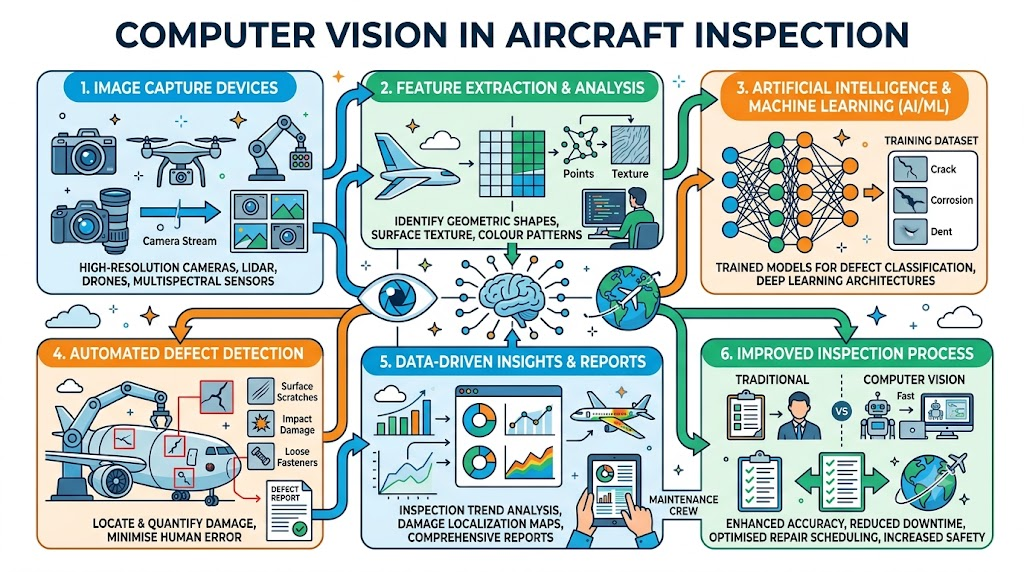
A computer vision inspection system normally combines imaging hardware with software capable of analyzing the captured information.
The process can be divided into several stages.
1. Image or Video Capture
Cameras capture photographs or video of the aircraft surface. Depending on the application, inspectors may use fixed cameras, handheld cameras, robotic systems, or drones.
High-resolution imaging is important because some aircraft defects can be very small.
2. Image Processing
The system processes the captured image to improve its usefulness. It may adjust brightness, remove noise, improve contrast, or correct certain image distortions.
This step helps the software identify relevant visual features.
3. Feature Identification
The computer vision model examines the image for patterns that may indicate a defect.
These patterns can include unusual edges, color differences, surface irregularities, cracks, or changes in texture.
4. Defect Classification
A trained artificial intelligence model can classify a detected area. For example, it may identify an area as potentially representing corrosion or surface damage.
The quality of this classification depends on the training data, imaging conditions, algorithm, and inspection environment.
5. Human Verification
A trained inspector reviews the result and determines what action should be taken.
This is an important part of the process. An AI system can assist with detection, but a maintenance decision should follow applicable aircraft maintenance procedures, technical documentation, and regulatory requirements.
Role of Artificial Intelligence and Machine Learning
Artificial intelligence provides the broader technology framework, while machine learning allows systems to learn patterns from data.
A machine learning model can be trained using large collections of aircraft images. Some images may contain known defects, while others represent normal aircraft surfaces.
During training, the system learns differences between these examples.
Deep learning, particularly convolutional neural networks, has become important in image-based applications because these models can identify complex visual patterns.
However, more training data does not automatically guarantee perfect results. The training dataset needs to represent realistic inspection conditions. Images should cover different aircraft components, lighting conditions, surface conditions, defect sizes, and viewing angles.
Poor or unrepresentative training data can produce unreliable results.
Where Can Computer Vision Be Used?
Computer vision can support inspection activities across different aircraft areas.
| Aircraft Inspection Area | Potential Computer Vision Application | Examples of Detectable Conditions |
|---|---|---|
| Fuselage | Surface image analysis | Cracks, dents, corrosion, paint damage |
| Wings | Structural surface inspection | Cracks, scratches, deformation, corrosion |
| Landing gear | Visual condition monitoring | Wear, corrosion, visible damage |
| Engine exterior | Surface inspection | Foreign object damage, leaks, surface abnormalities |
| Tail section | Image-based examination | Cracks, dents, corrosion, surface damage |
| Fasteners and joints | Close-up imaging | Missing, damaged, or unusual fasteners |
| Control surfaces | Surface monitoring | Dents, cracks, paint deterioration |
| Aircraft interiors | Visual inspection | Damaged panels, fittings, and visible components |
The exact application depends on the inspection procedure, aircraft design, camera system, and certification requirements.
Common Aircraft Defects Computer Vision Can Help Detect
One of the most useful applications of computer vision is identifying visible surface abnormalities.
Cracks
Cracks can sometimes appear as narrow lines or irregular patterns on aircraft surfaces. High-resolution imaging can help locate suspicious areas for further inspection.
Corrosion
Corrosion may change the color and texture of a material. Computer vision systems can analyze these visual changes and flag areas that appear abnormal.
Dents
Dents and surface deformation can sometimes be identified by examining changes in shape, shadows, and surface geometry.
Scratches and Paint Damage
Computer vision can identify differences in surface color and texture that may indicate scratches, coating damage, or other visible deterioration.
Foreign Object Damage
In some applications, image analysis can help identify visible damage associated with foreign objects, particularly around areas exposed to external hazards.
The system should not be treated as infallible. A suspected defect normally requires appropriate human examination and, where necessary, additional inspection methods.
Cameras, Sensors, Drones, and Imaging Technologies
The quality of computer vision inspection depends significantly on the imaging equipment.
High-resolution cameras can capture detailed photographs of aircraft surfaces. Specialized cameras may also support inspection under challenging conditions.
Drones can provide another option for examining large external surfaces, particularly when reaching certain areas manually is difficult. They can capture images from different angles while reducing the need for inspectors to physically access every location.
Robotic inspection systems can also move cameras across predetermined paths.
Other technologies may complement computer vision, including thermal imaging, 3D imaging, and other non-destructive inspection technologies. These technologies provide different types of information and may be useful when a visible photograph alone cannot provide enough evidence.
A Simple Computer Vision Inspection Process
Consider an aircraft undergoing a scheduled exterior inspection.
First, cameras capture high-resolution images of the aircraft surface. The system organizes the images according to the inspection area.
Next, software processes each image and searches for unusual patterns. Suppose the system identifies a small irregular line near a structural joint.
The software marks the location as a potential defect and provides the image to the inspection team.
A qualified inspector examines the highlighted area and compares it with applicable maintenance information. If necessary, the inspector performs a more detailed inspection using an appropriate approved method.
In this example, computer vision does not independently decide whether the aircraft is safe to fly. Instead, it helps the inspection team locate an area that deserves attention.
Benefits of Computer Vision in Aircraft Inspection
Computer vision can provide several advantages when properly integrated into an aircraft maintenance process.
Faster Visual Screening
A computer vision system can analyze large numbers of images quickly. This can help maintenance teams screen extensive areas before conducting detailed examinations.
Improved Consistency
Human inspectors can become tired during repetitive visual tasks. An automated system can apply the same programmed detection process across a large image collection.
Better Documentation
Digital images can provide a visual record of inspected areas. When combined with appropriate maintenance records, this can support documentation and future comparison.
Assistance With Small Defects
Some small visual abnormalities can be difficult to notice during a quick examination. Image processing can help highlight patterns that deserve closer attention.
Support for Remote Inspection
When cameras or drones capture images, specialists may be able to review the visual information without being physically present at the aircraft location, subject to applicable procedures and requirements.
Potential Maintenance Efficiency
By helping maintenance personnel prioritize suspicious areas, computer vision can contribute to more efficient inspection workflows.
Traditional Visual Inspection vs AI-Assisted Inspection
Computer vision should generally be viewed as an assistance technology rather than a complete replacement for qualified aircraft inspectors.
| Factor | Traditional Visual Inspection | AI-Assisted Computer Vision Inspection |
|---|---|---|
| Primary method | Human observation | Image analysis combined with human review |
| Speed | Depends on inspector and inspection area | Can rapidly screen large image sets |
| Pattern recognition | Based on human experience | Based on trained algorithms and data |
| Fatigue impact | Human fatigue can affect attention | Automated screening is less affected by human fatigue |
| Decision-making | Inspector evaluates findings | AI flags findings; qualified personnel evaluate them |
| Documentation | Depends on inspection procedures | Digital images can support visual records |
| Adaptability | Inspector can use judgment in unusual situations | Model performance depends on training and system design |
| Risk of error | Human observation can miss some defects | AI can produce false positives or false negatives |
| Human expertise | Central to inspection | Remains essential for verification and decisions |
The strongest approach can involve combining the strengths of both methods.
Common Mistakes When Understanding or Using Computer Vision in Aircraft Inspection
Assuming AI Can Replace Inspectors
One of the biggest misconceptions is that computer vision can completely replace aircraft maintenance professionals.
Aircraft inspection involves technical knowledge, engineering judgment, maintenance procedures, and safety responsibilities. Computer vision can provide assistance, but qualified professionals remain important.
Ignoring Image Quality
A sophisticated algorithm cannot compensate for every poor-quality image.
Low resolution, poor lighting, motion blur, dirt, reflections, or an unsuitable viewing angle can make defect detection more difficult.
Trusting Every AI Result
An AI-generated alert does not automatically mean that a defect exists.
The system can produce false positives, where it flags a normal area as abnormal. It can also produce false negatives, where it fails to identify an actual defect.
Using Inappropriate Training Data
A model trained on limited or unrealistic images may perform poorly when conditions change.
Training data should represent the environments and aircraft components where the system will actually operate.
Ignoring Maintenance and Regulatory Requirements
Aircraft maintenance operates within established technical and regulatory frameworks. A computer vision system must be integrated into those requirements rather than treated as an independent authority.
Important Considerations
Several factors should be considered before introducing computer vision into aircraft inspection.
Accuracy
Inspection systems need to demonstrate appropriate performance for their intended use. Accuracy should be evaluated using realistic test conditions rather than only laboratory images.
False Positives and False Negatives
A system may identify something that is not actually a defect or miss a defect that is present. Both situations require careful consideration because aircraft inspection is safety-critical.
Environmental Conditions
Lighting, weather, shadows, reflections, surface contamination, and camera position can influence image quality.
Aircraft Type
Aircraft differ in materials, structures, surface designs, components, and inspection requirements. A model developed for one application may not automatically work well for another.
Human Oversight
Qualified maintenance professionals should remain involved in interpreting findings and making maintenance decisions according to approved procedures.
Data Security
Digital inspection systems generate and store large amounts of visual and maintenance-related information. Organizations should protect this information from unauthorized access and manipulation.
Regulatory Acceptance
Any technology used in safety-critical aviation operations must fit within applicable aviation regulations, approved procedures, and organizational quality systems.
Computer Vision and Predictive Maintenance
Computer vision can also contribute to predictive maintenance when inspection information is collected over time.
For example, an organization could compare images of the same aircraft component from different inspection periods. Changes in corrosion, surface damage, or other visible conditions could potentially be tracked.
This creates a historical visual record that may help maintenance teams understand how a condition changes.
However, predictive maintenance requires more than simply collecting images. Organizations need reliable data, suitable analytical methods, maintenance expertise, and appropriate decision-making processes.
Applications in MRO
Maintenance, Repair, and Overhaul organizations are increasingly interested in digital technologies that can improve inspection workflows.
Computer vision can support MRO activities by helping teams organize inspection images, identify potentially damaged areas, compare current and previous images, and prioritize areas for closer examination.
For large maintenance operations, automated visual screening can potentially reduce repetitive work and allow inspectors to focus more attention on areas requiring professional judgment.
The technology works best when it complements established maintenance procedures rather than operating separately from them.
Skills Aviation and Aircraft Maintenance Students Should Develop
Students interested in the future of aviation maintenance can benefit from learning both traditional aviation fundamentals and emerging digital technologies.
Useful areas include:
- Aircraft structures
- Aircraft maintenance practices
- Aviation safety
- Basic electronics and sensors
- Computer vision fundamentals
- Artificial intelligence concepts
- Machine learning basics
- Image processing
- Data analysis
- Aviation regulations
- Maintenance documentation
- Cybersecurity awareness
Students do not necessarily need to become AI specialists to understand the technology. A basic knowledge of how computer vision systems work can help future aviation professionals communicate effectively with engineers, software developers, and maintenance teams.
Future of Computer Vision in Aircraft Inspection
Computer vision is likely to become more capable as cameras, sensors, artificial intelligence models, robotics, and data-processing systems improve.
Future systems may provide more detailed inspection support, better three-dimensional analysis, improved defect classification, and stronger integration with digital maintenance records.
Drones and robotic platforms may also make it easier to collect consistent images from difficult-to-reach areas.
Another important development could involve combining computer vision with other inspection technologies. Instead of relying on one source of information, maintenance teams could use visual data together with sensor readings, maintenance history, and other inspection results.
Even as technology advances, aviation safety will continue to require human responsibility, engineering judgment, verification, and compliance with applicable procedures.
Frequently Asked Questions
1. What is computer vision in aircraft inspection?
Computer vision in aircraft inspection uses cameras, image processing, and artificial intelligence to analyze aircraft images and identify visual patterns that may indicate defects or abnormalities.
2. What aircraft defects can computer vision detect?
Depending on the system, computer vision can help identify visible cracks, corrosion, dents, scratches, paint damage, surface deformation, and other abnormalities.
3. Can computer vision replace aircraft maintenance inspectors?
No. Computer vision can assist inspection activities, but qualified maintenance professionals remain important for evaluating findings and making decisions according to approved procedures.
4. How does AI identify aircraft defects?
AI models learn visual patterns from training data. When they analyze new images, they compare observed patterns with patterns learned during training and can flag areas that appear abnormal.
5. Are drones used for aircraft inspection?
Yes, drones can capture images of aircraft exterior surfaces and difficult-to-access areas. Their use depends on the application, operating environment, safety procedures, and applicable requirements.
6. Why is image quality important?
Computer vision depends on visual information. Poor lighting, low resolution, reflections, motion blur, dirt, or an unsuitable camera angle can reduce the system’s ability to identify defects accurately.
7. What are false positives and false negatives?
A false positive occurs when a system identifies a defect where there is no actual defect. A false negative occurs when the system fails to identify a defect that is actually present.
8. Is computer vision useful for MRO organizations?
It can support MRO activities by helping teams screen images, identify potentially damaged areas, organize inspection information, and prioritize detailed examinations.
9. What should aviation students learn about computer vision?
Students can start with aircraft maintenance fundamentals, image processing, AI concepts, machine learning basics, data analysis, aviation safety, and relevant regulatory principles.
10. What is the future of computer vision in aviation maintenance?
The technology is expected to become more integrated with drones, robotics, sensors, digital maintenance records, and other inspection technologies, while human oversight continues to play an important role.
Conclusion
Computer vision is becoming an important technology for supporting aircraft inspection. By combining cameras, image processing, artificial intelligence, and machine learning, it can help maintenance teams examine large amounts of visual information and identify areas that may require closer attention.
The technology offers potential benefits such as faster visual screening, consistent image analysis, improved documentation, and support for difficult-to-access inspection areas. At the same time, limitations such as image quality, false results, training-data limitations, and regulatory requirements must be considered carefully.
The most practical approach is to use computer vision as an aid to qualified aviation professionals rather than treating it as a replacement for human expertise. As aviation maintenance becomes increasingly digital, understanding how computer vision works will be valuable for students and professionals preparing for the future of aircraft inspection.