Introduction
Aviation safety depends on identifying hazards early and taking appropriate action before they develop into serious events.
Modern aircraft and aviation operations generate large amounts of information that can reveal useful safety patterns.
Artificial intelligence can help analyze this information and identify unusual conditions or potential risks that may deserve attention.
This guide explains how AI can support accident prevention while keeping human expertise and established safety practices at the center.
What Does Accident Prevention Mean in Aviation?
Accident prevention is about identifying hazards, understanding risks, and taking action before an unsafe situation becomes an accident.
Aviation already uses many established safety practices, including aircraft inspections, pilot training, maintenance procedures, air traffic management, reporting systems, and Safety Management Systems. AI can complement these practices by helping organizations process information and identify patterns that might otherwise be difficult to recognize.
The goal is not to predict every accident with certainty. Instead, AI can help safety professionals find warning signs, investigate trends, and make better-informed decisions.
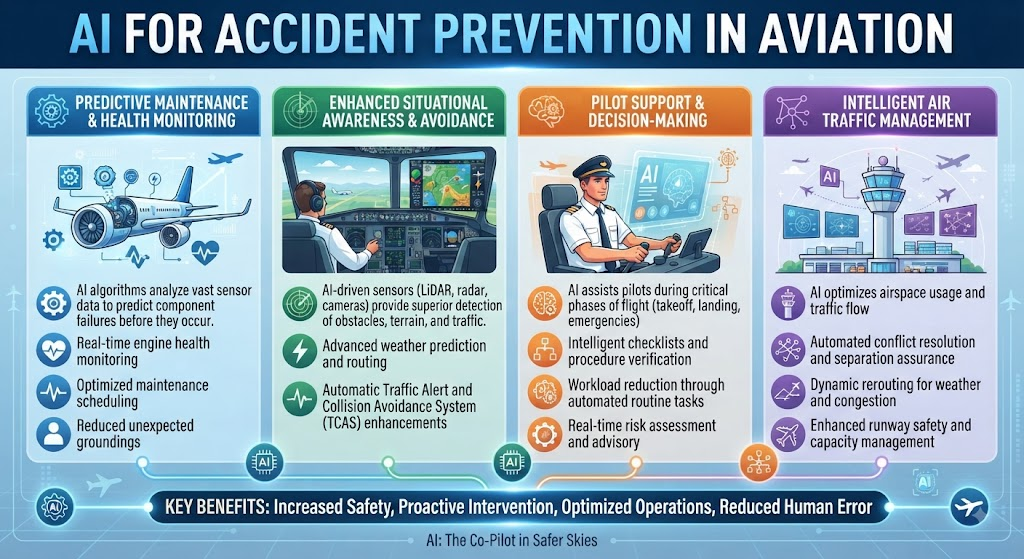
How AI Can Support Aviation Safety
Artificial intelligence refers to computer-based systems that can perform tasks involving pattern recognition, prediction, classification, or analysis of large amounts of information.
In aviation, this can be particularly useful because aircraft and aviation organizations generate information from many different sources.
For example, an airline may have records involving aircraft performance, maintenance, weather, flight operations, technical reports, and safety events. An AI-based system can analyze suitable datasets and identify relationships or unusual patterns.
The results can then help trained professionals decide whether a particular issue requires further investigation or corrective action.
Predictive Maintenance and Aircraft Safety
Aircraft maintenance is an important part of accident prevention. Traditional maintenance programs already involve scheduled inspections and detailed technical procedures. AI can add another layer of analysis by examining data from aircraft systems and components.
A predictive maintenance system may look for changes in parameters that could indicate developing abnormalities.
For example, if sensor data shows a pattern that differs from previous normal operating conditions, the system could flag it for further assessment.
Potential uses include:
- Monitoring component performance
- Identifying unusual equipment behavior
- Supporting maintenance planning
- Detecting developing trends
- Helping maintenance teams prioritize inspections
An AI-generated recommendation does not replace engineering judgment or approved maintenance procedures. Qualified personnel must determine what action is appropriate.
AI for Flight Data Analysis
Modern aircraft record significant amounts of operational information during flights. Flight data can provide valuable insights into how aircraft are being operated and where potential safety improvements may be needed.
AI can analyze large datasets to identify recurring patterns, deviations, or unusual combinations of flight parameters.
For example, an aviation safety team might discover that a particular operational deviation appears repeatedly under certain conditions. That finding could lead to further investigation, additional training, or a review of procedures.
This approach allows safety teams to look beyond individual events and examine broader trends.
AI and Pilot Decision Support
Pilots regularly make decisions using information from aircraft systems, air traffic control, weather reports, navigation systems, and other sources.
AI-based decision-support tools may help organize or analyze some of this information and highlight conditions that deserve attention.
Possible applications include:
- Situational awareness
- Weather-related information
- Traffic awareness
- Route-risk assessment
- Workload support
- Identification of unusual operational conditions
The purpose is to support the pilot rather than take responsibility away from the flight crew.
Pilots still need to understand the situation, evaluate the available information, and make decisions according to aircraft procedures and operational requirements.
Weather Risk Detection
Weather can create significant operational challenges for aviation. Thunderstorms, turbulence, icing, strong winds, reduced visibility, and other conditions can affect flight operations.
AI can be used to analyze weather information alongside other datasets to identify patterns and support forecasting or risk assessment.
For example, machine-learning models may process large amounts of meteorological information to identify patterns associated with particular weather conditions.
However, AI should not be treated as a perfect weather prediction tool. Weather is complex and continuously changing, so AI-based information must be considered alongside established meteorological sources and professional judgment.
AI for Air Traffic Management
Air traffic management involves coordinating aircraft while maintaining safe separation and efficient movement through controlled airspace.
AI can potentially support this work by analyzing traffic patterns, route demand, congestion, and operational information.
Possible applications include predicting traffic flow, identifying developing congestion, and supporting planning decisions.
By providing better insight into traffic patterns, AI may help professionals recognize situations that could create operational challenges.
Human controllers and established air traffic procedures remain essential because aviation decisions often require context, communication, and professional judgment that cannot be reduced to a single prediction.
AI for Runway and Airport Safety
Airports are complex environments where aircraft, ground vehicles, personnel, and equipment operate in close proximity.
AI-supported monitoring systems can analyze information from cameras, sensors, airport systems, and other sources to support safety monitoring.
Potential applications include:
- Runway monitoring
- Foreign object detection
- Ground vehicle tracking
- Surface traffic analysis
- Identification of unusual movement
- Monitoring restricted areas
For example, an automated monitoring system could identify an object or movement pattern that requires human attention.
The exact capabilities depend on the airport’s infrastructure, sensor technology, software, operating procedures, and regulatory approvals.
AI for Human Factors and Safety Trends
Human factors are an important part of aviation safety. Fatigue, workload, communication problems, procedural deviations, and other human-related factors can influence operational risk.
AI can help safety teams analyze suitable operational data to identify recurring patterns.
For example, an organization may analyze reports and operational records to determine whether certain types of procedural issues occur more frequently under particular circumstances.
However, human-related data requires careful handling. Privacy, security, fairness, and appropriate data governance are especially important when information relates to individual employees or crew members.
AI should be used to improve safety rather than create an environment where people are unfairly judged based solely on automated analysis.
AI and Safety Management Systems
A Safety Management System (SMS) provides a structured approach to managing aviation safety.
An SMS can involve hazard identification, risk assessment, safety reporting, monitoring, and corrective actions.
AI can complement these processes by helping safety teams analyze larger volumes of information.
For example, AI could assist in identifying repeated themes across safety reports or finding relationships between different operational factors.
The final safety decisions should remain part of the organization’s established safety-management process. AI can help bring important information to attention, but it should not independently determine what an organization considers safe or unsafe.
Real-Time Risk Detection
Some aviation applications require information to be analyzed while an operation is taking place.
AI-enabled systems can potentially monitor incoming information and identify unusual conditions in near real time.
This could be useful for applications involving aircraft systems, traffic, airport operations, or other safety-related information.
However, real-time monitoring also creates an important challenge: too many alerts can overwhelm the people responsible for responding to them.
An effective system therefore needs to distinguish meaningful conditions from normal variations and avoid creating unnecessary distractions.
AI Applications in Aviation Safety
The following table summarizes some of the areas where AI can support aviation safety.
| AI Application | Safety Purpose | Simple Example |
|---|---|---|
| Predictive maintenance | Identify unusual equipment patterns | Flagging an unexpected change in component performance |
| Flight-data analysis | Find recurring operational trends | Identifying repeated deviations during certain flight conditions |
| Weather-risk analysis | Support weather awareness | Analyzing large amounts of meteorological information |
| Air traffic management | Support traffic planning | Identifying developing congestion patterns |
| Runway monitoring | Improve airport surface awareness | Detecting unusual objects or movements |
| Pilot decision support | Organize safety-related information | Highlighting information that may require pilot attention |
| Safety-report analysis | Identify broader safety trends | Finding recurring themes across multiple reports |
These applications do not have identical levels of maturity or approval. Their use depends on the specific technology, operational environment, safety requirements, and applicable regulations.
The Role of Human Oversight
Human oversight is one of the most important considerations when using AI in aviation safety.
An AI system can identify a pattern, generate a prediction, or issue an alert, but it may not understand every operational circumstance behind that result.
A trained professional can consider context that may not be represented in the data.
For example, an unusual aircraft parameter may have a harmless explanation that an automated system does not recognize. Conversely, a combination of individually normal conditions could create a risk that requires deeper investigation.
Human experts therefore need to evaluate AI outputs rather than automatically accepting every recommendation.
Challenges of Using AI for Accident Prevention
AI offers useful possibilities, but introducing it into aviation safety also creates challenges.
Data Quality
AI systems depend heavily on the quality of the information used to train and operate them. Incomplete, inaccurate, or inconsistent data can affect results.
False Alarms
An AI system may identify conditions as potentially dangerous when they are actually normal. Excessive false alerts can reduce trust and increase workload.
Model Limitations
An AI model trained on one type of data or operational environment may not perform equally well in a different environment.
Cybersecurity
Safety-related AI systems need strong protection against unauthorized access, manipulation, and other cybersecurity threats.
Explainability
When an AI system identifies a potential safety concern, users may need to understand why the system produced that result, especially when the output influences an important operational decision.
Human Overreliance
There is also a risk that users may become too dependent on automated recommendations. Maintaining appropriate human judgment and system awareness is therefore essential.
Benefits and Challenges of AI for Accident Prevention
AI can provide useful safety capabilities, but its benefits need to be considered alongside practical limitations.
| Area | Potential Benefit | Important Challenge |
|---|---|---|
| Predictive maintenance | Earlier identification of unusual patterns | Requires reliable aircraft data and engineering validation |
| Real-time monitoring | Faster identification of potential risks | Excessive alerts can increase workload |
| Pilot support | Helps organize large amounts of information | Must not encourage overreliance on automation |
| Safety trend analysis | Identifies recurring patterns across datasets | Results depend on the quality and completeness of data |
| Airport monitoring | Supports runway and surface awareness | Requires suitable sensors and reliable system integration |
| Automated alerts | Brings potential problems to attention quickly | False or unclear alerts can reduce effectiveness |
The value of AI depends not only on the technology itself but also on how responsibly it is designed, tested, implemented, and monitored.
AI, Certification, and Aviation Regulation
Aviation is a highly regulated industry because many aircraft systems are safety-critical.
When AI is introduced into aviation operations, organizations need to consider factors such as system reliability, testing, validation, cybersecurity, traceability, and regulatory requirements.
Not every AI application has the same safety impact. A system used for general data analysis may have different requirements from one that directly influences a safety-critical aircraft function.
For this reason, AI implementation needs to follow the appropriate certification, approval, and operational processes for the specific application.
The Future of AI in Aviation Accident Prevention
AI is likely to become increasingly useful as aviation organizations collect more operational information and develop better methods for analyzing it.
Future applications may improve areas such as predictive maintenance, safety trend analysis, operational monitoring, weather-related decision support, and airport safety.
However, progress should be measured by practical safety improvements rather than by how much automation can be introduced.
The strongest approach is likely to combine advanced analytical capabilities with experienced pilots, engineers, controllers, maintenance professionals, safety teams, and regulators.
FAQs
1. Can AI completely prevent aviation accidents?
No. AI cannot guarantee that accidents will never occur. It can help identify patterns, risks, and unusual conditions, but aviation safety still depends on people, procedures, aircraft design, maintenance, training, and many other factors.
2. How can AI help detect aircraft maintenance problems?
AI can analyze suitable aircraft and component data to identify unusual patterns that may indicate developing problems. Maintenance professionals then assess the information and follow approved procedures.
3. Can AI replace pilots in accident prevention?
No. AI can support pilots by organizing information or highlighting potential risks, but pilots remain responsible for monitoring the aircraft, evaluating conditions, and making appropriate decisions.
4. How does AI analyze flight data?
AI systems can process large datasets containing information such as aircraft parameters, operational records, and other relevant data. They can look for recurring patterns, unusual combinations, or deviations that may require further investigation.
5. Can AI help identify dangerous weather?
AI can analyze meteorological and other relevant information to support weather-risk assessment. It cannot guarantee perfect prediction of every weather condition and should complement established weather information and professional judgment.
6. What are the risks of using AI in aviation safety?
Potential challenges include poor-quality data, false alarms, model limitations, cybersecurity concerns, lack of explainability, and excessive reliance on automated recommendations.
7. Why is human oversight important when using AI?
AI may identify a pattern without understanding the complete operational context. Human professionals can evaluate the result, consider additional information, and make decisions based on established procedures and experience.
Conclusion
AI can become a valuable supporting technology for aviation accident prevention by helping organizations analyze flight data, monitor aircraft health, identify safety trends, assess weather information, and improve awareness of operational risks.
Its effectiveness, however, depends on reliable data, appropriate validation, responsible implementation, cybersecurity, and proper human oversight. AI should not be treated as an independent replacement for pilots, engineers, air traffic controllers, safety professionals, or established aviation procedures.
The most practical approach is to use AI as another tool within a broader aviation safety framework, combining advanced data analysis with human expertise and proven safety practices.