Introduction
Aviation is one of the most safety-focused industries in the world. Every flight depends on careful planning, aircraft inspections, trained professionals, established procedures, and continuous safety monitoring. Traditionally, many safety measures have focused on identifying problems after an incident, malfunction, or operational deviation has occurred. Modern aviation is increasingly moving toward a more proactive approach by identifying potential risks before they develop into serious safety events.
This is where predictive safety systems in aviation are becoming increasingly valuable. These systems use operational data, aircraft information, maintenance records, weather conditions, flight data, and other safety-related information to identify patterns that may indicate emerging risks. Instead of waiting for a problem to occur, aviation organizations can use these insights to investigate potential hazards and take preventive action.
Predictive safety does not mean that every aviation accident or equipment failure can be predicted. Rather, it provides additional information that can help pilots, maintenance teams, flight operators, and safety professionals make better-informed decisions. When combined with effective Safety Management Systems and qualified human judgment, predictive technologies can contribute to a stronger and more proactive aviation safety culture.
What Are Predictive Safety Systems in Aviation?
Predictive safety systems are technologies, analytical methods, and processes used to identify potential aviation safety risks by examining historical and current data.
Traditional safety management often investigates an event after it has happened. Predictive safety takes a different approach by looking for patterns that could indicate a developing risk.
For example, an aircraft component may show gradual changes in performance over several flights. Individually, each change might not appear serious. However, when the data is analyzed over time, the pattern may indicate that the component requires additional attention.
The basic predictive safety process can be described as:
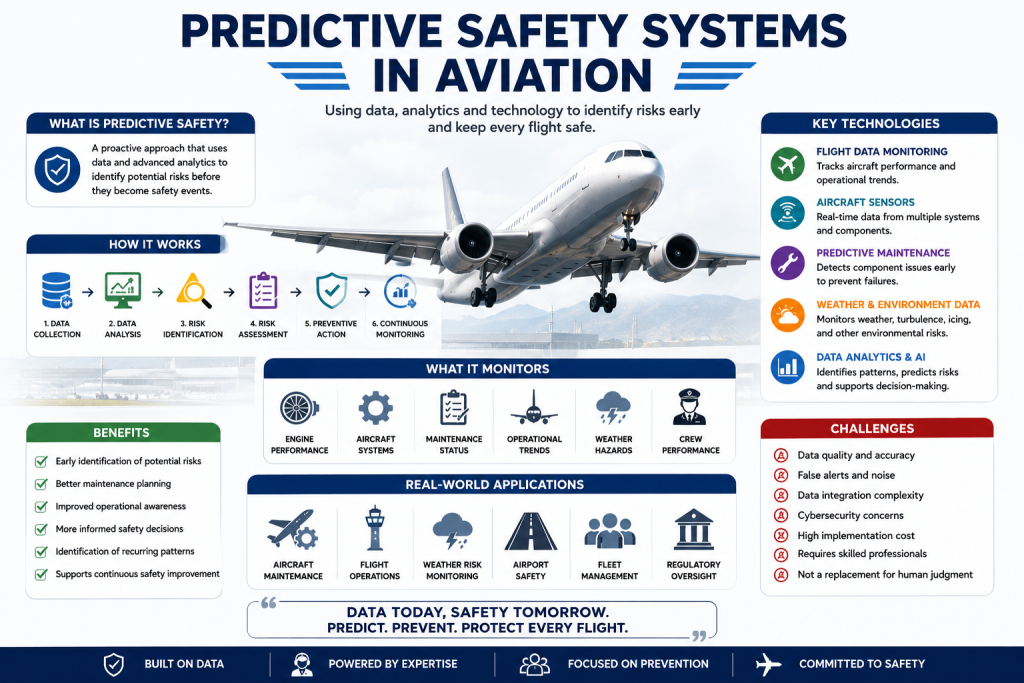
Data collection → Data analysis → Risk identification → Risk assessment → Preventive action → Continuous monitoring
Predictive safety therefore works as part of a broader safety-management approach rather than as a single piece of software.
How Do Predictive Safety Systems Work?
Predictive safety systems generally involve several stages.
1. Data Collection
The process begins with collecting relevant information from different aviation sources.
Depending on the application, this information may include:
- Flight data
- Aircraft sensor readings
- Maintenance records
- Safety reports
- Weather information
- Operational performance
- Training information
- Airport data
- Previous incidents and deviations
The quality of the information is important because inaccurate or incomplete data can affect the reliability of the analysis.
2. Data Processing and Analysis
Large amounts of aviation information must be organized and analyzed before useful patterns can be identified.
Analytical systems can compare current information with historical records and established safety indicators. This allows aviation organizations to investigate whether certain conditions or events are occurring repeatedly.
3. Risk Identification
The system looks for patterns or changes that may deserve further investigation.
For example, repeated unusual readings from an aircraft component could indicate a possible maintenance concern. Similarly, recurring operational deviations could highlight an area that requires additional safety attention.
4. Risk Assessment
Not every unusual pattern represents a serious safety threat.
Qualified professionals need to evaluate the information, consider the operational circumstances, and determine the actual level of risk.
5. Preventive Action
After a potential risk has been identified and assessed, appropriate action can be considered.
Depending on the situation, this could involve additional inspections, maintenance planning, operational changes, crew awareness, training, or increased monitoring.
6. Continuous Monitoring
Predictive safety is an ongoing process.
After preventive measures are introduced, organizations can continue monitoring relevant information to determine whether the risk has been reduced and whether the safety measures are effective.
Key Technologies Behind Predictive Aviation Safety
Predictive safety depends on several technologies and information sources working together.
Flight Data Monitoring
Flight data monitoring provides valuable information about aircraft operations.
Flight data can help organizations identify recurring operational patterns, deviations, and trends that may require further investigation. Such information can contribute to proactive safety management instead of being used only after an incident occurs.
Aircraft Sensors
Modern aircraft use numerous sensors to monitor aircraft systems and operating conditions.
Information from these sensors can help maintenance and engineering teams observe changes in performance. A gradual change in a parameter may provide an early indication that further investigation is needed.
Predictive Maintenance Systems
Predictive maintenance focuses on identifying potential equipment problems by examining condition and performance trends.
Applications may include monitoring:
- Engine performance
- Vibration
- Temperature
- Hydraulic systems
- Electrical systems
- Component condition
Predictive maintenance can support maintenance planning, but it does not replace required inspections, maintenance procedures, or the professional judgment of qualified maintenance personnel.
Weather and Environmental Data
Weather conditions can have a significant effect on flight operations.
Predictive systems can combine weather information with operational data to help identify conditions that may require additional planning or attention. Potential applications include turbulence, icing, visibility, and wind-related risks.
Data Analytics
Data analytics helps aviation organizations turn large quantities of information into useful safety insights.
Instead of examining individual records separately, analysts can study broader trends and relationships across multiple sources of information.
Predictive Maintenance and Aircraft Safety
Predictive maintenance is one of the important applications of predictive technology in aviation.
Traditional maintenance programs already include scheduled inspections, component replacement, testing, and other established procedures. Predictive maintenance can provide additional information by examining the actual performance and condition of aircraft components.
For example, if a component gradually begins showing unusual vibration or temperature readings, the trend may be identified before the component develops a more serious problem.
Maintenance professionals can then examine the available information and determine whether inspection, testing, or another maintenance action is appropriate.
This approach can support better maintenance planning and potentially reduce unexpected equipment problems.
However, predictive maintenance should not be treated as a guarantee that a component will fail or remain safe. Predictive information must be evaluated by qualified professionals and used alongside approved maintenance procedures.
How Predictive Systems Help Pilots and Flight Operations
Predictive safety systems can also support pilots and flight operations teams.
Depending on the system and available data, predictive tools may provide information related to:
- Weather hazards
- Turbulence
- Icing conditions
- Aircraft performance
- Operational trends
- Route-related risks
- Abnormal conditions
This information can support flight planning and operational decision-making.
Predictive systems are designed to assist aviation professionals rather than replace them. Pilots must continue to evaluate the actual operating environment, available information, aircraft condition, and applicable procedures when making decisions.
Human judgment remains an important part of aviation safety, particularly when conditions are changing quickly or when available information is incomplete.
The Role of Data in Predictive Aviation Safety
Data is the foundation of predictive safety systems.
Aviation organizations can work with information from many sources, including:
- Aircraft operations
- Flight data
- Maintenance activities
- Safety reports
- Weather observations
- Training programs
- Airport operations
- Safety inspections
When this information is analyzed appropriately, it can reveal trends that may not be obvious when individual records are viewed separately.
For example, several minor operational deviations may appear unrelated when examined individually. When analyzed together, however, they may reveal a recurring pattern that deserves additional attention.
At the same time, organizations must consider data quality, cybersecurity, privacy, access controls, and appropriate interpretation. Collecting more information does not automatically result in better safety. The information must be reliable, relevant, and properly understood.
Benefits of Predictive Safety Systems in Aviation
Predictive safety systems can provide several benefits to aviation organizations.
Earlier Identification of Potential Risks
Predictive analysis can help identify developing trends before they become more serious safety concerns.
Better Maintenance Planning
Condition and performance data can help maintenance teams plan inspections and maintenance activities more effectively.
Improved Operational Awareness
Flight operations teams can use safety information to better understand recurring operational patterns and potential environmental risks.
More Informed Safety Decisions
Data-supported insights can provide additional evidence when aviation professionals assess safety risks and determine appropriate actions.
Identification of Recurring Patterns
Predictive analysis can reveal patterns across multiple flights, aircraft, or operations that may not be visible from individual events.
Continuous Safety Improvement
Predictive information can be incorporated into safety-management processes to evaluate risks and determine whether preventive measures are working effectively.
Challenges and Limitations of Predictive Safety Systems
Although predictive systems offer valuable capabilities, they also have limitations.
Poor-Quality or Incomplete Data
If the information being analyzed is inaccurate, incomplete, or inconsistent, the resulting analysis may not be reliable.
False Alerts
A system may identify unusual activity that does not actually represent a significant safety risk. Too many unnecessary alerts can also make it difficult for professionals to focus on important issues.
Data Integration Difficulties
Aviation organizations often use multiple systems and databases. Combining information from different sources can be technically challenging.
Cybersecurity Concerns
Connected aircraft and digital aviation systems increase the importance of protecting operational and safety-related information from unauthorized access or manipulation.
Cost and Complexity
Advanced predictive systems can require investment in technology, infrastructure, training, data management, and skilled professionals.
Human Interpretation
Predictive results need to be interpreted within the correct operational context. A prediction or warning should not automatically be treated as a final safety decision.
Regulatory Requirements
Safety-related technologies must operate within applicable aviation regulations, standards, certification requirements, and organizational procedures.
Predictive Safety and Safety Management Systems
Predictive safety can work effectively alongside an aviation organization’s Safety Management System.
An SMS provides a structured approach for identifying hazards, assessing risks, implementing safety controls, and monitoring safety performance.
Predictive data can support this process by helping organizations identify potential hazards and emerging trends earlier.
A simplified process can be represented as:
Safety Data → Hazard Identification → Risk Assessment → Safety Action → Monitoring → Continuous Improvement
This approach allows predictive information to become part of the organization’s overall safety strategy rather than remaining isolated within a technical system.
For predictive safety to be effective, safety managers, pilots, maintenance professionals, analysts, and other relevant personnel need to understand how the information should be interpreted and applied.
Real-World Applications of Predictive Safety in Aviation
Predictive safety concepts can be applied across many areas of aviation.
Aircraft Maintenance
Aircraft performance data can be analyzed to identify unusual trends that may require additional inspection or maintenance attention.
Flight Operations
Flight data can help organizations identify recurring operational deviations and determine whether additional training, procedures, or safety measures may be useful.
Weather Risk Monitoring
Weather information can be analyzed alongside operational data to help identify potentially challenging conditions.
Airport Safety
Safety information can be used to identify recurring operational issues involving airport activities, runways, taxiways, and other areas of airport operations.
Fleet Management
Operators can compare information across aircraft to identify common maintenance or performance trends.
Regulatory Oversight
Data-supported safety information can help aviation authorities and organizations identify areas that may require additional oversight or investigation.
These applications show that predictive safety is not limited to one specific technology. It is a broader approach to using aviation information for proactive risk management.
Future of Predictive Safety Systems in Aviation
The future of predictive safety will likely involve greater integration of aircraft data, connected systems, operational information, advanced analytics, and decision-support technologies.
Aircraft and aviation organizations are generating increasing amounts of operational information. As data systems become more capable, organizations may be able to identify smaller changes and emerging patterns more effectively.
Advanced analytical technologies may also contribute to areas such as predictive maintenance, flight operations, weather monitoring, and risk assessment.
However, the future of predictive aviation safety should not be viewed simply as greater automation.
Effective aviation safety will continue to depend on:
- Qualified aviation professionals
- Reliable and relevant data
- Established procedures
- Human oversight
- Effective Safety Management Systems
- Appropriate training
- Regulatory compliance
- Strong safety culture
The most useful predictive system is not necessarily the most complicated one. It is the system that provides reliable and understandable information that aviation professionals can use when making safety decisions.
Frequently Asked Questions
1. What are predictive safety systems in aviation?
Predictive safety systems use aviation data, analytical methods, and monitoring technologies to identify patterns and potential risks before they develop into more serious safety problems.
2. How do predictive safety systems improve aviation safety?
They can help aviation organizations identify emerging risks earlier, monitor operational trends, support maintenance planning, and make better-informed safety decisions.
3. What data is used by predictive aviation systems?
Depending on the application, predictive systems may use flight data, aircraft sensor information, maintenance records, safety reports, weather information, operational data, and other relevant information.
4. How does predictive maintenance support aircraft safety?
Predictive maintenance can identify changes in aircraft component performance and provide information that helps qualified maintenance professionals investigate potential problems before unexpected failures occur.
5. Can predictive safety systems replace pilots?
No. Predictive safety systems are designed to support aviation professionals. Pilots remain responsible for evaluating flight conditions, available information, and applicable operating procedures.
6. What are the main limitations of predictive safety systems?
Common limitations include poor-quality data, false alerts, data integration problems, cybersecurity concerns, system complexity, implementation costs, and the need for qualified human interpretation.
7. What is the future of predictive safety in aviation?
Predictive safety is expected to become increasingly connected with aircraft monitoring, operational data, predictive maintenance, advanced analytics, and decision-support systems while continuing to depend on human expertise and oversight.
Conclusion
Predictive safety systems are helping aviation organizations move toward a more proactive approach to managing safety risks. Instead of focusing only on incidents or failures that have already occurred, these systems can analyze current and historical information to identify patterns that may indicate emerging concerns.
Flight data monitoring, aircraft sensors, predictive maintenance, weather information, operational analytics, and safety indicators can all contribute to this approach. When used correctly, they can support earlier risk identification, improved maintenance planning, better operational awareness, and more informed safety decisions.
However, predictive technology is not a replacement for pilots, maintenance professionals, safety managers, regulators, or established aviation procedures. Its effectiveness depends on reliable data, appropriate analysis, qualified human judgment, and strong safety-management practices.
As aviation continues to become more data-driven, the combination of predictive technology, human expertise, reliable information, and effective Safety Management Systems can play an important role in identifying risks earlier and supporting continuous improvements in aviation safety.