Introduction
Artificial Intelligence is transforming the aviation industry at a rapid pace. From aircraft systems and flight operations to airport management and air traffic control, AI is improving safety, efficiency, and decision-making across every layer of aviation.
For new learners, this transformation opens a strong career pathway. You do not need advanced experience to begin—AI aviation careers are now accessible to beginners who are willing to build skills step by step. Whether you are an aviation student, a recent graduate, or a beginner from a non-technical background, this guide will help you understand how to start your journey in AI aviation careers.
What is AI Aviation?
AI aviation refers to the use of Artificial Intelligence technologies in aviation systems to improve performance, safety, and operational efficiency.
Key Applications of AI in Aviation:
- Aircraft navigation and autopilot systems
- Predictive maintenance for aircraft health monitoring
- Airport operations such as baggage handling and passenger flow
- Airline scheduling and fuel optimization
- Flight data analysis for safety improvement
AI works as an intelligent support system that enhances aviation operations and reduces human workload.
Why AI Aviation is a Great Career for Beginners
AI aviation is one of the most beginner-friendly emerging career fields because it offers gradual learning opportunities and diverse entry points.
Key Advantages:
- High demand for AI-skilled aviation professionals globally
- Entry-level roles available for fresh learners
- Strong long-term career growth in aviation technology
- Opportunities in airlines, airports, drones, and aerospace sectors
- Future-proof career aligned with automation and digital transformation
Beginners can enter this field with consistent learning and skill development.
Career Opportunities in AI Aviation
New learners can explore multiple entry-level roles in AI aviation:
AI Aviation Analyst
Works with aviation data to improve efficiency, performance, and decision-making.
Aviation Data Technician
Supports data collection, processing, and analysis in aviation systems.
Drone Operations Assistant
Assists in managing AI-powered drone systems used in logistics, mapping, and surveillance.
AI Flight Systems Assistant
Supports the development and monitoring of AI-based aircraft systems.
Airport AI Operations Specialist
Helps manage smart airport systems including automation and passenger services.
Skills Beginners Need to Learn
To build a strong foundation in AI aviation, beginners should focus on essential skills.
Technical Skills:
- Basic Python programming
- Data analysis fundamentals
- Introduction to Artificial Intelligence concepts
Aviation Knowledge:
- Aircraft systems basics
- Flight operations understanding
- Airport workflow fundamentals
Soft Skills:
- Logical thinking
- Problem-solving ability
- Adaptability to new technologies
These skills form the foundation for advanced AI aviation careers.
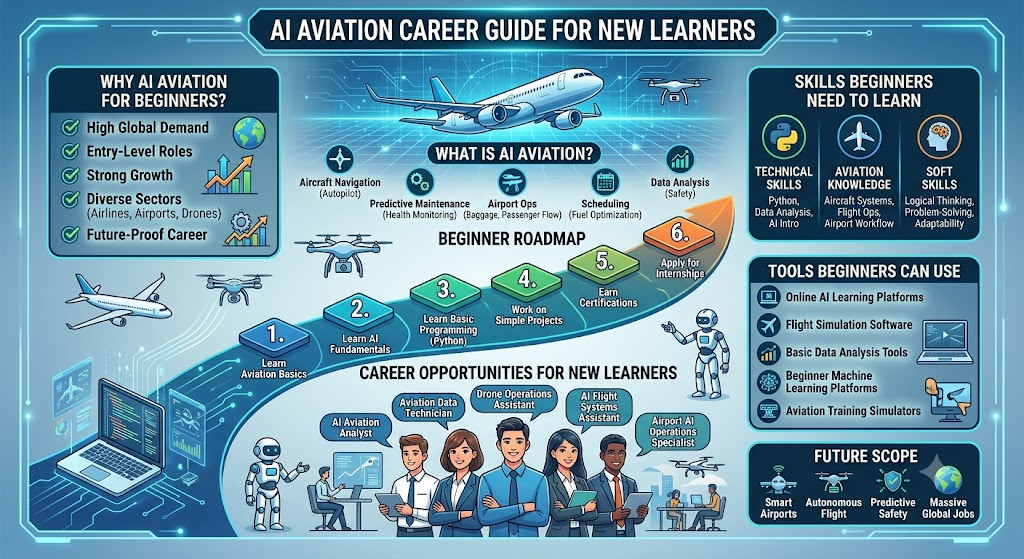
Step-by-Step Beginner Roadmap
Step 1: Learn Aviation Basics
Understand how aircraft, airlines, and airports operate.
Step 2: Learn AI Fundamentals
Study basic Artificial Intelligence and machine learning concepts.
Step 3: Learn Basic Programming
Start with Python as it is widely used in AI applications.
Step 4: Work on Simple Projects
Practice beginner-level projects like flight delay prediction or route optimization.
Step 5: Earn Certifications
Complete beginner-friendly AI and aviation-related certification courses.
Step 6: Apply for Internships
Gain real-world experience in aviation companies, startups, or training institutes.
Tools Beginners Can Use
Beginners can start learning AI aviation using accessible tools such as:
- Online AI learning platforms
- Flight simulation software
- Basic data analysis tools
- Beginner machine learning platforms
- Aviation training simulators
These tools help bridge the gap between theory and real-world applications.
Common Challenges for New Learners
New learners may face some challenges while starting their AI aviation journey:
- Lack of prior technical knowledge
- Confusion between aviation roles and AI roles
- Difficulty understanding programming concepts initially
- Limited awareness of career pathways
These challenges can be overcome through structured learning and consistent practice.
Future Scope of AI Aviation Careers
The future of aviation is strongly connected with Artificial Intelligence and automation.
Future Developments:
- Smart airports with fully automated systems
- AI-powered aircraft monitoring systems
- Autonomous flight and drone technologies
- Predictive safety and maintenance systems
- Digital aviation ecosystems with real-time decision-making
This growth will create massive global job opportunities for new learners.
Frequently Asked Questions (FAQs)
1. Can beginners start an AI aviation career without experience?
Yes, beginners can start with basic aviation and AI learning and gradually build skills for entry-level roles.
2. Is coding necessary for AI aviation careers?
Yes, basic Python programming is important for understanding AI systems and data analysis.
3. Do I need an aviation background to enter this field?
No, learners from any background can enter AI aviation with proper training.
4. What is the first step to start learning AI aviation?
Start with aviation basics and introductory Artificial Intelligence concepts.
5. Are there job opportunities for freshers in AI aviation?
Yes, many entry-level roles and internships are available for fresh learners.
6. How long does it take to learn AI aviation basics?
With consistent effort, beginners can understand the basics within a few months.
7. What industries hire AI aviation professionals?
Airlines, airports, aerospace companies, and drone technology organizations.
8. Is AI aviation a good long-term career option?
Yes, it is a fast-growing and future-focused career field with strong demand.
9. What tools should beginners start with?
Python, AI learning platforms, and basic aviation simulators are good starting tools.
10. Can career switchers enter AI aviation?
Yes, professionals from other fields can transition into AI aviation with proper training.
Conclusion
AI aviation is one of the most promising career paths for new learners who want to enter a future-driven industry. It combines aviation knowledge with Artificial Intelligence, creating opportunities in airlines, airports, drones, and aerospace technologies.
Beginners do not need to feel overwhelmed, as the learning path is structured and accessible. By starting with aviation basics, learning AI fundamentals, and practicing simple projects, anyone can build a strong foundation in this field.
As the aviation industry continues to evolve, professionals with AI skills will be in high demand. Starting early gives learners a significant advantage in building a successful and future-ready career in AI aviation.