Introduction
The aviation industry is undergoing a major transformation driven by Artificial Intelligence, automation, and advanced data systems. Aircraft operations, maintenance, air traffic control, and airport management are now increasingly dependent on intelligent technologies that improve safety, efficiency, and decision-making.
For engineers, this shift opens a powerful career opportunity. Whether from mechanical, aerospace, electrical, or computer science backgrounds, engineers already have the technical foundation needed to move into AI-powered aviation roles. By combining engineering knowledge with AI skills, they can enter one of the fastest-growing and most future-ready industries in the world.
What is AI in Aviation?
Artificial Intelligence in aviation refers to the use of intelligent systems, machine learning, and data-driven technologies to improve aviation operations.
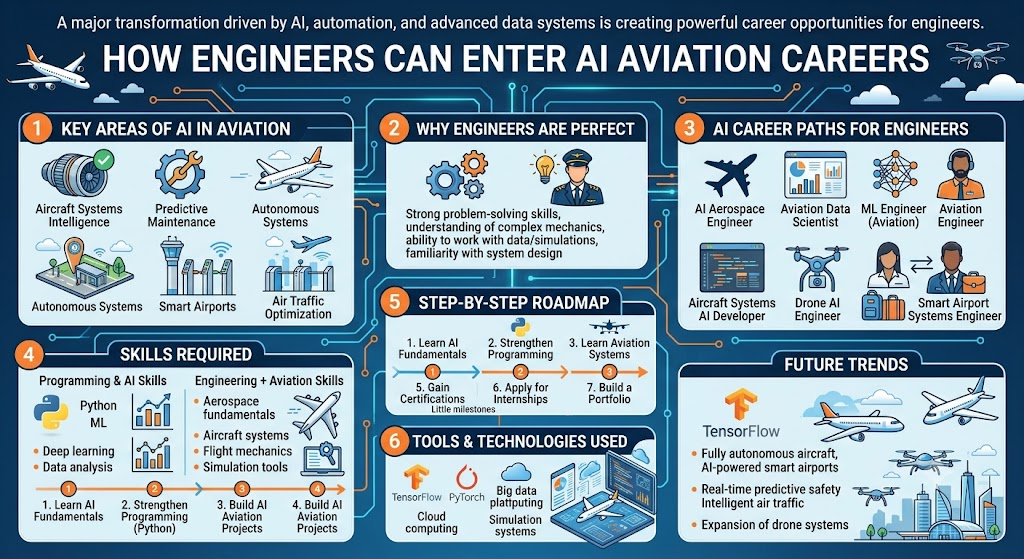
Key Areas of AI in Aviation:
- Aircraft Systems Intelligence: AI supports flight control, navigation, and system optimization
- Predictive Maintenance: Detects potential failures in engines and components before they occur
- Autonomous Systems: Supports semi-autonomous and fully automated flight operations
- Smart Airports: AI improves passenger flow, baggage handling, and security systems
- Air Traffic Optimization: Enhances route efficiency and reduces congestion
AI is making aviation safer, smarter, and more efficient than ever before.
Why Engineers Are Perfect for AI Aviation Careers
Engineers are naturally suited for AI aviation careers due to their strong technical foundation.
Key Reasons:
- Strong problem-solving and analytical skills
- Understanding of complex systems and mechanics
- Ability to work with data, models, and simulations
- Familiarity with system design and optimization
- Easy transition into programming and AI technologies
Engineering skills combined with AI knowledge create highly valuable aviation professionals.
AI Career Paths for Engineers in Aviation
Engineers can explore multiple high-growth career roles in AI aviation.
AI Aerospace Engineer
Designs intelligent aircraft systems and integrates AI into aerospace technologies.
Aviation Data Scientist
Analyzes aviation data to improve safety, efficiency, and operational performance.
Machine Learning Engineer (Aviation)
Builds AI models for flight prediction, maintenance, and optimization systems.
Aircraft Systems AI Developer
Develops intelligent software for aircraft control and monitoring systems.
Drone AI Engineer
Works on autonomous drone systems used in delivery, surveillance, and mapping.
Smart Airport Systems Engineer
Builds AI-powered airport infrastructure systems for operations and logistics.
Skills Required for AI Aviation Careers
To enter AI aviation roles, engineers must develop a combination of technical and aviation-specific skills.
Programming & AI Skills:
- Python programming
- Machine learning fundamentals
- Deep learning basics
- Data analysis and visualization
Engineering + Aviation Skills:
- Aerospace fundamentals
- Aircraft systems understanding
- Flight mechanics basics
- Simulation tools usage
Additional Skills:
- Problem-solving mindset
- System design thinking
- Analytical reasoning
- Continuous learning ability
Step-by-Step Roadmap for Engineers
Step 1: Learn AI Fundamentals
Start with machine learning, AI basics, and data science concepts.
Step 2: Strengthen Programming Skills
Focus on Python and basic data handling libraries.
Step 3: Learn Aviation Systems
Understand aircraft operations, navigation, and aerospace basics.
Step 4: Build AI Aviation Projects
Work on projects like flight delay prediction, fuel optimization, or maintenance forecasting.
Step 5: Gain Certifications
Pursue certifications in AI, machine learning, and aviation technologies.
Step 6: Apply for Internships
Join aerospace companies, airlines, or AI startups in aviation.
Step 7: Build a Portfolio
Showcase real-world AI aviation projects and technical work.
Tools & Technologies Used in AI Aviation
Engineers working in AI aviation use modern tools and platforms such as:
- Machine learning frameworks like TensorFlow and PyTorch
- Aviation simulation systems for testing models
- Big data platforms for flight analytics
- Cloud computing environments for real-time processing
- Predictive maintenance software for aircraft health monitoring
These tools help engineers build intelligent aviation systems.
Challenges in AI Aviation Careers
While the field is highly promising, engineers may face some challenges:
- High technical complexity combining aviation and AI
- Continuous learning requirements due to evolving technologies
- Strong global competition in AI and aerospace sectors
- Need for practical aviation domain knowledge
With consistent learning and hands-on practice, these challenges can be managed effectively.
Future of Engineers in AI Aviation
The future of aviation will heavily depend on AI-driven systems, and engineers will play a key role in building them.
Future Trends:
- Fully autonomous aircraft systems
- AI-powered smart airports
- Real-time predictive aviation safety systems
- Intelligent air traffic management networks
- Expansion of drone and unmanned aviation systems
Engineers with AI skills will be at the center of this transformation.
Frequently Asked Questions (FAQs)
1. Can engineers easily enter AI aviation careers?
Yes, engineers already have strong technical skills that make it easier to transition into AI aviation roles with additional AI training.
2. Which engineering branches are best for AI aviation?
Aerospace, mechanical, electrical, and computer science engineering are the most relevant fields.
3. Do engineers need aviation knowledge for AI careers?
Yes, basic aviation knowledge helps in understanding aircraft systems and industry applications.
4. Is coding required for AI aviation jobs?
Yes, Python and basic programming skills are essential for AI-related roles.
5. What is the salary scope in AI aviation careers?
It varies by role and experience, but AI aviation professionals generally earn competitive global salaries.
6. What are entry-level jobs in AI aviation?
Entry roles include data analyst, junior ML engineer, and aviation systems assistant roles.
7. Which companies hire AI aviation engineers?
Airlines, aerospace companies, defense organizations, and aviation tech startups hire such professionals.
8. How long does it take to enter AI aviation careers?
With focused learning, it may take 6–18 months to become job-ready in entry-level roles.
9. Are AI aviation careers future-proof?
Yes, they are highly future-proof due to increasing automation in aviation systems.
10. Can fresh engineers enter this field?
Yes, fresh graduates can enter through internships, certifications, and project-based learning.
Conclusion
AI is revolutionizing the aviation industry, creating powerful new opportunities for engineers across multiple disciplines. From aircraft systems to smart airports and autonomous flight technologies, the demand for AI-skilled engineering professionals is rapidly increasing.
Engineers who combine their technical expertise with Artificial Intelligence skills can unlock high-growth global careers in aviation. By following a structured learning path, gaining hands-on experience, and building strong project portfolios, they can successfully enter and excel in AI aviation careers.
The future of aviation belongs to engineers who understand both machines and intelligent systems—and now is the perfect time to begin that journey.