Introduction
The aviation industry is going through a major transformation where Artificial Intelligence is becoming a core part of flight operations, aircraft systems, and airline decision-making. Modern aviation is no longer only about manual flying skills—it is increasingly supported by intelligent systems that assist pilots in navigation, safety, and efficiency.
For pilots, this shift creates both opportunity and responsibility. The role of a pilot is evolving from traditional cockpit control to a more advanced, technology-driven decision-maker who works alongside AI systems. Learning Artificial Intelligence helps pilots stay relevant, improve operational understanding, and prepare for the future of smart aviation.
What is Artificial Intelligence in Aviation?
Artificial Intelligence in aviation refers to the use of smart algorithms and machine learning systems that help analyze data, automate processes, and support decision-making in flight operations.
Key Applications of AI in Aviation:
- Autopilot Systems: AI assists in controlling aircraft stability, navigation, and flight optimization
- Predictive Maintenance: Detects mechanical issues before they become critical failures
- Smart Cockpits: Provides real-time insights and decision support for pilots
- Air Traffic Management: Optimizes flight routes and reduces congestion
- Flight Data Analysis: Improves safety and performance through data insights
AI acts as a support system that enhances pilot performance and safety.
Why Pilots Should Learn Artificial Intelligence
Pilots who understand AI will have a strong advantage in the future aviation ecosystem.
Key Reasons:
- Aviation is becoming highly automated and data-driven
- Airlines prefer tech-aware and digitally skilled pilots
- AI knowledge improves understanding of aircraft systems
- Helps pilots make faster and more accurate decisions
- Increases long-term career opportunities in global aviation
Learning AI is a step toward future-proofing a pilot’s career.
How AI is Changing the Role of Pilots
Artificial Intelligence is not replacing pilots but reshaping their responsibilities.
1. From Manual Flying to Assisted Flying
Modern aircraft rely heavily on automation systems that support pilots during different phases of flight.
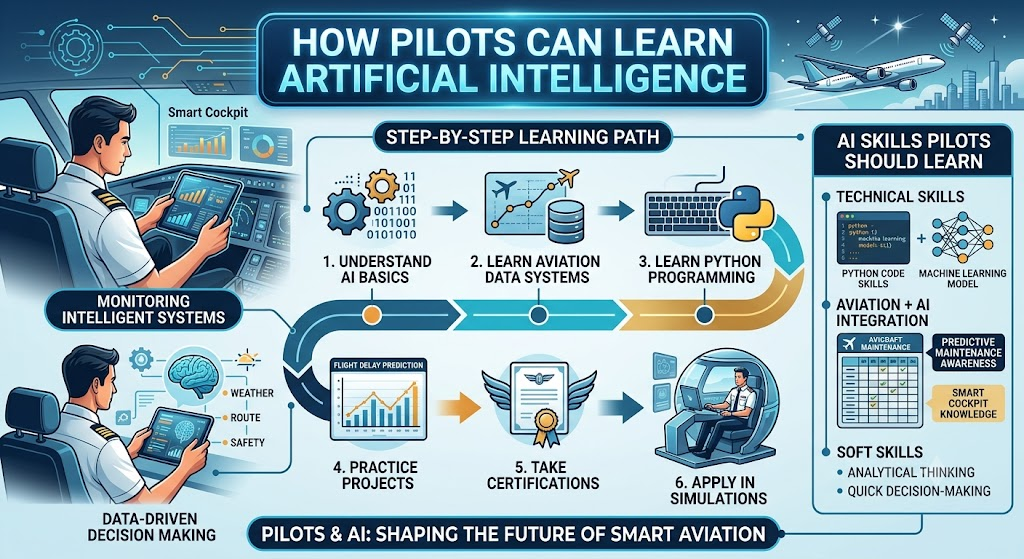
2. Data-Driven Decision Making
Pilots now receive real-time AI-generated insights that help improve safety and efficiency.
3. Monitoring Intelligent Systems
Instead of only controlling the aircraft, pilots supervise AI systems and ensure proper functioning.
4. Enhanced Safety Role
AI helps identify risks earlier, allowing pilots to take preventive actions.
AI Skills Pilots Should Learn
To adapt to this evolving industry, pilots should build both technical and analytical skills.
Technical Skills:
- Basic Python programming
- Machine learning fundamentals
- Data analysis and visualization
- Aviation data system understanding
Aviation + AI Integration Skills:
- Flight data interpretation
- Predictive maintenance awareness
- AI-assisted cockpit system knowledge
Soft Skills:
- Analytical thinking
- Quick decision-making
- Adaptability to new technologies
Step-by-Step Learning Path for Pilots
Step 1: Understand AI Basics
Start with fundamentals of Artificial Intelligence and how machines learn from data.
Step 2: Learn Aviation Data Systems
Study how flight data is collected and used in aviation operations.
Step 3: Learn Python Programming
Python is essential for working with AI and data systems.
Step 4: Practice with Aviation Projects
Work on small projects like flight delay prediction or route optimization.
Step 5: Take Certifications
Enroll in AI, machine learning, or aviation technology certification programs.
Step 6: Apply in Simulations
Use flight simulators and AI tools to understand real-world applications.
Tools Pilots Can Use to Learn AI
Pilots can use various tools to begin their AI journey:
- Flight simulation platforms with AI integration
- Aviation data analytics tools
- Machine learning learning environments
- Cloud-based AI platforms
- Training software used in modern aviation academies
These tools help bridge aviation knowledge with AI capabilities.
Challenges in Learning AI for Pilots
While AI offers great opportunities, pilots may face some challenges:
- Limited time due to flying schedules
- Technical complexity of AI concepts
- Continuous learning requirement
- Balancing aviation duties with technical study
However, consistent learning and practical exposure can overcome these challenges.
Future of Pilots with Artificial Intelligence
The future of aviation will be deeply connected with AI-powered systems.
Future Trends:
- AI-assisted and semi-autonomous cockpits
- Intelligent co-pilot systems
- Fully automated flight operations in some sectors
- Predictive safety systems reducing human error
- Smart air traffic management networks
Pilots will continue to play a critical role, but with more focus on system monitoring and decision-making.
Frequently Asked Questions (FAQs)
1. Can pilots learn Artificial Intelligence easily?
Yes, pilots can learn AI step by step with basic programming and aviation data understanding.
2. Do pilots need coding skills for AI?
Basic Python coding is helpful but advanced programming is not required initially.
3. Will AI replace pilots in the future?
No, AI will support pilots but not fully replace them. Human decision-making is still essential.
4. Why should pilots learn AI?
It helps improve career opportunities, safety understanding, and future readiness.
5. What is the first step to learn AI as a pilot?
Start with AI fundamentals and basic programming like Python.
6. Is AI important for student pilots?
Yes, it gives early exposure to future aviation technologies.
7. What jobs can pilots get with AI knowledge?
AI aviation analyst, flight data roles, and aerospace tech positions.
8. How long does it take to learn AI basics?
With consistent learning, basics can be understood in a few months.
9. Is AI used in real aircraft today?
Yes, AI is already used in autopilot systems, maintenance, and navigation support.
10. What is the future of pilots in AI aviation?
Pilots will work alongside AI systems as decision-makers and supervisors.
Conclusion
Artificial Intelligence is reshaping the aviation industry at every level, from cockpit systems to airline operations. For pilots, this is not a disruption but an opportunity to upgrade their skills and remain relevant in a highly technological future.
By learning AI, pilots can strengthen their understanding of modern aircraft systems, improve decision-making, and prepare for next-generation aviation environments. The combination of piloting expertise and AI knowledge will define the future of aviation careers.
Pilots who embrace AI early will have a significant advantage in global aviation, where intelligent systems and human expertise work together to ensure safer and more efficient skies.