Introduction
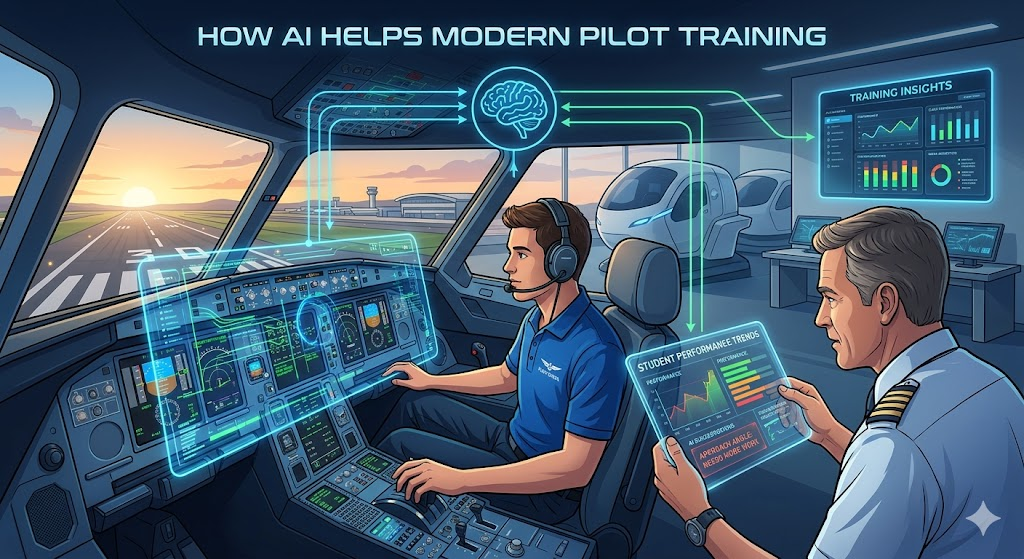
Artificial intelligence is changing the way many industries teach, train, and improve performance, and aviation training is also becoming more advanced with AI-supported tools. Modern pilot training is no longer limited to classroom lessons, textbooks, and aircraft flying only. Today, flight schools and aviation academies are exploring digital learning systems, intelligent simulators, performance tracking, virtual training environments, and data-based feedback. AI does not replace pilots or flight instructors, but it can make training more personalized, efficient, and safety-focused. For student pilots, AI can help identify weak areas, improve decision-making, support simulator practice, and make learning easier to understand. This guide explains how AI helps modern pilot training in simple language for aviation students, instructors, and beginners interested in the future of aviation education.
What Is Artificial Intelligence?
Artificial intelligence, commonly called AI, is technology that allows computer systems to perform tasks that usually require human-like thinking. These tasks may include learning from data, recognizing patterns, making predictions, giving recommendations, and improving responses over time.
In pilot training, AI can study student performance, identify repeated mistakes, suggest learning paths, create training scenarios, and help instructors understand where a student needs more support.
AI is different from simple automation. Automation follows fixed instructions, while AI can analyze information and adjust its response based on patterns and learning data.
Why Pilot Training Is Evolving
Pilot training is evolving because aviation itself is becoming more advanced. Modern aircraft use digital systems, advanced navigation tools, automation, weather data, and complex cockpit technology. Student pilots must learn not only how to fly but also how to understand systems, make safe decisions, and manage information.
Training methods are changing because of:
- Increasing demand for skilled pilots
- More advanced aircraft systems
- Higher safety expectations
- Need for efficient learning
- Growth of simulator-based training
- Digital learning platforms
- Better data tracking tools
- More focus on decision-making and human factors
AI-supported training can help students prepare for this modern aviation environment.
Traditional Pilot Training vs AI-Assisted Pilot Training
| Feature | Traditional Training | AI-Assisted Training |
|---|---|---|
| Learning Style | Same lesson flow for most students | Personalized learning based on student performance |
| Feedback | Mainly instructor-based | Instructor feedback supported by data analysis |
| Progress Tracking | Manual records and instructor notes | Digital progress tracking with performance trends |
| Mistake Identification | Based on observation | Uses data to detect repeated weak areas |
| Simulator Practice | Pre-planned scenarios | Adaptive scenarios based on training needs |
| Study Support | Books, notes, classroom lessons | Smart quizzes, recommendations, and learning dashboards |
| Training Efficiency | Depends heavily on schedule and instructor time | Helps focus training on specific improvement areas |
| Decision Training | Instructor-led discussions | Scenario-based practice with performance review |
Both methods are important. AI-assisted training works best when combined with experienced instructors, real flight training, and strong safety standards.
How AI Helps Modern Pilot Training
Personalized Learning Paths
Every student learns at a different speed. Some students may understand theory quickly but struggle with radio communication. Others may be confident in aircraft handling but need help with navigation or weather interpretation.
AI can help by analyzing student performance and recommending personalized study areas. For example, if a student repeatedly scores low in meteorology quizzes, the system can suggest extra lessons, practice questions, or revision modules.
This helps students focus on what they actually need instead of repeating everything equally.
Intelligent Flight Simulators
Flight simulators are already important in aviation training. With AI, simulators can become more adaptive and realistic. AI can create different weather conditions, traffic situations, emergency scenarios, and navigation challenges.
For example, a student may practice:
- Engine failure procedures
- Poor visibility flying
- Crosswind landings
- Radio communication
- Navigation errors
- Emergency decision-making
- Weather avoidance
AI-supported simulators can adjust difficulty based on student performance, making training more effective.
Performance Analysis
AI can collect and analyze training data from simulator sessions, quizzes, flight exercises, and learning platforms. It can show where the student is improving and where they need more practice.
Performance analysis may include:
- Reaction time
- Checklist discipline
- Altitude control
- Heading accuracy
- Communication habits
- Decision-making quality
- Procedure completion
- Mistake patterns
This helps instructors give more focused feedback.
Predictive Learning Support
AI can help predict areas where a student may struggle in future lessons. If a student shows repeated difficulty with navigation, the system may alert the instructor before advanced navigation training begins.
This allows instructors to take early action and prevent problems from becoming bigger.
Automated Knowledge Assessment
AI-powered learning systems can create smart quizzes and adaptive tests. If a student answers incorrectly, the system can provide explanation and then ask related questions to confirm understanding.
This helps students prepare better for aviation exams and ground school assessments.
AI-Powered Flight Simulators
AI-powered simulators are useful because they allow students to practice difficult situations safely. Some situations are risky or rare in real aircraft, but they can be practiced repeatedly in a simulator.
Scenario-Based Training
AI can create realistic flight scenarios based on student level. Beginners may practice basic aircraft control, while advanced students may handle complex flight conditions.
Emergency Situations
Students can practice engine failures, instrument problems, communication loss, and abnormal procedures in a safe environment.
Weather Simulation
AI can create changing weather conditions such as clouds, wind, rain, turbulence, or low visibility. This helps students learn weather decision-making.
Navigation Challenges
Students can practice route planning, diversion decisions, airspace awareness, and situational awareness.
Decision-Making Exercises
AI can create situations where students must choose the safest option. This builds judgment, not just technical flying ability.
How Flight Instructors Benefit from AI
AI is not a replacement for flight instructors. Instead, it helps instructors teach more effectively.
Instructors can benefit from AI through:
- Better student progress tracking
- Data-supported feedback
- Early identification of weak areas
- Improved lesson planning
- More focused simulator sessions
- Easier performance reporting
- Better exam preparation support
For example, an instructor may see that a student consistently struggles with altitude control during turns. The instructor can then plan a specific lesson to correct that problem.
How Student Pilots Benefit from AI
Student pilots can benefit from AI because it makes learning more personalized and easier to track.
Students may gain:
- Clearer understanding of strengths and weaknesses
- Personalized study recommendations
- More confidence before real flights
- Better simulator practice
- Faster feedback after exercises
- Improved exam preparation
- Better decision-making practice
- Reduced confusion during complex lessons
AI can help students become more self-aware learners.
AI and Aviation Safety Training
Safety is the most important part of aviation. AI can support safety training by helping students understand risks and practice correct responses.
AI helps safety training through:
- Error detection
- Risk awareness
- Emergency scenario practice
- Checklist monitoring
- Decision-making review
- Weather risk analysis
- Crew resource management support
For example, AI can review a simulator session and show where a student delayed a decision or missed a checklist item. This helps improve safety habits before real-world flying.
AI Applications Beyond Pilot Training
AI is also used in other aviation areas beyond student training.
Aircraft Maintenance Prediction
AI can help analyze aircraft data and predict when maintenance may be needed. This can improve reliability and reduce unexpected problems.
Flight Planning Support
AI can support route planning by analyzing weather, air traffic, fuel needs, and flight efficiency.
Air Traffic Management
AI can help process large amounts of air traffic data and support safer, more efficient airspace management.
Aviation Data Analysis
Airlines and training organizations can use AI to analyze performance, safety trends, and operational efficiency.
Common AI Technologies Used in Aviation Training
Machine Learning
Machine learning allows systems to learn from data. In training, it can help identify performance patterns and recommend improvements.
Predictive Analytics
Predictive analytics uses past data to estimate future outcomes. It can help identify students who may need extra support.
Virtual Reality Integration
Virtual reality can create immersive training environments where students can practice cockpit procedures and emergency responses.
Adaptive Learning Systems
Adaptive learning systems change lessons based on the student’s progress. This makes learning more personalized.
Data Visualization Tools
Data visualization tools show performance results in charts, dashboards, and progress reports. This helps students and instructors understand training progress clearly.
Challenges and Limitations of AI in Pilot Training
AI has many benefits, but it also has limitations.
Technology Costs
Advanced AI tools, simulators, and platforms can be expensive for flight schools.
Data Quality Requirements
AI works best when it has accurate and useful data. Poor data can lead to weak recommendations.
Need for Human Instructors
AI cannot replace the experience, judgment, communication, and mentorship of human instructors.
Regulatory Considerations
Aviation training must follow aviation authority rules. AI tools must fit within approved training systems.
Continuous Updates
AI systems need regular updates to remain useful, accurate, and secure.
Overdependence Risk
Students should not depend only on AI. Manual flying skills, judgment, and real-world experience remain essential.
Skills Students Still Need Despite AI
Even with advanced technology, pilots need strong human skills.
Communication Skills
Pilots must communicate clearly with instructors, air traffic control, crew, and passengers.
Leadership
Pilots must take responsibility and guide decisions during normal and difficult situations.
Situational Awareness
Pilots must understand aircraft position, weather, traffic, fuel, altitude, and risks at all times.
Manual Flying Skills
Technology can support training, but pilots must still learn aircraft control, takeoff, landing, and emergency handling.
Decision-Making Ability
Pilots must make safe decisions under pressure. AI can support training, but final responsibility belongs to trained humans.
Future of AI in Pilot Training
The future of AI in pilot training is likely to include smarter learning systems, more realistic simulators, better performance tracking, and stronger safety analysis.
Future developments may include:
- Real-time training feedback
- AI-supported instructor dashboards
- Smarter simulator scenarios
- Virtual cockpit practice
- Personalized exam preparation
- Better weather decision training
- Integrated training records
- Advanced crew coordination tools
- AI-supported safety trend analysis
- More immersive aviation learning platforms
AI will continue to support pilot education, but human instructors, real flight experience, and pilot judgment will remain central.
Interesting Facts About AI and Aviation
- AI can help identify repeated training mistakes.
- Flight simulators can use AI to create realistic scenarios.
- AI can support personalized study plans.
- Aviation uses large amounts of data, which makes AI useful.
- AI can help improve safety training.
- AI does not replace real aircraft flying.
- Instructors can use AI dashboards to track student progress.
- AI can support weather and route planning.
- Virtual reality can work with AI for cockpit training.
- Human judgment remains essential in aviation.
FAQs
1- What is AI in pilot training?
AI in pilot training means using intelligent computer systems to support learning, performance tracking, simulator practice, assessments, and feedback. It helps students understand their weak areas and allows instructors to plan better lessons.
2- Can AI replace flight instructors?
No, AI cannot replace flight instructors. Flight instructors provide judgment, experience, mentorship, safety supervision, and real-time human guidance. AI works best as a support tool that helps instructors teach more effectively.
3- How do AI-powered simulators work?
AI-powered simulators use data and adaptive scenarios to create realistic training situations. They can adjust difficulty, simulate weather, create emergency situations, and track student responses during practice.
4- Does AI make pilot training safer?
AI can support safer training by helping students practice emergencies, detect errors, improve decision-making, and review performance. However, safety still depends on qualified instructors, proper procedures, aircraft maintenance, and student discipline.
5- How does AI personalize learning?
AI studies student performance data and identifies strengths and weaknesses. Based on this information, it can suggest lessons, quizzes, simulator scenarios, or review topics that match the student’s needs.
6- Is AI used by modern flight schools?
Many modern aviation training organizations are exploring or using digital training tools, smart simulators, learning platforms, and performance tracking systems. The level of AI use may vary by school, budget, and training program.
7- What aviation skills cannot be replaced by AI?
AI cannot replace human judgment, leadership, communication, teamwork, situational awareness, manual flying skills, and emotional control. These skills must be developed through real training and instructor guidance.
8- Does AI reduce training time?
AI may help students learn more efficiently by focusing on weak areas and improving preparation. However, training time still depends on regulatory requirements, flight hours, student ability, weather, scheduling, and instructor assessment.
9- What challenges exist when using AI in aviation training?
Challenges include high technology costs, data accuracy, regulatory approval, system updates, cybersecurity, instructor training, and the risk of overdependence. AI must be used carefully and responsibly.
10- What is the future of AI in pilot education?
The future of AI in pilot education may include smarter simulators, personalized learning paths, real-time feedback, virtual reality training, predictive performance analysis, and stronger safety-focused training systems. AI will support pilots and instructors, not replace them.
Conclusion
AI helps modern pilot training by making learning more personalized, data-driven, realistic, and safety-focused. It supports students through adaptive lessons, smart assessments, simulator practice, performance analysis, and targeted feedback. It also helps flight instructors understand student progress more clearly and design better training sessions. However, AI is only a support tool. Real flying skills, instructor guidance, communication, judgment, discipline, and situational awareness remain essential for every pilot. As aviation education continues to evolve, AI will play a growing role in helping future pilots train smarter, practice better, and prepare for modern cockpit environments with greater confidence.