Introduction
Aircraft engineering is one of the most advanced fields in the world. Every aircraft part must be carefully designed because even a small design mistake can affect safety, performance, cost, and fuel efficiency.
In traditional aircraft design, engineers use their knowledge, calculations, testing methods, and design tools to create aircraft parts. This process is powerful, but it can take a long time. Engineers may need to test many versions before finding the best design.
Today, a modern technology called generative design is changing the way aircraft parts are created. It allows engineers to use artificial intelligence, advanced software, simulations, and design rules to generate many possible design options automatically.
Generative design does not replace aircraft engineers. Instead, it helps them explore better ideas faster. It can suggest lightweight, strong, and efficient designs that may not be easy to create manually.
For the aviation industry, this is very important. Lighter aircraft can use less fuel. Stronger parts can improve safety. Smarter designs can reduce waste. Faster engineering can help companies develop new aircraft technologies more efficiently.
In simple words, generative design helps aircraft engineers design better parts for the future of aviation.
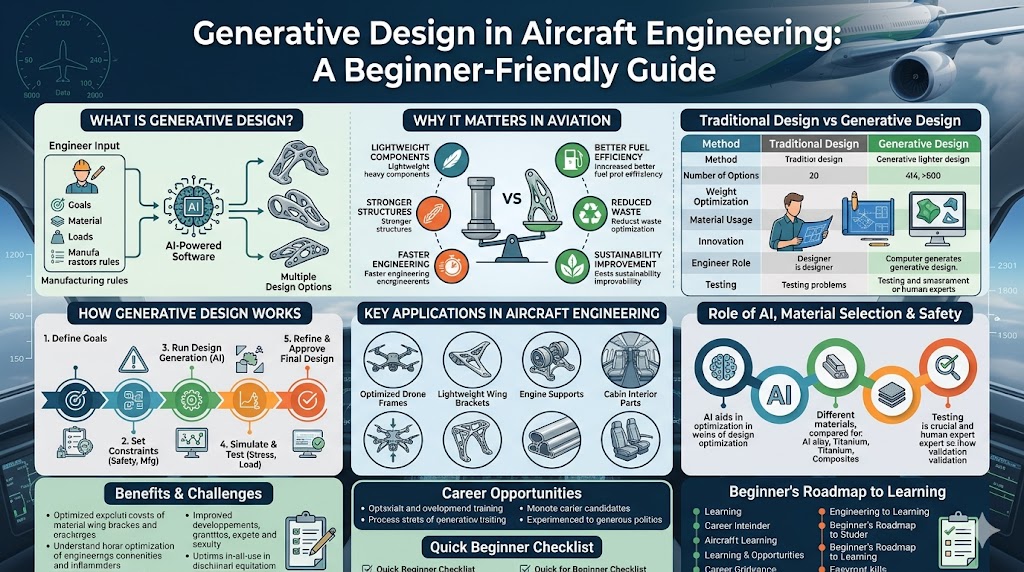
What Is Generative Design in Aircraft Engineering?
Generative design in aircraft engineering is a design method where engineers provide goals and rules to software, and the software generates multiple design options.
The engineer may tell the software:
- What the part should do
- How much weight it can carry
- What material should be used
- Where the part will be attached
- How much space is available
- What safety limits must be followed
- What manufacturing method will be used
After receiving these instructions, the generative design system creates different possible designs. These designs are then tested through simulation and analysis.
For example, if an engineer wants to design a lightweight aircraft bracket, the software can generate many bracket shapes. Some may look unusual, but they may use less material while still staying strong.
This makes generative design very useful in aircraft engineering because aircraft parts need to be strong, lightweight, and reliable.
Why Generative Design Matters in Aviation
Generative design matters because aviation always needs better performance, better safety, and better efficiency.
Aircraft manufacturers are constantly trying to reduce aircraft weight, improve fuel efficiency, lower emissions, and create safer structures. Generative design can support all these goals.
One of the biggest advantages is weight reduction. In aviation, even a small reduction in weight can make a difference. A lighter aircraft needs less fuel and may perform better during flight.
Generative design also helps engineers save time. Instead of manually creating only a few design options, engineers can use software to create hundreds or even thousands of possibilities.
This gives aircraft engineers more choices and helps them make better decisions.
Generative design matters in aviation because it supports:
- Lighter aircraft structures
- Better fuel efficiency
- Stronger parts
- Faster design development
- Reduced material waste
- Improved sustainability
- More innovative engineering
- Better use of modern manufacturing methods
It helps aviation move toward smarter and more efficient aircraft design.
Traditional Aircraft Design vs Generative Design
| Area | Traditional Aircraft Design | Generative Design |
|---|---|---|
| Design Method | Engineers manually create design options | Software generates multiple design options based on rules |
| Time Required | Can take longer | Can reduce early design time |
| Number of Options | Limited design versions | Many design possibilities |
| Weight Optimization | Depends on manual improvement | Automatically searches for lighter designs |
| Material Usage | May use extra material for safety margin | Removes unnecessary material while maintaining strength |
| Testing Support | Testing is done after design creation | Simulation can be included early |
| Innovation Potential | Based mainly on human imagination and experience | Can create new and unexpected shapes |
| Human Engineer Role | Creates and validates designs | Sets rules, reviews options, and approves final design |
| Manufacturing Planning | Often considered after design | Can include manufacturing limits from the beginning |
| Sustainability | Depends on design decisions | Can help reduce waste and improve efficiency |
Traditional design is still important. Generative design simply adds a smarter way to explore more possibilities.
How Generative Design Works
Generative design follows a structured process. It starts with a design problem and ends with a tested and refined solution.
1. Define the Design Goal
The first step is to define what the part must achieve.
For example, the goal may be to design a wing support bracket that is strong enough to carry load but lighter than the current design.
The goal must be clear because the software will create designs based on the information provided.
2. Add Engineering Constraints
Constraints are rules that the design must follow.
These may include:
- Maximum weight
- Minimum strength
- Available space
- Attachment points
- Safety requirements
- Temperature limits
- Vibration limits
- Manufacturing method
In aircraft engineering, constraints are very important because every part must meet strict performance and safety needs.
3. Select Materials
The engineer must choose possible materials for the design.
Aircraft materials may include aluminum alloys, titanium, carbon fiber composites, or advanced lightweight materials.
Different materials behave differently, so the software uses material information while generating designs.
4. Set Weight and Strength Requirements
The software needs to know how much load the part must carry and how light it should be.
This helps the system remove unnecessary material while keeping the part strong enough for aircraft use.
5. Run AI-Based Design Generation
After the goals and rules are added, the software starts generating design options.
It may create many different shapes and structures. Some designs may look simple, while others may look complex and organic.
6. Compare Design Options
Engineers compare the generated options based on weight, strength, cost, manufacturability, and safety.
Not every generated design is suitable. The engineer must choose the best options for further testing.
7. Test Through Simulation
Selected designs are tested using simulation tools.
Simulation helps check stress, vibration, fatigue, heat, and performance under different conditions.
8. Refine and Approve the Final Design
After testing, engineers refine the design. The final design must be reviewed, validated, manufactured, and approved according to aviation standards.
This shows that generative design is not a fully automatic process. Human engineering judgment remains essential.
Key Areas Where Generative Design Is Used in Aircraft Engineering
Generative design can be used in many areas of aircraft engineering. It is especially useful where lightweight and strong design is required.
Aircraft Structural Components
Aircraft structures must handle loads, pressure, vibration, and movement. Generative design can help create strong structures with less material.
This is useful for internal support parts, frame elements, and load-bearing components.
Wing Brackets and Supports
Wing brackets and supports must be strong because they help carry important loads. Generative design can reduce their weight while maintaining strength.
This can improve aircraft efficiency without reducing safety.
Cabin Interior Parts
Cabin parts such as seat frames, partitions, panels, and support elements can also benefit from generative design.
Lighter cabin parts can reduce overall aircraft weight and improve fuel efficiency.
Engine Components
Aircraft engines operate under high temperature, pressure, and vibration. Some engine components can be optimized using generative design to improve strength and reduce weight.
However, engine parts require very careful testing and certification.
Landing Gear Support Structures
Landing gear parts must handle strong forces during takeoff and landing. Generative design can help optimize support structures for strength and weight.
Lightweight Frames
Aircraft frames must be strong but not unnecessarily heavy. Generative design helps create frame structures that use material only where needed.
Drone and UAV Design
Drones and unmanned aerial vehicles need lightweight designs for better battery life, range, and performance.
Generative design is very useful for drone frames, arms, mounts, and internal structures.
Electric Aircraft Components
Electric aircraft need lightweight structures because batteries add weight. Generative design can help reduce structural weight and improve overall efficiency.
Space and Aerospace Parts
Generative design is also useful for aerospace and space vehicle parts where weight reduction is extremely important.
Every kilogram matters in aerospace engineering, so optimized design can provide major benefits.
Generative Design and Lightweight Aircraft Structures
Weight is one of the most important factors in aircraft engineering. A heavier aircraft needs more fuel, creates more emissions, and may have lower efficiency.
Generative design helps reduce weight by removing unnecessary material from a part. The software studies where material is needed for strength and where it can be removed safely.
This often creates shapes that look different from traditional designs. Some generative designs look like natural bone structures or tree branches. This is because nature also uses material efficiently.
For example, bones are strong but not solid everywhere. They have internal structures that provide strength with less weight. Generative design can create similar efficient shapes for aircraft parts.
Lightweight aircraft structures can help with:
- Lower fuel usage
- Better aircraft range
- Improved payload capacity
- Reduced emissions
- Lower operating cost
- Better overall performance
This is why generative design is becoming important in modern aviation engineering.
Role of AI in Generative Design
Artificial intelligence plays an important role in generative design.
AI helps the software understand design goals, explore many possibilities, compare options, and improve results. Instead of depending only on one manual design, AI can help generate many alternatives quickly.
AI can also learn from previous designs and simulation results. This helps the system improve future design suggestions.
For example, if previous designs show that a certain shape handles stress better, the AI system can use that knowledge while creating new designs.
AI supports generative design by helping with:
- Design option generation
- Pattern recognition
- Performance prediction
- Weight optimization
- Material comparison
- Simulation analysis
- Design improvement
However, AI does not make final decisions by itself. Engineers must review the designs and make sure they meet aviation safety standards.
Generative Design and Aerodynamics
Aerodynamics is the study of how air moves around an aircraft. Good aerodynamic design helps reduce drag, improve lift, and increase fuel efficiency.
Generative design can support aerodynamic improvement by helping engineers create smoother and more efficient shapes.
For example, generative design may be used to improve fairings, ducts, wing-related structures, and external components. These parts must be shaped carefully so they do not create unnecessary drag.
When generative design is combined with airflow simulation, engineers can test how a shape behaves in moving air.
This helps them understand:
- How air flows around the part
- Whether the design creates drag
- Whether the shape affects performance
- Whether the part can be made smoother
- Whether the design supports fuel efficiency
Generative design is not only about making parts lighter. It can also help make them more aerodynamically efficient.
Generative Design and Material Selection
Material selection is very important in aircraft engineering. A material must be strong, lightweight, durable, and suitable for aviation conditions.
Generative design can support material selection by comparing how different materials perform in the same design.
Common aircraft materials include:
- Aluminum alloys
- Titanium
- Carbon fiber composites
- Advanced polymers
- Lightweight metal alloys
- High-strength composites
Each material has different properties. Aluminum is widely used because it is light and workable. Titanium is strong and heat-resistant. Carbon fiber composites are lightweight and strong but can be expensive.
Generative design software can help engineers test different material options virtually.
For example, one design may work well with titanium but may be too weak with another material. Another design may be suitable for carbon fiber but difficult to manufacture with metal.
This helps engineers choose the best balance between weight, strength, cost, safety, and manufacturability.
Generative Design and Aircraft Safety
Safety is the most important requirement in aircraft engineering. Every aircraft part must be tested, verified, and approved before use.
Generative design can support safety, but it must be used carefully.
The generated design must go through several checks, such as:
- Stress testing
- Fatigue analysis
- Vibration testing
- Thermal analysis
- Load testing
- Simulation review
- Manufacturing review
- Human expert validation
Aircraft parts face many forces during flight. They must handle takeoff, landing, turbulence, pressure changes, temperature changes, and long-term usage.
A generative design may look strong in software, but it still needs proper engineering validation.
This is why human engineers remain very important. They must check whether the design is practical, safe, manufacturable, and suitable for aviation certification.
Generative design helps improve safety by identifying stronger and more efficient structures early in the design process.
Benefits of Generative Design in Aircraft Engineering
Generative design offers many benefits for aircraft engineering.
- Lighter aircraft components: It can reduce unnecessary material and lower part weight.
- Better fuel efficiency: Lighter aircraft can use less fuel.
- Stronger structural design: It can place material where strength is needed most.
- Faster development: Engineers can explore more options in less time.
- Reduced material waste: Optimized designs use material more efficiently.
- Better design flexibility: Engineers can test many design ideas quickly.
- Improved sustainability: Less weight and less waste support greener aviation.
- More innovative aircraft parts: It can create shapes that humans may not design manually.
- Lower long-term costs: Better designs can reduce fuel and maintenance costs.
- Support for future aircraft technologies: It is useful for drones, electric aircraft, and advanced aerospace systems.
These benefits make generative design a valuable tool for the future of aircraft engineering.
Challenges of Generative Design in Aircraft Engineering
Generative design also has challenges. It is not a magic solution. Engineers must understand its limitations.
Complex Software Requirement
Generative design tools are advanced and require proper training. Engineers must know how to set goals, constraints, and design rules correctly.
Need for High-Quality Data
Poor input data can produce poor design results. Aircraft engineering needs accurate data for safe design.
Certification and Safety Approval
Aviation has strict safety standards. Generative designs must be tested and certified before they can be used in real aircraft.
Manufacturing Limitations
Some generated designs may be difficult to manufacture using traditional methods. Engineers must check whether the part can be made properly.
High Computing Power
Generating and testing many design options can require powerful computers and advanced software.
Cost of Advanced Tools
Generative design software and simulation tools can be costly, especially for small companies or students.
Need for Skilled Engineers
The technology still needs skilled engineers who understand aircraft design, materials, manufacturing, and safety.
Trust and Explainability
Engineers must understand why a design is recommended. If the system gives a result without clear reasoning, it may be hard to trust.
These challenges show that generative design must be used with care, knowledge, and human supervision.
Generative Design and Additive Manufacturing
Generative design and additive manufacturing are closely connected.
Additive manufacturing is also known as 3D printing. It creates parts layer by layer using materials such as metal, plastic, or composite-based materials.
Many generative designs have complex shapes. These shapes may be difficult to create using traditional manufacturing methods. But 3D printing can make some of these complex designs possible.
For example, a lightweight aircraft bracket designed through generative design may have internal curves and open spaces. Traditional machining may find it difficult to produce, but additive manufacturing may create it more easily.
This combination can help aircraft engineering by:
- Creating lightweight parts
- Reducing material waste
- Producing complex shapes
- Supporting faster prototyping
- Improving design flexibility
- Making customized aircraft components
However, 3D-printed aircraft parts still need strict testing and approval before use in real aircraft.
Real-World Examples of Generative Design in Aircraft Engineering
Here are some simple examples of how generative design can be used in aircraft engineering.
1. Lightweight Aircraft Seat Brackets
Aircraft seats need strong brackets to stay safely attached. Generative design can create brackets that are lighter but still strong enough for safety requirements.
2. Optimized Wing Support Structures
Wing support parts must carry heavy loads. Generative design can help remove unnecessary material while keeping strength in the right areas.
3. Drone Frames
Drones need lightweight frames for better battery performance and longer flight time. Generative design can help create strong and light drone structures.
4. Engine Part Redesign
Some engine support parts can be redesigned to reduce weight and improve performance. These parts require careful testing because engines operate under extreme conditions.
5. Cabin Interior Components
Cabin panels, supports, and seat parts can be optimized to reduce weight. This helps improve aircraft efficiency without affecting passenger comfort.
These examples show how generative design can support both large aircraft and smaller aviation systems.
Tools and Technologies Used in Generative Design
Generative design uses many technologies together. Some important ones include:
AI-Based Design Software
These tools generate multiple design options based on engineering goals and constraints.
CAD Tools
Computer-Aided Design tools help engineers create and modify aircraft part designs.
Simulation Tools
Simulation tools test strength, stress, heat, vibration, and performance before physical manufacturing.
Computational Analysis
Computational analysis helps study how a design behaves under different forces and conditions.
Digital Twins
A digital twin is a virtual model of a real part or system. It helps engineers monitor and improve designs.
Additive Manufacturing
3D printing helps create complex lightweight shapes produced through generative design.
Machine Learning
Machine learning helps systems learn from previous design data and improve future suggestions.
Cloud Computing
Cloud computing provides high computing power for running complex design and simulation tasks.
These technologies work together to make aircraft design faster, smarter, and more efficient.
Future of Generative Design in Aviation
The future of generative design in aviation is very promising. As aircraft become more advanced, engineers will need smarter design methods.
Generative design may play a major role in electric aircraft, autonomous drones, air taxis, sustainable aviation, space vehicles, and advanced manufacturing.
Electric aircraft especially need lightweight design because batteries can be heavy. Generative design can help reduce structural weight and improve efficiency.
Air taxis and urban air mobility vehicles also need compact, lightweight, and strong designs. Generative design can help engineers explore new shapes and structures for these future aircraft.
In aerospace manufacturing, generative design may help reduce waste and create parts that are easier to produce with modern methods.
However, the future will still depend on human expertise. Engineers will use generative design as a powerful tool, but safety, testing, and final approval will remain human-led.
Career Opportunities in Generative Design and Aircraft Engineering
Generative design is creating new career opportunities for students and professionals interested in aviation and technology.
Some possible career paths include:
- Aerospace design engineer
- Aircraft structural engineer
- Generative design engineer
- CAD engineer
- Simulation engineer
- Additive manufacturing engineer
- Aviation AI specialist
- Drone design engineer
- Aircraft component design engineer
- Aerospace research engineer
To build a career in this field, students should learn aircraft engineering basics, design tools, materials, structures, AI concepts, and simulation methods.
This field is ideal for people who enjoy aviation, creativity, engineering, and modern technology.
Beginner Roadmap to Learn Generative Design in Aircraft Engineering
Beginners can follow a step-by-step roadmap to learn this field.
Step 1: Learn Aircraft Basics
Start with basic aircraft parts, flight principles, wings, engines, fuselage, landing gear, and control surfaces.
Step 2: Study Engineering Design Fundamentals
Learn how engineers design parts, analyze loads, choose materials, and test structures.
Step 3: Learn CAD Tools
CAD tools are important for aircraft design. Start with basic 3D modeling and part design.
Step 4: Understand Materials and Structures
Learn about aluminum, titanium, composites, carbon fiber, and aircraft structural behavior.
Step 5: Learn Basics of AI and Optimization
Understand how AI helps generate and improve design options. Learn the basic idea of optimization.
Step 6: Practice Simulation Tools
Simulation helps test whether a design can handle stress, vibration, and load.
Step 7: Explore Generative Design Software
Start experimenting with simple generative design tools and small projects.
Step 8: Work on Small Aircraft Design Projects
Practice with projects such as brackets, drone frames, seat supports, or lightweight panels.
Step 9: Build a Portfolio
Create a portfolio with your design models, simulation results, and project explanations.
A strong portfolio can help show your skills to employers, trainers, or academic institutions.
Common Mistakes Beginners Should Avoid
Beginners should avoid these common mistakes while learning generative design in aircraft engineering.
Ignoring Aircraft Fundamentals
Do not start with software only. First, learn how aircraft parts work and why safety is important.
Depending Only on Software
Generative design software can suggest ideas, but engineers must validate them.
Not Understanding Materials
A design is useful only when the material is suitable. Learn material properties carefully.
Skipping Simulation Testing
Every design must be tested through simulation and analysis before it can be trusted.
Ignoring Safety Requirements
Aircraft parts must follow strict safety needs. Never focus only on weight reduction.
Using Unrealistic Design Constraints
If the input rules are unrealistic, the generated design may not be practical.
Not Learning Manufacturing Limitations
Some designs may look good on screen but may be difficult or expensive to manufacture.
Avoiding these mistakes will help beginners learn generative design more effectively.
FAQs About Generative Design in Aircraft Engineering
1. What is generative design in aircraft engineering?
Generative design is a method where engineers give goals and constraints to software, and the software creates multiple design options for aircraft parts.
2. Is generative design the same as AI?
Generative design often uses AI, optimization, and simulation. AI helps create and compare different design possibilities.
3. Why is generative design useful in aviation?
It helps create lighter, stronger, and more efficient aircraft components, which can improve fuel efficiency and performance.
4. Can generative design replace aircraft engineers?
No. It supports aircraft engineers but does not replace them. Human experts are needed for safety, testing, and final decisions.
5. What aircraft parts can use generative design?
It can be used for brackets, supports, frames, cabin parts, drone structures, engine supports, and some aerospace components.
6. How does generative design reduce aircraft weight?
It removes unnecessary material while keeping strength in important areas. This creates lighter but strong structures.
7. Is generative design safe for aircraft parts?
It can support safe design, but every generated part must be tested, validated, and approved before real aircraft use.
8. What is the role of 3D printing in generative design?
3D printing can manufacture complex lightweight shapes created by generative design, especially for prototypes and advanced parts.
9. What skills are needed to learn generative design?
Useful skills include aircraft basics, CAD, materials, structures, simulation, AI basics, and manufacturing knowledge.
10. Is generative design important for future aviation?
Yes. It can support electric aircraft, drones, air taxis, sustainable aviation, and advanced aerospace manufacturing.
Conclusion
Generative design in aircraft engineering is a powerful modern approach that helps engineers create lighter, stronger, safer, and more efficient aircraft parts.
It allows engineers to explore many design options quickly. It also helps reduce unnecessary material, improve structural performance, support fuel efficiency, and encourage innovation.
However, generative design is not a replacement for aircraft engineers. It is a tool that supports human creativity, engineering knowledge, and decision-making.
Aircraft design will always require expert review, safety testing, certification, and practical manufacturing knowledge. Generative design simply helps engineers work smarter and explore better possibilities.
For students and beginners, this is an exciting area to learn. It connects aviation, artificial intelligence, design software, materials, simulation, and future aircraft technology.
As aviation moves toward electric aircraft, drones, sustainable flight, and smart aerospace manufacturing, generative design will become an important part of aircraft engineering.
The future of aircraft design will not depend on AI alone. It will depend on the powerful combination of human engineering skill and intelligent design technology.