Introduction
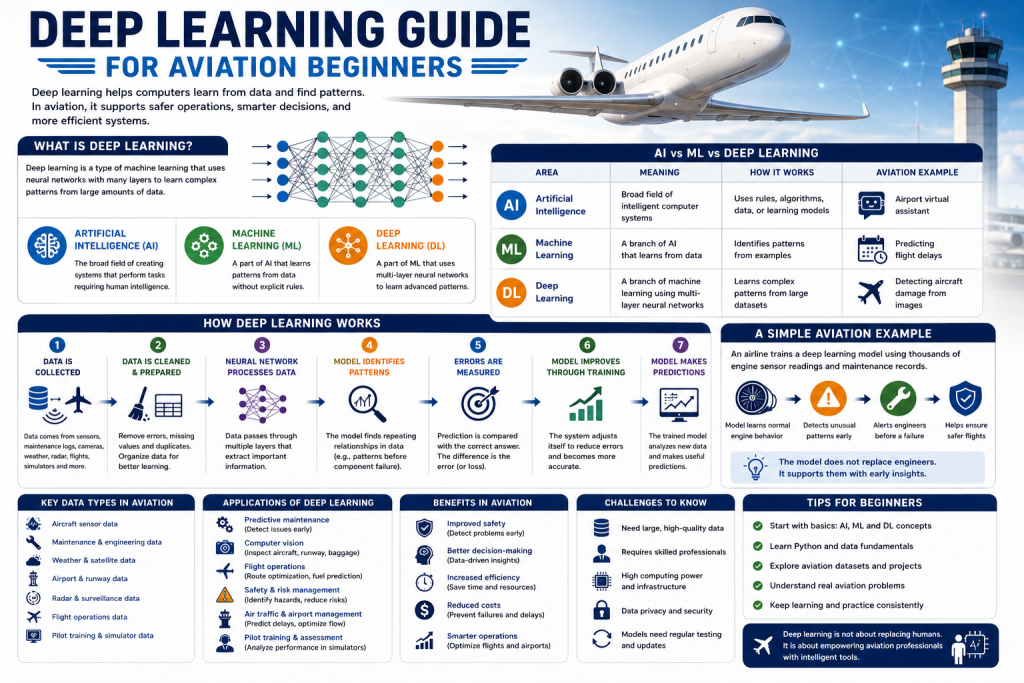
Deep learning is a branch of artificial intelligence that enables computers to learn patterns from large amounts of data. In aviation, it can help analyze aircraft sensor readings, maintenance records, weather information, airport video, flight routes, radar signals, and pilot training data. For beginners, understanding deep learning provides a useful foundation for exploring how modern technology supports safer, more efficient, and more intelligent aviation operations.
Deep learning does not replace pilots, engineers, air traffic controllers, maintenance professionals, or safety teams. Instead, it can support them by processing complex information, recognizing patterns, and highlighting issues that may require human attention. Aviation students who learn the basics of deep learning can better understand emerging technologies used in aircraft maintenance, airport management, unmanned aviation, flight simulation, and operational decision-making.
What Is Deep Learning?
Deep learning is a specialized form of machine learning that uses artificial neural networks to learn from data. These neural networks are inspired by the way the human brain processes information, although they are much simpler than biological brains.
To understand deep learning clearly, beginners should first understand three connected terms.
Artificial Intelligence
Artificial intelligence, commonly called AI, is the broad field of creating computer systems that can perform tasks usually associated with human intelligence. These tasks may include recognizing images, understanding language, making predictions, solving problems, or supporting decisions.
In aviation, AI may be used in maintenance analysis, passenger support, route planning, airport operations, security monitoring, and flight training.
Machine Learning
Machine learning is a part of artificial intelligence. Instead of following only fixed instructions written by programmers, a machine learning system studies data and learns patterns.
For example, a machine learning model could study historical aircraft maintenance records and learn which combinations of sensor readings are commonly associated with component failures.
Deep Learning
Deep learning is a more advanced type of machine learning. It uses neural networks with many processing layers, which is why the word “deep” is used.
Deep learning is especially useful for complex data such as:
- Images
- Video
- Speech
- Radar signals
- Weather maps
- Aircraft sensor readings
- Maintenance reports
- Flight movement data
A deep learning model can study thousands or millions of examples and gradually learn how to recognize important patterns.
Artificial Intelligence vs Machine Learning vs Deep Learning
| Area | Meaning | How It Works | Aviation Example |
|---|---|---|---|
| Artificial Intelligence | Broad field of intelligent computer systems | Uses rules, algorithms, data, or learning models | Airport virtual assistant |
| Machine Learning | A branch of AI that learns from data | Identifies patterns from examples | Predicting flight delays |
| Deep Learning | A branch of machine learning using multi-layer neural networks | Learns complex patterns from large datasets | Detecting aircraft damage from images |
Artificial intelligence is the widest category. Machine learning is one part of AI, while deep learning is one part of machine learning.
How Deep Learning Works
A deep learning system normally follows a structured process.
1. Data Is Collected
The first step is collecting relevant information. In aviation, this data may come from aircraft sensors, maintenance logs, airport cameras, weather systems, flight records, simulators, radar equipment, or satellite images.
2. Data Is Cleaned and Prepared
Raw data may contain missing values, errors, duplicate records, unclear images, or inconsistent formats. The data must be cleaned and organized before it can be used for training.
Poor-quality data can produce unreliable predictions, even when the deep learning model is technically advanced.
3. The Neural Network Processes the Data
The prepared data is passed through a neural network. The network contains several layers that process different parts of the information.
For example, an image-processing network may first identify edges, then shapes, then surface patterns, and finally possible aircraft damage.
4. The Model Identifies Patterns
During training, the model compares many examples and looks for repeating relationships.
A maintenance model may discover that a certain combination of vibration, temperature, and pressure changes often appears before a component develops a problem.
5. Errors Are Measured
The model’s prediction is compared with the correct answer. The difference between the prediction and the correct answer is called an error or loss.
6. The Model Improves Through Training
The system adjusts its internal values to reduce errors. This process is repeated many times until the model becomes more accurate on the training data.
7. The Model Makes Predictions
After training, the model can analyze new information it has not seen before.
For example, a trained image model may examine a new aircraft inspection photograph and identify areas that may require closer examination by a qualified technician.
A Simple Aviation Example
Imagine that an airline wants to develop a model that helps identify surface damage on aircraft.
The system may be trained using thousands of labeled images showing:
- Normal aircraft surfaces
- Paint damage
- Corrosion
- Dents
- Cracks
- Scratches
- Loose fasteners
The deep learning model studies these examples and learns visual patterns. When it receives a new inspection image, it can identify possible areas of concern.
However, the model’s output should be treated as inspection support. A qualified aviation maintenance professional must review the result and make the final decision.
What Are Neural Networks?
A neural network is a computer model made of connected processing units. These units are often called artificial neurons or nodes.
A basic neural network contains three main parts.
Input Layer
The input layer receives the original information.
For an aircraft image, the input could be the image pixels. For an engine-monitoring system, the input could include temperature, vibration, pressure, speed, and fuel-flow readings.
Hidden Layers
Hidden layers process the information and learn patterns. A deep learning model may contain many hidden layers.
Each layer can focus on different characteristics of the data.
Output Layer
The output layer produces the final result.
For example, the output may classify an image as:
- Normal surface
- Possible corrosion
- Possible crack
- Possible dent
Weights
Weights are internal numerical values that determine how strongly one piece of information influences another.
The network automatically adjusts these weights during training.
Training
Training is the process of showing the network many examples and helping it improve its predictions.
Prediction
Once training is complete, the network can evaluate new data and produce a prediction or classification.
A simple way to understand this is to imagine a student learning to identify aircraft. At first, the student may confuse different models. After studying many examples and receiving corrections, the student becomes better at recognizing features such as wing shape, engine position, landing gear, and tail design.
Deep Learning vs Traditional Programming
Traditional programming and deep learning solve problems in different ways.
| Factor | Traditional Programming | Deep Learning |
|---|---|---|
| Instructions | Written directly by programmers | Learned from data |
| Role of Data | Used as input for fixed rules | Used to train the model |
| Pattern Recognition | Limited by programmed rules | Can learn complex patterns |
| Adaptability | Requires manual rule changes | Can improve through retraining |
| Complex Images | Difficult to handle with fixed rules | Well suited for image analysis |
| Sensor Data | Uses predefined thresholds | Can recognize combinations and trends |
| Aviation Example | Alert when temperature crosses a fixed limit | Identify unusual patterns across several sensors |
Traditional software is often better when rules are clear and predictable. Deep learning is useful when the problem involves complicated patterns that are difficult to describe with fixed instructions.
Why Deep Learning Matters in Aviation
Aviation systems produce large amounts of data every day. This information may come from:
- Aircraft engines
- Flight control systems
- Navigation equipment
- Maintenance records
- Airport cameras
- Radar systems
- Flight simulators
- Weather stations
- Satellite platforms
- Passenger service systems
- Air traffic operations
- Drone sensors
Humans cannot manually examine every data point in real time. Deep learning can help process large datasets, identify unusual behavior, classify images, recognize speech, and support predictions.
Its value comes from its ability to find patterns that may not be immediately visible through basic analysis.
However, aviation is a safety-sensitive industry. Deep learning systems must be carefully tested, monitored, documented, and used under appropriate human supervision.
Major Applications of Deep Learning in Aviation
Predictive Aircraft Maintenance
Predictive maintenance uses data to estimate when an aircraft component may require inspection, servicing, or replacement.
Deep learning models can analyze:
- Engine temperature
- Vibration levels
- Pressure changes
- Fuel consumption
- Component age
- Maintenance history
- Operational conditions
The model may identify combinations of readings that have previously appeared before a failure or performance issue.
This does not mean the system can guarantee when a part will fail. Instead, it may provide an early warning that helps maintenance teams investigate the condition.
Aircraft Damage Detection
Aircraft inspections involve examining surfaces and components for possible damage. Deep learning-based computer vision can help review photographs, videos, drone images, and inspection-camera footage.
Possible applications include identifying:
- Cracks
- Corrosion
- Dents
- Paint damage
- Surface wear
- Missing fasteners
- Fluid leaks
- Foreign object damage
These tools may help technicians prioritize inspection areas. Final evaluations must still be performed by authorized aviation maintenance personnel.
Weather Forecasting and Analysis
Weather is one of the most important factors in aviation operations. Deep learning can help analyze complex weather information from:
- Radar images
- Satellite images
- Temperature records
- Wind measurements
- Pressure patterns
- Cloud data
- Historical forecasts
Models may support the identification of thunderstorms, cloud formations, turbulence patterns, rainfall, visibility changes, or wind conditions.
Weather decisions in aviation must continue to rely on approved meteorological information, trained professionals, and established operational procedures.
Flight Route Optimization
Flight planning involves many variables, including:
- Distance
- Weather
- Wind
- Airspace restrictions
- Traffic
- Aircraft performance
- Fuel requirements
- Airport conditions
Deep learning may help analyze these factors and support route suggestions. It can also help organizations study historical operations and identify patterns that affect fuel use, delays, or travel time.
The final route must meet operational, regulatory, safety, and air traffic requirements.
Airport Security and Surveillance
Airports use cameras and monitoring systems to protect passengers, aircraft, staff, and restricted areas.
Computer-vision models may assist with:
- Object detection
- Perimeter monitoring
- Restricted-zone alerts
- Unattended baggage identification
- Vehicle movement analysis
- Crowd-flow monitoring
- Unusual activity detection
Such systems must be managed carefully because they may involve privacy, security, data protection, and false-alarm concerns.
Air Traffic Management
Air traffic systems manage complex aircraft movements in controlled airspace. Deep learning may help analyze:
- Traffic density
- Aircraft trajectories
- Arrival patterns
- Departure sequences
- Congestion
- Weather disruptions
- Possible movement conflicts
These tools may support planning and workload management, but certified systems and trained air traffic professionals remain essential for operational decisions.
Autonomous and Assisted Flight Systems
Deep learning may support aircraft or drone systems by helping them interpret information from cameras, radar, lidar, sensors, and navigation equipment.
Possible functions include:
- Obstacle detection
- Terrain recognition
- Runway identification
- Landing-zone analysis
- Visual navigation
- Object tracking
- Decision support
Assisted flight systems and fully autonomous systems are not the same. Assisted systems support human operators, while fully autonomous systems perform tasks with much less human involvement.
In aviation, autonomy requires extensive testing, safety controls, fallback procedures, and regulatory approval.
Pilot Training and Flight Simulators
Deep learning can support personalized aviation training by analyzing learner performance.
A training system may study:
- Control inputs
- Reaction time
- Checklist use
- Communication
- Navigation decisions
- Repeated mistakes
- Workload management
- Simulator performance
The system may provide targeted feedback, recommend additional practice, or generate training scenarios based on areas where a learner needs improvement.
Human instructors remain important because they provide judgment, context, mentorship, and safety guidance.
Passenger Experience
Deep learning may also support passenger-facing aviation services.
Examples include:
- Virtual assistants
- Speech recognition
- Baggage tracking
- Passenger-flow forecasting
- Disruption management
- Demand prediction
- Personalized communication
- Service-request classification
These applications can improve convenience, but organizations must protect passenger data and avoid unfair or intrusive practices.
Drone and Unmanned Aircraft Operations
Drones often rely on cameras, sensors, and navigation systems. Deep learning can help them interpret their surroundings.
Possible applications include:
- Terrain analysis
- Object recognition
- Infrastructure inspection
- Landing-zone detection
- Crop monitoring
- Search and rescue support
- Obstacle avoidance
- Route assistance
Drone operations must follow applicable airspace, safety, privacy, and operational requirements.
Common Types of Deep Learning Models
Artificial Neural Networks
Artificial neural networks are general-purpose models that process connected input values.
Data type: Numerical or structured data
Aviation use case: Predicting whether a component may require inspection based on sensor readings.
Convolutional Neural Networks
Convolutional neural networks are designed mainly for image and video analysis. They can identify shapes, textures, edges, and visual patterns.
Data type: Images and video
Aviation use case: Detecting possible corrosion in aircraft inspection photographs.
Recurrent Neural Networks
Recurrent neural networks are designed to process information that follows a sequence.
Data type: Time-based or sequential data
Aviation use case: Studying a sequence of engine readings recorded during a flight.
Long Short-Term Memory Networks
Long Short-Term Memory networks are a specialized type of recurrent neural network. They are designed to remember important information over longer sequences.
Data type: Long time-series data
Aviation use case: Analyzing changes in aircraft sensor readings across several flight cycles.
Transformers
Transformers are deep learning models that can identify relationships between different parts of a sequence. They are widely used for language processing and can also work with images, time-series data, and multiple data types.
Data type: Text, images, speech, or sequences
Aviation use case: Analyzing maintenance reports and classifying recurring technical issues.
Autoencoders
Autoencoders learn how normal data is structured and can help identify unusual patterns.
Data type: Sensor data, images, or numerical records
Aviation use case: Detecting unusual engine behavior that differs from normal operating patterns.
Data Used in Aviation Deep Learning
The quality of a deep learning system depends heavily on the quality of its data.
Images and Video
Images may come from aircraft inspections, airport cameras, drones, satellites, or runway-monitoring systems.
Aircraft Sensor Data
Modern aircraft produce readings related to temperature, pressure, vibration, speed, position, fuel flow, and system performance.
Weather Information
Weather data may include wind, temperature, pressure, radar, visibility, clouds, precipitation, and turbulence information.
Radar Data
Radar systems provide information about aircraft location, movement, direction, and traffic patterns.
Maintenance Records
Maintenance data may contain inspection findings, component replacements, technical notes, defects, and repair histories.
Flight Paths
Flight-path data can include routes, altitude, speed, heading, departure information, and arrival information.
Audio and Voice Data
Audio may come from training recordings, communication systems, maintenance inspections, or aircraft sound analysis.
Text Reports
Text data may include maintenance reports, incident descriptions, technical documentation, and operational notes.
Simulator Performance Data
Flight simulators can produce information about pilot actions, reactions, errors, procedures, and decision-making.
Why Data Quality Matters
A deep learning model learns from the examples it receives. If the training data is inaccurate, incomplete, unbalanced, or poorly labeled, the model may produce unreliable results.
Good aviation datasets should be:
- Accurate
- Relevant
- Properly labeled
- Representative of real conditions
- Securely stored
- Legally collected
- Regularly reviewed
A model trained only on normal daytime conditions may perform poorly at night or during difficult weather. Training data should represent the conditions in which the system is expected to operate.
Benefits of Deep Learning in Aviation
Deep learning can offer several potential benefits.
Earlier Identification of Maintenance Risks
Models may identify unusual combinations of sensor readings before a problem becomes obvious.
Faster Analysis of Complex Data
Deep learning can process large amounts of image, sensor, text, and operational data more quickly than manual analysis.
Better Inspection Support
Computer vision may help technicians review large numbers of inspection images and locate areas that deserve closer attention.
Improved Operational Planning
Models may support decisions related to routes, staffing, airport flow, weather, or maintenance scheduling.
Personalized Training
Training systems may adapt lessons and simulator scenarios based on individual learner performance.
Enhanced Situational Awareness
Deep learning may combine information from several systems and highlight unusual conditions.
Reduced Repetitive Analysis
Automating repetitive review tasks may allow aviation professionals to focus on complex decisions.
Better Use of Historical Data
Organizations can use past maintenance, flight, weather, and operational records to identify useful patterns.
These benefits depend on reliable data, suitable model design, careful testing, cybersecurity, human supervision, and responsible implementation.
Challenges and Limitations
Deep learning has important limitations that beginners should understand.
Poor-Quality Data
Incorrect or incomplete data can lead to inaccurate predictions.
Limited Aviation Datasets
Real aviation data may be difficult to access because of safety, privacy, security, operational, or commercial restrictions.
High Computing Requirements
Training deep learning models may require powerful processors, large storage systems, and significant energy.
Difficult-to-Explain Decisions
Some deep learning models are difficult to interpret. Users may know the prediction but not fully understand why the system produced it.
Bias in Training Data
If the dataset does not represent all relevant aircraft, environments, people, or operating conditions, the model may produce unfair or unreliable results.
Cybersecurity Risks
Attackers may attempt to steal data, manipulate inputs, damage models, or interfere with connected systems.
Privacy Concerns
Airport video, passenger records, voice data, and employee information must be handled carefully.
False Predictions
A model may produce false alarms or fail to identify a real problem. These errors can create safety or operational risks.
Integration with Older Systems
Many aviation organizations operate legacy systems that may be difficult to connect with modern AI platforms.
Regulatory and Certification Requirements
Safety-related aviation technologies may require extensive testing, documentation, approval, and ongoing oversight.
Continuous Monitoring
A model that performs well during development may become less accurate when aircraft, environments, procedures, or data patterns change.
Human Oversight
Deep learning systems should not be trusted automatically. Qualified professionals must understand their limitations and review important outputs.
Deep Learning and Aviation Safety
Safety is the highest priority in aviation. Deep learning systems used in operational environments require careful control.
Verification and Validation
Developers must verify that the system has been built correctly and validate that it performs its intended function under realistic conditions.
Normal and Unusual Condition Testing
The system should be tested during normal operations and challenging situations such as poor weather, unusual sensor readings, incomplete data, and unexpected events.
Human-in-the-Loop Decision-Making
A human-in-the-loop system requires a qualified person to review, approve, or correct important decisions.
Redundancy and Fallback Systems
Critical functions should not depend on a single AI model. Backup systems and safe fallback procedures may be necessary.
Model Monitoring
Performance should be monitored after deployment. Changes in accuracy, data quality, or operating conditions must be investigated.
Data Governance
Organizations need clear rules for collecting, storing, using, sharing, and deleting aviation data.
Documentation
Model design, training data, testing methods, limitations, and changes should be documented.
Safety Risk Assessment
Organizations should evaluate what could go wrong, how likely it is, and what controls can reduce the risk.
Responsible Deployment
Aviation AI should be introduced gradually, tested carefully, and used only within its approved purpose.
Skills Aviation Beginners Should Learn
Beginners do not need to master every skill immediately. A strong foundation can be built step by step.
Basic Mathematics
Learn algebra, functions, graphs, percentages, and equations.
Statistics and Probability
Understand averages, distributions, probability, correlation, and variation.
Python Programming
Python is widely used for data analysis, machine learning, and deep learning.
Data Analysis
Learn how to clean, organize, visualize, and interpret information.
Machine Learning Fundamentals
Study datasets, features, labels, training, testing, classification, regression, and evaluation.
Neural Network Concepts
Understand layers, weights, activation functions, loss functions, and optimization.
Computer Vision
Computer vision is useful for aircraft inspection, airport monitoring, runway analysis, and drone operations.
Aviation Terminology
Learn common terms related to aircraft, navigation, weather, airports, maintenance, and flight operations.
Aircraft Systems
Basic knowledge of engines, controls, avionics, hydraulics, electrical systems, and structures can improve aviation AI understanding.
Aviation Safety
Learn why procedures, checklists, risk management, reporting, and human factors are important.
Communication and Problem-Solving
Aviation AI projects often require cooperation between software developers, engineers, pilots, instructors, maintenance teams, and safety professionals.
Beginner Learning Roadmap
Stage 1: Learn AI Fundamentals
Begin with the basic meanings of artificial intelligence, machine learning, deep learning, datasets, algorithms, models, and predictions.
Focus on understanding concepts rather than advanced coding.
Stage 2: Build Basic Mathematics Skills
Study:
- Algebra
- Functions
- Graphs
- Probability
- Statistics
- Vectors
- Introductory calculus
Mathematics helps learners understand how models process and improve information.
Stage 3: Learn Python
Start with:
- Variables
- Data types
- Conditions
- Loops
- Functions
- Lists
- Dictionaries
- Files
- Error handling
Build small programs before moving to machine learning.
Stage 4: Study Data Analysis
Learn how to:
- Import data
- Remove errors
- Handle missing values
- Create charts
- Compare variables
- Identify trends
- Prepare datasets
Stage 5: Learn Machine Learning
Study important concepts such as:
- Features
- Labels
- Training data
- Testing data
- Classification
- Regression
- Overfitting
- Accuracy
- Precision
- Recall
Stage 6: Explore Neural Networks
Learn about:
- Input layers
- Hidden layers
- Output layers
- Activation functions
- Loss functions
- Optimization
- Training cycles
Begin with small models and simple datasets.
Stage 7: Learn Aviation Fundamentals
Study:
- Aircraft types
- Aircraft systems
- Airports
- Navigation
- Weather
- Flight operations
- Maintenance
- Human factors
- Safety management
Stage 8: Complete Beginner Projects
Use public, simulated, or educational datasets to build simple projects. Avoid using experimental models in real aviation operations.
Stage 9: Study Responsible AI
Learn about:
- Bias
- Privacy
- Cybersecurity
- Explainability
- Human oversight
- Safety testing
- Data governance
- Ethical use
Beginner Deep Learning Project Ideas for Aviation
1. Aircraft Image Classification
Create a model that identifies different aircraft types from images.
Skills developed: Image preparation, computer vision, classification, and model evaluation.
2. Cloud Image Classification
Train a model to recognize basic cloud categories from educational weather images.
Skills developed: Image labeling, neural networks, and aviation weather awareness.
3. Simulated Component Temperature Prediction
Use generated sensor data to predict future component temperatures.
Skills developed: Time-series analysis, regression, and sensor-data processing.
4. Sensor Anomaly Detection
Build a model that identifies unusual values in simulated aircraft sensor readings.
Skills developed: Data cleaning, anomaly detection, and model evaluation.
5. Maintenance Report Classification
Classify sample maintenance notes into categories such as electrical, structural, engine, or hydraulic issues.
Skills developed: Text processing, classification, and aviation terminology.
6. Flight Delay Pattern Analysis
Study a sample dataset to identify factors associated with delays.
Skills developed: Data analysis, visualization, feature selection, and prediction.
7. Simulator Performance Analysis
Analyze simulated pilot-training data to identify repeated errors.
Skills developed: Performance analytics, pattern recognition, and reporting.
8. Runway Marking Recognition
Build an image model that recognizes basic runway or taxiway markings.
Skills developed: Computer vision, image labeling, and airport knowledge.
9. Aviation Question-Answering Assistant
Create a simple educational assistant using a controlled set of aviation learning materials.
Skills developed: Language processing, information organization, and responsible AI design.
10. Flight and Weather Data Visualization
Create charts that compare altitude, speed, wind, temperature, and route information.
Skills developed: Data visualization, aviation interpretation, and analytical thinking.
These projects should be treated as educational exercises. Real aviation systems require professional testing, authorization, safety controls, and regulatory compliance.
Deep Learning Career Opportunities in Aviation
Deep learning knowledge can support several aviation and aerospace career paths.
Aviation Data Analyst
Analyzes operational, maintenance, passenger, or safety data to identify useful trends.
Machine Learning Engineer
Designs, trains, tests, and maintains machine learning systems.
Computer-Vision Engineer
Develops systems that analyze images and video for inspection, monitoring, mapping, or navigation.
Aerospace AI Researcher
Studies new AI methods for aircraft, space systems, autonomous vehicles, and safety applications.
Predictive-Maintenance Analyst
Uses aircraft performance and maintenance data to support maintenance planning.
Flight-Systems Software Engineer
Develops software for avionics, navigation, simulation, monitoring, and decision support.
Drone Autonomy Engineer
Works on navigation, perception, obstacle detection, and automated drone operations.
Aviation Safety Analyst
Evaluates risks, system performance, human factors, incidents, and operational controls.
Airport Technology Specialist
Supports airport systems related to passenger flow, security, baggage, operations, and automation.
Simulation and Training Developer
Builds flight-training tools, adaptive simulators, virtual instructors, and performance-analysis systems.
Career requirements vary. Many roles combine aviation knowledge with software development, data science, mathematics, engineering, communication, and safety awareness.
Deep Learning vs Human Aviation Expertise
Deep learning and human expertise have different strengths.
| Area | Deep Learning Systems | Aviation Professionals |
|---|---|---|
| Pattern Recognition | Can review large datasets quickly | Can connect patterns with operational experience |
| Processing Speed | Processes large amounts of data rapidly | Slower but more selective |
| Judgment | Limited to training and system design | Uses experience, context, and professional judgment |
| Context | May misunderstand unfamiliar situations | Can interpret complex real-world conditions |
| Accountability | Cannot accept legal or professional responsibility | Responsible for decisions and actions |
| Adaptability | May struggle outside training conditions | Can respond creatively to unexpected events |
| Ethics | Follows programmed objectives | Can consider human, legal, and ethical consequences |
Deep learning is most valuable when it supports qualified aviation professionals rather than attempting to replace them completely.
Frequently Asked Questions
1- What is deep learning in aviation?
Deep learning in aviation refers to the use of multi-layer neural networks to analyze complex aviation data. It may be applied to maintenance records, aircraft sensor readings, weather maps, airport video, flight routes, and simulator performance. Its purpose is usually to recognize patterns, classify information, or support predictions. Human professionals remain responsible for important operational and safety decisions.
2- Is deep learning difficult for aviation beginners?
Deep learning can appear complicated at first, but beginners can learn it gradually. Start with basic AI concepts, simple mathematics, Python programming, and data analysis. After building these foundations, neural networks become easier to understand. Practical projects can make the learning process more engaging and less theoretical.
3- Do I need advanced mathematics to start?
Advanced mathematics is not required at the beginning. Basic algebra, graphs, percentages, probability, and statistics are enough for introductory learning. As you progress, vectors, matrices, derivatives, and calculus become more useful. Beginners should focus on understanding one concept at a time instead of trying to master everything immediately.
4- Is coding necessary for learning deep learning?
Coding is important for building and testing deep learning models. Python is a common starting language because it is readable and widely used in data science. However, beginners can first study the main ideas without writing complex programs. Coding skills can then be developed gradually through small exercises and projects.
5- How is deep learning different from machine learning?
Machine learning includes many methods that learn from data, while deep learning is a specialized type of machine learning based on multi-layer neural networks. Traditional machine learning may work well with structured tables and smaller datasets. Deep learning is often better suited to images, speech, text, video, and complex sensor patterns.
6- Can deep learning fly an aircraft independently?
Deep learning can support perception, navigation, monitoring, and decision-support functions, but fully independent aircraft operation is highly complex. Aviation autonomy requires more than a trained model. It also needs reliable hardware, redundancy, testing, cybersecurity, operational procedures, human oversight, and regulatory approval.
7- How is deep learning used in aircraft maintenance?
Deep learning can analyze sensor readings, maintenance reports, inspection images, and component histories. It may identify unusual patterns, classify defects, or highlight areas that require further inspection. These tools support maintenance professionals but do not replace authorized inspections, engineering judgment, or approved maintenance procedures.
8- What data is needed to train an aviation model?
The required data depends on the task. An inspection model needs labeled images, while a predictive-maintenance model needs sensor readings and maintenance outcomes. Good data should be accurate, relevant, representative, secure, and properly labeled. Data quality is often more important than simply collecting a very large quantity.
9- What are the risks of using deep learning in aviation?
Risks include inaccurate predictions, poor data quality, bias, cybersecurity attacks, privacy problems, limited explainability, and performance failure in unusual conditions. These risks are especially important in safety-related applications. Careful testing, monitoring, documentation, human review, and fallback procedures are necessary.
10- Which programming language should beginners learn?
Python is generally the most practical language for beginners interested in deep learning. It is used for data preparation, visualization, machine learning, automation, and model development. Learners should first understand basic programming concepts before using advanced libraries. Strong problem-solving skills are more important than memorizing code.
11- Can pilots benefit from learning deep learning?
Pilots can benefit by understanding how AI systems process data, produce predictions, and support aviation decisions. This knowledge can improve awareness of automation capabilities and limitations. Pilots do not necessarily need to become machine learning engineers, but a basic understanding can help them work more effectively with emerging aviation technologies.
12- What beginner aviation AI project should I start with?
Aircraft image classification or flight-data visualization can be good starting projects. They are easy to understand, visually engaging, and useful for learning basic data preparation and model evaluation. Use educational or simulated data and clearly describe the project’s limitations. Avoid presenting a beginner project as suitable for real aviation operations.
Conclusion
Deep learning is becoming an important technology across aviation, aerospace, airports, training, maintenance, weather analysis, drones, and operational planning. It can help computers identify patterns in images, sensor readings, text, speech, and flight data. For aviation beginners, the best learning path starts with AI fundamentals, mathematics, Python, data analysis, and small educational projects. Deep learning should always be approached responsibly, especially in safety-related environments. Reliable data, careful testing, cybersecurity, explainability, documentation, regulatory awareness, and human supervision are essential. By combining aviation knowledge with AI skills, learners can prepare for future opportunities while respecting the safety standards and professional responsibilities that define the aviation industry.