Introduction
Aviation is no longer only about aircraft, pilots, airports, and engines. Modern aviation is becoming smarter, faster, safer, and more data-driven because of advanced technology and artificial intelligence. From flight planning and aircraft maintenance to airport security, passenger support, air traffic management, and airline operations, AI is now playing an important role in how aviation works.
For beginners, aviation technology may sound complex, but the basic idea is simple: technology helps aviation professionals make better decisions, improve safety, reduce delays, save fuel, and create a smoother travel experience. AI adds another layer by helping systems analyze large amounts of data, detect patterns, predict problems, and support faster decision-making.
This guide explains aviation technology and AI in simple language for students, aspiring pilots, aviation professionals, and beginners who want to understand the future of aviation.
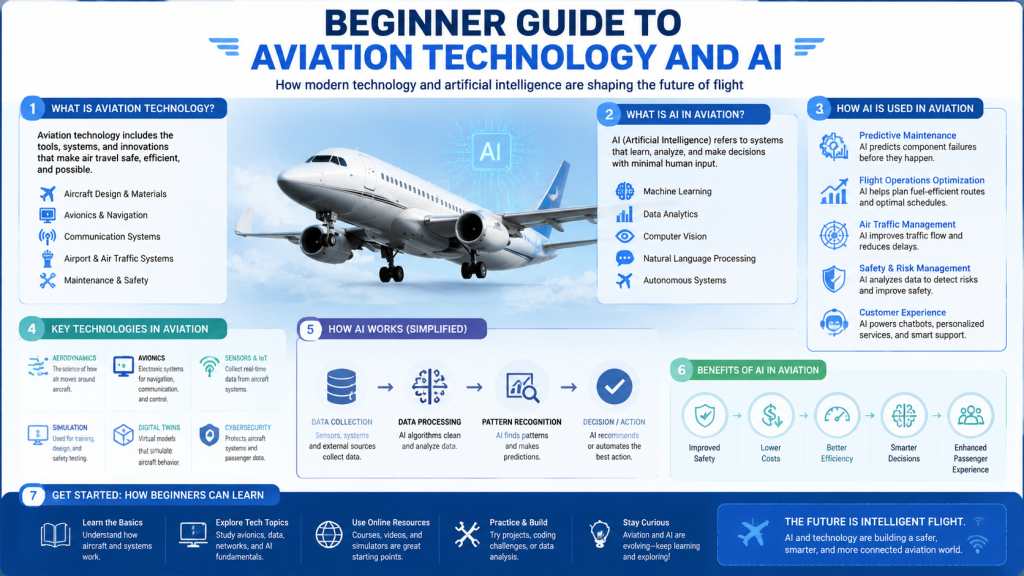
What Is Aviation Technology?
Aviation technology refers to the tools, systems, software, machines, and digital platforms used to support aircraft operations, airport management, airline services, safety systems, communication, navigation, and maintenance.
It includes technologies such as:
- Aircraft navigation systems
- Digital cockpit displays
- Flight management systems
- Aircraft sensors
- Weather monitoring systems
- Air traffic control systems
- Airport automation
- Maintenance software
- Passenger service platforms
- Aviation analytics tools
In simple words, aviation technology helps aircraft fly safely, airports operate efficiently, airlines manage operations, and passengers travel more smoothly.
What Is Artificial Intelligence?
Artificial Intelligence, or AI, is a technology that allows computer systems to perform tasks that usually require human intelligence. These tasks may include learning from data, recognizing patterns, making predictions, solving problems, and supporting decisions.
In aviation, AI can help with:
- Predicting aircraft maintenance issues
- Optimizing flight routes
- Analyzing weather risks
- Managing passenger flow
- Supporting airline customer service
- Improving airport security
- Reducing operational delays
AI does not mean aviation runs without humans. Instead, AI supports pilots, engineers, airport teams, airline managers, and safety experts by giving them better information.
Why AI Is Becoming Important in Aviation
The aviation industry handles massive amounts of data every day. Aircraft generate technical data, airports manage passenger movement, airlines track schedules, pilots monitor weather, and maintenance teams inspect aircraft systems.
AI is becoming important because it helps aviation teams manage this complexity.
Key reasons include:
- Growing air traffic needs better planning and coordination.
- Safety expectations require faster risk detection.
- Fuel efficiency is important for cost and sustainability.
- Passenger experience depends on speed, accuracy, and personalization.
- Maintenance planning needs early problem detection.
- Airport operations require smooth crowd and baggage management.
AI helps aviation become more proactive instead of reactive.
Major Areas Where AI Is Used in Aviation
1- Flight Operations
AI supports flight operations by helping airlines plan better routes, manage fuel usage, study weather patterns, and reduce delays.
It can help with:
- Route optimization
- Fuel planning
- Weather risk analysis
- Flight scheduling
- Delay prediction
- Crew planning
For example, AI can analyze weather, air traffic, aircraft performance, and route data to suggest more efficient flight paths.
2- Predictive Aircraft Maintenance
Aircraft maintenance is one of the most important areas where AI is useful. Modern aircraft have many sensors that collect data from engines, systems, and components.
AI can study this data and help predict when a part may need inspection or replacement.
Benefits include:
- Reduced aircraft downtime
- Early fault detection
- Better maintenance scheduling
- Improved safety
- Lower unexpected repair costs
Instead of waiting for a problem to happen, predictive maintenance helps teams act earlier.
3- Air Traffic Management
Air traffic management requires accurate planning, communication, and coordination. AI can support air traffic teams by analyzing traffic patterns, predicting congestion, and improving flight sequencing.
AI can help with:
- Traffic flow prediction
- Runway scheduling
- Congestion management
- Flight arrival sequencing
- Airspace optimization
Human controllers remain essential, but AI can provide useful decision support.
4- Airport Operations
Airports are complex environments with passengers, baggage, security, aircraft, ground vehicles, staff, and services moving at the same time.
AI can improve airport operations through:
- Passenger flow monitoring
- Smart baggage tracking
- Security screening support
- Queue management
- Gate allocation
- Resource planning
Smart airport systems help reduce waiting time and improve operational efficiency.
5- Customer Service
Many airlines and airports use AI-powered chatbots and virtual assistants to answer passenger questions quickly.
AI customer service tools can help with:
- Flight status updates
- Booking support
- Baggage information
- Refund guidance
- Travel document reminders
- Personalized notifications
This improves passenger support while allowing human agents to focus on complex issues.
6- Aviation Safety
Safety is the top priority in aviation. AI can support safety by detecting unusual patterns, analyzing incident reports, reviewing operational data, and helping teams identify risks earlier.
AI can support:
- Risk detection
- Safety reporting
- Incident trend analysis
- Operational monitoring
- Maintenance alerts
- Training improvement
AI does not replace safety professionals, but it gives them stronger insights.
How Airlines Use AI Today
Airlines use AI in many practical ways, including:
- Planning flight schedules
- Predicting delays
- Managing crew rosters
- Optimizing fuel use
- Forecasting maintenance needs
- Improving pricing decisions
- Supporting passengers through chatbots
- Personalizing travel offers
- Improving baggage tracking
- Analyzing customer feedback
AI helps airlines improve both behind-the-scenes operations and customer-facing services.
Aviation Technologies Every Beginner Should Know
1- Flight Management Systems
A flight management system helps pilots manage navigation, performance, and route planning during flight.
2- GPS Navigation
GPS helps aircraft determine accurate position and supports modern navigation.
3- Digital Cockpits
Digital cockpits display flight information on electronic screens, making information easier to read and manage.
4- Aircraft Sensors
Sensors collect information about engines, systems, temperature, pressure, speed, and performance.
5- Aviation Analytics Platforms
These platforms help airlines and airports analyze operational data for better decisions.
6- Aviation Cloud Systems
Cloud systems help aviation organizations store, manage, and access data securely.
7- AI-Powered Monitoring Tools
These tools analyze aircraft, airport, or airline data to detect patterns, alerts, and improvement opportunities.
Benefits of AI in Aviation
AI brings several benefits to aviation:
- Improved safety through earlier risk detection
- Better efficiency in scheduling, routing, and operations
- Lower costs through fuel savings and predictive maintenance
- Fewer delays through better planning
- Improved passenger experience through faster support
- Smarter maintenance through sensor-based insights
- Better decision-making through data analysis
AI helps aviation teams work smarter, not just faster.
Challenges of AI in Aviation
AI also brings challenges that must be handled carefully.
Important challenges include:
- Data privacy
- Cybersecurity risks
- Regulatory approval
- AI reliability
- Human oversight
- High implementation cost
- Staff training needs
- System integration complexity
Because aviation is safety-critical, AI must be tested, monitored, and used responsibly.
Future of Aviation Technology and AI
The future of aviation will likely include more digital systems, smarter airports, advanced aircraft monitoring, better automation, and stronger data-driven decision-making.
Future developments may include:
- AI-supported flight planning
- More advanced predictive maintenance
- Smarter airport operations
- AI copilots as support systems
- Improved passenger personalization
- Sustainable aviation technologies
- Advanced simulation-based training
- More connected aviation ecosystems
AI will not remove the need for skilled aviation professionals. Instead, it will increase the need for professionals who understand both aviation and technology.
Career Opportunities in Aviation Technology and AI
AI and aviation technology are creating new career paths.
Common career opportunities include:
- Aviation Data Analyst
- Aviation AI Specialist
- Flight Operations Analyst
- Airline Technology Consultant
- Airport Technology Manager
- Predictive Maintenance Analyst
- Aviation Software Engineer
- Aviation Cybersecurity Specialist
- Aircraft Systems Analyst
- Aviation Training Technology Specialist
These roles are ideal for people who enjoy aviation, technology, problem-solving, and data-driven work.
Skills Needed for Future Aviation Careers
Future aviation professionals should build both aviation and technology skills.
Important skills include:
- Aviation fundamentals
- Basic AI awareness
- Data analytics
- Problem-solving
- Cybersecurity basics
- Cloud computing awareness
- Communication skills
- Operational thinking
- Safety mindset
- Continuous learning
You do not need to become an AI expert on day one. Beginners can start by understanding aviation basics and gradually learning how technology supports the industry.
How Beginners Can Start Learning Aviation AI
Beginners can follow these steps:
- Learn aviation fundamentals
Understand aircraft, airports, airlines, safety, and operations. - Study basic AI concepts
Learn what AI, machine learning, automation, and data analytics mean. - Explore aviation use cases
Study how AI is used in maintenance, flight operations, airports, and customer service. - Learn data basics
Understand how data is collected, stored, analyzed, and used for decisions. - Follow aviation technology trends
Stay updated on smart airports, digital airlines, automation, and aviation safety systems. - Take beginner courses
Choose training that explains both aviation and AI in simple language. - Build practical skills
Learn tools related to analytics, reporting, dashboards, and aviation operations.
Common Myths About AI in Aviation
Myth 1- AI Will Replace All Pilots
AI can support pilots, but human judgment, training, communication, and responsibility remain essential in aviation.
Myth 2- AI Makes Human Expertise Unnecessary
AI works best when combined with skilled professionals who understand aviation operations and safety.
Myth 3- Aviation Will Become Fully Autonomous Immediately
Aviation changes carefully because safety and regulation are critical. Full autonomy will require extensive testing, approval, and trust.
Myth 4- AI Will Remove Aviation Jobs
AI may change some roles, but it also creates new jobs in data, technology, safety, cybersecurity, and operations.
Myth 5- Only Programmers Can Work in Aviation AI
Coding can help, but many aviation AI roles also need domain knowledge, analysis, communication, safety understanding, and operational expertise.
Frequently Asked Questions
1- What is aviation technology?
Aviation technology includes the systems, tools, software, machines, and digital platforms used in aircraft, airlines, airports, maintenance, communication, navigation, and safety. It helps aviation operate more safely, efficiently, and reliably.
2- How is AI used in aviation?
AI is used for flight planning, predictive maintenance, airport operations, customer service, air traffic support, delay prediction, safety analysis, and fuel optimization. It helps aviation teams analyze data and make better decisions.
3- Can AI replace pilots?
AI is not expected to fully replace pilots in normal aviation operations. It can support pilots with data, automation, and decision assistance, but human judgment and responsibility remain very important.
4- What is predictive maintenance?
Predictive maintenance uses aircraft sensor data and analytics to identify possible problems before they become serious. This helps airlines schedule maintenance earlier, reduce downtime, and improve safety.
5- How do smart airports work?
Smart airports use technology, sensors, automation, data analytics, and AI to improve passenger flow, baggage handling, security, gate planning, and airport operations. The goal is to make airports faster and more efficient.
6- Why do airlines use AI?
Airlines use AI to reduce delays, manage schedules, optimize fuel, improve maintenance, support customers, personalize services, and make operations more efficient. AI helps airlines handle complex data more effectively.
7- Is AI safe in aviation?
AI can improve safety when it is properly designed, tested, monitored, and used with human oversight. Since aviation is safety-critical, AI systems must meet strict standards before being trusted for important operations.
8- What careers combine aviation and AI?
Careers include aviation data analyst, aviation AI specialist, airline technology consultant, airport technology manager, predictive maintenance analyst, aviation cybersecurity specialist, and flight operations analyst.
9- Do pilots need AI knowledge?
Pilots do not need to become AI engineers, but basic knowledge of automation, digital systems, analytics, and AI-supported tools can help them understand modern aviation better.
10- What skills should aviation students learn?
Aviation students should learn aviation fundamentals, safety principles, communication, basic data analytics, AI awareness, cybersecurity basics, and technology-driven problem-solving.
11- How does AI improve safety?
AI improves safety by analyzing large amounts of data, detecting unusual patterns, predicting risks, supporting maintenance planning, and helping aviation teams identify problems earlier.
12- What are aviation analytics?
Aviation analytics means using data from aircraft, airlines, airports, passengers, weather, and operations to understand performance, identify problems, and improve decision-making.
13- Is coding required for aviation AI careers?
Coding is useful for technical roles, but it is not required for every aviation AI career. Some roles focus more on operations, analysis, management, safety, training, or business decision-making.
14- What is the future of AI in aviation?
The future of AI in aviation includes smarter maintenance, better flight planning, improved airport automation, AI-supported safety systems, advanced training tools, and more efficient airline operations.
15- How can beginners start learning aviation AI?
Beginners should start with aviation basics, then learn simple AI concepts, data analytics, automation, and real-world aviation use cases. Step-by-step learning is the best approach.
Conclusion
Aviation technology and AI are changing how airlines, airports, aircraft, and aviation professionals operate. For beginners, this transformation creates exciting learning and career opportunities. AI helps improve safety, efficiency, maintenance, passenger service, and decision-making, but it still requires skilled humans to guide, monitor, and manage its use. Future aviation professionals will benefit from understanding both aviation fundamentals and technology concepts. Whether you want to become a pilot, aviation analyst, airport technology manager, or AI-focused aviation professional, now is the right time to start learning. AIAviationAcademy.com can help beginners build the knowledge needed for the future of smart aviation.