Introduction
Weather is one of the most important factors affecting aviation safety, efficiency, and passenger comfort. Pilots, flight dispatchers, airport teams, meteorologists, and air traffic controllers depend on timely weather information before and during every flight. Artificial intelligence is adding a new layer of support by processing large volumes of radar, satellite, aircraft, and historical weather data faster than traditional manual analysis alone. However, AI in aviation weather forecasting is a decision-support technology—not a replacement for official weather information, trained meteorologists, approved procedures, or professional pilot judgment.
Understanding Aviation Weather Forecasting
Aviation weather forecasting is the process of observing current atmospheric conditions and estimating how those conditions may change along an aircraft’s planned route.
Unlike a general weather forecast, an aviation forecast must provide information that directly affects flight operations. Small changes in visibility, cloud height, wind direction, temperature, or precipitation can influence whether a flight can depart, land, continue on its planned route, or require an alternate airport.
Pilots and dispatchers use aviation weather forecasts to evaluate:
- Departure and destination conditions
- Weather along the planned route
- Suitable cruising altitudes
- Fuel requirements
- Possible turbulence or icing
- Alternate airport availability
- Thunderstorm avoidance
- Expected operational delays
- Takeoff and landing conditions
The main aviation weather products include:
- METAR: A coded report describing observed weather at an airport.
- TAF: A forecast of expected weather conditions around an airport for a defined period.
- SIGMET: A warning about significant weather that may affect aircraft operations.
- AIRMET: An advisory covering weather such as moderate turbulence, icing, reduced visibility, or strong winds.
- Weather radar: A system used to identify precipitation, storm movement, and storm intensity.
- Satellite imagery: Images that help meteorologists study clouds, moisture, storms, and large weather systems.
- Winds and temperatures aloft: Forecast information for wind direction, wind speed, and temperature at different altitudes.
- Pilot reports: Reports from pilots describing actual weather encountered during flight.
METAR is an internationally standardized format for reporting observed aviation weather, while official aviation weather services provide METARs, TAFs, pilot reports, SIGMETs, wind information, and related products.
Major Weather Hazards Affecting Aviation
Weather hazards can affect every phase of a flight. Thunderstorms may block a route, fog can reduce airport visibility, turbulence may cause injuries, and icing can change the aerodynamic performance of an aircraft.
Some hazards develop slowly, while others appear or intensify within minutes. This is one reason real-time weather monitoring and short-term forecasting are so important.
| Weather Hazard | Possible Aviation Impact | How AI Can Support Forecasting |
|---|---|---|
| Thunderstorms | Route deviations, lightning, hail, turbulence, wind shear and airport closures | Analyse radar, lightning, satellite and atmospheric data to identify developing storm cells |
| Turbulence | Passenger or crew injuries, altitude changes and route adjustments | Compare wind patterns, aircraft reports, jet-stream data and historical turbulence events |
| Icing | Reduced lift, increased drag and possible aircraft-control problems | Estimate areas where temperature, moisture and cloud conditions may support ice formation |
| Fog | Low visibility, delayed departures, diversions and approach restrictions | Study humidity, wind, surface temperature and historical airport fog patterns |
| Wind shear | Sudden airspeed or altitude changes, especially near airports | Analyse rapid wind changes using radar, airport sensors and aircraft observations |
| Snow and freezing rain | Runway contamination, de-icing needs and ground delays | Estimate precipitation type, surface accumulation and changing runway conditions |
AI can strengthen weather forecasting by combining different data sources and recognizing complex patterns. However, many weather applications are still being tested, evaluated, or introduced gradually into operational systems.
Traditional Aviation Weather Forecasting Methods
Traditional aviation weather forecasting uses observations, scientific models, specialist equipment, and human expertise.
Important sources include:
- Ground-based airport weather stations
- Weather radar
- Meteorological satellites
- Weather balloons
- Lightning detection systems
- Ocean and surface observations
- Numerical weather prediction models
- Aircraft-mounted sensors
- Pilot weather reports
- Human meteorologists
Numerical weather prediction models use mathematical equations to represent atmospheric processes. These models estimate how temperature, pressure, wind, moisture, and other conditions may change over time.
Meteorologists study the model outputs alongside actual observations. They consider local geography, seasonal behaviour, model limitations, and developing atmospheric patterns before preparing forecasts and warnings.
Traditional methods remain essential because they are based on physical science, established verification processes, and professional interpretation. Their main challenge is the enormous amount of data that must be processed as conditions change.
Meaning of AI in Aviation Weather Forecasting
Artificial intelligence refers to computer systems that analyse information, identify patterns, and generate predictions or other useful outputs. Machine learning is a branch of AI in which a system learns relationships from historical examples rather than depending only on manually programmed rules.
In aviation weather forecasting, AI may help computers study:
- Previous weather events
- Current radar images
- Satellite observations
- Airport sensor readings
- Aircraft weather reports
- Lightning activity
- Numerical model outputs
- Air traffic and delay information
An AI system can compare current conditions with patterns found in historical data. It may then estimate where a storm could move, when fog might form, or which altitude may carry a higher turbulence risk.
AI-based forecasting models often produce results faster than complex traditional models after training. However, training them requires large datasets, substantial computing resources, regular updates, and careful scientific validation. Their ability to handle unusual or extreme events must also be examined closely.
Artificial Intelligence
Artificial intelligence is the broader ability of a computer system to perform tasks that normally require human-like analysis or decision support.
Machine Learning
Machine learning allows a computer model to study data and learn relationships between different variables.
Deep Learning
Deep learning uses multi-layered neural networks to identify complicated patterns in large datasets, images, and sequences.
Predictive Analytics
Predictive analytics uses current and historical information to estimate what may happen in the future.
These technologies can support aviation professionals, but they do not carry the operational responsibility of a pilot, dispatcher, meteorologist, controller, or airline operator.
How AI-Based Aviation Weather Forecasting Works
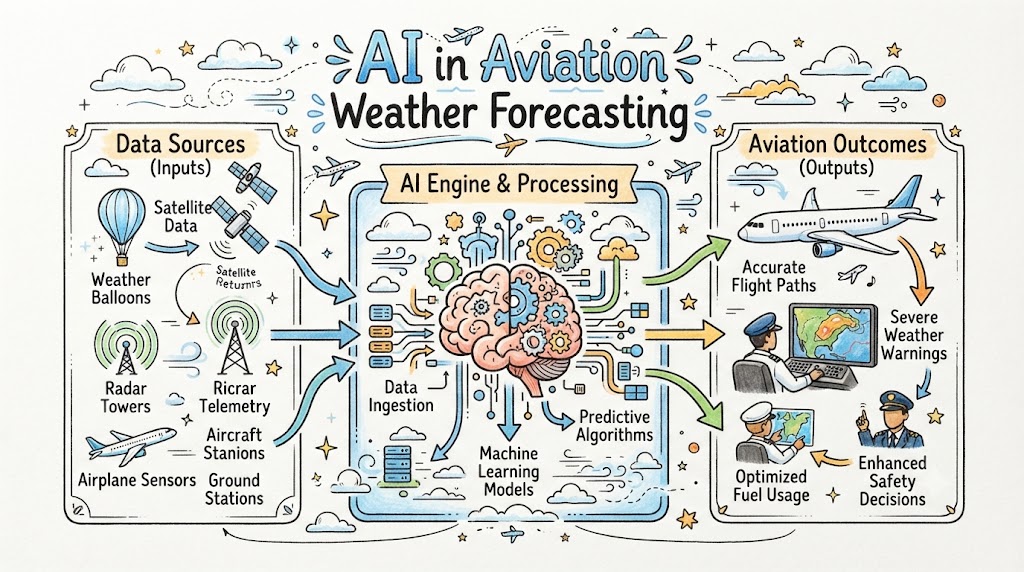
An AI-supported forecasting process normally includes the following stages:
- Weather data is collected. Information may come from satellites, radar, weather stations, aircraft sensors, lightning networks, and forecasting models.
- The data is checked and prepared. Duplicate, incomplete, delayed, or incorrect information may be identified before model processing.
- The AI model analyses patterns. It studies relationships between atmospheric conditions and previous weather events.
- A forecast is generated. The system may estimate the location, timing, probability, or intensity of a weather hazard.
- The result is displayed. Information may appear as a weather map, risk level, route alert, probability, or recommended area for closer review.
- Qualified professionals review it. Meteorologists, dispatchers, pilots, or operational teams compare the result with official products and other available information.
- An operational decision is made. The final decision follows regulations, company procedures, aircraft limitations, and professional judgment.
The accuracy of the result depends on the quality of the input data, the design of the model, local weather behaviour, forecast time, and whether the model has experienced similar conditions during training.
Important Data Sources Used by AI Systems
AI models become more useful when they can examine several types of information together.
Weather Satellites
Satellites provide information about cloud cover, storm movement, atmospheric moisture, temperature, and large weather systems.
Doppler Weather Radar
Radar helps identify precipitation intensity, storm direction, wind movement, and areas of possible severe weather.
Airport Weather Sensors
Airport equipment measures wind, temperature, visibility, cloud height, pressure, precipitation, and runway-related conditions.
Aircraft-Mounted Sensors
Aircraft may collect information about temperature, wind, turbulence, and atmospheric conditions during flight.
Pilot Reports
Pilot reports provide direct information about turbulence, icing, cloud conditions, visibility, and other weather actually encountered.
Historical Weather Records
Historical data helps machine-learning systems identify relationships between past atmospheric patterns and later weather outcomes.
Numerical Weather Models
AI systems may use traditional model outputs as inputs instead of trying to replace physics-based forecasting completely.
The FAA classifies aviation weather information as observations, analyses, and forecasts. It also advises pilots to consider all relevant products because each flight and weather situation is different.
Important AI Applications in Aviation Weather Forecasting
Turbulence Forecasting
Turbulence can result from thunderstorms, jet streams, mountain waves, wind shear, or unstable atmospheric conditions. It may occur even when the sky appears clear.
AI systems can compare:
- Wind speed and direction
- Changes in atmospheric pressure
- Temperature differences
- Jet-stream position
- Mountain terrain
- Previous turbulence events
- Aircraft sensor reports
- Pilot reports
The model may identify areas where turbulence is more likely at a particular altitude. Dispatchers can review this information during route planning, while pilots may use updated information to improve situational awareness.
The final altitude or route change must still be coordinated through approved operational procedures and air traffic control.
In March 2026, NOAA announced improvements to its Domestic Aviation Forecast System designed to strengthen turbulence and in-flight icing predictions. This is a practical example of advanced modelling being introduced into official aviation weather support rather than operating as an independent consumer prediction tool.
Thunderstorm and Lightning Prediction
Thunderstorms can produce turbulence, hail, lightning, icing, heavy rain, wind shear, downbursts, and rapidly changing wind conditions.
An AI-supported system can study:
- Radar development
- Satellite cloud patterns
- Humidity
- Atmospheric instability
- Temperature
- Air pressure
- Wind movement
- Lightning activity
The system may detect patterns associated with developing storm cells and estimate their movement over the next several minutes or hours.
Earlier awareness may support:
- Departure planning
- Safer route selection
- Additional fuel planning
- Ground-handling restrictions
- Airport staffing decisions
- Diversion preparation
- Air traffic flow management
However, thunderstorms remain highly dynamic. Their movement, strength, and internal hazards cannot always be predicted with complete accuracy.
Icing and Cold-Weather Forecasting
Aircraft icing can occur when supercooled water droplets freeze after contacting an aircraft surface. Ice accumulation may increase drag, reduce lift, affect instruments, and create control difficulties.
AI can analyse temperature, moisture, cloud structure, precipitation, altitude, and previous icing reports to estimate where icing may be possible.
On the ground, AI-supported systems may also help estimate:
- Frost formation
- Freezing rain
- Snow accumulation
- De-icing demand
- Runway contamination
- Possible airport delays
Forecast information does not replace aircraft limitations, de-icing inspections, official reports, or standard operating procedures.
AI in Airport Weather Management
Airports must coordinate runways, gates, ground vehicles, staff, de-icing equipment, and emergency procedures. Weather can affect all these activities at the same time.
Short-term AI-supported forecasts may help airport teams prepare for:
- Runway changes caused by shifting winds
- Low-visibility operations
- Thunderstorm ground stops
- Lightning protection procedures
- Heavy rain or drainage problems
- Snow-clearing requirements
- Aircraft de-icing demand
- Gate congestion
- Arrival and departure delays
For example, a forecast showing an increasing probability of heavy snow may allow an airport to position snow-removal equipment before the runway becomes contaminated.
The technology does not remove uncertainty, but it may provide teams with more time to prepare.
AI in Airline Flight Planning
Flight dispatchers examine aircraft performance, route conditions, weather, fuel, airport suitability, and regulatory requirements before releasing a flight.
AI-supported aviation weather tools may help them evaluate:
- Expected weather along several possible routes
- Turbulence at different altitudes
- Thunderstorm development
- Destination visibility
- Alternate airport conditions
- Fuel needed for deviations
- Possible departure delays
- Estimated arrival changes
- Diversion probability
A system may quickly compare many route and altitude combinations. The dispatcher and pilot can then review the most suitable options using approved weather information and operating rules.
Benefits of AI in Aviation Weather Forecasting
Potential benefits include:
- Faster processing of large datasets
- Improved recognition of complex patterns
- More frequent forecast updates
- Earlier identification of developing hazards
- Better route comparison
- Improved short-term airport planning
- More informed fuel calculations
- Better delay preparation
- More detailed situational awareness
- Support for meteorologists and operational teams
The FAA’s Aviation Weather Research Program focuses on moving improved weather capabilities into air traffic management and National Weather Service systems after research, testing, and assessment. Its research areas include turbulence, icing, convective weather, visibility, radar techniques, and prediction-model development.
Limitations and Challenges
AI forecasting has important limitations.
Data Quality Problems
A model may produce unreliable results when sensors are inaccurate, observations are missing, or data arrives late.
Unusual Weather Events
An AI model may struggle with a rare event that is poorly represented in its training data.
False Alarms
The system may predict a hazard that does not develop. Too many false warnings can reduce user confidence.
Missed Hazards
A model may fail to identify a developing danger, especially when observations are limited.
Limited Explainability
Some advanced models produce a prediction without clearly showing why that result was reached.
Model Bias
Training data may represent some regions, seasons, airports, or weather conditions better than others.
Cybersecurity Risks
Connected weather systems must be protected from unauthorized access, corrupted information, service disruption, and manipulation.
Infrastructure Dependence
AI tools depend on sensors, communications, electrical power, computer systems, and updated data.
Regulatory Challenges
A model that performs well during research still requires verification, testing, operational assessment, and appropriate approval before it can be relied upon in safety-critical aviation activities.
WMO emphasizes the need for robust, transparent, and fair verification of AI forecasts alongside traditional numerical weather prediction.
Traditional Forecasting and AI-Supported Forecasting
| Comparison Area | Traditional Forecasting | AI-Supported Forecasting |
|---|---|---|
| Data processing | Uses observations, physical equations, numerical models and expert analysis | Learns patterns from large historical and real-time datasets |
| Forecast speed | Complex models may require significant computing time | A trained model may generate predictions rapidly |
| Pattern recognition | Depends strongly on physical modelling and meteorologist interpretation | Can identify complicated relationships across large datasets |
| Human involvement | Meteorologists analyse models and prepare operational products | Humans validate outputs and decide how the information should be used |
| Real-time updates | Updated according to product and model schedules | Can support frequent updates when reliable data is available |
| Reliability challenges | Model assumptions, resolution and observation gaps | Training bias, poor data, explainability and unfamiliar events |
| Best use | Scientifically established operational forecasting | Additional analysis, rapid prediction and decision support |
The strongest future approach may be a hybrid system that combines physics-based forecasting, AI analysis, real-time observations, and human expertise. WMO notes that important questions remain about how these methods should be integrated into operational systems.
Role of Human Aviation Meteorologists
Human meteorologists remain essential because weather is influenced by complex local and global processes.
Their responsibilities include:
- Reviewing model outputs
- Identifying inconsistent results
- Interpreting unusual atmospheric patterns
- Applying knowledge of local geography
- Evaluating forecast uncertainty
- Issuing official warnings
- Communicating operational risks
- Explaining confidence levels
- Supporting emergency decisions
Meteorologists can also recognize when an AI output does not match observed conditions. They bring experience, scientific understanding, and contextual judgment that automated models do not independently possess.
ICAO has highlighted the need to place humans at the centre when AI is introduced into safety-critical aviation environments.
Responsibilities of Pilots and Flight Dispatchers
Pilots and flight dispatchers must understand both the advantages and limitations of digital forecasting tools.
They should:
- Review official observations and forecasts
- Check forecast issue and validity times
- Compare several relevant weather products
- Understand probability and uncertainty
- Monitor changing weather throughout the flight
- Maintain alternate routes and airports
- Follow aircraft limitations
- Communicate with air traffic control
- Report unexpected conditions
- Follow company and regulatory procedures
The FAA warns that unfamiliar or third-party weather products may not meet the same quality-control standards as approved services. It also advises users to check the product type, issue time, validity, and relevance.
Aviation Training for AI-Based Weather Systems
Future aviation professionals will need strong traditional weather knowledge as well as digital skills.
Important learning areas include:
- Aviation weather theory
- METAR and TAF interpretation
- Weather radar interpretation
- Thunderstorm and icing hazards
- Basic artificial intelligence concepts
- Data quality awareness
- Probability and uncertainty
- Automation limitations
- Forecast verification
- Cybersecurity awareness
- Human-machine teamwork
- Decision-making under changing conditions
A student pilot should first learn how weather develops and how official products are interpreted. AI tools can then be studied as an additional source of decision support.
Through educational content on AIAVIATIONACADEMY.COM, aviation learners can explore how artificial intelligence connects with weather forecasting, flight planning, airport management, and operational safety without treating automation as a substitute for certified training.
Practical Flight-Planning Example
Consider a flight scheduled between two airports during a period of developing afternoon thunderstorms.
An AI-supported system detects a pattern in radar, satellite, humidity, wind, and lightning data. It indicates that a group of storm cells may move toward the planned route near the expected departure time.
The flight dispatcher then:
- Reviews the latest METARs and TAFs.
- Checks SIGMETs and other official warnings.
- Examines radar and forecast charts.
- Compares alternative routes.
- Calculates additional fuel for a possible deviation.
- Reviews suitable alternate airports.
- Discusses the conditions with the flight crew.
The pilot reviews the same operational information and considers aircraft limitations, company procedures, air traffic control restrictions, and personal observations.
A route around the developing weather is selected, with additional fuel included for uncertainty. During the flight, the crew continues monitoring radar, reports from other aircraft, updated forecasts, and instructions from air traffic control.
In this situation, AI provided earlier pattern recognition. It did not make or authorize the final operational decision.
Best Practices for Using AI Weather Information
Aviation professionals should follow these practices:
- Never depend on one forecast source.
- Verify AI outputs against approved aviation weather information.
- Check when every product was issued.
- Understand the forecast period and geographical coverage.
- Review confidence levels where available.
- Monitor weather continuously.
- Maintain alternative plans.
- Report unexpected weather through approved channels.
- Learn the system’s limitations.
- Keep manual weather interpretation skills current.
- Follow regulations and organizational procedures.
- Treat AI recommendations as decision support rather than final authority.
Future of AI in Aviation Weather Forecasting
AI weather forecasting is developing rapidly, but its adoption will continue to depend on testing, verification, regulation, transparency, and user training.
Possible developments include:
- Higher-resolution airport forecasts
- Better short-term thunderstorm tracking
- More detailed turbulence predictions
- Improved icing-risk estimates
- Faster aircraft-to-ground weather sharing
- Route-specific weather alerts
- More accurate airport delay predictions
- Improved runway-condition forecasts
- Weather support for drones and air taxis
- Closer integration with flight-planning systems
- Better communication of forecast uncertainty
- Hybrid forecasting combining AI and physical models
AI-based and hybrid forecasting systems are already supporting some operational weather activities. At the same time, several applications remain in research, evaluation, or pilot implementation.
The future is therefore unlikely to involve AI working alone. A more realistic model combines reliable observations, physical science, machine learning, trained meteorologists, qualified aviation professionals, and clearly defined regulatory responsibility.
Key Takeaways
- AI can process large volumes of aviation weather data quickly.
- It may support forecasts for turbulence, icing, fog, thunderstorms, wind shear, and airport delays.
- AI forecasts depend heavily on accurate and representative data.
- Sudden or unusual weather can remain difficult to predict.
- AI-generated information must be verified using official aviation weather sources.
- Human meteorologists remain necessary for interpretation and warning decisions.
- Pilots and dispatchers retain responsibility for operational decisions.
- The most practical future approach combines AI, traditional forecasting, and human expertise.
Frequently Asked Questions
1. What is AI in aviation weather forecasting?
AI in aviation weather forecasting involves using computer models to study radar, satellite, aircraft, airport, historical, and numerical-model data. The systems identify patterns and estimate how weather may develop. They can support the prediction of turbulence, thunderstorms, icing, fog, and other hazards. AI does not independently decide whether a flight should depart, continue, divert, or land. Those decisions remain with qualified aviation professionals following approved information and procedures.
2. Can AI predict aviation weather accurately?
AI can produce useful forecasts when it is trained on reliable data and carefully tested. Its performance may be strong for weather patterns similar to those included in its training information. Accuracy can decrease when observations are missing, local conditions are poorly represented, or an unusual event occurs. AI forecasts should therefore be compared with official weather products, current observations, traditional forecast models, and professional meteorological interpretation.
3. Can AI replace aviation meteorologists?
AI is not a complete replacement for aviation meteorologists. Meteorologists interpret conflicting information, understand local weather behaviour, evaluate unusual situations, communicate uncertainty, and issue operational forecasts or warnings. AI can process large datasets and highlight patterns, but it may also generate false alarms or miss important hazards. The more reliable approach is to use AI as an analytical tool under qualified human supervision.
4. How does AI help pilots avoid turbulence?
AI can compare wind, temperature, jet-stream, terrain, atmospheric-stability, aircraft-sensor, and pilot-report data. It may identify altitudes or areas where turbulence is more likely. Pilots and dispatchers can use this information while evaluating routes and cruising levels. However, pilots must still follow air traffic control instructions, aircraft limitations, official forecasts, company procedures, and real-time observations before making route or altitude changes.
5. What data is used in AI weather forecasting?
AI forecasting systems may use satellite images, weather radar, airport observations, aircraft measurements, weather balloons, lightning networks, historical records, pilot reports, and numerical weather prediction outputs. The exact combination depends on the model and its purpose. Using several sources can improve the overall picture, but additional data does not guarantee accuracy. Every source must be checked for quality, timeliness, coverage, and compatibility.
6. How can AI reduce weather-related flight delays?
AI may provide earlier warning of fog, thunderstorms, snow, strong winds, or other disruptive conditions. Airlines and airports can use that information to prepare gates, crews, de-icing equipment, alternate routes, and revised departure schedules. Better preparation may reduce avoidable disruption. However, operational delays cannot always be prevented because weather may change unexpectedly and safety restrictions must take priority over schedule performance.
7. What are the risks of relying on AI forecasts?
Major risks include incomplete data, false warnings, missed hazards, model bias, limited explainability, technical failure, outdated information, and cybersecurity threats. A model may also perform poorly during rare weather events. Relying on an AI display without checking official products can create false confidence. Aviation users should understand the tool’s purpose, limitations, update time, forecast period, and approval status before using its information.
8. How should student pilots use AI-supported weather tools safely?
Student pilots should first learn basic meteorology, weather hazards, METARs, TAFs, radar, advisories, and standard briefing procedures. AI-supported tools can then be used to compare forecasts and improve situational awareness. Students should review results with an instructor and avoid treating colourful maps or automated alerts as final instructions. Official sources, aircraft limitations, instructor guidance, and applicable regulations must always receive priority.
9. Is AI weather information officially approved for flight decisions?
Approval depends on the system, operator, country, regulator, and intended use. Some advanced models contribute to official forecasting systems, while other tools are experimental or intended only for general awareness. A commercial application using government data is not automatically approved for every operational purpose. Pilots and operators must know which sources are authorized under the applicable regulations, operations specifications, and company procedures.
10. What is the future of AI-based aviation forecasting?
The future will probably include faster updates, higher-resolution forecasts, improved turbulence and icing guidance, route-specific alerts, and closer integration with flight-planning systems. AI may also support drones, advanced air mobility, and airport resource planning. Its success will depend on transparent testing, reliable data, cybersecurity, regulatory oversight, and human training. Hybrid systems combining AI with physical models and meteorological expertise are likely to remain the safest direction.
Conclusion
AI in aviation weather forecasting can help meteorologists and aviation professionals analyse complex data, recognize developing hazards, and prepare more detailed operational guidance. It may improve awareness of turbulence, icing, thunderstorms, fog, wind shear, and airport disruption, but it cannot remove weather uncertainty or guarantee a safe outcome. Official weather products, trained meteorologists, qualified pilots, flight dispatchers, air traffic controllers, aircraft limitations, and regulatory procedures remain essential. AIAVIATIONACADEMY.COM can help learners understand these emerging technologies while reinforcing the importance of responsible human oversight and professional aviation training.