Introduction
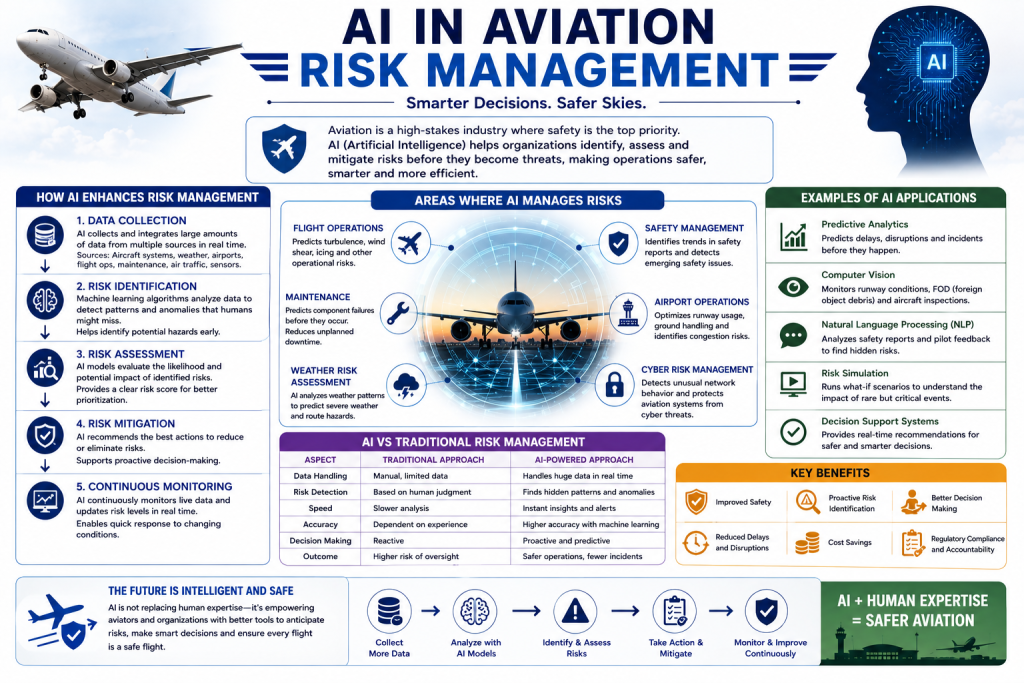
Aviation is one of the most safety-focused industries in the world. Every flight involves multiple systems, people, procedures, and environmental factors that need to work together effectively. Because aviation operations are complex, identifying potential hazards and managing risks before they develop into serious events is an essential part of maintaining safety.
Traditionally, aviation organizations have relied on safety reports, inspections, maintenance records, operational data, human expertise, and established Safety Management Systems to identify and manage risks. Today, the growing availability of digital data is creating new opportunities to support these processes.
Artificial intelligence can analyze large amounts of information, recognize patterns, identify unusual behavior, and provide decision-support information. When implemented responsibly, these capabilities can help aviation organizations improve how they identify and monitor potential risks.
However, AI is not a replacement for pilots, engineers, safety professionals, air traffic personnel, or other aviation specialists. It is better understood as a tool that can support human expertise and help professionals make more informed decisions.
Understanding Aviation Risk Management
Aviation risk management is the process of identifying hazards, evaluating the risks associated with them, and taking appropriate steps to control or reduce those risks.
A hazard is a condition or situation that has the potential to cause harm. A risk considers factors such as the likelihood of an unwanted event and the potential consequences associated with it.
Risk management generally involves several important activities:
- Identifying potential hazards.
- Assessing associated risks.
- Determining appropriate controls.
- Monitoring whether those controls are effective.
- Reviewing safety information continuously.
- Taking corrective action when necessary.
Risk management is not a one-time activity. Aviation operations change constantly because of weather, aircraft condition, traffic levels, human factors, airport conditions, and other variables.
This is why continuous safety monitoring is important.
What Is AI in Aviation?
Artificial intelligence refers to computer-based systems that can perform tasks that typically require forms of human intelligence, such as recognizing patterns, processing information, identifying relationships, and generating predictions or recommendations.
In aviation, AI can be used to process large datasets that may be difficult to examine manually at the same speed.
For example, an aviation organization may have information from:
- Flight operations.
- Aircraft sensors.
- Maintenance systems.
- Weather services.
- Safety reports.
- Airport operations.
- Air traffic systems.
- Operational records.
AI-based tools can examine this information to identify patterns or unusual conditions that may deserve further attention.
Importantly, AI does not automatically understand an aviation situation in the same way an experienced professional does. Its usefulness depends on the quality of the data, the design of the system, the context in which it is used, and appropriate human oversight.
How AI Supports Aviation Risk Management
Predictive Risk Identification
One of the most valuable potential uses of AI is identifying patterns that may indicate an increased level of risk.
Traditional safety analysis may involve reviewing large numbers of reports and records. AI can help analyze these datasets more quickly and identify relationships that may otherwise take considerable time to discover.
For example, an organization may notice that certain operational deviations occur more frequently under a particular combination of weather, traffic, and workload conditions.
An AI-based system could help identify that pattern and provide it to safety professionals for further investigation.
This does not mean that AI has automatically identified a future accident. Instead, it can provide an early indicator that deserves human attention.
Predictive Maintenance
Aircraft generate large amounts of technical information during operation.
AI can help analyze information related to aircraft systems and components to identify unusual patterns or changes in performance.
For example, a system might detect that a component is behaving differently from its normal operating pattern.
Maintenance professionals can then investigate the information and determine whether further inspection or action is appropriate.
Predictive maintenance can potentially help organizations move from a purely reactive approach toward a more proactive approach to maintenance planning.
However, AI-based predictions should not automatically replace established maintenance procedures, inspections, or approved technical decision-making processes.
Flight Data Analysis
Modern aircraft and flight operations can generate substantial amounts of data.
Analyzing this information can help safety teams identify trends and recurring operational patterns.
AI can support analysis of areas such as:
- Flight parameters.
- Operational deviations.
- Approach and landing trends.
- Aircraft performance.
- Environmental conditions.
- Repeated operational events.
For example, if similar deviations appear repeatedly across a group of flights, an organization can investigate whether there is an underlying operational, training, environmental, or procedural factor.
This can support a more proactive approach to safety management.
Weather Risk Assessment
Weather is an important factor in aviation risk management.
Conditions such as thunderstorms, turbulence, strong winds, icing, and reduced visibility can influence flight operations.
AI-based systems can process large amounts of meteorological and operational information and help identify patterns associated with changing conditions.
For example, AI may assist with analyzing weather information alongside flight routes and operational data to highlight areas that may require additional attention.
The final operational decision, however, still needs to account for current conditions, aviation procedures, aircraft capabilities, and professional judgment.
Human Performance and Fatigue Risk
Human factors are an important part of aviation safety.
Fatigue, workload, stress, and operational pressure can affect performance and decision-making.
Data-driven systems may help organizations identify patterns associated with fatigue risk or excessive workload.
For example, an organization could analyze scheduling information, duty patterns, and operational data to identify situations that may warrant closer review.
Such applications require careful consideration of privacy and appropriate data use. Monitoring people through technology should be handled responsibly and according to applicable rules and organizational policies.
AI should support safety rather than create an environment where employees feel unfairly monitored or judged by automated systems.
Airport and Ground Safety
Aircraft safety is not limited to what happens in the air. Airport ground operations also involve numerous potential hazards.
AI-based computer vision and data analysis systems can potentially support monitoring of:
- Aircraft movement areas.
- Ground vehicles.
- Runways and taxiways.
- Aprons.
- Ground equipment.
- Restricted areas.
For example, computer vision may help identify an object, vehicle, or unusual movement in a monitored area.
Such systems can provide alerts to operational personnel, who can then assess the situation and take appropriate action.
Air Traffic Management
Air traffic management involves managing complex interactions between aircraft, routes, airports, weather, and traffic demand.
AI may assist with:
- Traffic prediction.
- Congestion analysis.
- Route planning.
- Demand forecasting.
- Conflict-risk identification.
- Operational decision support.
These applications can help professionals process large amounts of information.
Because air traffic management is safety-critical, AI systems need appropriate validation, testing, monitoring, and human oversight before being relied upon for important operational functions.
AI Technologies Used in Aviation Risk Management
Several AI-related technologies can contribute to aviation risk management.
Machine Learning
Machine learning allows systems to identify patterns from data and improve their ability to make predictions or classifications based on available information.
In aviation, machine learning may support predictive maintenance, operational analysis, anomaly detection, and other applications.
Predictive Analytics
Predictive analytics uses historical and current information to estimate possible future trends or conditions.
For example, it can help organizations identify patterns that may indicate a higher likelihood of certain maintenance or operational events.
Computer Vision
Computer vision allows systems to analyze images or video.
In aviation, it can potentially support airport surveillance, runway monitoring, aircraft inspection, and detection of objects or unusual activity.
Natural Language Processing
Natural language processing allows computer systems to analyze human language.
It can be used to examine large volumes of written safety reports, maintenance records, incident descriptions, or other textual information and identify recurring themes.
Pattern Recognition
Pattern recognition helps systems identify relationships or recurring characteristics in data.
This can be useful when safety teams need to examine large datasets for trends that may not be obvious through manual review.
Anomaly Detection
Anomaly detection focuses on identifying information that differs significantly from an expected or normal pattern.
For example, an AI system may identify unusual aircraft sensor behavior or an unexpected operational parameter that deserves further investigation.
Examples of AI-Based Aviation Risk Management
AI can support aviation risk management in several practical situations.
Detecting Unusual Aircraft Component Behavior
An AI system can analyze historical and current technical data and identify changes that may indicate unusual component behavior.
Maintenance professionals can then investigate the alert and determine the appropriate response.
Identifying Recurring Flight Patterns
AI can analyze large numbers of flight records to identify recurring operational deviations or unusual patterns.
Safety teams can use these findings to investigate potential underlying causes.
Monitoring Airport Environments
Computer vision systems can monitor specific airport areas and identify objects, vehicles, or activities that require attention.
Supporting Weather-Related Risk Assessment
AI can help combine weather information with operational data to identify areas where changing conditions may affect planned operations.
Analyzing Safety Reports
An organization may have thousands of safety reports containing valuable information.
Natural language processing can help categorize these reports, identify recurring themes, and highlight areas for further investigation.
Identifying Maintenance Trends
AI can analyze maintenance records to identify recurring issues involving particular components, systems, or operating conditions.
Supporting Fatigue Risk Monitoring
Data analysis can help organizations identify scheduling patterns or operational conditions associated with potential fatigue risks.
These examples demonstrate how AI can support risk management, but actual capabilities depend on the specific system, data, aircraft, organization, and regulatory environment.
Benefits of AI in Aviation Risk Management
When implemented appropriately, AI can offer several potential benefits.
Faster Data Analysis
AI can process large datasets much faster than manual analysis in many situations.
This can help safety teams review information more efficiently.
Earlier Identification of Potential Risks
Pattern recognition and predictive analysis may help organizations identify warning signs before they develop into more serious problems.
Better Recognition of Recurring Patterns
AI can examine information across large datasets and identify relationships that may be difficult to recognize manually.
Improved Predictive Maintenance Support
Analyzing aircraft and component data can help maintenance teams identify unusual trends and plan investigations more proactively.
More Consistent Analysis
Automated data analysis can provide a consistent way of reviewing large datasets, although the system itself still needs to be properly designed and monitored.
Improved Safety Monitoring
AI can support continuous analysis of operational information and help safety teams focus attention on areas that require investigation.
Evidence-Based Decision Support
AI-generated insights can provide additional information for aviation professionals when they are evaluating operational or safety issues.
AI should therefore be viewed as a decision-support capability rather than an independent decision-maker.
Limitations and Challenges of AI in Aviation Safety
AI has significant potential, but it also has limitations.
Poor-Quality Data
AI systems depend heavily on the quality of the information provided to them.
Incomplete, inaccurate, inconsistent, or poorly structured data can produce unreliable results.
False Positives and False Negatives
An AI system may identify something as a potential risk when there is no actual problem. This is known as a false positive.
It may also fail to identify a genuine risk, resulting in a false negative.
Both situations can create challenges in safety-critical environments.
Bias in Data
If the data used to develop a system does not adequately represent the situations it will encounter, the system may produce biased or unreliable results.
Difficult-to-Explain Decisions
Some AI models can be difficult to interpret.
In aviation safety, professionals may need to understand why a system produced a particular recommendation or alert before deciding how to act on it.
Cybersecurity
Connected AI systems can create additional cybersecurity considerations.
Unauthorized access, data manipulation, system disruption, and malicious inputs can potentially affect the reliability of safety-related systems.
Data Privacy
Aviation organizations handle information about employees, passengers, aircraft, and operations.
Using this information for AI applications requires appropriate privacy protections and responsible data management.
Regulatory and Certification Challenges
Safety-critical aviation systems must meet appropriate regulatory and technical requirements.
An AI system cannot simply be introduced into a safety-critical operation because it produces useful predictions. It needs appropriate validation, testing, oversight, and approval where required.
Human Oversight and AI
One of the most important principles in aviation AI is the relationship between technology and human expertise.
AI can provide:
- Data analysis.
- Alerts.
- Predictions.
- Risk indicators.
- Decision-support information.
Aviation professionals provide something equally important: context, experience, judgment, and responsibility.
A safety professional may receive an AI-generated alert indicating an unusual pattern. Instead of automatically treating that alert as a confirmed safety event, the professional can examine the underlying information, consider operational circumstances, and determine what action is appropriate.
This combination of technology and human judgment can be more effective than relying entirely on either one.
Human oversight is particularly important in safety-critical aviation applications.
AI and the Aviation Safety Management System
A Safety Management System, commonly known as SMS, provides a structured approach to managing safety within an aviation organization.
AI can potentially support several parts of an SMS.
Hazard Identification
AI can analyze operational data, safety reports, and other information to identify patterns that may indicate potential hazards.
Risk Assessment
AI-generated information can help safety teams understand where certain risks may be occurring or increasing.
Safety Performance Monitoring
AI can support continuous monitoring of safety indicators and identify changes or unusual trends.
Incident and Occurrence Analysis
Large collections of incident and occurrence reports can be analyzed to identify recurring themes.
Corrective-Action Monitoring
Data analysis can help organizations monitor whether identified safety issues continue to appear after corrective measures have been introduced.
Continuous Safety Improvement
By continuously analyzing new information, AI can support the ongoing review and improvement of safety processes.
However, AI does not replace an organization’s SMS responsibilities. It is a tool that can strengthen existing safety processes when implemented appropriately.
Data Quality and Privacy
Data is one of the most important elements of AI-based risk management.
A system cannot produce reliable insights if the information it receives is incomplete or inaccurate.
Organizations should therefore pay attention to:
- Accurate data collection.
- Data consistency.
- Data validation.
- Secure storage.
- Appropriate access controls.
- Responsible data use.
- Privacy protection.
Data quality should be treated as a safety consideration, not merely a technical issue.
Privacy is also important, especially when information relates to pilots, maintenance personnel, air traffic personnel, or other employees.
Organizations need appropriate policies and safeguards for collecting, storing, analyzing, and sharing sensitive information.
Cybersecurity Risks
As aviation becomes more connected and dependent on digital systems, cybersecurity becomes increasingly important.
AI-based risk management systems may process operational data through interconnected networks and platforms. This can introduce potential cybersecurity concerns.
Possible risks include:
- Unauthorized system access.
- Data theft.
- Data manipulation.
- Malicious inputs.
- System disruption.
- Compromise of connected systems.
A manipulated dataset could potentially cause an AI system to produce unreliable conclusions.
For this reason, cybersecurity should be considered as part of the overall design and management of AI-based aviation systems.
AI adoption should not create a situation where improvements in one area introduce new risks elsewhere.
Future of AI in Aviation Risk Management
AI is likely to continue influencing how aviation organizations analyze operational and safety information.
Future developments may include:
- More advanced predictive analytics.
- Improved anomaly detection.
- Greater integration of operational datasets.
- More sophisticated decision-support systems.
- Improved maintenance forecasting.
- Enhanced airport safety monitoring.
- Better integration between safety and operational systems.
As these technologies develop, their use will depend on factors such as system reliability, data quality, regulatory requirements, certification, testing, cybersecurity, and acceptance by aviation professionals.
The future is therefore unlikely to be about simply replacing existing aviation processes with AI.
Instead, AI is more likely to become another tool within a broader safety framework that combines technology, procedures, regulation, and human expertise.
Common Misconceptions About AI in Aviation Risk Management
AI Can Replace Aviation Safety Professionals
AI can analyze data and provide useful information, but aviation safety involves context, judgment, communication, and responsibility.
Human professionals remain important for interpreting information and making appropriate decisions.
AI Can Predict Every Accident
AI can identify patterns and potential indicators of risk, but it cannot guarantee that every future accident or incident will be predicted.
Aviation events can result from complex combinations of factors that may not have appeared in historical data.
More Data Automatically Means Better Safety
More data is not necessarily better.
Data must be accurate, relevant, properly structured, and interpreted in the correct context.
Poor-quality data can produce poor-quality results regardless of how advanced the AI system is.
AI Recommendations Are Always Correct
AI systems can make mistakes.
They may produce false positives, miss important events, or generate recommendations based on incomplete information.
This is why appropriate validation and human oversight are essential.
How Aviation Professionals Can Prepare for AI-Based Risk Management
The increasing use of technology in aviation creates opportunities for professionals with both aviation knowledge and data-related skills.
Students and aviation professionals can benefit from learning about:
- Aviation safety fundamentals.
- Risk management principles.
- Safety Management Systems.
- Data analysis.
- Basic AI and machine learning concepts.
- Aviation regulations.
- Human factors.
- Cybersecurity awareness.
- Data privacy.
- Responsible technology use.
A pilot, safety professional, engineer, or aviation manager does not necessarily need to become a specialist in machine learning.
However, understanding what AI can do, what its limitations are, and how to interpret its outputs can become increasingly valuable.
Frequently Asked Questions
1. What is AI in aviation risk management?
AI in aviation risk management refers to the use of artificial intelligence technologies to analyze aviation data, identify patterns, detect anomalies, support predictions, and provide information that can help aviation professionals manage potential risks.
2. How can AI help improve aviation safety?
AI can support aviation safety by analyzing large amounts of operational and technical information, identifying unusual patterns, supporting predictive maintenance, analyzing safety reports, and helping professionals monitor potential risks.
3. Can AI predict aviation accidents?
AI cannot reliably predict every aviation accident. It can identify patterns and indicators associated with potential risks, but aviation events are often influenced by complex and changing factors.
4. How is AI used in predictive aircraft maintenance?
AI can analyze aircraft and component data to identify unusual patterns or changes in performance. Maintenance professionals can use these insights to investigate potential issues and support maintenance planning.
5. Can AI help identify flight safety risks?
Yes. AI can analyze flight data, operational records, weather information, and other datasets to identify patterns or anomalies that may indicate potential safety concerns.
6. What are the limitations of AI in aviation?
Important limitations include data-quality problems, false positives, false negatives, bias, difficulty explaining some outputs, cybersecurity concerns, privacy issues, and the need for appropriate validation and regulatory oversight.
7. Can AI replace aviation safety professionals?
AI is better viewed as a decision-support tool rather than a replacement for aviation safety professionals. Human expertise remains important for interpreting information, understanding operational context, and making responsible safety decisions.
8. How does AI support a Safety Management System?
AI can support hazard identification, risk assessment, safety performance monitoring, incident analysis, trend identification, and corrective-action monitoring. It supports SMS activities but does not replace the organization’s safety responsibilities.
9. What are the cybersecurity risks of using AI in aviation?
Potential cybersecurity concerns include unauthorized access, data manipulation, malicious inputs, system disruption, and compromise of connected systems. Appropriate cybersecurity controls are therefore important when implementing AI-based aviation systems.
10. What skills are useful for professionals working with AI and aviation safety?
Useful skills include aviation safety knowledge, risk management, Safety Management Systems, data analysis, basic understanding of AI and machine learning, human factors, cybersecurity awareness, and knowledge of relevant aviation regulations.
Conclusion
AI has the potential to make aviation risk management more data-driven and proactive. By analyzing large amounts of information, recognizing patterns, detecting anomalies, and supporting predictive analysis, AI can help aviation organizations identify potential concerns and focus attention on areas that may require further investigation.
Its applications can extend across predictive maintenance, flight data analysis, weather risk assessment, airport safety, air traffic management, safety reporting, and Safety Management Systems.
However, AI should not be treated as a technology that independently guarantees aviation safety. Its effectiveness depends on reliable data, appropriate system design, validation, cybersecurity, privacy protections, regulatory oversight, and responsible implementation.
Most importantly, human expertise remains central to aviation safety. Pilots, engineers, safety professionals, air traffic personnel, and other trained specialists provide the judgment and operational context needed to interpret AI-generated information.