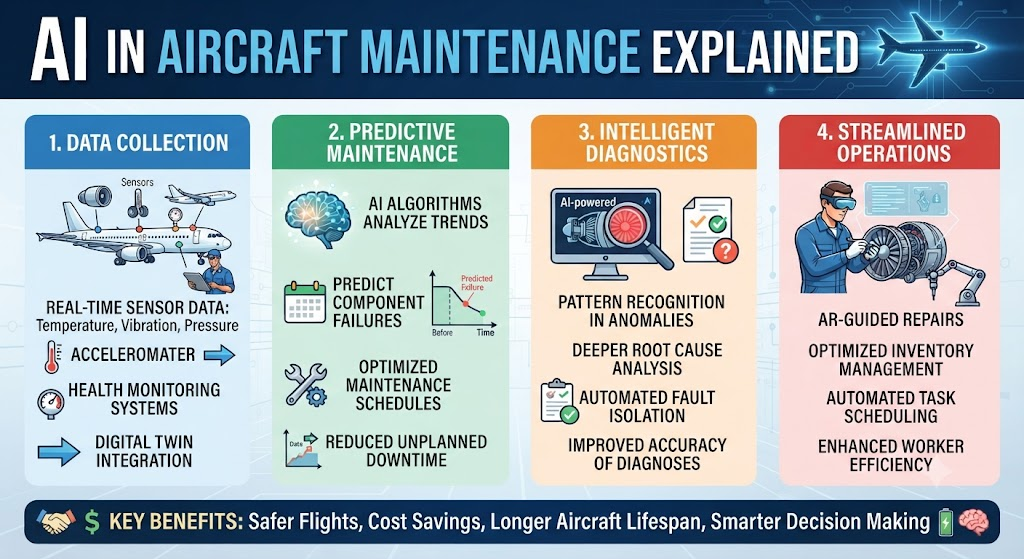
Introduction
Artificial Intelligence is becoming an increasingly important technology in modern aircraft maintenance, particularly as aircraft and maintenance organizations generate growing amounts of operational and technical data. AI can help maintenance teams identify patterns, detect unusual behavior, and support predictive maintenance activities.
For aviation students and maintenance professionals, understanding AI means learning how data-driven tools can complement established maintenance practices. The important point is that AI is generally a support technology, not a substitute for qualified human judgment, approved procedures, or regulatory requirements.
What Is AI in Aircraft Maintenance?
AI in aircraft maintenance refers to the use of computational systems that can analyze information, recognize patterns, identify anomalies, generate predictions, or assist people with maintenance-related decisions.
Machine Learning, or ML, is one important part of AI. Instead of programming every possible situation manually, machine-learning models can be trained using data and then used to recognize patterns in new data. The FAA describes machine learning as a computational approach in which models learn from data and generalize that knowledge into algorithms.
Aircraft maintenance can generate large quantities of information from sources such as:
- Aircraft sensors
- Engine monitoring systems
- Maintenance records
- Fault messages
- Component histories
- Inspection findings
- Flight and operational data
- Aircraft health-monitoring systems
AI can process this information much faster than a person manually examining every individual data point.
The goal is not simply to collect more information. The goal is to turn maintenance data into useful insights that can help qualified personnel understand aircraft condition and plan appropriate maintenance activities.
Why Is AI Becoming Important in Aircraft Maintenance?
Modern aircraft contain increasingly complex systems and produce large amounts of technical information. EASA notes that digitalization is increasing the amount of data handled by production and maintenance organizations, creating opportunities for AI-based analysis and predictive maintenance.
AI can be useful because it can examine large datasets and search for patterns that may be difficult to identify through manual analysis alone.
For example, a maintenance organization may want to know whether repeated changes in temperature, vibration, pressure, or other parameters could indicate developing problems.
Rather than waiting until a component produces a major fault, an AI-supported system may identify an unusual pattern earlier and bring it to the attention of the maintenance team.
This can support:
- Maintenance planning
- Fault investigation
- Aircraft health monitoring
- Component-condition assessment
- Troubleshooting
- Inspection support
- Maintenance scheduling
However, an AI prediction is not automatically a confirmed maintenance finding. It needs appropriate evaluation within the applicable maintenance and airworthiness framework.
How AI Works in Aircraft Maintenance
A simplified AI-supported maintenance workflow can be understood through seven stages.
1. Data Collection
The process begins with collecting relevant aircraft and maintenance data.
Depending on the application, this could include sensor readings, fault messages, component information, inspection results, and historical maintenance records.
2. Data Processing
Raw information normally needs to be organized, cleaned, and prepared before an AI model can use it effectively.
Poor-quality or incomplete data can reduce the reliability of an AI system.
3. Pattern Identification
The AI model analyzes available information and searches for relationships or patterns.
For example, it may identify that certain combinations of measurements have historically appeared before a particular type of maintenance event.
4. Anomaly Detection
The system can compare current information against expected patterns.
If something appears significantly different from normal behavior, it may generate an alert for further review.
5. Prediction or Recommendation
Depending on its design and authorization, the system may provide a prediction, risk indicator, or recommendation.
For example, it might indicate that a particular component deserves additional attention.
6. Human Review
A qualified maintenance professional reviews the information.
This is a critical step because AI output can contain uncertainty, false alerts, or incorrect interpretations.
7. Approved Maintenance Action
If maintenance is required, the responsible personnel follow the applicable approved technical information, maintenance procedures, inspections, and organizational requirements.
The AI system does not simply replace that process.
Major Applications of AI in Aircraft Maintenance
Predictive Maintenance
Predictive maintenance attempts to identify potential maintenance needs before an obvious failure occurs.
AI can analyze historical and current data to identify patterns associated with component degradation or abnormal system behavior.
EASA specifically identifies AI-based predictive maintenance as an area where large amounts of data can be used to help optimize maintenance schedules and estimate the remaining useful life of parts.
The practical objective is to give maintenance teams additional information that may help them plan work more effectively.
Fault Detection and Diagnosis
Aircraft systems can generate numerous fault messages and technical indications.
AI can help analyze these signals and identify relationships between different symptoms.
Instead of looking at each signal independently, an AI system may recognize that several seemingly unrelated indications form a particular pattern.
This can help maintenance personnel narrow down possible areas for investigation.
Anomaly Detection
Anomaly detection focuses on identifying behavior that differs from an expected normal condition.
For example, if a system normally operates within a particular range and begins producing an unusual combination of readings, an AI system may flag the change.
An anomaly does not necessarily mean that a component has failed. It means that the behavior deserves appropriate investigation.
Aircraft Health Monitoring
Aircraft health monitoring combines aircraft data, data transmission, and analysis to provide information about aircraft systems and condition.
The FAA’s AC 43-218 describes Integrated Aircraft Health Management as an end-to-end process involving onboard sensors, data transmission, and data analysis for aircraft system performance and structural condition.
AI can become part of this broader data-analysis environment by identifying patterns and supporting maintenance decisions.
AI-Assisted Visual Inspection
Computer vision is another potential application.
A camera-based system can analyze images of aircraft components or structures and look for visual abnormalities such as:
- Surface damage
- Corrosion
- Cracks
- Missing or damaged features
- Other visible irregularities
The important distinction is that AI-based image analysis can provide assistance, but the exact role of the system depends on its intended use, validation, authorization, and applicable procedures.
Maintenance Forecasting
AI can also support maintenance forecasting.
By analyzing historical maintenance events, operational patterns, and component information, an organization may be able to identify trends that help with maintenance planning.
This can potentially improve the timing of inspections, component planning, and maintenance resources.
Troubleshooting Support
Modern maintenance troubleshooting can involve large amounts of technical information.
AI-based systems can potentially help organize relevant information and identify useful troubleshooting paths.
For example, an AI system could analyze a fault indication and help prioritize potentially relevant technical information.
However, maintenance personnel still need to work with the applicable approved documentation and procedures.
Practical Example: AI Detecting a Possible Aircraft Component Problem
Consider a hypothetical aircraft component monitored through several sensors.
During normal operation, the system records parameters such as temperature, pressure, vibration, or other relevant measurements.
Over time, an AI model learns patterns associated with normal operation.
Later, the model notices that several measurements have changed in an unusual combination.
The system generates an alert indicating that the component’s behavior may deserve maintenance attention.
A maintenance professional then reviews the alert and the available technical information.
The technician does not simply replace the component because the AI generated an alert. Instead, the maintenance team performs the appropriate investigation using approved procedures and available evidence.
If the investigation confirms that maintenance is necessary, the required maintenance action is performed according to the applicable technical documentation and organizational procedures.
This example demonstrates the proper concept: AI can help identify information, while qualified professionals remain responsible for interpreting and acting on that information within the applicable maintenance framework.
Traditional Maintenance vs AI-Assisted Maintenance
| Aspect | Traditional Approach | AI-Assisted Approach |
|---|---|---|
| Data analysis | Manual or limited analysis | Large-scale data analysis |
| Fault identification | Primarily technician-driven | AI can identify patterns for review |
| Maintenance planning | Schedules, inspections, and findings | Can incorporate predictive indicators |
| Decision-making | Human-controlled | Human-controlled with AI support |
| Main benefit | Established maintenance processes | Additional data-driven insight |
Benefits of AI in Aircraft Maintenance
Earlier Identification of Abnormal Conditions
AI can continuously examine large datasets and potentially identify unusual patterns earlier than manual analysis.
Better Use of Maintenance Data
Historical maintenance information can contain valuable patterns. AI can help analyze this information at a scale that would be difficult to achieve manually.
Improved Maintenance Planning
Predictive indicators may provide additional information for planning inspections and maintenance activities.
Faster Access to Relevant Information
AI-supported systems can help organize large quantities of technical information and potentially make troubleshooting more efficient.
Support for Aircraft Health Monitoring
AI can complement aircraft health-monitoring systems by identifying patterns across multiple data sources.
Improved Maintenance Efficiency
When appropriately designed and validated, AI can reduce some repetitive data-analysis tasks and allow maintenance personnel to focus more attention on technical assessment and physical maintenance work.
EASA identifies predictive maintenance and AI-based data analysis as potential ways to improve efficiency while maintaining a human-centered approach to aviation safety.
Limitations and Challenges of AI in Aircraft Maintenance
AI also introduces significant challenges.
Poor-Quality Data
AI systems depend heavily on the data used to train and operate them. Incorrect, incomplete, inconsistent, or biased data can affect results.
False Alerts
An AI system can identify something unusual even when no actual component failure exists.
This can result in unnecessary investigation if alerts are not properly managed.
Missed Anomalies
AI systems are not guaranteed to identify every problem.
A model may fail to recognize a condition that differs from the patterns it was trained to detect.
Model Limitations
An AI model may perform well in one environment but less effectively when operating conditions, aircraft configurations, data sources, or component behavior change.
Explainability
Maintenance professionals may need to understand why a system generated a particular recommendation.
EASA’s AI work specifically addresses concepts such as AI explainability, learning assurance, human factors, and trustworthy AI.
Cybersecurity
Connected aircraft and maintenance systems create cybersecurity considerations. AI systems themselves also need protection against inappropriate access, manipulation, or compromised data.
Integration With Existing Systems
AI tools may need to interact with established aircraft health-monitoring, maintenance, engineering, and documentation systems.
Poor integration can create additional complexity rather than solving existing problems.
Regulatory and Certification Considerations
Aviation safety cannot rely on technology simply because it performs well in testing.
AI-based aviation systems require appropriate assurance and regulatory consideration according to their intended function and level of safety significance.
The FAA is actively working on AI and machine-learning safety assurance, while EASA has developed an AI roadmap and specific guidance and regulatory work addressing trustworthy AI in aviation.
AI Applications, Benefits, and Limitations
| AI Application | Possible Benefit | Important Limitation |
|---|---|---|
| Predictive maintenance | Earlier maintenance planning | Predictions depend on data quality |
| Fault detection | Faster identification of unusual behavior | May produce false alerts |
| Visual inspection | Helps identify visible abnormalities | Requires appropriate human verification |
| Aircraft health monitoring | Continuous analysis of aircraft data | Complex systems require careful interpretation |
| Troubleshooting support | Helps organize relevant information | Does not replace approved procedures |
AI vs Human Aircraft Maintenance Professionals
One of the most important ideas to understand is that AI and maintenance professionals have different strengths.
AI is good at processing large datasets, identifying statistical patterns, comparing information, and performing repetitive analytical tasks.
Maintenance professionals bring practical technical knowledge, physical inspection skills, experience, judgment, and an understanding of the aircraft and maintenance environment.
A technician can physically inspect a component, interpret a maintenance situation in context, recognize unusual circumstances, and determine what additional evidence may be needed.
EASA’s current AI framework emphasizes a human-centric approach, including human assistance and human-AI cooperation.
Therefore, the future of AI in aircraft maintenance is better understood as human expertise supported by intelligent technology, rather than simply replacing people with machines.
Important Considerations Before Using AI in Aircraft Maintenance
Organizations considering AI-based maintenance applications need to evaluate several factors.
Data Accuracy
The organization should understand where the data comes from and whether it is complete and reliable.
Human Oversight
Personnel need to understand what the AI system is doing and what its output means.
System Validation
AI systems used for safety-related purposes require appropriate evaluation and assurance.
Cybersecurity
Data and AI systems need protection against unauthorized access and manipulation.
Explainability
Users should have sufficient information to understand and appropriately interpret AI outputs.
Regulatory Compliance
AI implementation must fit within the applicable aviation regulatory and airworthiness framework.
Traceability
Maintenance-related decisions should remain appropriately documented and traceable.
Technician Training
Maintenance professionals increasingly need some understanding of data, AI limitations, and human-AI interaction.
EASA’s work on AI trustworthiness specifically considers areas including assurance, human factors, ethics, and AI-based assistance.
Skills Aviation Maintenance Students Should Develop for an AI-Enabled Future
Students preparing for aircraft maintenance careers can benefit from developing both traditional aviation knowledge and digital skills.
Important areas include:
- Aircraft systems fundamentals
- Aircraft maintenance practices
- Technical documentation
- Troubleshooting
- Data interpretation
- Basic AI and machine-learning concepts
- Sensor-data understanding
- Critical thinking
- Cybersecurity awareness
- Human-machine interaction
- Safety management
- Technical communication
Students do not necessarily need to become AI programmers.
However, understanding what AI can do, what it cannot do, and how to critically evaluate its output can become an increasingly useful professional skill.
Common Mistakes When Understanding AI in Aircraft Maintenance
1. Assuming AI Can Replace Technicians
AI can support analysis, but aircraft maintenance involves physical inspection, technical judgment, procedures, and safety responsibilities.
2. Treating Every AI Alert as a Confirmed Fault
An alert indicates that further evaluation may be appropriate. It does not automatically prove that a component has failed.
3. Ignoring Data Quality
AI results are strongly influenced by the quality and relevance of the underlying data.
4. Assuming AI Predictions Are Always Accurate
AI models can make mistakes, particularly when encountering conditions that differ from their training or operating environment.
5. Ignoring Approved Procedures
AI output should not be treated as a replacement for applicable approved maintenance information.
6. Failing to Verify Recommendations
Human review remains important, especially when AI output could influence safety-related decisions.
7. Overlooking Cybersecurity
Connected AI and maintenance systems introduce cybersecurity considerations that should be addressed during system design and operation.
8. Thinking AI Removes Human Responsibility
The introduction of AI does not eliminate the need for appropriate human oversight, accountability, and technical competence.
Frequently Asked Questions
1. What is AI in aircraft maintenance?
AI in aircraft maintenance refers to using artificial intelligence and machine-learning technologies to analyze aircraft and maintenance data, identify patterns, detect anomalies, support predictions, and assist maintenance professionals.
2. How does AI support predictive aircraft maintenance?
AI can analyze historical and current aircraft data to identify patterns associated with abnormal conditions or potential component degradation. This information can support maintenance planning and investigation.
3. Can AI detect aircraft faults?
AI can help detect unusual patterns that may indicate a potential fault. However, an AI alert does not automatically confirm a fault. Appropriate technical investigation is still required.
4. What is predictive maintenance in aviation?
Predictive maintenance uses available data and analytical techniques to estimate when a component or system may require attention, allowing maintenance organizations to plan work based on condition-related information rather than relying only on fixed schedules.
5. How is machine learning used in aircraft maintenance?
Machine learning can be trained on aircraft and maintenance datasets to recognize patterns, classify conditions, detect anomalies, and generate predictions or recommendations.
6. Can AI replace aircraft maintenance engineers or technicians?
AI is not a complete replacement for qualified maintenance professionals. Physical inspection, technical judgment, approved procedures, safety responsibilities, and regulatory requirements remain essential.
7. What are the main limitations of AI in aircraft maintenance?
Important limitations include data quality, false alerts, missed anomalies, model limitations, cybersecurity risks, explainability challenges, system integration issues, and regulatory considerations.
8. How can aviation students prepare for AI-based maintenance?
Students should develop strong aircraft maintenance fundamentals while also learning basic data analysis, AI concepts, troubleshooting, cybersecurity awareness, and critical thinking.
9. Is AI-assisted aircraft maintenance safe?
AI can potentially support aviation safety, but safety depends on how the system is designed, validated, integrated, monitored, and used. AI should not be assumed to be safe simply because it produces accurate results in a test environment. Aviation authorities are developing frameworks and guidance for trustworthy AI use.
10. What skills are useful for working with AI in aviation maintenance?
Useful skills include aircraft systems knowledge, troubleshooting, data literacy, technical documentation, critical thinking, basic AI understanding, cybersecurity awareness, and the ability to evaluate AI-generated information.
Conclusion
AI is changing the way aviation organizations can analyze aircraft and maintenance information. Predictive maintenance, anomaly detection, aircraft health monitoring, visual inspection support, and AI-assisted troubleshooting are examples of areas where intelligent technologies can provide additional value.
At the same time, aviation is a safety-critical environment. AI cannot simply be introduced as an independent decision-maker without considering data quality, validation, human factors, cybersecurity, regulatory requirements, and operational context.
For aviation students, the most useful approach is to understand both sides of the technology: what AI can do and where its limitations begin. The future of aircraft maintenance is likely to involve closer cooperation between skilled aviation professionals and increasingly capab