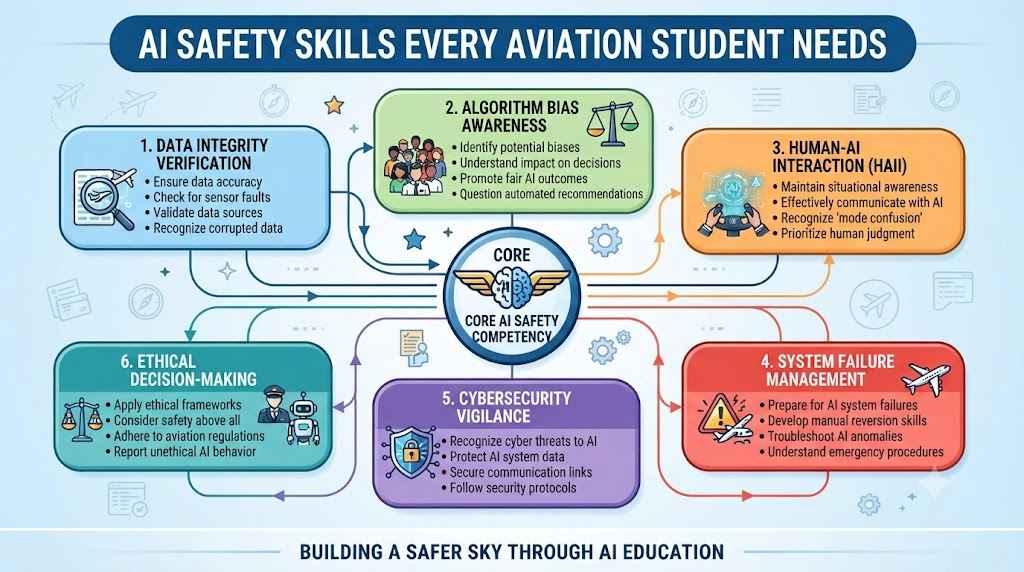
Introduction
Artificial intelligence is becoming an increasingly important part of modern aviation, supporting areas such as flight planning, navigation, training, maintenance, weather analysis, and operational decision-making.
For aviation students, learning how to use AI responsibly is becoming an important part of developing strong safety awareness.
However, AI tools are not a replacement for pilots, instructors, air traffic controllers, or established aviation procedures.
Understanding both the benefits and limitations of AI can help future aviation professionals make safer and more informed decisions.
Understanding the Role of AI in Aviation
Artificial intelligence can process large amounts of information and assist aviation professionals with tasks that require data analysis, prediction, monitoring, and pattern recognition. AI-supported technologies may be used in areas such as aircraft maintenance, flight operations, training simulations, weather forecasting, and safety management.
For aviation students, the goal is not necessarily to become AI experts. Instead, students should understand how AI systems work at a basic level, what information they provide, and when their recommendations should be questioned or verified.
A safe aviation professional should always understand the difference between assistance and authority. An AI system may provide information or recommendations, but aviation decisions must continue to follow approved procedures, regulations, training, and professional judgment.
Why AI Safety Skills Matter for Aviation Students
Flight training already requires students to develop situational awareness, communication, decision-making, and risk-management skills. AI adds another layer to these responsibilities.
Students who understand AI safety can better recognize when technology is useful and when it may create additional risks. They can also avoid becoming overly dependent on automated systems.
AI safety awareness can help students:
- Recognize the limitations of automated systems.
- Verify information before relying on it.
- Maintain human control over important decisions.
- Identify unusual or incorrect AI outputs.
- Protect sensitive aviation information.
- Respond appropriately when technology becomes unavailable.
- Develop better automation awareness.
- Combine technological assistance with sound aviation judgment.
1. Understand AI-Assisted Aviation Systems
The first important skill is understanding what an AI-assisted system actually does.
Aviation students may encounter intelligent software through flight simulators, electronic flight tools, aircraft systems, maintenance applications, or other digital platforms. Students should understand the basic purpose of these systems and the type of information they process.
Instead of assuming that an AI system is always correct, students should ask:
- What information is the system using?
- What is the system designed to do?
- What are its limitations?
- How reliable is the information?
- Does the information need independent verification?
This mindset encourages responsible use of technology.
2. Develop Strong Human Oversight
One of the most important AI safety skills is maintaining human oversight.
AI can analyze information quickly, but aviation professionals remain responsible for understanding the situation and making appropriate decisions within their authority and procedures.
For example, if an AI-supported tool provides a recommendation that appears inconsistent with weather conditions, aircraft limitations, operational requirements, or instructor guidance, a student should not blindly follow the recommendation.
Human judgment must remain an essential part of the decision-making process.
3. Recognize AI Errors and Limitations
AI systems can produce inaccurate, incomplete, outdated, or misleading information. This is especially important when AI tools generate text, predictions, explanations, or recommendations.
Aviation students should learn to recognize warning signs such as:
- Information that conflicts with official sources.
- Unclear or unsupported recommendations.
- Unexpected system behavior.
- Incorrect calculations or interpretations.
- Missing operational details.
- Excessive confidence in an uncertain answer.
Students should develop the habit of verify first, trust second.
4. Build Automation Awareness
Automation can reduce workload, but excessive dependence on automation can create safety concerns.
Aviation students should understand what an automated system is doing rather than simply monitoring it without comprehension. They should know how to recognize changes in system behavior and understand when manual intervention may be necessary.
Automation awareness involves knowing:
- What the system is currently doing.
- Why it is performing that action.
- What information it is using.
- What could happen if the system becomes unavailable.
- What procedures apply if manual control or alternative methods are required.
This skill is valuable because technology can fail, become unavailable, or behave differently from what the user expects.
5. Maintain Situational Awareness
AI should never cause an aviation student to lose awareness of the overall operational situation.
Students should continue monitoring important factors such as weather, aircraft status, traffic, navigation, communication, fuel considerations, and other relevant conditions.
An AI tool may provide useful assistance, but it does not replace the student’s responsibility to remain aware of what is happening around the aircraft.
Strong situational awareness means understanding the whole situation, not just the information displayed by one digital tool.
6. Learn to Verify AI-Generated Information
Generative AI can produce useful explanations and educational material, but students should understand that AI-generated information can contain errors.
For example, an AI tool may explain an aviation concept incorrectly or provide information that does not match current regulations or approved procedures.
Aviation students should verify important information through appropriate authoritative sources, such as:
- Approved training materials.
- Instructor guidance.
- Aircraft documentation.
- Official aviation regulations.
- Approved operational procedures.
- Current aviation publications and notices.
AI can be a learning assistant, but it should not become the sole source of aviation-critical information.
7. Develop Cybersecurity and Data Privacy Awareness
Modern aviation depends heavily on digital systems, making cybersecurity awareness increasingly important.
Students should understand that aviation-related information may include sensitive operational, personal, technical, or organizational data. Such information should not be entered into an AI tool without understanding how the platform handles submitted data.
Students should practice basic cybersecurity habits, including:
- Using strong and secure passwords.
- Protecting account credentials.
- Avoiding unnecessary sharing of sensitive information.
- Being cautious with unfamiliar AI tools.
- Recognizing suspicious messages and links.
- Following their organization’s technology policies.
- Keeping software and devices appropriately updated.
Cybersecurity is not only an IT responsibility. Every aviation professional can contribute to a safer digital environment.
8. Know When Not to Use AI
Knowing when not to rely on AI is just as important as knowing how to use it.
An aviation student should avoid treating an AI tool as an authority for decisions that require approved procedures, professional supervision, or current official information.
| Situation | Appropriate Approach |
|---|---|
| Learning an aviation concept | Use AI as a supplementary educational tool and verify important information |
| Understanding a technical topic | Ask for an explanation, then compare it with approved training material |
| Flight planning | Follow approved procedures, current information, and instructor guidance |
| Safety-critical decision | Rely on applicable aviation procedures, trained judgment, and authorized sources |
| AI provides unexpected information | Stop, assess, and independently verify the information |
| AI system becomes unavailable | Follow established procedures and use appropriate alternatives |
The safest approach is to understand AI as an additional resource, not as a substitute for aviation training.
9. Practice Emergency Decision-Making Without Technology
Aviation students should be capable of responding appropriately even when digital tools are unavailable.
Technology can experience technical problems, connectivity issues, incorrect outputs, or unexpected failures. Students therefore need strong fundamental aviation knowledge that does not depend entirely on AI.
During training, students should continue developing:
- Manual problem-solving skills.
- Emergency procedures.
- Communication skills.
- Navigation fundamentals.
- Situational awareness.
- Risk assessment.
- Decision-making under pressure.
AI should enhance these abilities rather than replace them.
10. Develop Responsible AI Habits
Responsible AI use begins with a professional attitude.
Students should ask whether using AI is appropriate for a particular task and whether the information produced can be trusted. They should also understand any rules or restrictions established by their flight school, instructor, training organization, or aviation authority.
A responsible aviation student should:
- Use AI honestly and transparently when required.
- Verify important information.
- Protect sensitive information.
- Avoid overdependence on automation.
- Follow approved aviation procedures.
- Seek instructor clarification when uncertain.
- Continue developing independent professional judgment.
How Aviation Students Can Build AI Safety Skills During Training
AI safety skills can be developed gradually alongside traditional flight training.
Students can begin by learning the basic principles behind AI-assisted systems and then practice evaluating AI-generated information in low-risk educational situations.
Instructors can also encourage students to discuss questions such as:
- What happens if an automated system gives incorrect information?
- How should conflicting information be handled?
- When should a student stop using an AI tool?
- How can technology affect situational awareness?
- What information should never be shared with an AI platform?
- How can pilots maintain their skills when automation is available?
These discussions can help students develop a balanced relationship with technology.
| AI Safety Skill | How Students Can Practice It |
| AI awareness | Learn the purpose and limitations of AI-assisted systems |
| Information verification | Compare AI responses with approved aviation sources |
| Automation awareness | Understand system behavior instead of passively relying on automation |
| Situational awareness | Continue monitoring the complete operational environment |
| Cybersecurity | Practice responsible handling of digital information |
| Decision-making | Develop independent judgment through flight training scenarios |
| Emergency preparedness | Practice procedures that do not depend entirely on technology |
| Continuous learning | Keep up with changes in aviation technology and procedures |
Common Mistakes Aviation Students Should Avoid
AI can be useful, but students can create unnecessary risks if they use it incorrectly.
Blindly Trusting AI
An AI-generated answer can sound confident even when it is incorrect. Students should always verify important aviation information.
Depending Too Much on Automation
Automation should not replace fundamental aviation skills. Students need to maintain their ability to understand and manage situations independently.
Ignoring Official Procedures
AI-generated recommendations should never override applicable aviation regulations, aircraft documentation, approved procedures, or instructor guidance.
Sharing Sensitive Information
Students should avoid entering confidential or sensitive aviation information into AI platforms without authorization.
Forgetting Human Judgment
Technology can support decision-making, but aviation professionals must continue to evaluate circumstances using training, procedures, and professional judgment.
Benefits and Limitations of AI Safety Skills
Benefits
Developing AI safety skills can help aviation students:
- Use emerging technology more responsibly.
- Recognize potential technology-related risks.
- Improve information-verification habits.
- Understand automation more effectively.
- Strengthen digital awareness.
- Prepare for increasingly technology-driven aviation environments.
Limitations
AI safety knowledge does not eliminate all aviation risks. AI systems can still produce inaccurate information, depend on incomplete data, or behave unexpectedly.
Students also need comprehensive flight training, practical experience, technical knowledge, communication skills, and emergency preparedness. AI should therefore be considered one part of a broader aviation education.
Important Considerations for Safe AI Use
Before relying on an AI-supported aviation tool, students should consider several important questions:
- Is the tool approved or appropriate for the intended purpose?
- Is the information current?
- Can the information be independently verified?
- Could an incorrect answer affect safety?
- Does the tool have known limitations?
- Is sensitive information being shared?
- What should be done if the technology becomes unavailable?
- Are established aviation procedures being followed?
When there is uncertainty, students should consult their instructor or another appropriately qualified aviation professional rather than relying solely on an AI system.
Frequently Asked Questions
1. Why do aviation students need AI safety skills?
AI is becoming increasingly relevant to aviation operations and training. Understanding its capabilities and limitations helps students use technology responsibly while maintaining proper aviation judgment.
2. Can AI replace a pilot’s decision-making?
No. AI may provide assistance, but pilots and other qualified aviation professionals must continue to apply appropriate procedures, training, judgment, and situational awareness.
3. What is the most important AI safety skill for an aviation student?
One of the most important skills is knowing how to verify AI-generated information rather than automatically accepting it as correct.
4. Can aviation students use AI for studying?
AI can be useful as a supplementary learning tool for explanations, practice questions, and general educational support. Important information should still be checked against approved and authoritative aviation resources.
5. What should a student do if AI provides information that conflicts with an instructor?
The student should not blindly follow the AI output. Instructor guidance and applicable approved procedures should be followed, and the discrepancy can be discussed with the instructor.
6. Why is automation awareness important in aviation?
Automation awareness helps students understand what automated systems are doing and recognize when system behavior may require additional attention or appropriate human intervention.
7. Is cybersecurity part of AI safety?
Yes. Responsible AI use includes protecting sensitive information, securing accounts, recognizing digital threats, and following applicable organizational cybersecurity policies.
8. What happens if an AI system fails during an aviation operation?
Aviation professionals should follow established procedures and use appropriate alternative methods. Students should therefore continue developing fundamental skills that do not depend entirely on AI or automation.
9. Should students trust AI-generated aviation information?
AI-generated information should be treated carefully. General educational information may be useful, but safety-critical or regulatory information should be verified through appropriate authoritative sources.
10. How can students prepare for the future of AI in aviation?
Students can develop strong aviation fundamentals while learning about automation, AI limitations, cybersecurity, data awareness, information verification, and responsible technology use.
Conclusion
AI is likely to remain an important part of the aviation industry’s technological development, making AI safety awareness increasingly valuable for future aviation professionals. Aviation students do not need to become AI specialists, but they should understand how AI-assisted systems work, where their limitations exist, and how to use them responsibly.
The strongest aviation professionals will be those who can combine modern technology with sound training, situational awareness, critical thinking, and human judgment. By developing AI safety skills alongside traditional aviation knowledge, students can become better prepared to work safely and confidently in an increasingly technology-driven aviation environment.