Introduction
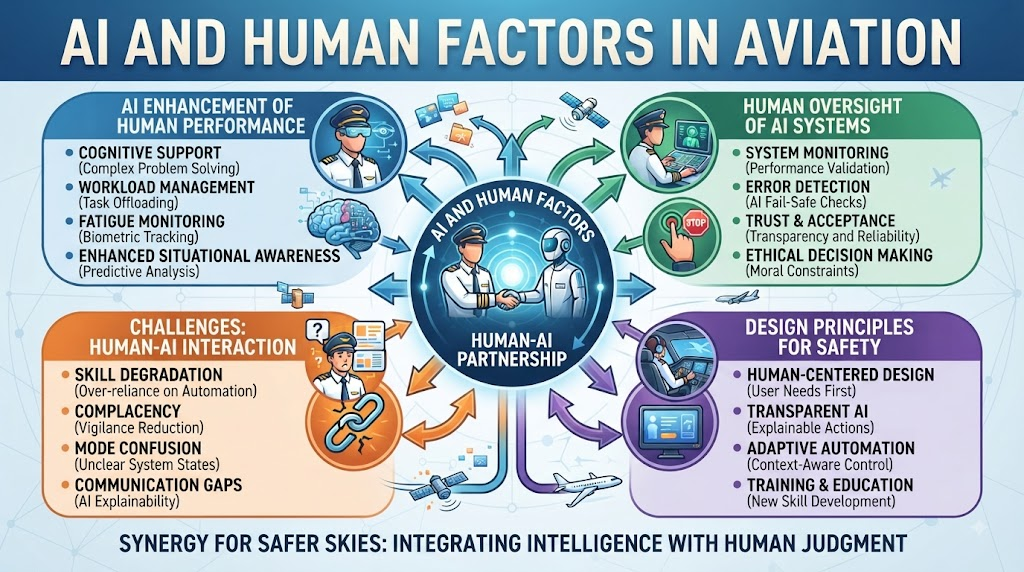
Aviation has always depended on the interaction between people, aircraft, technology, and operating procedures. Pilots, air traffic controllers, maintenance professionals, engineers, and other aviation workers must make decisions while managing large amounts of information and responding to changing conditions.
Artificial intelligence is becoming increasingly relevant to this environment. AI-based systems can process large amounts of data, identify patterns, support predictions, and assist aviation professionals with different operational tasks.
However, introducing advanced technology does not remove the importance of human factors. In many situations, it makes human factors even more important. Aviation professionals need to understand what an AI system can do, where it may have limitations, and how to respond when its recommendations do not match the actual situation.
The future of aviation is therefore not simply about making systems more automated. It is about creating effective cooperation between technology and the people responsible for safe operations.
What Are Human Factors in Aviation?
Human factors refer to the way people interact with aircraft, technology, procedures, organizations, and their working environment.
In aviation, human performance can be influenced by many factors, including:
- Fatigue
- Workload
- Stress
- Communication
- Training
- Situational awareness
- Decision-making
- Experience
- Teamwork
- Environmental conditions
Human factors are much broader than pilot error. They consider how the entire aviation system affects the way people perform their responsibilities.
For example, a poorly designed interface may make it difficult for a pilot to understand important information. An excessive number of alerts may distract a controller. A complicated maintenance system may increase the possibility of misunderstanding.
This is why human factors need to be considered whenever new aviation technology is introduced.
What Is AI in Aviation?
Artificial intelligence refers to computer-based systems that can perform tasks involving activities such as pattern recognition, prediction, data analysis, and decision support.
In aviation, AI can potentially process large amounts of information faster than a person could manually analyze it.
Examples of aviation applications include:
- Predictive maintenance
- Flight data analysis
- Weather analysis
- Air traffic management
- Safety monitoring
- Pilot training
- Operational decision support
- Risk assessment
AI can be particularly useful when aviation professionals need to examine large datasets or identify patterns that may be difficult to detect manually.
However, AI should not be viewed as an infallible source of information. Its output depends on the quality of the data, the design of the system, and the circumstances in which it is being used.
Why Human Factors Matter When Using AI
AI systems operate within human-centered environments.
A pilot may receive a recommendation from an automated system. A maintenance engineer may receive a warning about a possible component problem. An air traffic controller may receive information intended to support traffic management.
In each situation, a person still needs to understand the information and determine how it should be used.
Important human-factor considerations include:
- Trust
- Workload
- Situational awareness
- Training
- Communication
- Monitoring
- Decision-making
- Understanding system limitations
A system can produce technically impressive results but still create operational difficulties if people do not understand how to interpret its output.
AI as a Decision-Support Tool
One of the most useful roles of AI in aviation can be decision support.
Instead of making every operational decision independently, an AI system can help aviation professionals by processing information and presenting relevant findings.
For example, an AI-based system may help identify:
- Unusual flight patterns
- Potential maintenance concerns
- Changes in weather conditions
- Operational risks
- Trends in aircraft data
The human operator can then consider this information alongside other available sources.
This approach allows AI to contribute processing power while the human retains responsibility for understanding the wider operational situation.
Human-AI Interaction in the Cockpit
Modern aircraft already contain highly automated systems that help pilots manage different aspects of flight operations.
As technology becomes more advanced, AI-based decision-support tools may become more capable of analyzing information and providing recommendations.
Cockpit interaction may involve:
- Automated systems
- Alerts
- Recommendations
- Data presentation
- System monitoring
- Pilot inputs
- Decision-support functions
The design of these systems is important.
If information is presented clearly, it can support the pilot. If the cockpit contains too many alerts or complicated recommendations, it may increase workload instead of reducing it.
The objective should be to help pilots understand the situation rather than overwhelm them with additional information.
Automation and Human Factors
Automation can provide important benefits in aviation.
It can help:
- Reduce repetitive workload
- Process information
- Maintain consistent system performance
- Support complex calculations
- Monitor certain parameters
- Assist with routine tasks
At the same time, automation can create human-factor challenges.
These may include:
- Automation dependency
- Reduced manual involvement
- Complacency
- Loss of situational awareness
- Difficulty taking over from automated systems
- Over-reliance on recommendations
A pilot who becomes too dependent on automation may become less actively engaged with the aircraft’s operation.
For this reason, pilots need to understand both what automated systems can do and what they cannot do.
The Risk of Automation Bias
Automation bias occurs when people place too much confidence in information provided by an automated system.
For example, if an AI system recommends a particular action, a user may assume that the recommendation must be correct simply because it was produced by advanced technology.
This can be dangerous if the system is working with incomplete information or encounters an unusual situation.
Aviation professionals should therefore be trained to:
- Understand system limitations
- Verify important information
- Maintain independent judgment
- Monitor the actual operating environment
- Question unexpected recommendations
Trust in technology should be based on appropriate understanding rather than blind confidence.
Situational Awareness and AI
Situational awareness is the ability to understand what is happening, recognize what may happen next, and use that understanding to make appropriate decisions.
AI can potentially support situational awareness by analyzing information from different sources.
For example, a system might identify a pattern in aircraft data or highlight an operational issue that deserves attention.
However, there is also a potential risk.
If users become too dependent on automated systems, they may stop actively monitoring their surroundings and systems.
Effective aviation operations therefore require a balance between using automated assistance and maintaining human awareness.
AI, Workload, and Cognitive Performance
AI can influence workload in both positive and negative ways.
A well-designed system may reduce workload by handling repetitive data-processing tasks.
However, a poorly designed system may create additional workload through:
- Excessive alerts
- Confusing recommendations
- Too much information
- Complex interfaces
- Unexpected system behavior
- Repeated notifications
Reducing workload should not be the only objective.
The real goal should be maintaining an appropriate level of workload that allows aviation professionals to remain engaged, aware, and capable of making good decisions.
Fatigue and AI-Assisted Aviation
Fatigue can affect human performance in several ways.
A tired aviation professional may experience difficulties with:
- Attention
- Reaction time
- Memory
- Decision-making
- Situational awareness
AI systems may potentially help organizations identify patterns in operational data that could be associated with fatigue-related risks.
For example, data analysis might help organizations identify scheduling patterns or operational conditions that deserve attention.
However, technology should not be treated as a perfect method for determining whether an individual is fit for duty.
Fatigue management still requires appropriate organizational procedures, rest practices, professional judgment, and human oversight.
AI and Pilot Decision-Making
Pilots make decisions using information from many different sources.
These can include:
- Aircraft instruments
- Aircraft systems
- Weather information
- Air traffic information
- Operational procedures
- Training
- Experience
- Visual observations
AI may provide another source of information.
For example, an AI system could analyze multiple data points and provide a recommendation or highlight a potential concern.
The pilot still needs to evaluate that information in context.
A recommendation may be useful, but the pilot must understand whether it makes sense in the actual situation and whether it is consistent with applicable procedures.
AI and Air Traffic Controllers
Air traffic management involves processing significant amounts of information.
AI can potentially support controllers by helping with tasks such as:
- Traffic prediction
- Conflict detection
- Data analysis
- Route optimization
- Workload support
These capabilities could help controllers manage information more efficiently.
However, air traffic controllers remain responsible for understanding the operational environment and applying appropriate procedures.
AI-based assistance should therefore be designed to support human decision-making rather than create unnecessary complexity.
AI and Predictive Maintenance
Aircraft generate large amounts of operational and maintenance data.
AI can analyze this information to identify patterns that may indicate changing equipment conditions.
Potential applications include identifying patterns associated with:
- Component degradation
- Abnormal system behavior
- Maintenance requirements
- Potential equipment problems
This can support predictive maintenance by helping maintenance teams identify areas that may require closer attention.
However, an AI-generated prediction does not automatically replace inspection or professional maintenance judgment.
Qualified maintenance personnel still need to interpret findings and follow the appropriate maintenance procedures.
AI in Aviation Training
AI can also influence how aviation professionals learn.
AI-supported training systems may provide:
- Personalized learning
- Performance analysis
- Adaptive exercises
- Simulation scenarios
- Training feedback
- Learning recommendations
For example, a training system could identify areas where a student repeatedly struggles and provide additional practice.
This can make training more targeted.
However, instructors continue to play an important role. Human instructors can provide context, explain complex situations, observe behavior, and offer practical guidance that may not be captured by an automated system.
Human Factors in AI-Based Training Systems
AI-based training systems also need to consider human factors.
A training system should not simply provide more information. It should provide information in a way that helps students learn.
Important considerations include:
- Clear feedback
- Appropriate difficulty
- Avoiding information overload
- Understanding learner needs
- Instructor involvement
- Meaningful explanations
If an AI system tells a student that an answer is wrong without explaining why, the student may not understand the underlying concept.
Good training systems should therefore support understanding rather than simply measure performance.
Trust in AI Aviation Systems
Trust is one of the most important issues in human-AI interaction.
If aviation professionals do not trust a system at all, they may ignore useful information.
On the other hand, excessive trust can lead to over-reliance.
The goal is appropriate trust based on:
- System performance
- Training
- Experience
- Clear limitations
- Transparency
- Consistent behavior
Users should understand when an AI system is reliable and when additional verification may be necessary.
Explainability and Transparency
Aviation professionals may sometimes need to understand why an AI system has produced a recommendation.
An unexplained recommendation can be difficult to evaluate, especially in safety-critical situations.
Useful AI systems should therefore aim for understandable outputs.
Depending on the application, this may involve:
- Clear alerts
- Understandable recommendations
- Relevant supporting information
- Confidence information where appropriate
- Traceable data
- Human-readable explanations
The level of explanation required can vary depending on how the system is used.
AI Errors and Human Responsibility
AI systems can make mistakes.
These mistakes can occur for different reasons, including:
- Poor-quality data
- Incomplete information
- Unexpected conditions
- Incorrect assumptions
- System limitations
- Changes in operating environments
An AI system trained or tested under one set of conditions may not always perform in the same way when circumstances change.
Aviation professionals therefore need to understand that AI recommendations are inputs into a decision-making process, not unquestionable instructions.
Training should include how to recognize unusual system behavior and what to do when an automated recommendation does not appear consistent with the actual situation.
Cybersecurity and Human Factors
As aviation systems become increasingly connected, cybersecurity becomes another important human-factor consideration.
Technology can provide strong security features, but human behavior remains part of the security environment.
Important areas include:
- Access management
- Secure authentication
- Phishing awareness
- System permissions
- Reporting suspicious activity
- Following security procedures
An employee who accidentally provides unauthorized access can create a security problem even when the underlying technology is sophisticated.
This shows why cybersecurity and human factors need to be considered together.
Ethical Considerations
The increasing use of AI also raises important questions about responsibility and accountability.
Some areas that require careful consideration include:
- Human oversight
- Accountability
- Transparency
- Data privacy
- Bias
- Responsibility for decisions
- Appropriate use of automation
If an AI system contributes to an operational recommendation, aviation organizations need clear processes for determining who is responsible for evaluating and acting on that information.
Technology should support a clear safety structure rather than make responsibility unclear.
Training Aviation Professionals for AI
As AI becomes more common in aviation, professionals may need additional knowledge about the systems they use.
Pilots, controllers, engineers, maintenance personnel, and other aviation workers may benefit from understanding:
- AI capabilities
- AI limitations
- Automation management
- System monitoring
- Interpreting recommendations
- Recognizing unusual system behavior
- Maintaining human judgment
This does not mean every aviation professional needs to become a computer scientist.
They do, however, need enough understanding to use AI-enabled systems responsibly.
Benefits of Combining AI With Human Expertise
The combination of AI and human expertise can provide several potential advantages.
Faster Data Analysis
AI can process large datasets quickly and identify patterns that may require significant human effort to find manually.
Improved Monitoring
Automated systems can continuously monitor selected information and highlight unusual conditions.
Predictive Support
AI can help identify patterns that may indicate future operational or maintenance concerns.
Reduced Repetitive Work
Automating certain repetitive tasks can allow professionals to focus more attention on activities requiring judgment.
Additional Decision Support
AI can provide another source of information that professionals can consider alongside other available data.
Improved Training
AI-based tools can help personalize practice and identify areas where additional learning may be useful.
These benefits depend on good system design, reliable data, appropriate training, and effective human oversight.
Challenges of AI and Human Factors in Aviation
Despite its potential, AI introduces several challenges.
Automation Dependency
Users may become overly dependent on automated systems.
Automation Bias
People may accept automated recommendations without sufficient verification.
Poor Transparency
Users may struggle to understand why a system produced a particular result.
Excessive Alerts
Too many notifications can increase workload and make important information harder to identify.
Training Gaps
Professionals may not understand the limitations of new AI-based systems without appropriate training.
Data Quality
AI performance depends heavily on the information available to the system.
Cybersecurity
Connected systems can create additional security considerations.
Unclear Responsibility
Organizations need clear procedures for determining how human professionals interact with AI recommendations and who remains responsible for operational decisions.
Best Practices for Human-Centered AI in Aviation
Keep Humans in the Loop
AI should be integrated in ways that maintain appropriate human oversight for important operational decisions.
Design Clear Interfaces
Information should be presented clearly so users can understand important information without unnecessary cognitive effort.
Train Users Properly
Aviation professionals should understand both the capabilities and limitations of the systems they use.
Avoid Excessive Automation
Automation should be introduced where it genuinely supports safety, efficiency, and human performance.
Monitor System Performance
AI systems should be evaluated continuously rather than assumed to remain reliable in every possible situation.
Encourage Independent Judgment
Professionals should be able to question, verify, or reject recommendations when the operational situation requires it.
Future of AI and Human Factors in Aviation
The relationship between AI and human factors is likely to become increasingly important as aviation technology develops.
Future applications may include:
- More advanced decision-support systems
- AI-assisted air traffic management
- Greater cockpit automation
- Predictive maintenance
- Advanced training systems
- Automated safety monitoring
- More sophisticated human-machine interfaces
Long-term aviation development will likely focus not simply on increasing automation but on improving how humans and automated systems work together.
Future pilots and other aviation professionals may therefore need a combination of traditional aviation skills and a better understanding of automated decision-support systems.
The goal should be technology that strengthens human performance rather than technology that encourages people to stop thinking critically.
Frequently Asked Questions
1. What are human factors in aviation?
Human factors refer to the ways people interact with aircraft, technology, procedures, organizations, and their working environment. They include areas such as workload, fatigue, communication, decision-making, training, and situational awareness.
2. How is AI used in aviation?
AI can be used for applications such as predictive maintenance, flight data analysis, safety monitoring, training, weather analysis, air traffic management, and operational decision support.
3. Why are human factors important when using AI?
AI systems operate within environments where people must interpret and act on their outputs. Human factors help ensure that technology supports rather than unnecessarily complicates human performance and decision-making.
4. Can AI replace pilots in aviation?
AI can support and automate certain tasks, but aviation involves complex decision-making, judgment, communication, and responsibility. The role of human professionals remains important, and the extent of automation depends on the specific application and regulatory environment.
5. What is automation bias?
Automation bias is the tendency to place excessive confidence in an automated system’s recommendation. In aviation, users need to understand system limitations and verify important information when appropriate.
6. How can AI affect pilot workload?
AI can reduce workload by processing information and handling repetitive tasks. However, poorly designed systems can also increase workload through excessive alerts, confusing interfaces, or unnecessary information.
7. How does AI support aviation safety?
AI can potentially support safety by identifying patterns, monitoring information, predicting potential problems, assisting decision-making, and supporting maintenance and training activities.
8. Why is human oversight important in AI-based aviation systems?
AI systems can have limitations and can produce incorrect results. Human oversight allows qualified aviation professionals to evaluate system outputs in the context of the actual operational situation.
9. What skills will aviation professionals need as AI becomes more common?
They may increasingly need skills related to automation management, system monitoring, understanding AI limitations, interpreting recommendations, maintaining situational awareness, and applying independent professional judgment.
10. What is the future of AI and human factors in aviation?
The future is likely to involve greater cooperation between humans and intelligent systems. AI may take on more data-processing and decision-support tasks while aviation professionals continue to provide judgment, oversight, communication, and operational responsibility.
Conclusion
AI is changing the way information can be processed and used across the aviation industry, but technology does not eliminate the importance of human factors. In many cases, it makes understanding human performance even more important.
AI can help analyze large datasets, identify patterns, support predictive maintenance, assist with training, monitor operations, and provide decision support. At the same time, aviation professionals must understand the limitations of these systems and avoid becoming overly dependent on automated recommendations.
Human judgment, situational awareness, communication, experience, and responsibility remain essential components of aviation safety.