Introduction
Artificial Intelligence is changing the way the aviation industry works. From flight planning and aircraft maintenance to pilot training, air traffic control, airport operations, and passenger services, AI is becoming an important part of modern aviation. For aviation students, learning AI skills is no longer only an extra advantage. It is becoming a smart career move. Students who understand both aviation and AI can prepare themselves for future roles in airlines, airports, aerospace companies, aircraft maintenance, safety departments, and aviation technology teams. This guide explains the most important AI skills every aviation student should learn in simple language.
Why AI Is Becoming Important in Aviation
AI is helping aviation companies work faster, safer, and more efficiently. Airlines use AI to analyze flight data, predict delays, improve fuel planning, manage maintenance, and support customer service. Airports use AI for passenger flow, baggage handling, security screening, and resource planning. Aircraft maintenance teams use AI to predict technical issues before they become serious problems.
AI is also improving pilot training through smarter simulators and performance analysis. In flight operations, AI can support decision-making by processing large amounts of weather, route, aircraft, and traffic data. This does not mean AI replaces aviation professionals. Instead, it helps them make better, faster, and more informed decisions.
Understanding Artificial Intelligence in Simple Terms
Artificial Intelligence means creating computer systems that can perform tasks that usually need human intelligence. These tasks may include learning from data, recognizing patterns, making predictions, solving problems, and supporting decisions.
Artificial Intelligence
AI is the broad field where machines are designed to act intelligently. In aviation, AI may help analyze aircraft data, predict maintenance needs, support scheduling, or improve safety monitoring.
Machine Learning
Machine Learning is a part of AI where computers learn from data. For example, a system can study past aircraft maintenance records and learn to predict when a part may need inspection.
Deep Learning
Deep Learning is an advanced type of machine learning that can process large and complex data. It is often used in image recognition, speech processing, and advanced automation systems.
Automation
Automation means using technology to perform tasks with less manual effort. In aviation, automation is used in cockpit systems, airport processes, maintenance tracking, and airline operations.
Data Analytics
Data analytics means studying data to find useful insights. Aviation produces huge amounts of data from flights, engines, passengers, weather, and operations. Students who can understand this data will have strong career value.
Predictive Systems
Predictive systems use data to estimate what may happen next. For example, AI can predict aircraft component wear, possible delays, fuel needs, or airport congestion.
Top AI Skills Every Aviation Student Should Learn
Data Analysis Basics
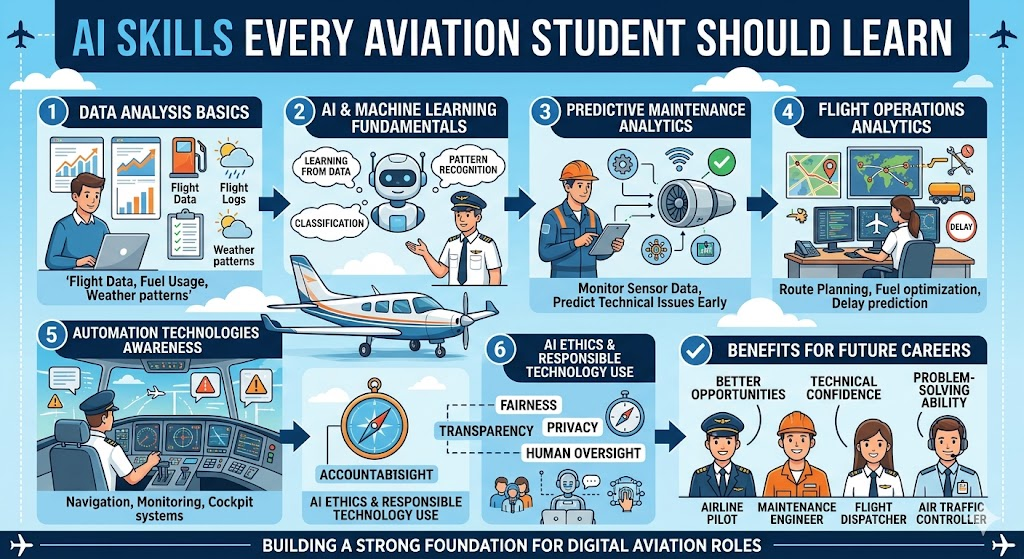
Data analysis is one of the most important AI-related skills for aviation students. It helps students understand patterns, trends, and performance. Aviation data can include flight time, fuel usage, engine temperature, weather conditions, maintenance records, passenger flow, and route performance.
Students should learn how to read data, clean data, organize it, and identify useful information. This skill is helpful for pilots, engineers, dispatchers, safety analysts, and aviation managers.
AI Fundamentals
Aviation students should understand the basic meaning of AI, how it works, where it is used, and what its limitations are. They do not need to become AI scientists, but they should know how AI systems support aviation decisions.
AI fundamentals help students understand tools used in predictive maintenance, simulation training, safety monitoring, and airport operations.
Machine Learning Concepts
Machine learning helps systems learn from historical data. Aviation students should understand concepts like training data, prediction, classification, pattern recognition, and model accuracy.
For example, a machine learning model can study past flight delay data and predict which future flights may be delayed due to weather, crew scheduling, or airport congestion.
Aviation Data Interpretation
Aviation data is different from general business data because it is connected to safety, performance, compliance, and operations. Students should learn how to interpret aircraft performance data, flight logs, maintenance reports, safety reports, and operational dashboards.
This skill helps students make sense of real aviation problems instead of only understanding theory.
Predictive Maintenance Analytics
Predictive maintenance is one of the most valuable uses of AI in aviation. Instead of waiting for a part to fail, AI can analyze sensor data and maintenance history to predict possible issues early.
Aviation students interested in aircraft maintenance, engineering, or airline operations should understand how predictive maintenance improves safety, reduces downtime, and lowers operating costs.
Flight Operations Analytics
Flight operations analytics helps airlines plan better routes, improve fuel usage, reduce delays, and manage aircraft schedules. Students should learn how data supports route planning, flight dispatch, weather decisions, and crew management.
This skill is especially useful for future pilots, dispatchers, airline managers, and operations professionals.
Aviation Cybersecurity Awareness
As aviation becomes more digital, cybersecurity becomes very important. AI systems, aircraft data, airport networks, and airline platforms must be protected from cyber risks.
Aviation students should understand basic cybersecurity concepts such as data privacy, secure systems, digital threats, access control, and responsible technology use.
Automation Technologies
Automation is already a major part of aviation. Modern aircraft use automated systems for navigation, flight control support, monitoring, and alerts. Airports use automation for check-in, baggage handling, and passenger services.
Students should learn how automation works, where it helps, and why human supervision is still important.
AI-Powered Decision Making
AI can support decisions by analyzing large amounts of data quickly. However, aviation professionals must still use human judgment. Students should learn how to use AI recommendations carefully and understand when to question them.
This skill is important because aviation safety depends on both technology and responsible human decision-making.
Problem Solving Using Data
AI is useful only when it solves real problems. Aviation students should learn how to identify a problem, collect relevant data, analyze it, test possible solutions, and explain results clearly.
For example, a student project could analyze why flights on a certain route are often delayed and suggest improvements.
Digital Communication Skills
Future aviation professionals must explain technical information clearly. Students should learn how to communicate AI insights, data reports, dashboard results, and safety findings in simple language.
This skill is useful in airline meetings, maintenance briefings, safety reports, and team discussions.
Basic Programming Knowledge
Programming helps students understand how AI tools work. Python is a good first language because it is widely used for data analysis and AI learning.
Students do not need to become expert programmers immediately. They can start with simple tasks such as reading data files, creating charts, and building small prediction projects.
AI Ethics and Responsible Technology Use
AI must be used responsibly, especially in safety-sensitive industries like aviation. Students should understand fairness, transparency, privacy, accountability, and human oversight.
Responsible AI means using technology in a way that supports safety, trust, and good decision-making.
How AI Is Used Across the Aviation Industry
Airline Operations
Airlines use AI to manage flight schedules, predict delays, optimize routes, improve fuel planning, and support customer service. AI helps airlines reduce waste and improve operational reliability.
Flight Planning
AI can analyze weather, traffic, aircraft performance, fuel needs, and route options. This helps pilots and dispatchers plan safer and more efficient flights.
Air Traffic Control
AI can support air traffic management by analyzing traffic flow, predicting congestion, and helping controllers manage busy airspace more efficiently.
Aircraft Maintenance
Maintenance teams use AI to study sensor data and maintenance history. This helps detect early signs of wear, reduce unexpected failures, and improve aircraft availability.
Aviation Safety
AI can identify safety trends by analyzing reports, flight data, and operational patterns. This helps safety teams prevent incidents and improve procedures.
Pilot Training Simulators
Modern simulators can use AI to track student performance, identify weak areas, and create personalized training scenarios. This makes pilot training more effective.
Airport Operations
Airports use AI for passenger flow, security screening support, baggage handling, staff planning, gate allocation, and crowd management.
Passenger Experience Management
AI helps airlines and airports improve customer service through chat support, personalized travel updates, delay notifications, and faster issue resolution.
Cargo and Logistics Operations
Cargo aviation uses AI for shipment tracking, route planning, warehouse operations, demand forecasting, and delivery optimization.
AI Skills for Different Aviation Careers
Future Pilots
Pilots should understand AI-powered cockpit support, automation, flight data, weather analysis, and decision-support tools. They should also know the limits of automation and the importance of human judgment.
Aircraft Maintenance Engineers
Maintenance engineers should learn predictive maintenance, sensor data analysis, digital inspection tools, and AI-supported fault detection.
Flight Dispatchers
Dispatchers can benefit from AI skills in route planning, weather analysis, fuel optimization, delay prediction, and operational decision-making.
Air Traffic Controllers
Air traffic professionals should understand automation support, traffic flow prediction, digital communication systems, and AI-assisted airspace planning.
Aviation Managers
Aviation managers should learn data analytics, AI-based planning, performance dashboards, passenger analytics, and operational optimization.
Aerospace Engineers
Aerospace engineers can use AI for design analysis, simulation, testing, digital twins, system optimization, and advanced research.
Aviation Safety Specialists
Safety specialists should learn how AI can analyze incident reports, identify risks, detect patterns, and support safety management systems.
Airline Operations Professionals
Operations teams can use AI to improve crew scheduling, aircraft utilization, turnaround time, route performance, and delay management.
Basic Programming Skills Aviation Students Should Learn
Python Fundamentals
Python is one of the best programming languages for beginners in AI and data analysis. Students should learn variables, lists, functions, conditions, loops, and file handling.
Data Visualization
Data visualization means turning data into charts and graphs. It helps students explain trends clearly. For aviation, charts can show fuel usage, delay patterns, maintenance frequency, or passenger demand.
Automation Basics
Students can learn how to automate simple tasks such as organizing reports, cleaning data, or creating repeated calculations. This saves time and builds confidence.
Working With Aviation Datasets
Students should practice with sample aviation datasets such as flight schedules, airport delays, aircraft performance data, or maintenance logs. This makes learning more practical.
Simple AI Projects
Good beginner projects include delay prediction, maintenance trend analysis, fuel usage comparison, airport traffic visualization, or flight route analysis.
AI Tools Aviation Students Can Explore
Aviation students can explore simple AI and data tools to build confidence. They can use AI-powered analytics tools for learning patterns, data visualization platforms for charts, flight simulation software for training, and basic programming tools for practical projects.
Students should focus on learning concepts first. Tools may change over time, but strong understanding remains valuable.
Benefits of Learning AI During Aviation Studies
Learning AI during aviation studies gives students a major advantage. It helps them understand the future of aviation and prepares them for technology-driven roles.
Key benefits include:
- Better career opportunities
- Stronger technical confidence
- Improved problem-solving ability
- Better understanding of airline operations
- Readiness for digital aviation roles
- Competitive advantage in interviews
- Ability to work with modern aviation systems
- Foundation for future leadership roles
Challenges Students May Face While Learning AI
AI can feel difficult at first because it includes data, mathematics, programming, and new terminology. Many aviation students may feel more comfortable with aircraft and flight concepts than coding or analytics.
However, students can overcome this by learning step by step. They should start with basic concepts, simple examples, and small projects. The goal is not to learn everything at once, but to build practical understanding over time.
Balancing aviation studies and AI learning can also be challenging. Students should create a simple learning plan and practice regularly.
Future of AI in Aviation
The future of aviation will include more AI-powered systems. Aircraft may use smarter monitoring tools, airports may become more automated, and airlines may use advanced analytics for nearly every part of operations.
Important future trends include:
- Autonomous support systems
- Advanced flight assistance
- Smart airports
- Digital twins for aircraft systems
- Predictive safety systems
- AI-driven airline operations
- Automated maintenance planning
- Intelligent passenger services
- Advanced simulation training
- More efficient air traffic management
Students who understand AI early will be better prepared for these future changes.
Practical Roadmap for Aviation Students
Year 1 Foundation Skills
Start with basic aviation knowledge, computer literacy, mathematics basics, and simple data understanding. Learn what AI is and how it is used in daily life and aviation.
Year 2 AI Awareness
Learn basic AI concepts, machine learning basics, data analysis, and aviation technology examples. Start using simple tools for charts and reports.
Year 3 Practical Projects
Begin small projects using aviation-related data. Practice Python basics, visualization, automation, and simple prediction models.
Year 4 Specialization and Career Preparation
Choose a focus area such as pilot technology, maintenance analytics, airline operations, aviation safety, or aerospace AI. Build a portfolio of projects and prepare for internships or entry-level roles.
Tips for Building AI Skills Successfully
Start small and stay consistent. Learn one concept at a time and connect it with aviation examples. Practice with real or sample datasets whenever possible.
Students should also improve communication skills because explaining AI results is just as important as creating them. Join aviation technology communities, attend workshops, complete beginner courses, and work on practical projects.
Most importantly, do not fear AI. It is a tool that can help aviation professionals work smarter and safer.
Frequently Asked Questions
1- Why should aviation students learn AI?
Aviation students should learn AI because the aviation industry is becoming more digital and data-driven. AI is used in flight planning, maintenance, safety, airports, and airline operations. Students with AI knowledge can prepare for better future career opportunities.
2- Do pilots need AI knowledge?
Pilots do not need to become AI engineers, but they should understand automation, AI-supported decision tools, flight data, and system limitations. This helps them work safely with modern cockpit and airline technologies.
3- Is programming required for aviation careers?
Programming is not required for every aviation career, but basic programming knowledge can be very useful. It helps students understand data, automation, analytics, and AI tools used in modern aviation.
4- What AI skills are most valuable in aviation?
The most valuable AI skills include data analysis, machine learning basics, aviation data interpretation, predictive maintenance, automation awareness, cybersecurity awareness, and responsible AI use.
5- How is AI used in airline operations?
AI is used in airline operations for route planning, delay prediction, fuel optimization, crew scheduling, aircraft maintenance planning, customer service, and operational performance analysis.
6- Can AI replace pilots?
AI can support pilots, but it cannot fully replace human responsibility in aviation. Pilots provide judgment, leadership, communication, safety decisions, and emergency handling that technology alone cannot manage completely.
7- Which programming language should aviation students learn first?
Python is a good first programming language for aviation students because it is beginner-friendly and widely used in data analysis, automation, machine learning, and AI projects.
8- How does AI improve aviation safety?
AI improves aviation safety by analyzing large amounts of flight, maintenance, and safety data. It can help identify risks, predict failures, detect patterns, and support better decision-making.
9- What careers combine aviation and AI?
Careers that combine aviation and AI include aviation data analyst, predictive maintenance specialist, aerospace AI engineer, airline operations analyst, aviation safety analyst, smart airport specialist, and flight technology consultant.
10- How can students start learning AI today?
Students can start by learning basic AI concepts, data analysis, Python fundamentals, and simple aviation-related projects. They can also use flight simulators, online learning resources, and sample datasets to practice.
Conclusion
AI skills are becoming essential for the next generation of aviation professionals. Aviation students who understand data analysis, automation, machine learning basics, predictive maintenance, and responsible AI use will be better prepared for the future. AI is not here to remove the human role in aviation; it is here to support safer, smarter, and more efficient operations. Students who begin learning AI early can build stronger career paths in pilot training, aircraft maintenance, airline operations, aerospace engineering, aviation safety, and airport management. The best approach is to start with simple concepts, practice regularly, and connect every AI skill with real aviation problems.