Introduction
Machine Learning is rapidly becoming part of everyday software systems, but building a model is only the first step. The real challenge is deploying, scaling, monitoring, and maintaining machine learning systems in production. This is where MLOps (Machine Learning Operations) plays a critical role by combining DevOps, automation, and machine learning into a reliable and repeatable lifecycle.
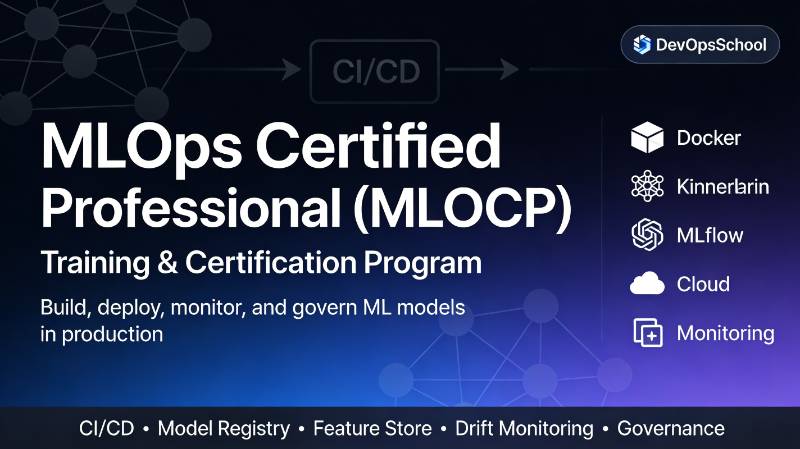
Organizations today need professionals who can manage the complete ML workflow — from data preparation to model deployment and monitoring. The DevOps MLOps Certified Professional (MLOCP) certification is designed to help engineers and technology leaders gain practical, real-world skills to run machine learning systems efficiently, reliably, and at scale.
This guide explains the certification, required skills, preparation roadmap, and career value, helping you understand how MLOCP can support your growth in the fast-evolving world of AI and intelligent engineering systems.
Why MLOps is Important Today
Organizations are investing heavily in AI, data, and automation. However, many ML projects fail when moving to production due to lack of automation, monitoring, and governance. MLOps solves this by combining DevOps + Machine Learning + Automation + Data Engineering into one reliable lifecycle.
Engineers with MLOps skills are in high demand because they can:
- Automate ML pipelines
- Deploy models safely into production
- Monitor performance and detect drift
- Scale ML systems using cloud and containers
- Maintain reproducibility and governance
Comparison Table
| Area | MLOps Certified Professional (MLOCP) | DevOps Track | DevSecOps Track | SRE Track | DataOps Track | FinOps Track |
|---|---|---|---|---|---|---|
| Primary Focus | Production ML lifecycle end-to-end | Software delivery automation | Secure delivery + compliance | Reliability + uptime | Data pipeline reliability | Cloud cost governance |
| Best For | DevOps/ML/Data/Platform engineers | DevOps/Cloud engineers | Security + DevOps teams | Platform/SRE engineers | Data engineers/analytics teams | Cloud + finance-aware teams |
| Key Outcome | Automated pipelines, deployment, monitoring, retraining | CI/CD + IaC + containers | Secure CI/CD + policy controls | SLOs + incident response + observability | Orchestration + data quality + governance | Cost allocation + optimization + guardrails |
| Core Skills | Model/versioning, CI/CD for ML, drift, Kubernetes, automation | CI/CD, IaC, Kubernetes | secrets, SAST/DAST, policy-as-code | SLIs/SLOs, runbooks, on-call | ETL/ELT, orchestration, data quality | tagging, showback/chargeback, budgeting |
| Typical Projects | Deploy model on Kubernetes, monitor drift, auto-retrain | Build CI/CD pipeline + infra automation | Secure pipelines + compliance reporting | Reduce incidents, improve observability | Build governed data pipeline | Reduce cloud spend, enforce budgets |
| When to Choose | When ML must run reliably in production | When delivery automation is the goal | When security is priority | When reliability is main concern | When data quality/pipelines are key | When cloud spend is high |
| Career Roles | MLOps Engineer, ML Platform Engineer | DevOps Engineer, Platform Engineer | DevSecOps Engineer | SRE, Production Engineer | DataOps Engineer | FinOps Practitioner |
What it is MLOps Certified Professional (MLOCP)?
MLOCP is a professional certification focused on the complete Machine Learning Operations lifecycle. It teaches how to automate ML workflows, deploy models, manage pipelines, and monitor model performance in real production environments.
Who should take it
- DevOps Engineers working with ML systems
- Machine Learning Engineers deploying models
- Data Engineers managing ML pipelines
- Cloud and Platform Engineers supporting ML infrastructure
- Engineers moving toward AI/MLOps roles
- Engineering Managers leading ML-driven teams
Skills you’ll gain
- End-to-end ML lifecycle management
- CI/CD for ML pipelines
- Model deployment and scaling
- Data and model versioning
- Monitoring, logging, and drift detection
- Kubernetes for ML workloads
- Automation and reproducibility
- Feature store and pipeline orchestration
- ML governance and reliability
Real-world projects you should be able to do after it
- Build automated ML pipeline (data → train → deploy)
- Deploy ML model using Docker and Kubernetes
- Implement monitoring and drift detection
- Create automated retraining pipeline
- Implement data and model versioning
- Deploy models using blue/green or canary strategy
- Build scalable ML infrastructure on cloud
- Implement ML observability and logging
Preparation plan
Preparing for MLOCP requires both theory and hands-on practice because MLOps connects DevOps, ML, and automation.
7–14 Days
Focus on ML lifecycle, CI/CD, and deployment basics. Revise DevOps and ML fundamentals and practice simple ML deployment.
30 Days
Deep dive into pipeline automation, model deployment, monitoring, and versioning. Build a small end-to-end ML pipeline project.
60 Days
Build production-grade ML system with monitoring, retraining, scaling, governance, and automation. Practice real-world scenarios and architecture design.
Common mistakes
- Ignoring ML lifecycle and focusing only on models
- Not learning automation and CI/CD for ML
- Skipping monitoring and drift detection
- Lack of infrastructure understanding
- Memorizing tools instead of concepts
Best next certification after this
After MLOCP, choose next certification based on your career direction.
Same track: Advanced MLOps / AI Engineering
Cross-track: DevOps Architect or DataOps Professional
Leadership: DevOps Manager / AI Platform Architect
Choose Your Path
Choosing the right path helps you build a strong career direction in modern engineering.
DevOps Path
Focus on CI/CD, automation, containers, and infrastructure as code. MLOps extends DevOps by adding ML lifecycle automation.
DevSecOps Path
Focus on secure pipelines, compliance, and governance. Combining DevSecOps with MLOps helps build secure ML systems
SRE Path
Focus on reliability, observability, and performance. MLOps + SRE enables stable and observable ML platforms.
AIOps / MLOps Path
Focus on automation using AI and ML lifecycle management. Ideal for engineers working in intelligent platforms.
DataOps Path
Focus on data pipelines, orchestration, and governance. Strong data foundation improves ML reliability.
FinOps Path
Focus on cloud cost optimization and governance. Helps manage expensive ML infrastructure efficiently.
Role → Recommended Certifications
| Role | Recommended Certifications |
|---|---|
| DevOps Engineer | DevOps Professional → MLOCP |
| SRE | SRE Professional → MLOCP |
| Platform Engineer | DevOps Architect → MLOCP |
| Cloud Engineer | Cloud + DevOps → MLOCP |
| Security Engineer | DevSecOps Professional |
| Data Engineer | DataOps Professional → MLOCP |
| FinOps Practitioner | FinOps Professional |
| Engineering Manager | DevOps Manager / AI Platform |
Next Certifications to Take
After MLOps Certified Professional (MLOCP), choose your next certification based on your career direction — deeper expertise, broader skills, or leadership growth.
Same Track
- AIOps Certified Professional (AIOCP)
- Kubernetes (CKA / CKAD)
- Observability Engineering
Cross-Track
- DataOps Certified Professional
- DevSecOps Certified Professional
- Cloud Architect / Cloud DevOps
Leadership Track
- Master in DevOps Engineering
- DevOps Manager
- DevOps Architect
Training & Certification Support Institutions
DevOpsSchool
Provides structured, hands-on training with real-world labs, guided projects, and mentor support. Focuses on practical DevOps and MLOps implementation and certification readiness.
Cotocus
Helps professionals connect theory with real production challenges. Strong focus on automation, cloud, and enterprise engineering workflows.
ScmGalaxy
Focuses on CI/CD, automation, and DevOps toolchains. Useful for strengthening delivery automation and engineering practices.
BestDevOps
Offers certification-oriented learning with job-ready skills and project-based training. Helps professionals transition from DevOps to advanced engineering roles.
devsecopsschool.com
Focused on secure DevOps lifecycle, compliance, and security automation for regulated environments.
sreschool.com
Specializes in reliability engineering, observability, and large-scale production system stability.
aiopsschool.com
Focused on AI-driven operations, predictive monitoring, and intelligent automation.
dataopsschool.com
Supports learning around data pipelines, orchestration, and data governance for ML systems.
finopsschool.com
Focused on cloud cost optimization, budgeting, and financial governance for infrastructure.
General FAQs
Is MLOCP difficult?
Moderate difficulty, easier with DevOps and ML basics.
How long does preparation take?
Most professionals prepare in 30–60 days.
Do I need ML experience?
Basic understanding is recommended.
Is coding required?
Yes, mainly Python and automation scripting.
Is certification valuable?
Yes, high demand in AI-driven companies.
Can beginners take it?
Better after DevOps or ML foundation.
Does it help career growth?
Yes, opens ML and platform engineering roles.
Is cloud knowledge required?
Basic cloud knowledge helps significantly.
Is certification practical?
Yes, focused on real production systems.
What roles can I target after it?
MLOps Engineer, ML Platform Engineer, AI Engineer.
Does it include real-world scenarios?
Yes, production ML deployment and monitoring.
Is it globally useful?
Yes, valuable across global tech industry.
MLOCP Specific FAQs
What makes MLOCP unique?
It combines DevOps, ML, and automation into production engineering.
Does it cover Kubernetes?
Yes, for deployment and scaling.
Will I learn pipeline automation?
Yes, core focus of certification.
Is monitoring included?
Yes, includes observability and drift detection.
Can it help move into AI roles?
Yes, strong foundation for AI engineering.
Does it include deployment projects?
Yes, real production ML deployment scenarios.
What tools are typically covered?
CI/CD, containers, orchestration, monitoring, ML lifecycle tools.
Who benefits most?
Engineers working with ML in production environments.
Conclusion
The future of engineering is driven by automation, AI, and reliability. MLOps is becoming a core engineering skill as organizations deploy intelligent systems at scale. Professionals who understand both machine learning and operations are highly valued across industries.
The MLOps Certified Professional (MLOCP) certification provides practical, production-ready skills to design, deploy, and manage scalable ML systems. Whether you are a DevOps Engineer, Data Engineer, ML Engineer, or Platform Engineer, this certification strengthens your technical depth and career growth.
With the right preparation and continuous practice, MLOCP can help you move confidently into the next generation of AI-driven engineering roles.