Introduction
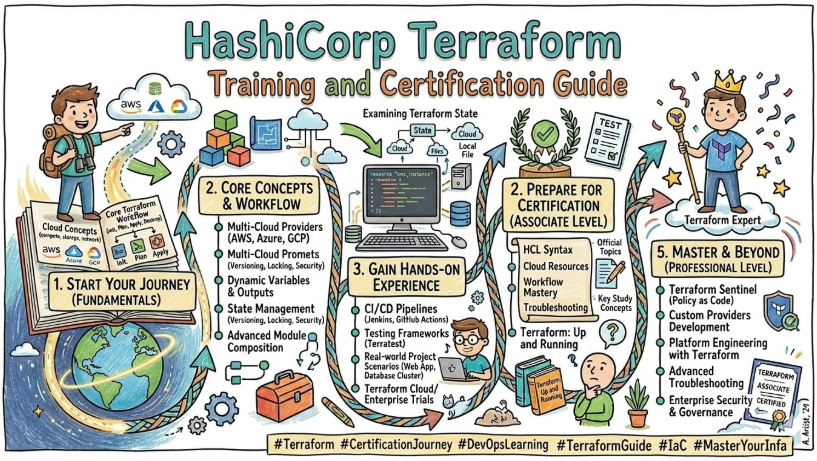
Terraform has become one of the most practical tools for teams that want repeatable, version-controlled, and scalable infrastructure. The main starting certification is the Terraform Associate, and HashiCorp also offers an advanced Terraform Authoring and Operations Professional certification for deeper operational and authoring skills. DevOpsSchool’s catalog also lists both Terraform Associate and Terraform Authoring and Operations Professional training paths, which makes it possible to move from beginner-level certification preparation into more advanced Terraform practice.
For working engineers and managers, this matters because Terraform is not only a tool exam topic. It sits at the center of modern infrastructure automation, cloud provisioning, reusable modules, state handling, collaboration, and environment consistency. The Terraform Associate validates foundational knowledge, while the advanced professional path focuses on scalable modules, resilient design, and operating Terraform in more complex settings.
Why This Certification Matters
Many engineers know cloud platforms, but fewer can build infrastructure in a clean, repeatable, team-friendly way. That is where Terraform stands out. It gives teams a common language for infrastructure, helps reduce manual changes, and supports consistent deployment patterns across environments. The Associate certification is designed for people who understand Terraform basics and want to prove they can work with its core workflow, modules, providers, and lifecycle concepts.
For managers, the certification is useful because it signals a real-world skill set that affects delivery speed, reliability, and governance. A certified engineer is more likely to write cleaner infrastructure code, collaborate safely, and reduce drift between development, staging, and production. That makes this certification useful not just for job seekers, but also for internal team capability building.
Certification Table
| Track | Level | Who it’s for | Prerequisites | Skills covered | Recommended order |
|---|---|---|---|---|---|
| Infrastructure as Code / Terraform | Associate | DevOps engineers, system administrators, cloud engineers, software engineers starting IaC | Basic cloud knowledge, CLI comfort, basic infrastructure concepts | Terraform workflow, HCL, providers, modules, state, lifecycle basics, troubleshooting | Step 1 |
| Infrastructure as Code / Terraform | Professional | Engineers already using Terraform in real projects | Strong Terraform basics, module design exposure, operational experience | Advanced authoring, reusable modules, resilient design, long-term operations | Step 2 |
The Associate certification appears in DevOpsSchool’s certification catalog, while the Terraform course catalog also lists the advanced HashiCorp Certified: Terraform Authoring and Operations Professional path. HashiCorp’s own certification page confirms these as the foundational and advanced Terraform certifications.
HashiCorp Terraform Associate
What It Is
The HashiCorp Certified: Terraform Associate validates foundational knowledge of infrastructure automation using Terraform. It focuses on Terraform basics, configuration workflow, modules, providers, and the ability to manage infrastructure through code rather than manual setup.
Who Should Take It
- DevOps Engineers
- Cloud Engineers
- Platform Engineers
- System Administrators
- Software Engineers moving into infrastructure automation
- Managers who want a practical understanding of IaC team capabilities
This certification is especially suitable for engineers who already work with AWS, Azure, or GCP and want a structured Terraform credential.
Skills You’ll Gain
- Writing and reading Terraform configuration
- Understanding providers and resources
- Managing state safely
- Using input variables and outputs
- Working with modules
- Planning and applying infrastructure changes
- Understanding Terraform workflow and lifecycle
- Troubleshooting basic Terraform issues
These skills are directly aligned with how the Associate certification is described in DevOpsSchool and HashiCorp references.
Real-World Projects You Should Be Able to Do After It
- Provision a basic multi-tier application environment
- Create reusable Terraform modules for common infrastructure
- Manage dev, test, and production environments with cleaner structure
- Automate cloud resource creation for compute, networking, and storage
- Integrate Terraform into CI/CD workflows at a basic level
- Read plans and reduce risky manual changes
Preparation Plan
7–14 days
Best for people already using Terraform in projects. Focus on the exam blueprint, commands, workflow, modules, state, providers, and practice questions.
30 days
Best for busy working professionals. Study one topic at a time, build small labs, revise HCL syntax, and repeat the plan/apply/state flow until it becomes natural.
60 days
Best for beginners. Start with infrastructure basics, then move into Terraform syntax, providers, modules, state, and real cloud labs. End with revision and mock practice.
Common Mistakes
- Learning only theory without building labs
- Ignoring state management concepts
- Memorizing commands without understanding workflow
- Skipping modules and variables
- Not practicing plan output reading
- Confusing provider setup with module logic
- Studying cloud-specific examples without mastering Terraform basics
Best Next Certification After This
The strongest next step in the same Terraform path is Terraform Authoring and Operations Professional, because it builds on reusable design and operational maturity. For broader cross-track growth, DevOpsSchool and GurukulGalaxy list paths such as Kubernetes, DevOps, SRE, DevSecOps, AIOps, MLOps, and DataOps certifications that support platform and automation careers.
Choose Your Path
DevOps Path
Start with Terraform Associate, then move toward DevOps Certified Professional (DCP) or Master in DevOps Engineering (MDE) for full delivery lifecycle skills. GurukulGalaxy includes both among top certifications for software engineers.
DevSecOps Path
Use Terraform Associate as the infrastructure base, then continue with DevSecOps Certified Professional (DSOCP) to add policy, compliance, and security automation thinking.
SRE Path
Terraform helps standardize infrastructure, while Site Reliability Engineering Certified Professional (SRECP) builds reliability, observability, and service operations depth.
AIOps / MLOps Path
Terraform is useful for provisioning ML platforms and observability stacks. After the Associate, move into MLOps Certified Professional (MLOCP) or AiOps Certified Professional (AIOCP) depending on your platform direction.
DataOps Path
Infrastructure-as-code is valuable for data platforms too. After Terraform, DataOps Certified Professional (DOCP) helps engineers manage pipeline-driven environments and delivery workflows.
FinOps Path
Terraform helps with standardized provisioning and governance. A FinOps path is a strong match when your work involves cost visibility, guardrails, and scalable cloud operations. DevOpsSchool’s catalog includes FinOps Foundation Certification.
Role → Recommended Certifications
| Role | Recommended certifications |
|---|---|
| DevOps Engineer | Terraform Associate → DCP → KCAD |
| SRE | Terraform Associate → SRECP → Observability-focused path |
| Platform Engineer | Terraform Associate → Terraform Professional → KCAD |
| Cloud Engineer | Terraform Associate → AWS/GCP/Azure architect path |
| Security Engineer | Terraform Associate → DSOCP → cloud security certification |
| Data Engineer | Terraform Associate → DOCP → cloud data engineering certification |
| FinOps Practitioner | Terraform Associate → FinOps Foundation → cloud governance path |
| Engineering Manager | Terraform Associate → CDM or leadership-oriented DevOps path |
These recommendations are inferred from the Terraform certification paths, DevOpsSchool certification catalog, and GurukulGalaxy’s list of top software engineering certifications.
Next Certifications to Take
Same Track
Terraform Authoring and Operations Professional
This is the natural next step after Associate. It is meant for stronger authoring and operational depth in Terraform.
Cross-Track
Kubernetes Certified Administrator & Developer (KCAD)
Terraform plus Kubernetes is a very practical combination for platform teams. GurukulGalaxy includes KCAD among top certifications for software engineers.
Leadership
Certified DevOps Manager (CDM) or Master in DevOps Engineering (MDE)
These help engineers move from tooling capability into system-wide delivery, team coordination, architecture, and management thinking.
Top Institutions for Training and Certification Support
1. DevOpsSchool
DevOpsSchool is the clearest fit here because the provided official Terraform certification link belongs to it, and its catalog lists Terraform Associate as well as broader DevOps, SRE, DevSecOps, MLOps, DataOps, and FinOps programs. It is useful for learners who want one provider for both entry and next-step certifications.
2. Cotocus
Cotocus is often positioned as a practical training support brand for engineers who want structured upskilling. It is useful for learners who prefer guided support and applied learning orientation.
3. ScmGalaxy
ScmGalaxy is helpful for learners who want broader tooling and ecosystem awareness around DevOps and automation. It can support engineers who need complementary skills around source control, CI/CD, and automation workflows.
4. BestDevOps
BestDevOps is commonly seen as a skills-building brand around real-world DevOps capabilities. It is a strong fit for engineers who want hands-on, project-style learning.
5. DevSecOpsSchool
Best for engineers who want to combine Terraform with security-driven infrastructure and policy thinking.
6. SRESchool
Useful for engineers who want to connect Terraform-based automation with reliability engineering and production operations.
7. AiOpsSchool
A good direction for professionals building automated operational workflows with analytics and event-driven operations.
8. DataOpsSchool
Relevant for engineers managing automated data platform infrastructure and repeatable environments.
9. FinOpsSchool
A smart fit for professionals who want Terraform knowledge to support cloud cost control, governance, and financial accountability.
FAQs on HashiCorp Terraform Training and Certification
1. Is Terraform certification difficult?
It is not the hardest certification in infrastructure, but it does require real hands-on understanding. Engineers who practice labs usually find it manageable.
2. How much time do most people need?
Many working professionals can prepare in about 30 to 45 days with steady practice. Faster learners with prior Terraform experience may need less.
3. Are there formal prerequisites?
There are no strict formal prerequisites, but basic cloud and command-line familiarity help a lot.
4. Is this certification good for software engineers?
Yes. It helps software engineers understand infrastructure workflows, deployment environments, and IaC collaboration more clearly.
5. Should beginners start with Terraform Associate?
Yes, if they want a structured entry into infrastructure as code. It is the foundational Terraform certification.
6. What is the best study method?
Use a mix of concept review, small labs, command practice, modules, state exercises, and mock questions.
7. Does Terraform certification help in job growth?
Yes. It supports roles in DevOps, cloud engineering, platform engineering, and infrastructure automation because it validates a practical modern skill.
8. What should I take after Terraform Associate?
The best same-track option is Terraform Authoring and Operations Professional.
9. Is Terraform enough by itself?
No. It is powerful, but strongest when combined with cloud, CI/CD, Kubernetes, security, or reliability knowledge.
10. Can managers benefit from this path?
Yes. Even if they do not write code daily, it helps them assess team maturity and delivery practices more realistically.
11. Is this certification vendor-neutral?
It is tool-specific to Terraform, but the infrastructure-as-code thinking it builds is broadly valuable.
12. Does practice matter more than reading?
Yes. Terraform is best learned by doing. Reading helps, but labs make the concepts stick.
13. Can I prepare while working full time?
Yes. A 30-day plan with daily focused study works well for most professionals.
14. Is this useful for cloud migrations?
Very much. Terraform helps standardize and repeat migration-related infrastructure provisioning.
Conclusion
HashiCorp Terraform training and certification is one of the most practical investments for engineers who want to become stronger in cloud automation, infrastructure as code, and repeatable platform delivery. The Associate certification gives a solid base, while the advanced professional path creates room for deeper authoring and operational growth.
It is valuable for DevOps engineers, cloud engineers, platform teams, SREs, and even managers who want clearer visibility into automation maturity. The smartest approach is to start with Terraform fundamentals, build real labs, earn the Associate, and then expand into DevOps, SRE, DevSecOps, DataOps, MLOps, or FinOps depending on your role and long-term direction.