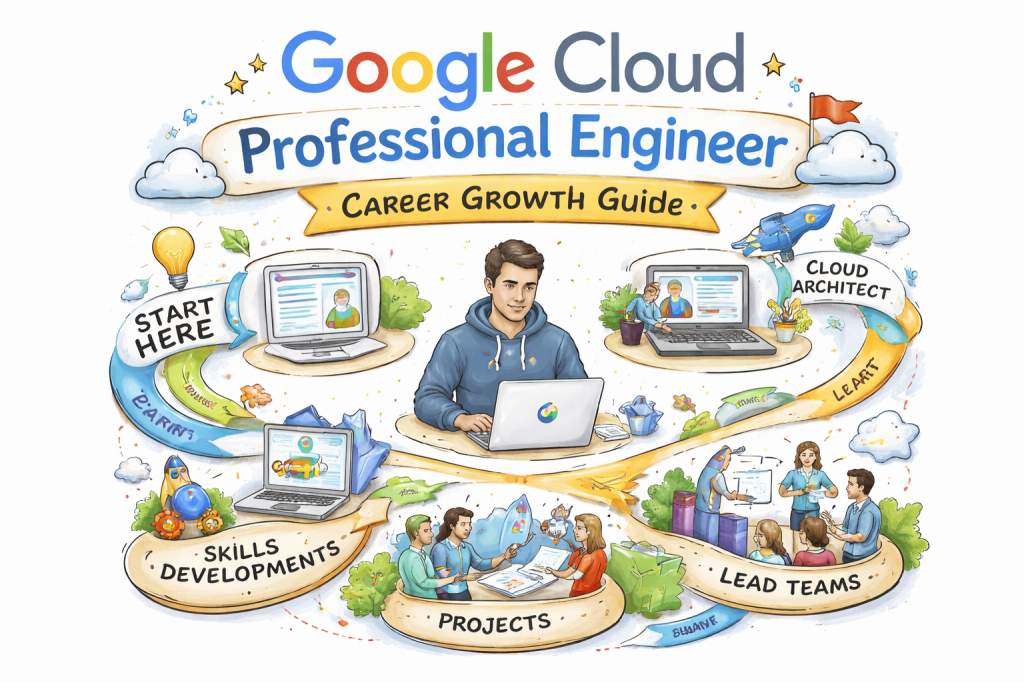
Introduction:
Google Cloud is now a key platform for digital products, data platforms, and AI workloads across many industries. Companies want engineers and managers who can design, build, and operate solutions on Google Cloud in a reliable, secure, and cost‑effective way.
Google Cloud Professional‑level certifications validate advanced, job‑ready skills for roles like Cloud Architect, DevOps Engineer, Security Engineer, Network Engineer, and Data Engineer. They show that you can handle critical responsibilities such as solution design, reliability, security, and optimization in real environments.
This guide explains the Google Cloud Professional Engineer certification family in simple language. You will see what these certifications are, who should take them, key skills, preparation plans, common mistakes, learning paths, role mappings, training options, and FAQs focused on difficulty, time, prerequisites, sequence, value, and career outcomes.
What Is “Google Cloud Professional Engineer”?
When we say Google Cloud Professional Engineer, we refer to the family of Professional‑level Google Cloud certifications that target experienced engineers. These certifications prove that you can design, build, secure, operate, and optimize solutions on Google Cloud at scale.
Google recommends Professional‑level certifications for people with several years of industry experience and at least one year working with Google Cloud. These are not entry‑level exams; they are meant to validate advanced, role‑specific skills.
Google Cloud Professional‑Level Certification Tracks
Google currently offers multiple Professional‑level certifications across different roles.
Major tracks include:
- Professional Cloud Architect
- Professional Cloud Developer
- Professional Cloud Security Engineer
- Professional Cloud Network Engineer
- Professional Cloud DevOps Engineer
- Professional Data Engineer
- Professional Machine Learning Engineer
- Professional Cloud Database Engineer
In this guide, we treat them together as the “Google Cloud Professional Engineer” family and show how to choose and grow with them.
Who Should Take Google Cloud Professional‑Level Certifications?
These certifications are designed for people who already work with cloud or want to move into senior engineering roles. They are ideal for:
- Software and Cloud Engineers designing or building on Google Cloud
- DevOps Engineers and SREs responsible for delivery and reliability
- Security, Network, and Data Engineers working with GCP environments
- Architects and Platform Engineers designing shared platforms and services
- Engineering Managers who want deep technical understanding of GCP solutions
If you already use GCP or plan to migrate to it, a Professional‑level certification is a strong way to show depth and readiness for critical responsibilities.
Skills You Will Gain
Exact skills differ by specific professional certification, but common themes include:
- Solution design and architecture
- Translate business requirements into GCP architectures
- Choose the right compute, storage, networking, and data services
- Design for security, reliability, performance, and cost
- Implementation and automation
- Deploy infrastructure with scripts and infrastructure as code
- Build CI/CD pipelines and automated deployments where relevant
- Integrate services and external systems
- Operations and reliability
- Monitor services using Cloud Operations tools
- Implement logging, metrics, tracing, and alerting
- Manage incidents and improve systems based on feedback
- Security and compliance
- Use IAM, network security, and encryption features correctly
- Apply least privilege, segmentation, and governance policies
- Support compliance and audit needs
- Optimization
- Identify performance bottlenecks
- Optimize resource usage and cost
- Adjust designs as workloads and requirements evolve
What It Is
A Google Cloud Professional‑level certification validates that you can perform advanced technical tasks for a specific role (for example, Architect, DevOps Engineer, Data Engineer) on Google Cloud. It tests real‑world design, implementation, and operations skills rather than only theoretical knowledge.
Who Should Take It
- Engineers already using Google Cloud in production
- Professionals ready to move from associate‑level to advanced roles
- Architects and leads guiding cloud adoption and modernization
- Managers who need deeper technical credibility in cloud discussions
Skills You’ll Gain
- Strong understanding of GCP services and patterns for your role
- Ability to design and review architectures with clear trade‑offs
- Confidence in implementing, automating, and operating workloads on GCP
- Better communication with stakeholders about cost, risk, and performance
Real‑World Projects After Certification
After a professional‑level certification, you should be able to:
- Design and document complete GCP solutions for business use cases
- Lead migrations or greenfield projects using best practices
- Review existing environments and recommend improvements
- Work with cross‑functional teams to ship and operate services safely
Preparation Plan (7–14 Days / 30 Days / 60 Days)
The exact content differs by track, but you can follow this general structure.
7–14 Days (If You Already Work Deeply With GCP)
- Days 1–3: Review exam guide, key domains, and refresh weaker GCP services for your chosen role
- Days 4–7: Focused labs and case studies for each domain (design, security, networking, data, operations)
- Days 8–10: Work through 1–2 realistic end‑to‑end scenarios similar to exam case studies
- Days 11–14: Practice exams and deep review of mistakes until you feel stable on every domain
30 Days (Balanced Plan for Working Engineers)
- Week 1: GCP fundamentals refresh (resource hierarchy, IAM, core compute, storage, networking)
- Week 2: Role‑specific core domains (for example, architecture design, CI/CD, data modeling, or security)
- Week 3: Hands‑on labs and mini‑projects to apply concepts in real GCP environments
- Week 4: Case‑study practice, sample questions, and final revision before the exam
60 Days (If You Are Newer to GCP or the Role)
- Month 1: GCP fundamentals, Linux and networking basics, hands‑on exploration of key services relevant to your target certification
- Month 2: Systematic coverage of exam domains, multiple labs and small projects, and two or more full practice tests with detailed review
Common Mistakes Across Google Cloud Professional Exams
- Attempting a professional exam without enough GCP fundamentals or real practice
- Reading summaries but skipping the official exam guide and domain weights
- Avoiding hands‑on labs and relying only on video courses or notes
- Ignoring non‑technical skills in case studies, such as trade‑off discussions and stakeholder needs
- Not practising with multi‑choice and multi‑select questions similar to the real exam format
Best Next Certification After a Google Cloud Professional Exam
Based on common certification advice:
- Same track (deep specialization):
- Go deeper in the same area, such as taking Architect after DevOps or Security after Architect, to become a go‑to expert in that domain.
- Cross‑track (broadening skills):
- Add another professional certification in a nearby area, for example, Data Engineer plus Cloud Architect, or DevOps Engineer plus Security Engineer, to cover more of the stack.
- Leadership (architecture and strategy):
- Move toward architecture‑oriented certifications and leadership programs that help you handle organization‑wide design, governance, and mentorship.
Choose Your Path: 6 Learning Paths
DevOps Path
In the DevOps path, you combine a Professional‑level certification with strong CI/CD, automation, and infrastructure as code skills. You become responsible for designing and operating fast, safe delivery pipelines on GCP for multiple teams.
DevSecOps Path
In the DevSecOps path, you use Google Cloud security controls, policies, and automation to embed security checks into delivery workflows. You treat security as part of the pipeline and platform instead of a separate step.
SRE Path
In the SRE path, you apply SLI/SLO thinking, error budgets, and production‑grade monitoring to services built on GCP. A Professional‑level certification helps you design and run reliable systems that still evolve quickly.
AIOps / MLOps Path
In the AIOps and MLOps path, you work with data and ML workloads on Google Cloud. Professional‑level skills help you create automated pipelines, reliable training and inference flows, and observable ML systems.
DataOps Path
In the DataOps path, you apply DevOps ideas to data platforms, using GCP services for storage, processing, and analytics. Professional‑level certifications in data, DevOps, or architecture help you design secure, reliable data pipelines.
FinOps Path
In the FinOps path, you focus on cost, value, and governance. With Professional‑level skills, you can design architectures and automation that balance performance, reliability, and cloud cost for the business.
Role → Recommended Certifications Mapping
| Role | How Google Cloud Professional‑level certs help | Recommended direction after first Professional‑level cert |
|---|---|---|
| DevOps Engineer | Strong GCP automation, pipelines, and operations skills | Add Architect or Security‑focused certifications for broader responsibility |
| SRE | Better design, observability, and reliability on GCP | Combine with Architect and sometimes Security for resilience and risk coverage |
| Platform Engineer | Design and run shared platforms serving many teams | Grow into Architect and Network/ Security Professional tracks |
| Cloud Engineer | Move from basic provisioning to full lifecycle ownership | Advance into Architect or DevOps Professional certifications |
| Security Engineer | Apply security design and governance at scale | Extend into Architect and DevOps to influence system‑wide security |
| Data Engineer | Build and run secure, reliable data platforms | Combine with Data, Machine Learning, or Architect Professional certifications |
| FinOps Practitioner | Understand technical drivers of cost and value | Add Architect‑type credentials to support governance and budgeting |
| Engineering Manager | Gain deep insight into how teams build and run on GCP | Mix Architect and DevOps/SRE paths for leadership and decision‑making strength |
Top Institutions for Google Cloud Professional Engineer Training
DevOpsSchool
DevOpsSchool offers structured training programs targeted at cloud and DevOps roles, including Google Cloud‑focused content. Their programs usually combine instructor‑led sessions, more than one lab assignment, real‑world projects, and interview preparation, helping you connect certification content with job‑ready skills.
Cotocus
Cotocus provides consulting and training for DevOps and cloud adoption. It helps participants understand how Professional‑level GCP skills fit into real transformation projects, platform designs, and modernization journeys.
Scmgalaxy
Scmgalaxy focuses on CI/CD, configuration management, and DevOps tooling. This is useful for building the automation and pipeline side that many GCP Professional‑level exams expect, especially for DevOps and Architect roles.
BestDevOps
BestDevOps curates content and communities around DevOps and cloud engineering. For Professional‑level certification candidates, this ecosystem helps with patterns, best practices, and knowledge sharing across roles and tools.
devsecopsschool.com
devsecopsschool.com focuses on secure development and DevSecOps practices. Adding this perspective to GCP Professional‑level learning helps you embed security inside your designs, pipelines, and operations.
sreschool.com
sreschool.com is centered on Site Reliability Engineering. Combined with GCP Professional‑level certifications, it helps you apply SRE principles on Google Cloud more effectively, from SLIs to postmortems.
aiopsschool.com
aiopsschool.com teaches AIOps and intelligent operations practices. This pairs well with GCP Professional skills by using metrics, logs, and ML‑driven automation for smarter operations and incident handling.
dataopsschool.com
dataopsschool.com focuses on DataOps and data platform engineering. Together with GCP Professional skills, it helps you create reliable, automated, and governed data pipelines and analytics platforms on Google Cloud.
finopsschool.com
finopsschool.com covers FinOps and cloud cost management. Combined with Professional‑level technical skills, you can design architectures and processes that keep both performance and cost under control.
FAQs on Google Cloud Professional Engineer Certifications
1. Are Google Cloud Professional‑level exams difficult?
Yes, they are considered advanced. Google recommends several years of experience and at least one year working with GCP, so the exams test real design and operations skills.
2. How long does preparation usually take?
Most working professionals need a few weeks to a few months, depending on starting experience and how much time they can study each week.
3. Are there formal prerequisites?
There are no strict exam prerequisites, but strong GCP fundamentals and real project or lab experience are highly recommended before attempting a Professional‑level certification.
4. In what sequence should I approach Google Cloud certifications?
A common sequence is: fundamentals or associate‑level learning → at least one real or lab project → one Professional‑level certification in your main role → optional cross‑track or leadership‑oriented certifications.
5. Is it worth doing these certifications for software engineers?
Yes. Professional‑level certifications help software engineers understand how their services are deployed, scaled, secured, and operated on GCP, which is crucial for modern product teams.
6. What is the career value of a Professional‑level certification?
They show you can handle critical, production‑grade responsibilities on Google Cloud. This often supports promotions, new roles, and stronger positioning for senior or lead positions.
7. Can I prepare while working full‑time?
Yes. Most people prepare using a 30 or 60‑day plan, combining self‑paced learning, labs, and practice questions around their existing workload.
8. What if I skip hands‑on practice?
If you only read or watch videos, you will likely struggle with scenario questions and case‑study style tasks. Hands‑on labs and small projects are critical for success and long‑term skill.
9. Are these certifications only useful if my company uses GCP?
They are most useful if you use or plan to use GCP, but the patterns of architecture, reliability, security, and cost management transfer well to other clouds too.
10. Will Professional‑level certifications stay relevant?
As long as organizations rely on cloud solutions, advanced skills in designing and operating systems on GCP will stay valuable, and Google updates exams to reflect new services and best practices.
11. Do these certifications help with leadership roles?
Yes. They give you a strong technical base for discussions about architecture, operations, and risk, which is essential for tech leads, architects, and engineering managers.
12. How do they compare with other software engineering certifications?
Many certifications focus on coding or single tools. Google Cloud Professional‑level certifications validate broad, real‑world capabilities across design, security, operations, and optimization on a major cloud platform.
Conclusion
Google Cloud Professional‑level certifications are powerful markers of advanced engineering skill and responsibility. They show that you can design, implement, secure, operate, and optimize solutions on GCP in real production environments.
With a clear study plan, hands‑on labs, and support from training partners such as DevOpsSchool and related institutions, these certifications can play a central role in your growth as a DevOps Engineer, SRE, Platform Engineer, Cloud Architect, Data Engineer, Security Engineer, FinOps Practitioner, or Engineering Manager.