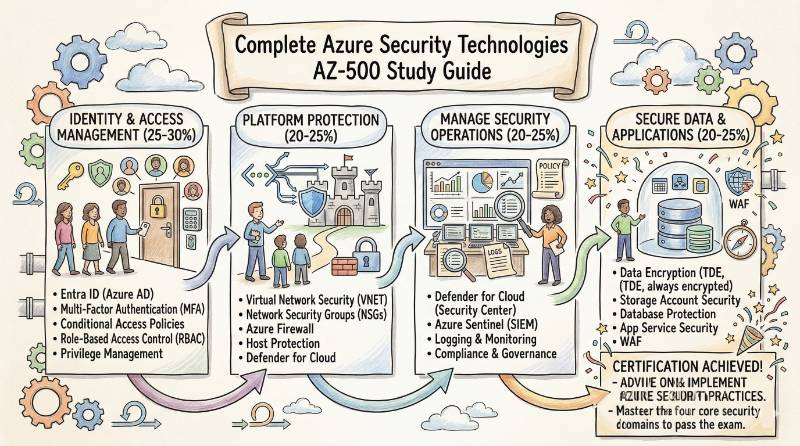
Security in the cloud isn’t an afterthought—it’s the foundation. After years of watching organizations move their critical workloads to Azure, one truth stands clear: the companies that thrive are those that build security into every layer of their architecture. The Microsoft Azure Security Technologies (AZ-500) certification represents the gold standard for professionals who want to prove they can protect modern cloud environments .
This guide walks you through everything you need to know about the AZ-500 certification. Whether you’re an engineer looking to level up or a manager wanting to understand what your security teams should master, you’re in the right place.
What is Microsoft Azure Security Technologies (AZ-500)?
The Microsoft Azure Security Technologies (AZ-500) is a specialized certification that validates your ability to implement security controls, maintain a security posture, and manage identity and access across Azure environments . It’s not just a theoretical exam—it tests your hands-on capability to protect real-world cloud workloads.
This certification proves you can:
- Manage identity and access using Microsoft Entra ID
- Implement platform protection across networks and infrastructure
- Secure data, applications, and storage
- Manage security operations using tools like Microsoft Defender for Cloud and Microsoft Sentinel
Certification at a Glance
| Track | Level | Who It’s For | Prerequisites | Skills Covered | Recommended Order |
|---|---|---|---|---|---|
| Security | Associate | Security Engineers, DevOps, SREs, Cloud Architects, IT Managers | Azure administration experience, networking knowledge, familiarity with security best practices | Identity management, network security, data protection, security operations | AZ-900 → AZ-104 → AZ-500 |
Deep Dive into Microsoft Azure Security Technologies (AZ-500)
What It Is
The Microsoft Azure Security Technologies (AZ-500) certification validates your expertise in implementing security controls, protecting identities, securing networks, and managing security operations in Microsoft Azure . It’s designed for professionals who want to demonstrate they can handle the complex security challenges of enterprise cloud environments. This certification goes beyond basic concepts and tests your ability to actually configure and manage Azure security services in real-world scenarios .
Who Should Take It
This certification is ideal for professionals who work with Azure every day and want to specialize in security:
- Security Engineers: Those responsible for implementing and managing security controls
- DevOps Professionals: Engineers integrating security into CI/CD pipelines
- Cloud Architects: Designers building secure Azure solutions
- SREs: Professionals ensuring reliability through security monitoring
- IT Managers: Leaders needing deep security knowledge to guide teams
- Software Engineers: Developers building secure applications on Azure
Skills You’ll Gain
- Identity and Access Management: Master Microsoft Entra ID (Azure AD), implement Multi-Factor Authentication, configure Conditional Access policies, and manage Privileged Identity Management
- Network Security: Build secure networks using Azure Firewall, Network Security Groups (NSGs), Application Security Groups, and Web Application Firewalls
- Data Protection: Implement encryption strategies, manage secrets with Azure Key Vault, configure data classification, and protect databases
- Security Operations: Monitor environments with Microsoft Defender for Cloud, investigate threats with Microsoft Sentinel, automate responses to security alerts
Real-World Projects You Should Be Able to Do After It
- Implement a Zero-Trust Architecture: Design and deploy an environment where every access request is verified, regardless of where it originates
- Secure a Multi-Tier Application: Build a web application with a hidden database, front-end protected by WAF, and all traffic encrypted
- Automate Threat Response: Create Sentinel playbooks that automatically block malicious IP addresses when suspicious login patterns emerge
- Enforce Governance at Scale: Write Azure Policies that prevent creation of unencrypted storage accounts or VMs without network security groups
- Manage Secrets Securely: Build a solution using Key Vault to rotate secrets automatically and provide secure access to applications
Master Microsoft Azure Security Technologies AZ‑500 Guide
7–14 Days (The Sprint): For experienced Azure professionals who use these tools daily. Focus on practice exams and identify weak areas. Spend 80% of time on hands-on labs in areas you don’t use regularly .
30 Days (The Standard Path): Ideal for most working engineers. Dedicate one hour daily to concepts and two hours each weekend to hands-on labs. Build everything yourself in the Azure portal .
60 Days (The Deep Learning Path): Perfect for managers or those transitioning from other fields. Take time to understand fundamentals. Build each lab twice—once following guides, once from memory .
Common Mistakes
- Focusing Only on Theory: You cannot pass by reading alone. You must configure firewalls, set up identity rules, and work in the actual Azure portal
- Ignoring Networking: Many candidates focus on identity but forget that network isolation is critical. Master subnets, NSGs, and firewalls thoroughly
- Skipping Security Operations: Microsoft Sentinel and Defender for Cloud represent a huge portion of the exam. Don’t neglect monitoring and response
- Poor Time Management: The exam includes long case studies. Practice pacing yourself so complex scenarios don’t catch you off guard
- Memorizing Without Understanding: The exam tests implementation, not definitions. Know how settings work, not just what they’re called
Best Next Certification After This
- Same Track: SC-100 (Microsoft Cybersecurity Architect) – For professionals designing comprehensive security strategies
- Cross-Track: AZ-400 (Designing and Implementing Microsoft DevOps Solutions) – Perfect for DevSecOps career paths
- Leadership Path: AZ-305 (Designing Microsoft Azure Infrastructure Solutions) – For architects designing complete Azure solutions
Choose Your Path: 6 Learning Journeys
DevOps Path: Focus on “Policy as Code” and infrastructure automation. Use AZ-500 skills to ensure every deployed resource meets security standards automatically.
DevSecOps Path: Integrate security directly into development pipelines. Become the expert who ensures speed never compromises safety. This represents the most direct application of AZ-500 skills .
SRE Path: Use security monitoring to ensure system reliability. Learn how security incidents impact uptime and build automated responses that protect both security and availability .
AIOps/MLOps Path: Secure machine learning models and AI pipelines. Protect training data from tampering and ensure only authorized users access models .
DataOps Path: Focus on data sovereignty and protection. Master encryption, masking, and access controls for data pipelines and analytical workloads .
FinOps Path: Use security policies to control costs. Prevent creation of expensive unauthorized resources and protect the organization from financial waste .
Role → Recommended Certifications Mapping
| Your Role | Recommended Certification Path |
|---|---|
| DevOps Engineer | AZ-104 → AZ-500 → AZ-400 |
| SRE | AZ-104 → AZ-500 → AZ-700 |
| Platform Engineer | AZ-104 → AZ-500 → AZ-305 |
| Cloud Engineer | AZ-900 → AZ-104 → AZ-500 |
| Security Engineer | AZ-500 → SC-200 → SC-300 |
| Data Engineer | DP-203 → AZ-500 |
| FinOps Practitioner | AZ-900 → AZ-500 |
| Engineering Manager | AZ-900 → AZ-500 |
Next Certifications to Take
Based on data from leading certification resources, here are your best options after AZ-500:
- SC-100 (Microsoft Cybersecurity Architect) – For deep security specialization. This represents the pinnacle for security professionals designing enterprise-wide protection strategies .
- AZ-400 (Designing and Implementing Microsoft DevOps Solutions) – For broadening into DevSecOps. Perfect if you want to lead automation and security integration in development pipelines .
- AZ-305 (Designing Microsoft Azure Infrastructure Solutions) – For moving into solutions architecture. Ideal if you want to design the big picture that engineers build .
Top Institutions for Azure Security Technologies (AZ-500) Training
DevOpsSchool: A globally recognized platform offering comprehensive AZ-500 training with hands-on labs and real-world projects. Their programs include lifetime LMS access, 100+ lab assignments, and mentorship from industry experts. They focus on making you job-ready, not just certified .
Cotocus: Specializes in high-end cloud architecture and security training. Their courses dive deep into enterprise governance and advanced security configurations, perfect for teams managing complex Azure environments .
Scmgalaxy: A vibrant technical community and training hub. They combine formal instruction with peer learning through blogs, forums, and technical deep-dives, creating a well-rounded learning experience .
BestDevOps: Known for streamlined, efficient training modules. They focus on the most critical skills needed in today’s market, helping professionals get certified and job-ready quickly without unnecessary fluff.
DevSecOpsSchool: The go-to source for integrating security into development. They connect AZ-500 concepts with modern automation and CI/CD tools, perfect for DevSecOps practitioners .
Sreschool: Focuses on the intersection of security and reliability. Their training helps you use security monitoring to ensure maximum uptime and system stability .
Aiopsschool: Teaches AI-powered security operations. Their courses prepare you for the future of threat detection using machine learning and automation .
Dataopsschool: Dedicated to securing data pipelines. They help data professionals apply Azure security technologies to protect data lakes and analytical workloads .
Finopsschool: Unique focus on using security policies to manage cloud costs. They teach financial protection while maintaining strong security posture .
FAQs on Microsoft Azure Security Technologies (AZ-500)
Career and Strategy FAQs
Q1: Is the AZ-500 exam very difficult?
Yes, it’s considered one of the tougher associate-level exams. It covers a wide range of complex services and requires hands-on knowledge, not just theory .
Q2: How much time do I need to study?
Most working professionals find 30 to 45 days of consistent study provides the best balance between preparation and retention .
Q3: Should I take AZ-104 before AZ-500?
Highly recommended. Knowing how to manage Azure (AZ-104) makes understanding how to secure it (AZ-500) much easier. While not mandatory, this path builds essential foundations .
Q4: What jobs can I get with AZ-500?
Common roles include Cloud Security Engineer, Azure Security Analyst, DevSecOps Specialist, and Senior DevOps Engineer. Demand is high across all industries .
Q5: Is this certification valued in India?
Extremely. India has massive demand for cloud security experts. Major IT firms and global capability centers prioritize candidates with AZ-500 certification .
Q6: Does the certification expire?
It’s valid for one year. You can renew it for free through a short online assessment on the Microsoft Learn platform .
Q7: Is there coding in the exam?
You don’t need to be a developer, but you should be comfortable with basic PowerShell/CLI scripting and reading JSON files for policies .
Q8: What’s the passing score?
You need 700 out of 1000 to pass the exam .
Q9: Are there labs in the exam?
Microsoft occasionally includes performance-based labs where you must configure settings in a live portal. Be prepared for hands-on tasks .
Q10: Is this better than general security certifications?
If you work in Azure, absolutely. This certification teaches specific tools and configurations you’ll use daily, unlike theoretical general security certs .
Q11: Can managers benefit from this certification?
Yes. It helps technical leaders understand risks their teams face and make better decisions about security investments and priorities .
Q12: What if I fail the first time?
You can retake after 24 hours. If you fail again, waiting periods increase. Don’t get discouraged—many experienced professionals fail their first attempt .
Technical FAQs
Q13: What is Microsoft Entra ID?
It’s the new name for Azure Active Directory. It serves as the core identity and access management service for Azure resources .
Q14: How do I manage secrets in Azure?
Use Azure Key Vault. It provides secure storage for certificates, connection strings, and API keys with fine-grained access control .
Q15: What’s the role of Azure Firewall?
It’s a managed, cloud-native firewall service that protects Azure Virtual Network resources from external threats .
Q16: How does Microsoft Defender for Cloud help?
It provides unified security management and advanced threat protection across hybrid and multi-cloud workloads .
Conclusion
The Microsoft Azure Security Technologies (AZ-500) certification represents a significant milestone in any cloud professional’s career. It validates not just what you know, but what you can actually do to protect modern cloud environments .
Security is no longer a separate discipline—it’s woven into every aspect of cloud engineering. Whether you follow the DevOps, SRE, or pure security path, AZ-500 provides the foundation you need to build secure, resilient systems .
The journey requires hands-on practice, consistent study, and real-world application. But for those who master these skills, the opportunities are enormous. Cloud security professionals are among the most sought-after experts in today’s job market, and AZ-500 certification opens doors across industries and geographies .
Start your preparation today. Build labs in the Azure portal. Take practice exams. Connect with training providers who emphasize practical skills. Your future self—and the organizations you protect—will thank you.